第16章療法と治療
Psychotherapy: Play Therapy心理療法:遊戯療法
Play therapy is often used with children since they are not likely to sit on a couch and recall their dreams or engage in traditional talk therapy. This technique uses a therapeutic process of play to “help clients prevent or resolve psychosocial difficulties and achieve optimal growth” (O’Connor, 2000, p. 7). The idea is that children play out their hopes, fantasies, and traumas while using dolls, stuffed animals, and sandbox figurines (Figure 16.10). Play therapy can also be used to help a therapist make a diagnosis. The therapist observes how the child interacts with toys (e.g., dolls, animals, and home settings) in an effort to understand the roots of the child’s disturbed behavior. Play therapy can be nondirective or directive. In nondirective play therapy, children are encouraged to work through their problems by playing freely while the therapist observes (LeBlanc & Ritchie, 2001). In directive play therapy, the therapist provides more structure and guidance in the play session by suggesting topics, asking questions, and even playing with the child (Harter, 1977).
英語のヒント
遊戯療法は子どもに対してよく用いられる。子どもがカウチに座って自分の夢を思い出したり、従来の対話療法に取り組んだりする可能性は低いからである。この技法は、遊びという治療的な過程を用いて、「クライエントが心理社会的な困難を予防または解決し、最適な成長を遂げるのを助ける」(O’Connor, 2000, p. 7)。その考え方は、子どもは人形やぬいぐるみ、箱庭用の小さな人形を使いながら、自分の希望や空想、トラウマを遊びの中で表現する、というものである(図16.10)。遊戯療法は、セラピストが診断を下す助けとしても用いることができる。セラピストは、子どもの問題行動の根源を理解しようとして、子どもがおもちゃ(たとえば人形、動物、家の模型)とどのようにかかわるかを観察する。遊戯療法には、非指示的なものと指示的なものがある。非指示的遊戯療法では、セラピストが観察するなかで、子どもは自由に遊ぶことによって自分の問題に取り組み、乗り越えるよう促される(LeBlanc & Ritchie, 2001)。指示的遊戯療法では、セラピストがテーマを提案したり、質問をしたり、さらには子どもと一緒に遊んだりして、遊びのセッションにより多くの枠組みと導きを与える(Harter, 1977)。
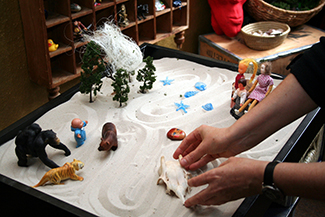
Figure 16.10図 16.10
This type of play therapy is known as sandplay or sandtray therapy. Children can set up a three-dimensional world using various figures and objects that correspond to their inner state (Kalff, 1991). (credit: Kristina Walter)
この種の遊戯療法は、箱庭療法(サンドプレイ療法、サンドトレイ療法)として知られている。子どもは、自分の内面の状態に対応するさまざまな人形や物を使って、立体的な世界をつくることができる(Kalff, 1991)。(出典:Kristina Walter)
Psychotherapy: Behavior Therapy心理療法:行動療法
In psychoanalysis, therapists help their patients look into their past to uncover repressed feelings. In behavior therapy, a therapist employs principles of learning to help clients change undesirable behaviors—rather than digging deeply into one’s unconscious. Therapists with this orientation believe that dysfunctional behaviors, like phobias and bedwetting, can be changed by teaching clients new, more constructive behaviors. Behavior therapy employs both classical and operant conditioning techniques to change behavior.
英語のヒント
精神分析では、セラピストは、患者が自分の過去をのぞき込み、抑圧された感情を掘り起こすのを助ける。行動療法では、セラピストは、その人の無意識を深く掘り下げるのではなく、学習の原理を用いて、クライエントが望ましくない行動を変えるのを助ける。この立場のセラピストは、恐怖症や夜尿のような機能不全の行動は、クライエントに新しい、より建設的な行動を教えることによって変えられると考えている。行動療法は、行動を変えるために、古典的条件づけとオペラント条件づけの両方の技法を用いる。
One type of behavior therapy utilizes classical conditioning techniques. Therapists using these techniques believe that dysfunctional behaviors are conditioned responses. Applying the conditioning principles developed by Ivan Pavlov, these therapists seek to recondition their clients and thus change their behavior. Emmie is eight years old, and frequently wets her bed at night. She’s been invited to several sleepovers, but she won’t go because of her problem. Using a type of conditioning therapy, Emmie begins to sleep on a liquid-sensitive bed pad that is hooked to an alarm. When moisture touches the pad, it sets off the alarm, waking up Emmie. When this process is repeated enough times, Emmie develops an association between urinary relaxation and waking up, and this stops the bedwetting. Emmie has now gone three weeks without wetting her bed and is looking forward to her first sleepover this weekend.
英語のヒント
行動療法の一つの種類は、古典的条件づけの技法を用いる。この技法を用いるセラピストは、機能不全の行動は条件反応であると考える。こうしたセラピストは、イワン・パヴロフが発展させた条件づけの原理を応用して、クライエントを条件づけし直し、それによって行動を変えようとする。エミーは8歳で、夜によくおねしょをする。お泊まり会に何度か誘われているが、この問題があるので行こうとしない。ある種の条件づけ療法として、エミーは、アラームにつながれた、液体を感知するベッドパッドの上で眠りはじめる。湿り気がパッドに触れるとアラームが鳴り、エミーは目を覚ます。この過程が十分な回数繰り返されると、エミーは排尿時の弛緩と目覚めとのあいだに結びつきを形成し、これによっておねしょが止まる。エミーは今では3週間おねしょをしておらず、今週末の初めてのお泊まり会を楽しみにしている。
One commonly used classical conditioning therapeutic technique is counterconditioning: a client learns a new response to a stimulus that has previously elicited an undesirable behavior. Two counterconditioning techniques are aversive conditioning and exposure therapy. Aversive conditioning uses an unpleasant stimulus to stop an undesirable behavior. Therapists apply this technique to eliminate addictive behaviors, such as smoking, nail biting, and drinking. In aversion therapy, clients will typically engage in a specific behavior (such as nail biting) and at the same time are exposed to something unpleasant, such as a mild electric shock or a bad taste. After repeated associations between the unpleasant stimulus and the behavior, the client can learn to stop the unwanted behavior.
英語のヒント
古典的条件づけを用いた治療技法のうち、よく使われるものの一つが拮抗条件づけである。拮抗条件づけでは、クライエントは、以前は望ましくない行動を引き起こしていた刺激に対して、新しい反応を学習する。拮抗条件づけの技法には、嫌悪条件づけと曝露療法の二つがある。嫌悪条件づけは、不快な刺激を用いて望ましくない行動をやめさせる。セラピストはこの技法を、喫煙、爪かみ、飲酒などの嗜癖的な行動をなくすために適用する。嫌悪療法では、クライエントはふつう、特定の行動(爪かみなど)をすると同時に、軽い電気ショックや嫌な味など、何か不快なものにさらされる。不快な刺激とその行動との結びつきが繰り返されると、クライエントは望まない行動をやめることを学習できる。
Aversion therapy has been used effectively for years in the treatment of alcoholism (Davidson, 1974; Elkins, 1991; Streeton & Whelan, 2001). One common way this occurs is through a chemically based substance known as Antabuse. When a person takes Antabuse and then consumes alcohol, uncomfortable side effects result including nausea, vomiting, increased heart rate, heart palpitations, severe headache, and shortness of breath. Antabuse is repeatedly paired with alcohol until the client associates alcohol with unpleasant feelings, which decreases the client’s desire to consume alcohol. Antabuse creates a conditioned aversion to alcohol because it replaces the original pleasure response with an unpleasant one.
英語のヒント
嫌悪療法は、アルコール依存症の治療に長年効果的に用いられてきた(Davidson, 1974; Elkins, 1991; Streeton & Whelan, 2001)。その一般的な方法の一つが、アンタビュースとして知られる化学物質を用いるものである。アンタビュースを服用したあとに飲酒すると、吐き気、嘔吐、心拍数の増加、動悸、激しい頭痛、息切れなどの不快な副作用が生じる。クライエントがアルコールを不快な感覚と結びつけるようになるまで、アンタビュースはアルコールと繰り返し対にされる。これによって、クライエントの飲酒欲求は低下する。アンタビュースは、もともとの快の反応を不快な反応に置き換えるので、アルコールに対する条件づけられた嫌悪をつくりだす。
In exposure therapy, a therapist seeks to treat clients’ fears or anxiety by presenting them with the object or situation that causes their problem, with the idea that they will eventually get used to it. This can be done via reality, imagination, or virtual reality. Exposure therapy was first reported in 1924 by Mary Cover Jones, who is considered the mother of behavior therapy. Jones worked with a boy named Peter who was afraid of rabbits. Her goal was to replace Peter’s fear of rabbits with a conditioned response of relaxation, which is a response that is incompatible with fear (Figure 16.11). How did she do it? Jones began by placing a caged rabbit on the other side of a room with Peter while he ate his afternoon snack. Over the course of several days, Jones moved the rabbit closer and closer to where Peter was seated with his snack. After two months of being exposed to the rabbit while relaxing with his snack, Peter was able to hold the rabbit and pet it while eating (Jones, 1924).
英語のヒント
曝露療法では、セラピストは、クライエントの問題を引き起こしている対象や状況をクライエントに提示することで、その恐怖や不安を治療しようとする。そうすればクライエントはやがてそれに慣れるだろう、という考えに基づいている。この提示は、現実の場面でも、想像の中でも、仮想現実でも行うことができる。曝露療法は、1924年にメアリー・カヴァー・ジョーンズによって初めて報告された。ジョーンズは行動療法の母とみなされている。ジョーンズは、ウサギを怖がるピーターという男の子を担当した。彼女の目標は、ピーターのウサギへの恐怖を、リラックスという条件反応に置き換えることだった。リラックスは恐怖と両立しない反応である(図16.11)。彼女はどのようにしてそれを行ったのだろうか。ジョーンズはまず、ピーターが午後のおやつを食べているあいだ、ピーターのいる部屋の反対側に、かごに入れたウサギを置いた。数日かけて、ジョーンズはウサギを、ピーターがおやつを前に座っている場所へと少しずつ近づけていった。おやつを食べてくつろぎながらウサギにさらされることを2か月続けたあと、ピーターは食べながらウサギを抱き、なでることができるようになった(Jones, 1924)。
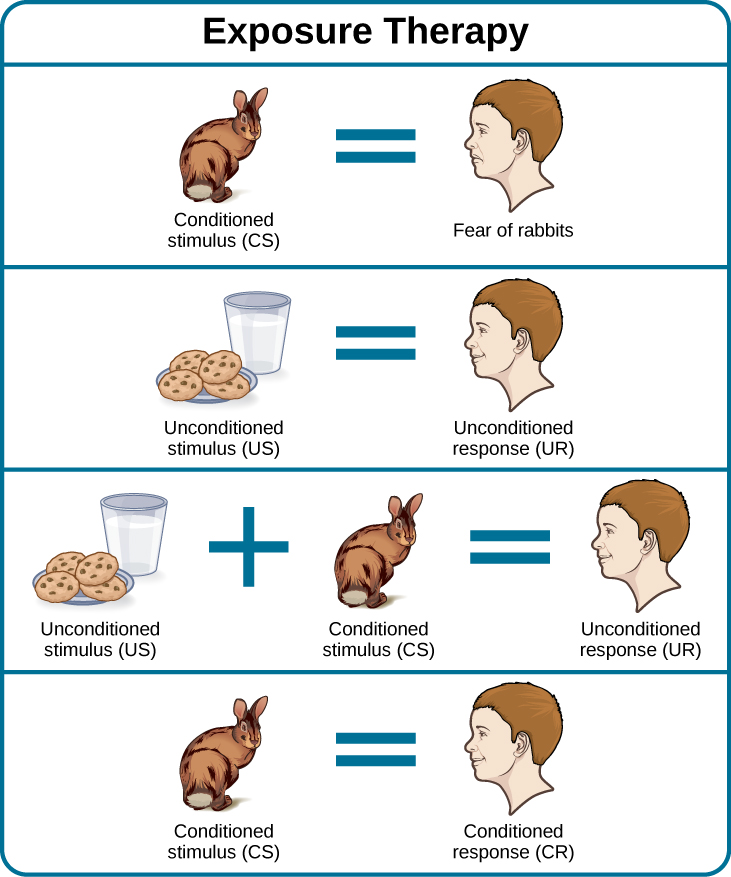


Figure 16.11図 16.11
Exposure therapy seeks to change the response to a conditioned stimulus (CS). An unconditioned stimulus is presented over and over just after the presentation of the conditioned stimulus. This figure shows conditioning as conducted in Mary Cover Jones’ 1924 study.
曝露療法は、条件刺激(CS)に対する反応を変えようとする。条件刺激を提示した直後に、無条件刺激を何度も繰り返し提示する。この図は、メアリー・カヴァー・ジョーンズの1924年の研究で行われた条件づけを示している。
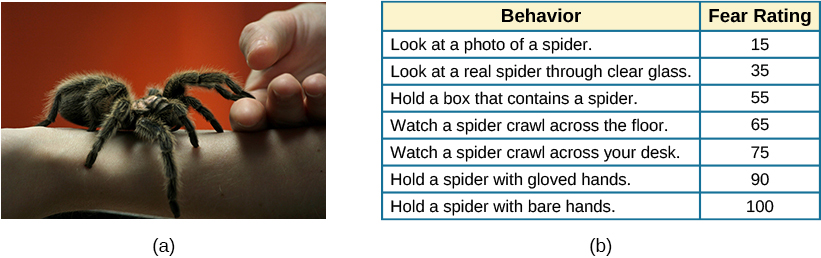
Thirty years later, Joseph Wolpe (1958) refined Jones’s techniques, giving us systematic desensitization. Using this method, a person creates a hierarchy of anxiety, ranging from the least-anxiety-producing stimulus to the feared object. These activities are paired with relaxation techniques, which are taught to the client beforehand and used during the graduated exposures. The idea is that a person cannot be nervous and relaxed at the same time. Therefore, if they can learn to relax when they are facing environmental stimuli that make them nervous or fearful, they can eventually eliminate the unwanted fear response. (Figure 16.12).
英語のヒント
30年後、ジョセフ・ウォルピ(1958)はジョーンズの技法を洗練させ、系統的脱感作を生み出した。この方法では、本人が、最も不安を引き起こさない刺激から恐れている対象までを並べた不安の階層表をつくる。これらの活動はリラクセーション技法と組み合わされる。リラクセーション技法は、あらかじめクライエントに教えておき、段階的な曝露のあいだに用いるものである。その考え方は、人は緊張していると同時にリラックスしていることはできない、というものである。したがって、自分を緊張させたり怖がらせたりする環境刺激に直面しているときにリラックスすることを学べれば、やがて望まない恐怖反応をなくすことができる(図16.12)。
OpenStax, Rice University; Psychology 2e. (credit: “GollyGforce – Living My Worst Nightmare”/Flickr) · CC BY 4.0 · Source出典

Figure 16.12図 16.12
This person suffers from arachnophobia (fear of spiders). Through exposure therapy they are learning how to face their fear in a controlled, therapeutic setting. (credit: “GollyGforce – Living My Worst Nightmare”/Flickr)
この人はクモ恐怖症(クモに対する恐怖)に苦しんでいる。曝露療法を通して、管理された治療の場で自分の恐怖に向き合う方法を学んでいるところである。(出典:“GollyGforce – Living My Worst Nightmare”/Flickr)
For example, Jayden is terrified of elevators. Nothing bad has ever happened to him on an elevator, but he’s so afraid of elevators that he will always take the stairs. That wasn’t a problem when Jayden worked on the second floor of an office building, but now he has a new job—on the 29th floor of a skyscraper in downtown Los Angeles. Jayden knows he can’t climb 29 flights of stairs in order to get to work each day, so he decided to see a behavior therapist for help. The therapist asks Jayden to first construct a hierarchy of elevator-related situations that elicit fear and anxiety. They range from situations of mild anxiety such as being nervous around the other people in the elevator, to the fear of getting an arm caught in the door, to panic-provoking situations such as getting trapped or the cable snapping. Next, the therapist uses progressive relaxation. They teach Jayden how to relax each of his muscle groups so that he achieves a drowsy, relaxed, and comfortable state of mind. Once he’s in this state, the therapist asks Jayden to imagine a mildly anxiety-provoking situation. Jayden is standing in front of the elevator thinking about pressing the call button.
英語のヒント
たとえば、ジェイデンはエレベーターがひどく怖い。エレベーターで何か悪いことが起きたことは一度もないのだが、エレベーターが怖すぎて、いつも階段を使う。ジェイデンがオフィスビルの2階で働いていたときには、それは問題にならなかった。しかし今、彼には新しい仕事がある。ロサンゼルスの中心街にある超高層ビルの29階である。毎日29階分の階段を上って出勤することはできないと分かっているので、ジェイデンは行動療法のセラピストに助けを求めることにした。セラピストはジェイデンに、まず、恐怖と不安を引き起こすエレベーター関連の状況の階層表をつくるよう求める。その状況は、エレベーターの中でほかの人たちのそばにいると緊張するといった軽い不安の状況から、腕がドアに挟まることへの恐怖、さらには閉じ込められる、ケーブルが切れるといったパニックを引き起こす状況にまで及ぶ。次に、セラピストは漸進的弛緩法を用いる。セラピストはジェイデンに、眠気を催すような、リラックスした心地よい精神状態に達するよう、筋肉群を一つずつ緩める方法を教える。ジェイデンがこの状態になったら、セラピストは、軽い不安を引き起こす状況を想像するよう求める。ジェイデンはエレベーターの前に立ち、呼び出しボタンを押すことを考えている。
If this scenario causes Jayden anxiety, he lifts his finger. The therapist would then tell Jayden to forget the scene and return to his relaxed state. They repeat this scenario over and over until Jayden can imagine himself pressing the call button without anxiety. Over time the therapist and Jayden use progressive relaxation and imagination to proceed through all of the situations on Jayden’s hierarchy until he becomes desensitized to each one. After this, Jayden and the therapist begin to practice what he only previously envisioned in therapy, gradually going from pressing the button to actually riding an elevator. The goal is that Jayden will soon be able to take the elevator all the way up to the 29th floor of his office without feeling any anxiety.
英語のヒント
この場面でジェイデンが不安を感じたら、彼は指を上げる。するとセラピストは、その場面を忘れてリラックスした状態に戻るようジェイデンに告げることになる。二人は、ジェイデンが不安を感じずに呼び出しボタンを押す自分を想像できるようになるまで、この場面を何度も繰り返す。時間をかけて、セラピストとジェイデンは漸進的弛緩法と想像を用い、ジェイデンの階層表にあるすべての状況を、彼がその一つ一つに対して脱感作されるまで順に進めていく。その後、ジェイデンとセラピストは、それまで療法の中で思い描くだけだったことを実際に練習しはじめ、ボタンを押すことから、本当にエレベーターに乗ることへと少しずつ進んでいく。目標は、ジェイデンが近いうちに、少しの不安も感じることなく、職場のある29階までずっとエレベーターで上がれるようになることである。
Sometimes, it’s too impractical, expensive, or embarrassing to re-create anxiety-producing situations, so a therapist might employ virtual reality exposure therapy by using a simulation to help conquer fears. Virtual reality exposure therapy has been used effectively to treat numerous anxiety disorders such as the fear of public speaking, claustrophobia (fear of enclosed spaces), aviophobia (fear of flying), and post-traumatic stress disorder (PTSD), a trauma and stressor-related disorder (Gerardi, Cukor, Difede, Rizzo, & Rothbaum, 2010).
英語のヒント
不安を引き起こす状況を再現することが、あまりに非現実的だったり、費用がかかりすぎたり、気恥ずかしすぎたりする場合もある。そのためセラピストは、シミュレーションを用いて恐怖の克服を助ける仮想現実曝露療法を用いることがある。仮想現実曝露療法は、人前で話すことへの恐怖、閉所恐怖症(閉ざされた空間への恐怖)、飛行恐怖症(飛行機に乗ることへの恐怖)、そして心的外傷およびストレス因関連障害の一つである心的外傷後ストレス障害(PTSD)など、数多くの不安障害の治療に効果的に用いられてきた(Gerardi, Cukor, Difede, Rizzo, & Rothbaum, 2010)。
Some behavior therapies employ operant conditioning. Recall what you learned about operant conditioning: We have a tendency to repeat behaviors that are reinforced. What happens to behaviors that are not reinforced? They become extinguished. These principles, defined by Skinner as operant conditioning, can be applied to help people with a wide range of psychological problems.
英語のヒント
行動療法の中には、オペラント条件づけを用いるものもある。オペラント条件づけについて学んだことを思い出してほしい。私たちには、強化された行動を繰り返す傾向がある。では、強化されない行動はどうなるのだろうか。それらは消去される。スキナーがオペラント条件づけとして定義したこれらの原理は、幅広い心理的な問題を抱える人々を助けるために応用できる。
One popular operant conditioning intervention is called the token economy. This involves a controlled setting where individuals are reinforced for desirable behaviors with tokens, such as a poker chip, that can be exchanged for items or privileges. Token economies are often used in psychiatric hospitals to increase patient cooperation and activity levels. Patients are rewarded with tokens when they engage in positive behaviors (e.g., making their beds, brushing their teeth, coming to the cafeteria on time, and socializing with other patients). They can later exchange the tokens for extra TV time, private rooms, visits to the canteen, and so on (Dickerson, Tenhula, & Green-Paden, 2005).
英語のヒント
よく用いられるオペラント条件づけの介入の一つに、トークン・エコノミーと呼ばれるものがある。これは管理された環境の中で、望ましい行動に対して、品物や特権と交換できるトークン(ポーカーチップなど)を与えて強化するものである。トークン・エコノミーは、患者の協力と活動の水準を高めるために、精神科病院でよく用いられている。患者は、好ましい行動(たとえば、ベッドを整える、歯を磨く、時間どおりに食堂に来る、ほかの患者と交流する)をとるとトークンを受け取る。後でそのトークンを、テレビの視聴時間の延長、個室、売店に行くことなどと交換できる(Dickerson, Tenhula, & Green-Paden, 2005)。