第8章記憶
Forgetting忘却
“I’ve a grand memory for forgetting,” quipped Robert Louis Stevenson. Forgetting refers to loss of information from long-term memory. We all forget things, like a loved one’s birthday, someone’s name, or where we put our car keys. As you’ve come to see, memory is fragile, and forgetting can be frustrating and even embarrassing. But why do we forget? To answer this question, we will look at several perspectives on forgetting.
英語のヒント
「私は忘れることにかけては大した記憶力を持っている」と、ロバート・ルイス・スティーヴンソンは冗談めかして言った。忘却とは、長期記憶から情報が失われることを指す。私たちは誰でも、大切な人の誕生日、誰かの名前、車の鍵をどこに置いたかといったことを忘れる。これまで見てきたように、記憶はもろく、忘却はいらだたしく、恥ずかしいものにさえなりうる。では、なぜ私たちは忘れるのだろうか。この問いに答えるために、忘却についてのいくつかの見方を見ていこう。
Encoding Failure符号化の失敗
Sometimes memory loss happens before the actual memory process begins, which is encoding failure. We can’t remember something if we never stored it in our memory in the first place. This would be like trying to find a book on your e-reader that you never actually purchased and downloaded. Often, in order to remember something, we must pay attention to the details and actively work to process the information (effortful encoding). Lots of times we don’t do this. For instance, think of how many times in your life you’ve seen a penny. Can you accurately recall what the front of a U.S. penny looks like? When researchers Raymond Nickerson and Marilyn Adams (1979) asked this question, they found that most Americans don’t know which one it is. The reason is most likely encoding failure. Most of us never encode the details of the penny. We only encode enough information to be able to distinguish it from other coins. If we don’t encode the information, then it’s not in our long-term memory, so we will not be able to remember it.
英語のヒント
記憶の喪失は、実際の記憶の過程が始まる前に起こることがある。これが符号化の失敗である。そもそも記憶に貯蔵していなければ、それを思い出すことはできない。これは、実際には一度も購入もダウンロードもしていない本を、電子書籍リーダーの中で探そうとするようなものだろう。何かを覚えるためには、多くの場合、細部に注意を払い、情報を処理しようと能動的に取り組まなければならない(努力を要する符号化)。しかし私たちは、そうしないことが多い。たとえば、これまでの人生で1セント硬貨を何回見たことがあるか考えてみよう。アメリカの1セント硬貨の表がどのような見た目か、正確に思い出せるだろうか。研究者のレイモンド・ニッカーソンとマリリン・アダムズ(1979)がこの質問をしたところ、ほとんどのアメリカ人は、どれが正しいのか分からないことが分かった。その理由は、おそらく符号化の失敗である。私たちの大半は、1セント硬貨の細部を一度も符号化していない。ほかの硬貨と区別できるだけの情報しか符号化しないのである。情報を符号化しなければ、それは長期記憶の中にないので、思い出すことはできないだろう。
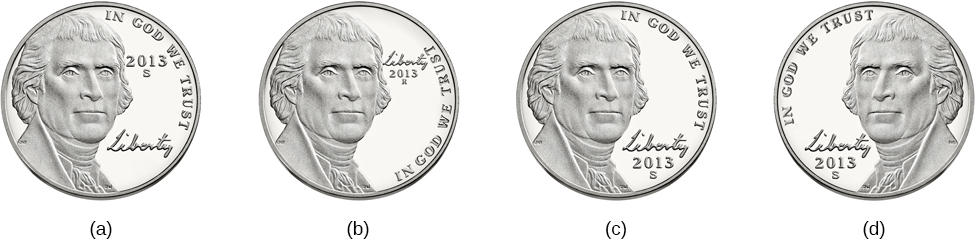
Figure 8.13図 8.13
Can you tell which coin, (a), (b), (c), or (d) is the accurate depiction of a US nickel? The correct answer is (c).
(a)(b)(c)(d)のうち、アメリカの5セント硬貨を正確に描いているのはどれか、分かるだろうか。正解は(c)である。
Memory Errors記憶の誤り
Psychologist Daniel Schacter (2001), a well-known memory researcher, offers seven ways our memories fail us. He calls them the seven sins of memory and categorizes them into three groups: forgetting, distortion, and intrusion (Table 8.1).
英語のヒント
よく知られた記憶研究者である心理学者ダニエル・シャクター(2001)は、記憶が私たちを裏切る七つのあり方を挙げている。彼はそれらを記憶の七つの罪と呼び、忘却、歪曲、侵入の三つのグループに分類している(表8.1)。
Schacter’s Seven Sins of Memory シャクターの記憶の七つの罪 |
|||
|---|---|---|---|
Sin 罪 |
Type 種類 |
Description 説明 |
Example 例 |
Transience 一過性 |
Forgetting 忘却 |
Accessibility of memory decreases over time 時間とともに記憶へのアクセスしやすさが低下する |
Forget events that occurred long ago ずっと前に起こった出来事を忘れる |
Absentmindedness 不注意 |
Forgetting 忘却 |
Forgetting caused by lapses in attention 注意の途切れによって起こる忘却 |
Forget where your phone is 携帯電話をどこに置いたか忘れる |
Blocking 妨害 |
Forgetting 忘却 |
Accessibility of information is temporarily blocked 情報へのアクセスが一時的に妨げられる |
Tip of the tongue 喉まで出かかっているのに出てこない(舌先現象) |
Misattribution 誤帰属 |
Distortion 歪曲 |
Source of memory is confused 記憶の出どころが混同される |
Recalling a dream memory as a waking memory 夢の記憶を、起きているときの記憶として想起する |
Suggestibility 被暗示性 |
Distortion 歪曲 |
False memories 偽記憶 |
Result from leading questions 誘導質問によって生じる |
Bias バイアス |
Distortion 歪曲 |
Memories distorted by current belief system 現在の信念体系によって歪められた記憶 |
Align memories to current beliefs 記憶を現在の信念に合わせる |
Persistence 持続性 |
Intrusion 侵入 |
Inability to forget undesirable memories 望ましくない記憶を忘れられない |
Traumatic events 外傷的な出来事 |
Let’s look at the first sin of the forgetting errors: transience, which means that memories can fade over time. Here’s an example of how this happens. Nathan’s English teacher has assigned his students to read the novel To Kill a Mockingbird. Nathan comes home from school and tells his mom he has to read this book for class. “Oh, I loved that book!” she says. Nathan asks her what the book is about, and after some hesitation she says, “Well . . . I know I read the book in high school, and I remember that one of the main characters is named Scout, and her father is an attorney, but I honestly don’t remember anything else.” Nathan wonders if his mother actually read the book, and his mother is surprised she can’t recall the plot. What is going on here is storage decay: unused information tends to fade with the passage of time.
英語のヒント
まず、忘却の誤りのうち最初の罪である一過性を見てみよう。一過性とは、記憶が時間とともに薄れうることを意味する。これがどのように起こるかの例を挙げよう。ネイサンの英語の先生は、生徒たちに小説『アラバマ物語』を読む課題を出した。ネイサンは学校から帰ると、授業のためにこの本を読まなければならないと母親に話す。「まあ、その本は大好きだったわ」と母親は言う。ネイサンがどんな話なのかを尋ねると、母親は少しためらってからこう言う。「そうねえ……高校で読んだのは確かだし、主人公の一人がスカウトという名前で、その父親が弁護士だったことは覚えているけど、正直言って、ほかには何も覚えていないわ」ネイサンは、母親が本当にその本を読んだのか疑問に思い、母親のほうも、筋を思い出せないことに驚いている。ここで起こっているのは貯蔵の減衰である。使われない情報は、時の経過とともに薄れていく傾向があるのだ。
In 1885, German psychologist Hermann Ebbinghaus analyzed the process of memorization. First, he memorized lists of nonsense syllables. Then he measured how much he learned (retained) when he attempted to relearn each list. He tested himself over different periods of time from 20 minutes later to 30 days later. The result is his famous forgetting curve (Figure 8.14). Due to storage decay, an average person will lose 50% of the memorized information after 20 minutes and 70% of the information after 24 hours (Ebbinghaus, 1885/1964). Your memory for new information decays quickly and then eventually levels out.
英語のヒント
1885年、ドイツの心理学者ヘルマン・エビングハウスは、記憶する過程を分析した。彼はまず、無意味つづりのリストを記憶した。次に、それぞれのリストを覚え直そうとしたときに、どれだけ学習していたか(保持していたか)を測定した。彼は、20分後から30日後まで、さまざまな時間を置いて自分自身をテストした。その結果が、有名な忘却曲線である(図8.14)。貯蔵の減衰のために、平均的な人は、記憶した情報の50%を20分後に、70%を24時間後に失う(Ebbinghaus, 1885/1964)。新しい情報についての記憶は急速に減衰し、その後、最終的には横ばいになる。
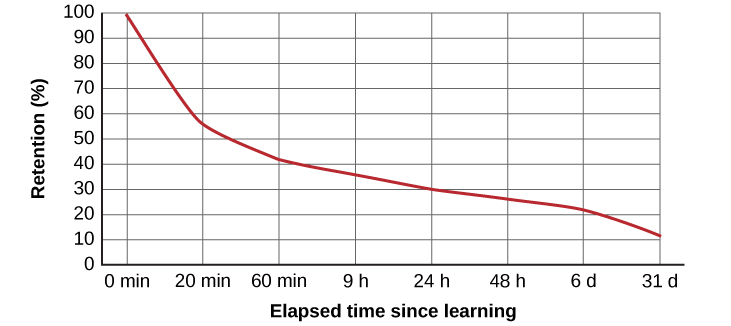


Figure 8.14図 8.14
The Ebbinghaus forgetting curve shows how quickly memory for new information decays.
エビングハウスの忘却曲線は、新しい情報についての記憶がどれほど速く減衰するかを示している。
Are you constantly losing your cell phone? Have you ever driven back home to make sure you turned off the stove? Have you ever walked into a room for something, but forgotten what it was? You probably answered yes to at least one, if not all, of these examples—but don’t worry, you are not alone. We are all prone to committing the memory error known as absentmindedness, which describes lapses in memory caused by breaks in attention or our focus being somewhere else.
英語のヒント
あなたはしょっちゅう携帯電話をなくしていないだろうか。コンロの火を消したか確かめるために、車で家に引き返したことはないだろうか。何かを取りに部屋に入ったのに、それが何だったか忘れてしまったことはないだろうか。これらの例のすべてとは言わないまでも、おそらく少なくとも一つには「はい」と答えただろう。でも心配はいらない。そうなのはあなただけではない。私たちは誰でも、不注意として知られる記憶の誤りを犯しがちである。不注意とは、注意が途切れたり、注意がどこか別のところに向いていたりすることによって起こる記憶の欠落をいう。
Cynthia, a psychologist, recalls a time when she recently committed the memory error of absentmindedness.
英語のヒント
心理学者のシンシアは、最近、不注意という記憶の誤りを犯したときのことを振り返っている。
When I was completing court-ordered psychological evaluations, each time I went to the court, I was issued a temporary identification card with a magnetic strip which would open otherwise locked doors. As you can imagine, in a courtroom, this identification is valuable and important and no one wanted it to be lost or be picked up by a criminal. At the end of the day, I would hand in my temporary identification. One day, when I was almost done with an evaluation, my daughter’s day care called and said she was sick and needed to be picked up. It was flu season, I didn’t know how sick she was, and I was concerned. I finished up the evaluation in the next ten minutes, packed up my briefcase, and rushed to drive to my daughter’s day care. After I picked up my daughter, I could not remember if I had handed back my identification or if I had left it sitting out on a table. I immediately called the court to check. It turned out that I had handed back my identification. Why could I not remember that? (personal communication, September 5, 2013)英語のヒント
裁判所の命令による心理鑑定を担当していたころ、私は裁判所に行くたびに、磁気ストライプの付いた一時的な身分証を渡されていた。そのカードがあれば、ふだんは施錠されているドアを開けることができた。想像がつくように、法廷ではこの身分証は貴重で重要なものであり、それがなくなったり犯罪者に拾われたりすることは誰も望んでいなかった。一日の終わりには、私はその一時的な身分証を返却していた。ある日、鑑定がもう少しで終わるというときに、娘の保育園から電話があり、娘の具合が悪いので迎えに来てほしいと言われた。インフルエンザの流行期で、娘がどれほど悪いのか分からず、私は心配した。私はそれから10分で鑑定を仕上げ、書類かばんに荷物を詰め、急いで車で娘の保育園に向かった。娘を迎えた後、私は身分証を返したのか、それともテーブルの上に置きっぱなしにしてきたのか、思い出せなかった。すぐに裁判所に電話して確かめた。結局、身分証は返していたことが分かった。なぜ私はそれを思い出せなかったのだろうか。(personal communication, September 5, 2013)
When have you experienced absentmindedness?
英語のヒント
あなたはどんなときに不注意を経験したことがあるだろうか。
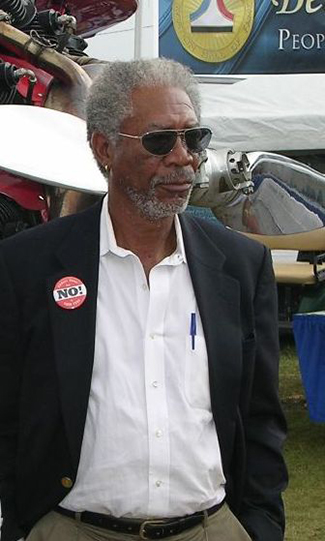
“I just streamed this movie called Oblivion, and it had that famous actor in it. Oh, what’s his name? He’s been in all of those movies, like The Shawshank Redemption and The Dark Knight trilogy. I think he’s even won an Oscar. Oh gosh, I can picture his face in my mind, and hear his distinctive voice, but I just can’t think of his name! This is going to bug me until I can remember it!” This particular error can be so frustrating because you have the information right on the tip of your tongue. Have you ever experienced this? If so, you’ve committed the error known as blocking: you can’t access stored information (Figure 8.15).
英語のヒント
「さっき『オブリビオン』っていう映画を配信で見たんだけど、あの有名な俳優が出てたんだ。ああ、名前なんだっけ。『ショーシャンクの空に』とか『ダークナイト』三部作とか、ああいう映画に全部出てる人。アカデミー賞も取ってたと思う。ああもう、顔は頭に浮かぶし、あの特徴のある声も聞こえるのに、どうしても名前が出てこない。思い出すまで気になってしかたないよ!」この種の誤りがこれほどいらだたしいものになりうるのは、その情報がまさに喉まで出かかっているからである。あなたもこんな経験をしたことがあるだろうか。もしあるなら、あなたは妨害として知られる誤りを犯したことになる。貯蔵されている情報にアクセスできないのである(図8.15)。
OpenStax, Rice University; Psychology 2e. (credit: modification of work by D. Miller) · CC BY 4.0 · Source出典

Figure 8.15図 8.15
Blocking is also known as tip-of-the-tongue (TOT) phenomenon. The memory is right there, but you can’t seem to recall it, just like not being able to remember the name of that very famous actor, Morgan Freeman. (credit: modification of work by D. Miller)
妨害は、舌先現象(TOT現象)とも呼ばれる。記憶はすぐそこにあるのに、どうにも思い出せない。ちょうど、あのとても有名な俳優、モーガン・フリーマンの名前が思い出せないのと同じである。(出典:D. Millerの作品を改変)
Now let’s take a look at the three errors of distortion: misattribution, suggestibility, and bias. Misattribution happens when you confuse the source of your information. Let’s say Alejandra was dating Lucia and they saw the first Hobbit movie together. Then they broke up and Alejandra saw the second Hobbit movie with someone else. Later that year, Alejandra and Lucia get back together. One day, they are discussing how the Hobbit books and movies are different and Alejandra says to Lucia, “I loved watching the second movie with you and seeing you jump out of your seat during that super scary part.” When Lucia responded with a puzzled and then angry look, Alejandra realized she’d committed the error of misattribution.
英語のヒント
次に、歪曲の三つの誤り、すなわち誤帰属、被暗示性、バイアスを見てみよう。誤帰属は、情報の出どころを混同したときに起こる。たとえば、アレハンドラがルシアと付き合っていて、二人で『ホビット』の1作目の映画を一緒に見たとしよう。その後二人は別れ、アレハンドラは『ホビット』の2作目を別の人と見た。その年の後半、アレハンドラとルシアはよりを戻す。ある日、二人は『ホビット』の原作と映画がどう違うかを話していて、アレハンドラがルシアに「2作目をあなたと一緒に見て、あのすごく怖い場面であなたが席から飛び上がるのを見たのは楽しかったな」と言う。ルシアが当惑した表情を浮かべ、それから怒った顔をしたとき、アレハンドラは自分が誤帰属の誤りを犯したことに気づいた。
What if someone is a victim of rape shortly after watching a television program? Is it possible that the victim could actually blame the rape on the person she saw on television because of misattribution? This is exactly what happened to Donald Thomson.
英語のヒント
テレビ番組を見た直後に、誰かが強姦の被害に遭ったとしたらどうだろうか。被害者が誤帰属のために、テレビで見た人物に強姦の罪を実際に着せてしまうことはありうるだろうか。まさにそれが、ドナルド・トムソンの身に起こったことである。
Australian eyewitness expert Donald Thomson appeared on a live TV discussion about the unreliability of eyewitness memory. He was later arrested, placed in a lineup and identified by a victim as the man who had raped her. The police charged Thomson although the rape had occurred at the time he was on TV. They dismissed his alibi that he was in plain view of a TV audience and in the company of the other discussants, including an assistant commissioner of police. . . . Eventually, the investigators discovered that the rapist had attacked the woman as she was watching TV—the very program on which Thomson had appeared. Authorities eventually cleared Thomson. The woman had confused the rapist's face with the face that she had seen on TV. (Baddeley, 2004, p. 133)英語のヒント
オーストラリアの目撃証言の専門家ドナルド・トムソンは、目撃者の記憶の信頼性の低さについて論じる生放送のテレビ討論に出演した。彼は後に逮捕され、面通しの列に並ばされ、ある被害者によって、自分を強姦した男だと識別された。強姦は彼がテレビに出ていた時間に起こっていたにもかかわらず、警察はトムソンを告発した。警察は、自分はテレビの視聴者から丸見えの状態にあり、警察の副長官を含むほかの討論者たちと一緒にいた、という彼のアリバイを退けた。……最終的に捜査員たちは、強姦犯が、女性がテレビを見ているときに彼女を襲ったことを突き止めた。それは、まさにトムソンが出演していた番組だった。当局は最終的にトムソンの疑いを晴らした。女性は、強姦犯の顔を、テレビで見た顔と混同していたのである。(Baddeley, 2004, p. 133)
The second distortion error is suggestibility. Suggestibility is similar to misattribution, since it also involves false memories, but it’s different. With misattribution you create the false memory entirely on your own, which is what the victim did in the Donald Thomson case above. With suggestibility, it comes from someone else, such as a therapist or police interviewer asking leading questions of a witness during an interview.
英語のヒント
歪曲の二つ目の誤りは被暗示性である。被暗示性は、偽記憶を伴うという点で誤帰属と似ているが、異なるものである。誤帰属では、偽記憶を完全に自分自身でつくり出す。上で見たドナルド・トムソンの事件で被害者がしたのは、まさにこれである。被暗示性では、偽記憶は、たとえば聴取中に目撃者に誘導質問をするセラピストや警察の聴取者のように、ほかの誰かから生じる。
Memories can also be affected by bias, which is the final distortion error. Schacter (2001) says that your feelings and view of the world can actually distort your memory of past events. There are several types of bias:
英語のヒント
記憶はまた、歪曲の最後の誤りであるバイアスの影響も受けうる。シャクター(2001)によれば、人の感情や世界観は、過去の出来事についての記憶を実際に歪めうる。バイアスにはいくつかの種類がある。
- Stereotypical bias involves racial and gender biases. For example, when Asian American and European American research participants were presented with a list of names, they more frequently incorrectly remembered typical African American names such as Jamal and Tyrone to be associated with the occupation basketball player, and they more frequently incorrectly remembered typical White names such as Greg and Howard to be associated with the occupation of politician (Payne, Jacoby, & Lambert, 2004).
英語のヒント
ステレオタイプ的バイアスには、人種や性別に関するバイアスが含まれる。たとえば、アジア系アメリカ人とヨーロッパ系アメリカ人の研究参加者に名前のリストを提示したところ、参加者は、ジャマールやタイロンといった典型的なアフリカ系アメリカ人の名前を、バスケットボール選手という職業と結びついていたと誤って記憶することがより多く、グレッグやハワードといった典型的な白人の名前を、政治家という職業と結びついていたと誤って記憶することがより多かった(Payne, Jacoby, & Lambert, 2004)。 - Egocentric bias involves enhancing our memories of the past (Payne et al., 2004). Did you really score the winning goal in that big soccer match, or did you just assist?
英語のヒント
自己中心性バイアスは、過去についての記憶を実際よりよいものにすることにかかわる(Payne et al., 2004)。あの大事なサッカーの試合で、あなたは本当に決勝ゴールを決めたのだろうか。それとも、アシストしただけだったのだろうか。 - Hindsight bias happens when we think an outcome was inevitable after the fact. This is the “I knew it all along” phenomenon. The reconstructive nature of memory contributes to hindsight bias (Carli, 1999). We remember untrue events that seem to confirm that we knew the outcome all along.
英語のヒント
後知恵バイアスは、ある結果を、事が起こった後になって、避けられないものだったと考えるときに生じる。これは「最初から分かっていた」現象である。記憶が再構成されるという性質が、後知恵バイアスの一因となる(Carli, 1999)。私たちは、自分が最初から結果を知っていたことを裏づけるように見える、事実でない出来事を記憶するのである。
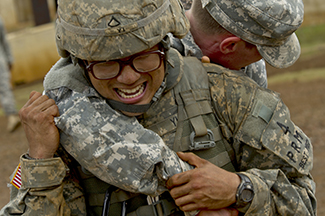
Have you ever had a song play over and over in your head? How about a memory of a traumatic event, something you really do not want to think about? When you keep remembering something, to the point where you can’t “get it out of your head” and it interferes with your ability to concentrate on other things, it is called persistence. It’s Schacter’s seventh and last memory error. It’s actually a failure of our memory system because we involuntarily recall unwanted memories, particularly unpleasant ones (Figure 8.16). For instance, you witness a horrific car accident on the way to work one morning, and you can’t concentrate on work because you keep remembering the scene.
英語のヒント
ある歌が頭の中で何度も繰り返し流れたことはないだろうか。外傷的な出来事の記憶、つまり本当は考えたくないことの記憶ではどうだろうか。何かを思い出し続け、それが「頭から離れず」、ほかのことに集中する能力が妨げられるほどになる場合、それは持続性と呼ばれる。これは、シャクターの七つ目の、そして最後の記憶の誤りである。持続性は、実は記憶システムの失敗である。望まない記憶、とりわけ不快な記憶を、意図せずに想起してしまうからである(図8.16)。たとえば、ある朝、通勤の途中で悲惨な自動車事故を目撃し、その光景を思い出し続けて仕事に集中できない、といった場合である。
OpenStax, Rice University; Psychology 2e. (credit: Department of Defense photo by U.S. Air Force Tech. Sgt. Michael R. Holzworth) Embedded rights notice: Public Domain · CC BY 4.0 · Source出典

Figure 8.16図 8.16
Many veterans of military conflicts involuntarily recall unwanted, unpleasant memories. (credit: Department of Defense photo by U.S. Air Force Tech. Sgt. Michael R. Holzworth)
軍事紛争を経験した退役軍人の多くは、望まない不快な記憶を意図せずに想起する。(出典:Department of Defense photo by U.S. Air Force Tech. Sgt. Michael R. Holzworth)