第8章記憶
Long-term Memory長期記憶
Long-term memory (LTM) is the continuous storage of information. Unlike short-term memory, long-term memory storage capacity is believed to be unlimited. It encompasses all the things you can remember that happened more than just a few minutes ago. One cannot really consider long-term memory without thinking about the way it is organized. Really quickly, what is the first word that comes to mind when you hear “peanut butter”? Did you think of jelly? If you did, you probably have associated peanut butter and jelly in your mind. It is generally accepted that memories are organized in semantic (or associative) networks (Collins & Loftus, 1975). A semantic network consists of concepts, and as you may recall from what you’ve learned about memory, concepts are categories or groupings of linguistic information, images, ideas, or memories, such as life experiences. Although individual experiences and expertise can affect concept arrangement, concepts are believed to be arranged hierarchically in the mind (Anderson & Reder, 1999; Johnson & Mervis, 1997, 1998; Palmer, Jones, Hennessy, Unze, & Pick, 1989; Rosch, Mervis, Gray, Johnson, & Boyes-Braem, 1976; Tanaka & Taylor, 1991). Related concepts are linked, and the strength of the link depends on how often two concepts have been associated.
英語のヒント
長期記憶(LTM)とは、情報を継続的に貯蔵することである。短期記憶とは違って、長期記憶の貯蔵容量には限りがないと考えられている。長期記憶には、ほんの数分以上前に起きたことで、思い出せることのすべてが含まれる。長期記憶について本当に考えようとすれば、それがどのように整理されているかを考えないわけにはいかない。さあ、すぐに答えてみよう。「ピーナッツバター」と聞いて最初に思い浮かぶ言葉は何だろうか。ジャムを思い浮かべただろうか。そうだとしたら、おそらくあなたは心の中でピーナッツバターとジャムを連合させている。記憶が意味(あるいは連合)ネットワークの形で整理されていることは、広く受け入れられている(Collins & Loftus, 1975)。意味ネットワークは概念から成る。記憶について学んだことから覚えているかもしれないが、概念とは、言語的な情報、イメージ、考え、あるいは人生経験のような記憶を、カテゴリーやまとまりにしたものである。個人の経験や専門知識は概念の配置に影響しうるものの、概念は心の中で階層的に配置されていると考えられている(Anderson & Reder, 1999; Johnson & Mervis, 1997, 1998; Palmer, Jones, Hennessy, Unze, & Pick, 1989; Rosch, Mervis, Gray, Johnson, & Boyes-Braem, 1976; Tanaka & Taylor, 1991)。関連する概念どうしは結びついており、その結びつきの強さは、二つの概念がどれくらい頻繁に連合されてきたかによって決まる。
Semantic networks differ depending on personal experiences. Importantly for memory, activating any part of a semantic network also activates the concepts linked to that part to a lesser degree. The process is known as spreading activation (Collins & Loftus, 1975). If one part of a network is activated, it is easier to access the associated concepts because they are already partially activated. When you remember or recall something, you activate a concept, and the related concepts are more easily remembered because they are partially activated. However, the activations do not spread in just one direction. When you remember something, you usually have several routes to get the information you are trying to access, and the more links you have to a concept, the better your chances of remembering.
英語のヒント
意味ネットワークは、個人の経験によって異なる。記憶にとって重要なのは、意味ネットワークのどの部分を活性化しても、その部分に結びついている概念も、より弱い程度で活性化されるということである。この過程は活性化拡散として知られている(Collins & Loftus, 1975)。ネットワークのある部分が活性化されると、連合している概念にアクセスしやすくなる。それらの概念がすでに部分的に活性化されているからである。何かを思い出したり再生したりするとき、あなたはある概念を活性化しており、関連する概念は部分的に活性化されているので、より思い出しやすくなる。しかし、活性化は一つの方向にだけ広がるわけではない。何かを思い出すとき、アクセスしようとしている情報にたどり着く経路は、ふつういくつもある。そして、ある概念へのつながりが多いほど、思い出せる見込みは高くなる。
There are two types of long-term memory: explicit and implicit (Figure 8.6). Understanding the difference between explicit memory and implicit memory is important because aging, particular types of brain trauma, and certain disorders can impact explicit and implicit memory in different ways. Explicit memories are those we consciously try to remember, recall, and report. For example, if you are studying for your chemistry exam, the material you are learning will be part of your explicit memory. In keeping with the computer analogy, some information in your long-term memory would be like the information you have saved on the hard drive. It is not there on your desktop (your short-term memory), but most of the time you can pull up this information when you want it. Not all long-term memories are strong memories, and some memories can only be recalled using prompts. For example, you might easily recall a fact, such as the capital of the United States, but you might struggle to recall the name of the restaurant at which you had dinner when you visited a nearby city last summer. A prompt, such as that the restaurant was named after its owner, might help you recall the name of the restaurant. Explicit memory is sometimes referred to as declarative memory, because it can be put into words. Explicit memory is divided into episodic memory and semantic memory.
英語のヒント
長期記憶には、顕在記憶と潜在記憶の二つの種類がある(図8.6)。顕在記憶と潜在記憶の違いを理解することは重要である。加齢、特定の種類の脳外傷、ある種の障害は、顕在記憶と潜在記憶にそれぞれ異なる形で影響しうるからである。顕在記憶とは、私たちが意識的に思い出し、再生し、報告しようとする記憶である。たとえば、化学の試験に向けて勉強しているなら、学んでいる内容は顕在記憶の一部になる。コンピューターのたとえに沿って言えば、長期記憶の中の一部の情報は、ハードディスクに保存してある情報のようなものだろう。それはデスクトップ(短期記憶)の上にはないが、たいていは、必要なときにその情報を呼び出すことができる。すべての長期記憶が強い記憶であるわけではなく、手がかりを使わなければ再生できない記憶もある。たとえば、アメリカの首都のような事実は簡単に思い出せるかもしれないが、去年の夏に近くの都市を訪れたときに夕食をとったレストランの名前は、なかなか思い出せないかもしれない。そのレストランが店主の名前にちなんで名づけられていた、といった手がかりがあれば、レストランの名前を思い出す助けになるかもしれない。顕在記憶は、言葉にして表すことができるので、宣言的記憶と呼ばれることもある。顕在記憶は、エピソード記憶と意味記憶に分けられる。
Episodic memory is information about events we have personally experienced (i.e., an episode). For instance, the memory of your last birthday is an episodic memory. Usually, episodic memory is reported as a story. The concept of episodic memory was first proposed about in the 1970s (Tulving, 1972). Since then, Tulving and others have reformulated the theory, and currently scientists believe that episodic memory is memory about happenings in particular places at particular times—the what, where, and when of an event (Tulving, 2002). It involves recollection of visual imagery as well as the feeling of familiarity (Hassabis & Maguire, 2007). Semantic memory is knowledge about words, concepts, and language-based knowledge and facts. Semantic memory is typically reported as facts. Semantic means having to do with language and knowledge about language. For example, answers to the following questions like “what is the definition of psychology” and “who was the first African American president of the United States” are stored in your semantic memory.
英語のヒント
エピソード記憶とは、私たちが個人的に経験した出来事(すなわちエピソード)についての情報である。たとえば、前回の誕生日の記憶はエピソード記憶である。エピソード記憶は、ふつう物語として報告される。エピソード記憶という概念は、1970年代ごろに初めて提唱された(Tulving, 1972)。それ以来、タルヴィングらはこの理論を練り直してきた。現在、科学者たちは、エピソード記憶とは特定の場所と特定の時点での出来事についての記憶、つまり出来事の「何が」「どこで」「いつ」についての記憶だと考えている(Tulving, 2002)。エピソード記憶には、視覚的なイメージの想起と、なじみのある感じの両方が伴う(Hassabis & Maguire, 2007)。意味記憶とは、単語、概念、言語に基づく知識や事実についての知識である。意味記憶は、ふつう事実として報告される。「意味的」とは、言語や、言語についての知識にかかわることを意味する。たとえば、「心理学の定義は何か」「アメリカで最初のアフリカ系アメリカ人の大統領は誰だったか」といった問いへの答えは、意味記憶に貯蔵されている。
Implicit memories are long-term memories that are not part of our consciousness. Although implicit memories are learned outside of our awareness and cannot be consciously recalled, implicit memory is demonstrated in the performance of some task (Roediger, 1990; Schacter, 1987). Implicit memory has been studied with cognitive demand tasks, such as performance on artificial grammars (Reber, 1976), word memory (Jacoby, 1983; Jacoby & Witherspoon, 1982), and learning unspoken and unwritten contingencies and rules (Greenspoon, 1955; Giddan & Eriksen, 1959; Krieckhaus & Eriksen, 1960). Returning to the computer metaphor, implicit memories are like a program running in the background, and you are not aware of their influence. Implicit memories can influence observable behaviors as well as cognitive tasks. In either case, you usually cannot put the memory into words that adequately describe the task. There are several types of implicit memories, including procedural, priming, and emotional conditioning.
英語のヒント
潜在記憶とは、私たちの意識にのぼらない長期記憶である。潜在記憶は自覚の外で学習され、意識的に再生することはできないが、何らかの課題の遂行の中に現れる(Roediger, 1990; Schacter, 1987)。潜在記憶は、人工文法の課題成績(Reber, 1976)、単語の記憶(Jacoby, 1983; Jacoby & Witherspoon, 1982)、言葉にされず書かれてもいない随伴性や規則の学習(Greenspoon, 1955; Giddan & Eriksen, 1959; Krieckhaus & Eriksen, 1960)など、認知的な負荷のかかる課題を用いて研究されてきた。コンピューターのたとえに戻ると、潜在記憶はバックグラウンドで動いているプログラムのようなもので、私たちはその影響に気づいていない。潜在記憶は、認知的な課題だけでなく、観察可能な行動にも影響を与えうる。どちらの場合も、その課題を適切に説明する言葉で記憶を言い表すことは、ふつうできない。潜在記憶にはいくつかの種類があり、手続き記憶、プライミング、感情条件づけなどが含まれる。
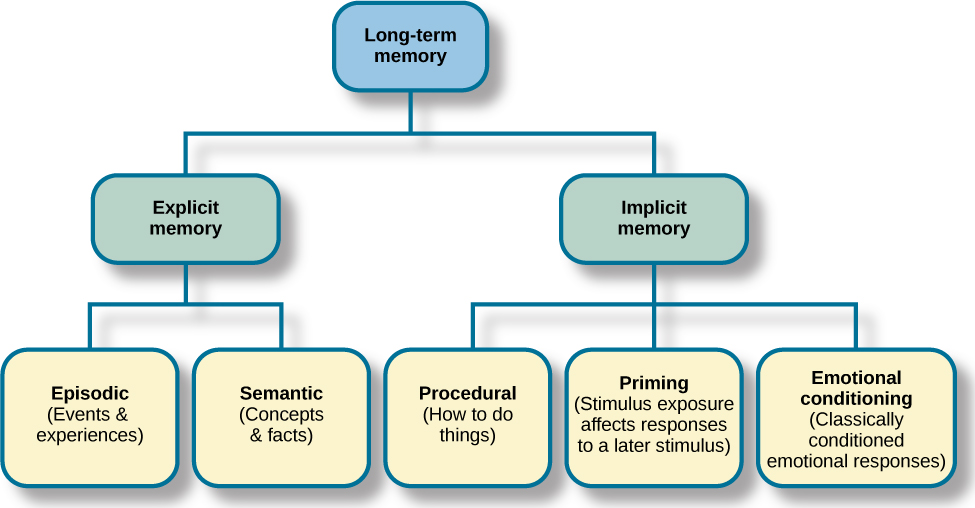

Figure 8.6図 8.6
There are two components of long-term memory: explicit and implicit. Explicit memory includes episodic and semantic memory. Implicit memory includes procedural memory and things learned through conditioning.
長期記憶には、顕在記憶と潜在記憶の二つの構成要素がある。顕在記憶にはエピソード記憶と意味記憶が含まれる。潜在記憶には、手続き記憶と、条件づけによって学習されたものが含まれる。
Implicit procedural memory is often studied using observable behaviors (Adams, 1957; Lacey & Smith, 1954; Lazarus & McCleary, 1951). Implicit procedural memory stores information about the way to do something, and it is the memory for skilled actions, such as brushing your teeth, riding a bicycle, or driving a car. You were probably not that good at riding a bicycle or driving a car the first time you tried, but you were much better after doing those things for a year. Your improved bicycle riding was due to learning balancing abilities. You likely thought about staying upright in the beginning, but now you just do it. Moreover, you probably are good at staying balanced, but cannot tell someone the exact way you do it. Similarly, when you first learned to drive, you probably thought about a lot of things that you just do now without much thought. When you first learned to do these tasks, someone may have told you how to do them, but everything you learned since those instructions that you cannot readily explain to someone else as the way to do it is implicit memory.
英語のヒント
潜在的な手続き記憶は、観察可能な行動を用いて研究されることが多い(Adams, 1957; Lacey & Smith, 1954; Lazarus & McCleary, 1951)。潜在的な手続き記憶は、何かのやり方についての情報を貯蔵しており、歯を磨く、自転車に乗る、車を運転するといった熟練した動作の記憶である。初めて試みたとき、あなたはおそらく自転車に乗るのも車を運転するのもそれほど上手ではなかったが、それを1年間続けた後にはずっと上手になっていた。自転車に乗るのが上達したのは、バランスをとる能力を学習したためである。最初のうちは、倒れないようにまっすぐ乗っていることを考えていただろうが、今ではただそうしているだけである。さらに、あなたはおそらくバランスを保つのが上手だが、それをどうやっているのかを正確に人に伝えることはできない。同じように、初めて運転を習ったときには、今ではほとんど考えずにこなしている多くのことについて、あれこれ考えていたことだろう。こうした課題を初めて学んだとき、誰かがやり方を教えてくれたかもしれない。しかし、その指示を受けて以来学んだことのうち、やり方として他人にすぐには説明できないものは、すべて潜在記憶である。
Implicit priming is another type of implicit memory (Schacter, 1992). During priming exposure to a stimulus affects the response to a later stimulus. Stimuli can vary and may include words, pictures, and other stimuli to elicit a response or increase recognition. For instance, some people really enjoy picnics. They love going into nature, spreading a blanket on the ground, and eating a delicious meal. Now, unscramble the following letters to make a word.
英語のヒント
潜在的プライミングは、潜在記憶のもう一つの種類である(Schacter, 1992)。プライミングでは、ある刺激にさらされることが、後の刺激への反応に影響する。刺激はさまざまであり、反応を引き出したり再認を高めたりするための単語や絵、そのほかの刺激が含まれうる。たとえば、ピクニックが大好きな人がいる。彼らは、自然の中に出かけ、地面に敷物を広げ、おいしい食事をとるのが大好きだ。では、次の文字を並べ替えて、単語を一つ作ってみよう。
(8.1)
What word did you come up with? Chances are good that it was "plate."
英語のヒント
どんな単語を思いついただろうか。「plate(皿)」だった可能性が高い。
Had you read, “Some people really enjoy growing flowers. They love going outside to their garden, fertilizing their plants, and watering their flowers,” you probably would have come up with the word "petal" instead of plate.
英語のヒント
もしあなたが「花を育てるのが大好きな人がいる。彼らは庭に出て、植物に肥料をやり、花に水をやるのが大好きだ」という文を読んでいたなら、おそらく「plate」ではなく「petal(花びら)」という単語を思いついていただろう。
Do you recall the earlier discussion of semantic networks? The reason people are more likely to come up with “plate” after reading about a picnic is that plate is associated (linked) with picnic. Plate was primed by activating the semantic network. Similarly, “petal” is linked to flower and is primed by flower. Priming is also the reason you probably said jelly in response to peanut butter.
英語のヒント
先に述べた意味ネットワークの話を覚えているだろうか。ピクニックについて読んだ後に「plate」を思いつく可能性が高くなるのは、plate(皿)がpicnic(ピクニック)と連合している(結びついている)からである。意味ネットワークが活性化されたことで、plateがプライミングされたのである。同じように、「petal」はflower(花)と結びついており、flowerによってプライミングされる。「ピーナッツバター」に対しておそらく「ジャム」と答えたのも、プライミングによる。
Implicit emotional conditioning is the type of memory involved in classically conditioned emotion responses (Olson & Fazio, 2001). These emotional relationships cannot be reported or recalled but can be associated with different stimuli. For example, specific smells can cause specific emotional responses for some people. If there is a smell that makes you feel positive and nostalgic, and you don't know where that response comes from, it is an implicit emotional response. Similarly, most people have a song that causes a specific emotional response. That song's effect could be an implicit emotional memory (Yang, Xu, Du, Shi, & Fang, 2011).
英語のヒント
潜在的な感情条件づけとは、古典的に条件づけられた感情反応にかかわる種類の記憶である(Olson & Fazio, 2001)。こうした感情的な結びつきは、報告することも再生することもできないが、さまざまな刺激と連合しうる。たとえば、特定のにおいが、一部の人に特定の感情反応を引き起こすことがある。前向きで懐かしい気持ちにさせるにおいがあり、その反応がどこから来るのか分からないなら、それは潜在的な感情反応である。同じように、たいていの人には、特定の感情反応を引き起こす歌がある。その歌の効果は、潜在的な感情記憶なのかもしれない(Yang, Xu, Du, Shi, & Fang, 2011)。