第8章記憶
Storage貯蔵
Once the information has been encoded, we have to somehow retain it. Our brains take the encoded information and place it in storage. Storage is the creation of a permanent record of information.
英語のヒント
情報がいったん符号化されたら、私たちはそれを何らかの方法で保持しなければならない。脳は符号化された情報を受け取り、それを貯蔵する。貯蔵とは、情報の永続的な記録をつくることである。
In order for a memory to go into storage (i.e., long-term memory), it has to pass through three distinct stages: Sensory Memory, Short-Term Memory, and finally Long-Term Memory. These stages were first proposed by Richard Atkinson and Richard Shiffrin (1968). Their model of human memory (Figure 8.4), called Atkinson and Shiffrin's model, is based on the belief that we process memories in the same way that a computer processes information.
英語のヒント
記憶が貯蔵(すなわち長期記憶)に入るためには、三つの異なる段階を通過しなければならない。感覚記憶、短期記憶、そして最後に長期記憶である。これらの段階は、リチャード・アトキンソンとリチャード・シフリン(1968)によって初めて提唱された。二人による人間の記憶のモデル(図8.4)は、アトキンソン=シフリンのモデルと呼ばれ、私たちはコンピューターが情報を処理するのと同じやり方で記憶を処理している、という考えに基づいている。
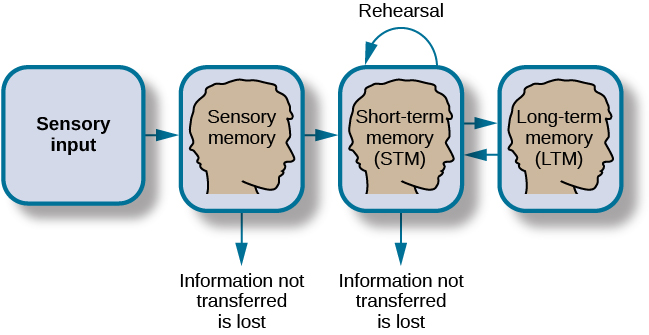
Figure 8.4図 8.4
According to the Atkinson-Shiffrin model of memory, information passes through three distinct stages in order for it to be stored in long-term memory.
アトキンソン=シフリンのモデルによれば、情報は長期記憶に貯蔵されるために、三つの異なる段階を通過する。
Atkinson and Shiffrin's model is not the only model of memory. Baddeley and Hitch (1974) proposed a working memory model in which short-term memory has different forms. In their model, storing memories in short-term memory is like opening different files on a computer and adding information. The working memory files hold a limited amount of information. The type of short-term memory (or computer file) depends on the type of information received. There are memories in visual-spatial form, as well as memories of spoken or written material, and they are stored in three short-term systems: a visuospatial sketchpad, an episodic buffer (Baddeley, 2000), and a phonological loop. According to Baddeley and Hitch, a central executive part of memory supervises or controls the flow of information to and from the three short-term systems, and the central executive is responsible for moving information into long-term memory.
英語のヒント
アトキンソン=シフリンのモデルは、記憶の唯一のモデルではない。バドリーとヒッチ(1974)は、短期記憶がいくつかの異なる形をとるワーキングメモリーのモデルを提唱した。彼らのモデルでは、短期記憶に記憶を貯蔵することは、コンピューター上で別々のファイルを開いて情報を書き加えることに似ている。ワーキングメモリーのファイルが保持できる情報の量には限りがある。短期記憶(あるいはコンピューターのファイル)の種類は、受け取る情報の種類によって決まる。話し言葉や書き言葉の題材についての記憶に加えて、視空間的な形の記憶もある。それらは三つの短期的なシステム、すなわち視空間スケッチパッド、エピソード・バッファー(Baddeley, 2000)、音韻ループに貯蔵される。バドリーとヒッチによれば、記憶の中の中央実行系という部分が、三つの短期システムに出入りする情報の流れを監督または制御しており、中央実行系は情報を長期記憶へ移す役割を担っている。
Sensory Memory感覚記憶
In the Atkinson-Shiffrin model, stimuli from the environment are processed first in sensory memory: storage of brief sensory events, such as sights, sounds, and tastes. It is very brief storage—up to a couple of seconds. We are constantly bombarded with sensory information. We cannot absorb all of it, or even most of it. And most of it has no impact on our lives. For example, what was your professor wearing the last class period? As long as the professor was dressed appropriately, it does not really matter what she was wearing. Sensory information about sights, sounds, smells, and even textures, which we do not view as valuable information, we discard. If we view something as valuable, the information will move into our short-term memory system.
英語のヒント
アトキンソン=シフリンのモデルでは、環境からの刺激はまず感覚記憶で処理される。感覚記憶とは、光景、音、味といった短い感覚的な出来事を貯蔵するものである。これはごく短い貯蔵で、長くても2秒ほどしか続かない。私たちは絶えず感覚情報を浴びせられている。そのすべてを取り込むことはできないし、大部分でさえ取り込めない。しかも、その大部分は私たちの生活に何の影響も与えない。たとえば、前回の授業のとき、教授は何を着ていただろうか。教授が場にふさわしい服装をしていたかぎり、何を着ていたかは実のところ重要ではない。光景、音、におい、さらには手ざわりについての感覚情報のうち、価値のある情報とみなさないものを、私たちは捨てている。何かを価値があるとみなせば、その情報は短期記憶のシステムへ移っていく。
Short-Term Memory短期記憶
Short-term memory (STM) is a temporary storage system that processes incoming sensory memory. The terms short-term and working memory are sometimes used interchangeably, but they are not exactly the same. Short-term memory is more accurately described as a component of working memory. Short-term memory takes information from sensory memory and sometimes connects that memory to something already in long-term memory. Short-term memory storage lasts 15 to 30 seconds. Think of it as the information you have displayed on your computer screen, such as a document, spreadsheet, or website. Then, information in STM goes to long-term memory (you save it to your hard drive), or it is discarded (you delete a document or close a web browser).
英語のヒント
短期記憶(STM)は、入ってくる感覚記憶を処理する一時的な貯蔵システムである。短期記憶とワーキングメモリーという用語は区別せずに使われることもあるが、まったく同じものではない。短期記憶は、ワーキングメモリーの構成要素の一つと言ったほうがより正確である。短期記憶は感覚記憶から情報を受け取り、ときにはその記憶を、すでに長期記憶にある何かと結びつける。短期記憶の貯蔵は15〜30秒続く。短期記憶は、コンピューターの画面に表示している情報、たとえば文書や表計算ソフトの表、ウェブサイトのようなものだと考えるとよい。その後、STMの情報は長期記憶へ移る(ハードディスクに保存する)か、捨てられる(文書を削除したり、ウェブブラウザーを閉じたりする)。
Rehearsal moves information from short-term memory to long-term memory. Active rehearsal is a way of attending to information to move it from short-term to long-term memory. During active rehearsal, you repeat (practice) the information to be remembered. If you repeat it enough, it may be moved into long-term memory. For example, this type of active rehearsal is the way many children learn their ABCs by singing the alphabet song. Alternatively, elaborative rehearsal is the act of linking new information you are trying to learn to existing information that you already know. For example, if you meet someone at a party and your phone is dead but you want to remember his phone number, which starts with area code 203, you might remember that your uncle Abdul lives in Connecticut and has a 203 area code. This way, when you try to remember the phone number of your new prospective friend, you will easily remember the area code. Craik and Lockhart (1972) proposed the levels of processing hypothesis that states the deeper you think about something, the better you remember it.
英語のヒント
リハーサルは、情報を短期記憶から長期記憶へ移す。能動的リハーサルとは、情報を短期記憶から長期記憶へ移すために、その情報に注意を向けるやり方である。能動的リハーサルでは、覚えるべき情報を繰り返す(練習する)。十分に繰り返せば、その情報は長期記憶へ移されるかもしれない。たとえば、多くの子どもはアルファベットの歌を歌ってABCを覚えるが、そのやり方がこの種の能動的リハーサルである。別のやり方として、精緻化リハーサルがある。これは、学ぼうとしている新しい情報を、すでに知っている既存の情報に結びつける行為である。たとえば、パーティーで誰かと知り合ったが、携帯電話の電池が切れていて、それでも彼の電話番号を覚えておきたいとしよう。番号は市外局番203で始まる。このとき、おじのアブドゥルがコネチカット州に住んでいて、市外局番が203であることを思い出すかもしれない。こうすれば、友人になりそうなその新しい知り合いの電話番号を思い出そうとするとき、市外局番は簡単に思い出せるだろう。クレイクとロックハート(1972)は処理水準仮説を提唱した。何かについて深く考えるほど、それをよく覚えている、とする仮説である。
You may find yourself asking, “How much information can our memory handle at once?” To explore the capacity and duration of your short-term memory, have a partner read the strings of random numbers (Figure 8.5) out loud to you, beginning each string by saying, “Ready?” and ending each by saying, “Recall,” at which point you should try to write down the string of numbers from memory.
英語のヒント
「私たちの記憶は一度にどれくらいの情報を扱えるのだろうか」と自問している自分に気づくかもしれない。自分の短期記憶の容量と持続時間を調べるために、パートナーにランダムな数字の列(図8.5)を声に出して読んでもらおう。パートナーには、各列の始めに「用意はいい?」と言い、終わりに「思い出して」と言ってもらう。「思い出して」と言われたら、その時点で、記憶を頼りにその数字の列を書き出してみよう。



Figure 8.5図 8.5
Work through this series of numbers using the recall exercise explained above to determine the longest string of digits that you can store.
上で説明した再生の練習のやり方でこの数字の列に取り組み、自分が貯蔵できる最も長い数字の列を確かめよう。
Note the longest string at which you got the series correct. For most people, the capacity will probably be close to 7 plus or minus 2. In 1956, George Miller reviewed most of the research on the capacity of short-term memory and found that people can retain between 5 and 9 items, so he reported the capacity of short-term memory was the "magic number" 7 plus or minus 2. However, more contemporary research has found working memory capacity is 4 plus or minus 1 (Cowan, 2010). Generally, recall is somewhat better for random numbers than for random letters (Jacobs, 1887) and also often slightly better for information we hear (acoustic encoding) rather than information we see (visual encoding) (Anderson, 1969).
英語のヒント
正しく書けた最も長い列を書き留めておこう。たいていの人の場合、容量はおそらく7±2に近いだろう。1956年、ジョージ・ミラーは短期記憶の容量についての研究の大半を検討し、人は5〜9項目を保持できることを見いだした。そこで彼は、短期記憶の容量は「マジカルナンバー」7±2であると報告した。しかし、より最近の研究では、ワーキングメモリーの容量は4±1であることが分かっている(Cowan, 2010)。一般に、再生の成績は、ランダムな文字よりもランダムな数字のほうがいくらかよく(Jacobs, 1887)、また、目で見る情報(視覚的符号化)よりも耳で聞く情報(音響的符号化)のほうがわずかによいことが多い(Anderson, 1969)。
Memory trace decay and interference are two factors that affect short-term memory retention. Peterson and Peterson (1959) investigated short-term memory using the three letter sequences called trigrams (e.g., CLS) that had to be recalled after various time intervals between 3 and 18 seconds. Participants remembered about 80% of the trigrams after a 3-second delay, but only 10% after a delay of 18 seconds, which caused them to conclude that short-term memory decayed in 18 seconds. During decay, the memory trace becomes less activated over time, and the information is forgotten. However, Keppel and Underwood (1962) examined only the first trials of the trigram task and found that proactive interference also affected short-term memory retention. During proactive interference, previously learned information interferes with the ability to learn new information. Both memory trace decay and proactive interference affect short-term memory. Once the information reaches long-term memory, it has to be consolidated at both the synaptic level, which takes a few hours, and into the memory system, which can take weeks or longer.
英語のヒント
記憶痕跡の減衰と干渉は、短期記憶の保持に影響を与える二つの要因である。ピーターソンとピーターソン(1959)は、トリグラムと呼ばれる3文字の並び(たとえばCLS)を用いて短期記憶を調べた。参加者は、3〜18秒のさまざまな時間間隔をおいた後に、トリグラムを再生しなければならなかった。参加者は、3秒の遅延の後にはトリグラムの約80%を覚えていたが、18秒の遅延の後には10%しか覚えていなかった。この結果から二人は、短期記憶は18秒で減衰すると結論づけた。減衰では、時間がたつにつれて記憶痕跡の活性化が弱まり、情報が忘れられる。しかし、ケッペルとアンダーウッド(1962)は、トリグラム課題の最初の試行だけを調べ、順向干渉も短期記憶の保持に影響していることを見いだした。順向干渉では、以前に学んだ情報が、新しい情報を学ぶ能力を妨げる。記憶痕跡の減衰と順向干渉は、どちらも短期記憶に影響する。情報が長期記憶に達したら、それはシナプスのレベルと記憶システムの両方で固定化されなければならない。シナプスのレベルでの固定化には数時間かかり、記憶システムへの固定化には数週間、あるいはそれ以上かかることもある。