第8章記憶
The Cerebellum and Prefrontal Cortex小脳と前頭前野
Although the hippocampus seems to be more of a processing area for explicit memories, you could still lose it and be able to create implicit memories (procedural memory, motor learning, and classical conditioning), thanks to your cerebellum (Figure 8.8). For example, one classical conditioning experiment is to accustom subjects to blink when they are given a puff of air to the eyes. When researchers damaged the cerebellums of rabbits, they discovered that the rabbits were not able to learn the conditioned eye-blink response (Steinmetz, 1999; Green & Woodruff-Pak, 2000).
英語のヒント
海馬はどちらかといえば顕在記憶を処理する領域であるようだが、海馬を失っても、小脳のおかげで、潜在記憶(手続き記憶、運動学習、古典的条件づけ)はそれでもつくれるだろう(図8.8)。たとえば、古典的条件づけの実験の一つに、目に空気を吹きつけられたときにまばたきをするよう対象者を慣らすというものがある。研究者がウサギの小脳を損傷させたところ、ウサギはまばたきの条件反応を学習できないことが分かった(Steinmetz, 1999; Green & Woodruff-Pak, 2000)。
Other researchers have used brain scans, including positron emission tomography (PET) scans, to learn how people process and retain information. From these studies, it seems the prefrontal cortex is involved. In one study, participants had to complete two different tasks: either looking for the letter a in words (considered a perceptual task) or categorizing a noun as either living or non-living (considered a semantic task) (Kapur et al., 1994). Participants were then asked which words they had previously seen. Recall was much better for the semantic task than for the perceptual task. According to PET scans, there was much more activation in the left inferior prefrontal cortex in the semantic task. In another study, encoding was associated with left frontal activity, while retrieval of information was associated with the right frontal region (Craik et al., 1999).
英語のヒント
ほかの研究者たちは、人がどのように情報を処理し保持するのかを知るために、陽電子放出断層撮影(PET)をはじめとする脳スキャンを用いてきた。これらの研究からすると、前頭前野がかかわっているようである。ある研究では、参加者は二つの異なる課題を行わなければならなかった。単語の中から文字aを探す課題(知覚的課題とみなされる)か、名詞を生物か無生物かに分類する課題(意味的課題とみなされる)のいずれかである(Kapur et al., 1994)。その後、参加者は、前に見たのはどの単語だったかを尋ねられた。再生は、知覚的課題よりも意味的課題のほうがはるかによかった。PETスキャンによると、意味的課題では、左の下前頭前野の活性化がずっと大きかった。別の研究では、符号化は左の前頭部の活動と関連し、一方、情報の検索は右の前頭部の領域と関連していた(Craik et al., 1999)。
Neurotransmitters神経伝達物質
There also appear to be specific neurotransmitters involved with the process of memory, such as epinephrine, dopamine, serotonin, glutamate, and acetylcholine (Myhrer, 2003). There continues to be discussion and debate among researchers as to which neurotransmitter plays which specific role (Blockland, 1996). Although we don’t yet know which role each neurotransmitter plays in memory, we do know that communication among neurons via neurotransmitters is critical for developing new memories. Repeated activity by neurons leads to increased neurotransmitters in the synapses and more efficient and more synaptic connections. This is how memory consolidation occurs.
英語のヒント
エピネフリン、ドーパミン、セロトニン、グルタミン酸、アセチルコリンなど、記憶の過程にかかわる特定の神経伝達物質もあるようだ(Myhrer, 2003)。どの神経伝達物質がどの特定の役割を果たしているのかについては、研究者のあいだで今も議論と論争が続いている(Blockland, 1996)。それぞれの神経伝達物質が記憶の中でどんな役割を果たしているのかはまだ分かっていないが、神経伝達物質を介したニューロン間の情報伝達が、新しい記憶をつくるのに決定的に重要であることは確かに分かっている。ニューロンが繰り返し活動すると、シナプスの神経伝達物質が増え、シナプス結合がより効率的になり、また数も増える。記憶の固定化はこのようにして起こる。
It is also believed that strong emotions trigger the formation of strong memories, and weaker emotional experiences form weaker memories; this is called arousal theory (Christianson, 1992). For example, strong emotional experiences can trigger the release of neurotransmitters, as well as hormones, which strengthen memory; therefore, our memory for an emotional event is usually better than our memory for a non-emotional event. When humans and animals are stressed, the brain secretes more of the neurotransmitter glutamate, which helps them remember the stressful event (McGaugh, 2003). This is clearly evidenced by what is known as the flashbulb memory phenomenon.
英語のヒント
また、強い感情は強い記憶の形成を引き起こし、それより弱い感情経験はより弱い記憶を形成すると考えられている。これは覚醒理論と呼ばれる(Christianson, 1992)。たとえば、強い感情経験は、神経伝達物質やホルモンの放出を引き起こしうる。それらが記憶を強めるのである。そのため、感情を伴う出来事についての記憶は、感情を伴わない出来事についての記憶よりも、ふつうはよい。人間や動物がストレスを受けると、脳は神経伝達物質のグルタミン酸をより多く分泌し、それがストレスの多い出来事を思い出すのを助ける(McGaugh, 2003)。このことは、フラッシュバルブ記憶の現象として知られるものによって、はっきりと裏づけられている。
A flashbulb memory is an exceptionally clear recollection of an important event (Figure 8.9). Many people who have lived through historic and momentous events can recall exactly where they were and how they heard about them. For example, a Pew Research Center (2011) survey found that for those Americans who were age 8 or older at the time of 9/11 terrorist attacks, 97% can recall the moment they learned of this event, even a decade after it happened. Many widely discussed examples of flashbulb memories pertain to national or global events, but according to their initial definition by researchers Brown and Kulik (1977) as well as additional work by more recent researchers, such a widely shared event is not required (Hirst & Phelps, 2016). Family members might always remember how they heard about an important event in their lives, or people in a school may recall nearly everything about the way they experienced a major event in that setting. And although most studies (and many conversations) involve negative memories, positive events can also elicit flashbulb memories.
英語のヒント
フラッシュバルブ記憶とは、重要な出来事についての、並外れて鮮明な想起である(図8.9)。歴史的で重大な出来事を経験した人の多くは、自分がそのときどこにいて、それをどのように聞いたのかを正確に思い出すことができる。たとえば、ピュー・リサーチ・センター(2011)の調査によると、9.11同時多発テロの当時8歳以上だったアメリカ人のうち97%が、事件から10年たっても、この出来事を知った瞬間を思い出せる。広く論じられているフラッシュバルブ記憶の例の多くは、国家的な出来事や世界的な出来事にかかわるものである。しかし、研究者ブラウンとクーリック(1977)による最初の定義や、より最近の研究者たちによる追加の研究によれば、そのように広く共有された出来事である必要はない(Hirst & Phelps, 2016)。家族の成員は、自分たちの生活の中の重要な出来事をどのように聞いたかをいつまでも覚えているかもしれないし、ある学校にいる人々は、その場で大きな出来事をどのように経験したかについて、ほぼすべてを思い出すかもしれない。そして、ほとんどの研究(そして多くの会話)は否定的な記憶を扱っているが、肯定的な出来事もフラッシュバルブ記憶を引き起こしうる。
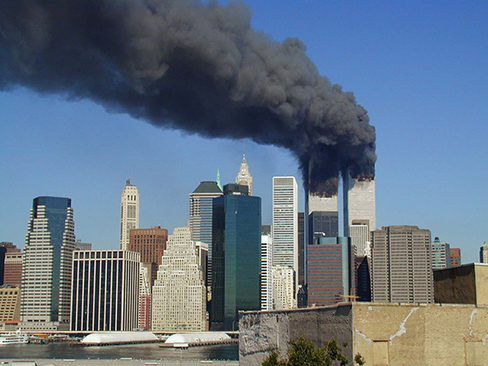

Figure 8.9図 8.9
Most people can remember where they were when they first heard about the 9/11 terrorist attacks. This is an example of a flashbulb memory: a record of an atypical and unusual event that has very strong emotional associations. (credit: Michael Foran)
ほとんどの人は、9.11同時多発テロについて最初に聞いたとき、自分がどこにいたかを思い出すことができる。これはフラッシュバルブ記憶の一例である。フラッシュバルブ記憶とは、非常に強い感情的な結びつきを持つ、典型的でない珍しい出来事の記録である。(出典:Michael Foran)