第8章記憶
The Misinformation Effect誤情報効果
Cognitive psychologist Elizabeth Loftus has conducted extensive research on memory. She has studied false memories as well as recovered memories of childhood sexual abuse. Loftus also developed the misinformation effect paradigm, which holds that after exposure to additional and possibly inaccurate information, a person may misremember the original event.
英語のヒント
認知心理学者のエリザベス・ロフタスは、記憶について幅広い研究を行ってきた。彼女は偽記憶とともに、子ども時代の性的虐待について回復された記憶も研究してきた。ロフタスはまた、誤情報効果パラダイムを考案した。これは、付け加えられた、不正確かもしれない情報にさらされた後で、人はもとの出来事を誤って記憶することがある、とするものである。
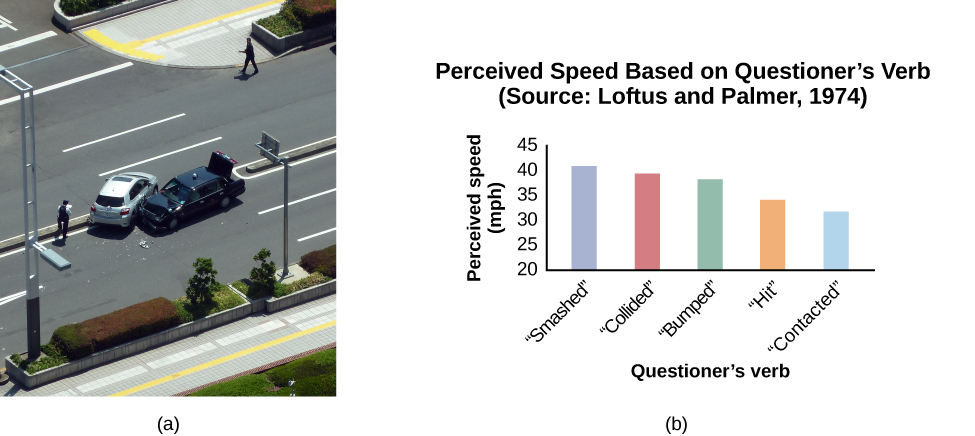
According to Loftus, an eyewitness’s memory of an event is very flexible due to the misinformation effect. To test this theory, Loftus and John Palmer (1974) asked 45 U.S. college students to estimate the speed of cars using different forms of questions (Figure 8.12). The participants were shown films of car accidents and were asked to play the role of the eyewitness and describe what happened. They were asked, “About how fast were the cars going when they (smashed, collided, bumped, hit, contacted) each other?” The participants estimated the speed of the cars based on the verb used.
英語のヒント
ロフタスによれば、出来事についての目撃者の記憶は、誤情報効果のために非常に柔軟である。この理論を検証するために、ロフタスとジョン・パーマー(1974)は、アメリカの大学生45人に、さまざまな形の質問を使って車の速度を推定させた(図8.12)。参加者は自動車事故の映像を見せられ、目撃者の役を演じて、何が起こったかを述べるよう求められた。参加者は、「車が互いに(激突した、衝突した、ぶつかった、当たった、接触した)とき、車はおよそどのくらいの速さで走っていましたか」と尋ねられた。参加者は、使われた動詞に基づいて車の速度を推定した。
Participants who heard the word “smashed” estimated that the cars were traveling at a much higher speed than participants who heard the word “contacted.” The implied information about speed, based on the verb they heard, had an effect on the participants’ memory of the accident. In a follow-up one week later, participants were asked if they saw any broken glass (none was shown in the accident pictures). Participants who had been in the “smashed” group were more than twice as likely to indicate that they did remember seeing glass. Loftus and Palmer demonstrated that a leading question encouraged them to not only remember the cars were going faster, but to also falsely remember that they saw broken glass.
英語のヒント
「激突した」という語を聞いた参加者は、「接触した」という語を聞いた参加者よりも、車がはるかに速い速度で走っていたと推定した。聞いた動詞に基づいて暗に示された速度についての情報が、事故についての参加者の記憶に影響を与えたのである。1週間後の追跡調査で、参加者は割れたガラスを見たかどうかを尋ねられた(事故の映像には、割れたガラスは一つも映っていなかった)。「激突した」の群にいた参加者は、ガラスを見たことを確かに覚えていると答える可能性が2倍以上高かった。ロフタスとパーマーが示したのは、誘導質問によって参加者が、車がより速く走っていたと記憶するようになっただけでなく、割れたガラスを見たと誤って記憶するようにもなったということである。
OpenStax, Rice University; Psychology 2e. (credit a: modification of work by Rob Young) · CC BY 4.0 · Source出典

Figure 8.12図 8.12
When people are asked leading questions about an event, their memory of the event may be altered. (credit a: modification of work by Rob Young)
ある出来事について誘導質問をされると、その出来事についての記憶が変わってしまうことがある。(出典a:Rob Youngの作品を改変)
Controversies over Repressed and Recovered Memories抑圧された記憶と回復された記憶をめぐる論争
Other researchers have described how whole events, not just words, can be falsely recalled, even when they did not happen. The idea that memories of traumatic events could be repressed has been a theme in the field of psychology, beginning with Sigmund Freud, and the controversy surrounding the idea continues today.
英語のヒント
ほかの研究者たちは、単語だけでなく出来事全体が、実際には起こっていない場合でさえ、誤って想起されうることを記述してきた。外傷的な出来事の記憶は抑圧されうるという考えは、ジークムント・フロイトに始まり、心理学の分野における一つのテーマであり続けてきた。そして、この考えをめぐる論争は今日も続いている。
Recall of false autobiographical memories is called false memory syndrome. This syndrome has received a lot of publicity, particularly as it relates to memories of events that do not have independent witnesses—often the only witnesses to the abuse are the perpetrator and the victim (e.g., sexual abuse).
英語のヒント
偽りの自伝的記憶を想起することは、偽記憶症候群と呼ばれる。この症候群は大きな注目を集めてきた。とりわけ、独立した目撃者のいない出来事の記憶にかかわる場合である。そうした場合、虐待の目撃者は加害者と被害者だけであることが多い(例:性的虐待)。
On one side of the debate are those who have recovered memories of childhood abuse years after it occurred. These researchers argue that some children’s experiences have been so traumatizing and distressing that they must lock those memories away in order to lead some semblance of a normal life. They believe that repressed memories can be locked away for decades and later recalled intact through hypnosis and guided imagery techniques (Devilly, 2007).
英語のヒント
論争の一方の側には、子ども時代の虐待の記憶を、それが起こってから何年もたって回復した人々がいる。この立場の研究者たちは、一部の子どもの経験はあまりに外傷的で苦痛に満ちたものだったため、その子どもたちは、普通の生活らしきものを送るために、その記憶を閉じ込めてしまわなければならないのだと主張する。彼らは、抑圧された記憶は何十年も閉じ込められたままでありえ、後に催眠や誘導イメージ法によって、損なわれないまま想起されうると考えている(Devilly, 2007)。
Research suggests that having no memory of childhood sexual abuse is quite common in adults. For instance, one large-scale study conducted by John Briere and Jon Conte (1993) revealed that 59% of 450 men and women who were receiving treatment for sexual abuse that had occurred before age 18 had forgotten their experiences. Ross Cheit (2007) suggested that repressing these memories created psychological distress in adulthood. The Recovered Memory Project was created so that victims of childhood sexual abuse can recall these memories and allow the healing process to begin (Cheit, 2007; Devilly, 2007).
英語のヒント
研究は、子ども時代の性的虐待の記憶がないことが、大人ではかなりよく見られることを示唆している。たとえば、ジョン・ブリエールとジョン・コンテ(1993)が行ったある大規模な研究では、18歳より前に受けた性的虐待の治療を受けていた男女450人のうち59%が、その経験を忘れていたことが明らかになった。ロス・チェイト(2007)は、こうした記憶を抑圧することが、大人になってからの心理的苦痛を生んだと示唆した。回復記憶プロジェクトは、子ども時代の性的虐待の被害者がこうした記憶を想起し、癒やしの過程を始められるようにするためにつくられた(Cheit, 2007; Devilly, 2007)。
On the other side, Loftus has challenged the idea that individuals can repress memories of traumatic events from childhood, including sexual abuse, and then recover those memories years later through therapeutic techniques such as hypnosis, guided visualization, and age regression.
英語のヒント
もう一方の側では、ロフタスが、人は性的虐待を含む子ども時代の外傷的な出来事の記憶を抑圧し、何年も後に、催眠、誘導視覚化、年齢退行といった治療技法によってその記憶を回復できる、という考えに異議を唱えてきた。
Loftus is not saying that childhood sexual abuse doesn’t happen, but she does question whether or not those memories are accurate, and she is skeptical of the questioning process used to access these memories, given that even the slightest suggestion from the therapist can lead to misinformation effects. For example, researchers Stephen Ceci and Maggie Brucks (1993, 1995) asked three-year-old children to use an anatomically correct doll to show where their pediatricians had touched them during an exam. Fifty-five percent of the children pointed to the genital/anal area on the dolls, even when they had not received any form of genital exam.
英語のヒント
ロフタスは、子ども時代の性的虐待が起こらないと言っているわけではない。しかし、そうした記憶が正確かどうかは確かに疑問視している。さらに、セラピストのほんのわずかな暗示でさえ誤情報効果につながりうることを考えると、そうした記憶を引き出すために使われる質問の過程にも懐疑的である。たとえば、研究者のスティーブン・セシとマギー・ブルック(1993, 1995)は、3歳の子どもたちに、解剖学的に正確な人形を使って、診察のときに小児科医が自分の体のどこを触ったかを示すよう求めた。子どもの55%が人形の性器・肛門の部分を指さした。性器の診察を一切受けていなかった場合でさえ、そうだったのである。
Ever since Loftus published her first studies on the suggestibility of eyewitness testimony in the 1970s, social scientists, police officers, therapists, and legal practitioners have been aware of the flaws in interview practices. Consequently, steps have been taken to decrease suggestibility of witnesses. One way is to modify how witnesses are questioned. When interviewers use neutral and less leading language, children more accurately recall what happened and who was involved (Goodman, 2006; Pipe, 1996; Pipe, Lamb, Orbach, & Esplin, 2004). Another change is in how police lineups are conducted. It’s recommended that a blind photo lineup be used. This way the person administering the lineup doesn’t know which photo belongs to the suspect, minimizing the possibility of giving leading cues. Additionally, judges in some states now inform jurors about the possibility of misidentification. Judges can also suppress eyewitness testimony if they deem it unreliable.
英語のヒント
1970年代にロフタスが目撃証言の被暗示性についての最初の研究を発表して以来、社会科学者、警察官、セラピスト、法律の実務家は、事情聴取のやり方にある欠陥を認識してきた。その結果、目撃者の被暗示性を減らすための措置がとられてきた。その一つは、目撃者への質問の仕方を改めることである。聴取者が中立的で誘導の少ない言葉を使うと、子どもは何が起こったのか、誰がかかわっていたのかを、より正確に想起する(Goodman, 2006; Pipe, 1996; Pipe, Lamb, Orbach, & Esplin, 2004)。もう一つの変化は、警察の面通しの実施方法にある。ブラインド方式の写真面通しを用いることが推奨されている。こうすれば、面通しを実施する人はどの写真が容疑者のものか知らないので、誘導的な手がかりを与えてしまう可能性を最小限に抑えられる。さらに、いまでは一部の州の裁判官が、陪審員に誤認の可能性について説明している。裁判官はまた、目撃証言が信頼できないと判断すれば、それを証拠から排除することもできる。