第8章記憶
8.2 Parts of the Brain Involved with Memory8.2 記憶にかかわる脳の部位
Learning Objectives学習目標
By the end of this section, you will be able to:
この節を学び終えると、次のことができるようになる。
- Explain the brain functions involved in memory記憶にかかわる脳の働きを説明する
- Recognize the roles of the hippocampus, amygdala, and cerebellum海馬、扁桃体、小脳の役割を認識する
Are memories stored in just one part of the brain, or are they stored in many different parts of the brain? Karl Lashley began exploring this problem, about 100 years ago, by making lesions in the brains of animals such as rats and monkeys. He was searching for evidence of the engram: the group of neurons that serve as the “physical representation of memory” (Josselyn, 2010). First, Lashley (1950) trained rats to find their way through a maze. Then, he used the tools available at the time—in this case a soldering iron—to create lesions in the rats’ brains, specifically in the cerebral cortex. He did this because he was trying to erase the engram, or the original memory trace that the rats had of the maze.
英語のヒント
記憶は脳の一か所だけに蓄えられているのだろうか。それとも、脳の多くの異なる部位に蓄えられているのだろうか。カール・ラシュレーは、およそ100年前、ラットやサルなどの動物の脳に損傷をつくることによって、この問題の探究を始めた。彼が探していたのは、エングラム、すなわち「記憶の物理的な表象」として働くニューロンの集まりの証拠だった(Josselyn, 2010)。ラシュレー(1950)はまず、ラットに迷路を通り抜ける道を見つけるよう訓練した。次に、当時使うことのできた道具、この場合ははんだごてを用いて、ラットの脳、具体的には大脳皮質に損傷をつくった。そうしたのは、エングラム、つまりラットが持っていた迷路についての元の記憶痕跡を消し去ろうとしていたからである。
Lashley did not find evidence of the engram, and the rats were still able to find their way through the maze, regardless of the size or location of the lesion. Based on his creation of lesions and the animals’ reaction, he formulated the equipotentiality hypothesis: if part of one area of the brain involved in memory is damaged, another part of the same area can take over that memory function (Lashley, 1950). Although Lashley’s early work did not confirm the existence of the engram, modern psychologists are making progress locating it. For example, Eric Kandel has spent decades studying the synapse and its role in controlling the flow of information through neural circuits needed to store memories (Mayford, Siegelbaum, & Kandel, 2012).
英語のヒント
ラシュレーはエングラムの証拠を見つけられなかった。そして、損傷の大きさや位置にかかわらず、ラットは依然として迷路を通り抜ける道を見つけることができた。自分がつくった損傷と、それに対する動物の反応をもとに、ラシュレーは等能性仮説を立てた。記憶にかかわる脳のある領域の一部が損傷を受けても、同じ領域の別の部分がその記憶の機能を引き継ぐことができる、という仮説である(Lashley, 1950)。ラシュレーの初期の研究はエングラムの存在を確かめられなかったが、現代の心理学者たちは、その場所を突き止めることに向けて前進している。たとえばエリック・カンデルは、数十年にわたって、シナプスと、記憶を蓄えるのに必要な神経回路を通る情報の流れを制御するうえでシナプスが果たす役割とを研究してきた(Mayford, Siegelbaum, & Kandel, 2012)。
Many scientists believe that the entire brain is involved with memory. However, since Lashley’s research, other scientists have been able to look more closely at the brain and memory. They have argued that memory is located in specific parts of the brain, and specific neurons can be recognized for their involvement in forming memories. The main parts of the brain involved with memory are the amygdala, the hippocampus, the cerebellum, and the prefrontal cortex (Figure 8.8).
英語のヒント
多くの科学者は、脳全体が記憶にかかわっていると考えている。しかし、ラシュレーの研究以来、ほかの科学者たちは、脳と記憶をより詳しく調べられるようになった。彼らは、記憶は脳の特定の部位に位置しており、特定のニューロンを、記憶の形成への関与によって見分けられる、と論じてきた。記憶にかかわる脳の主な部位は、扁桃体、海馬、小脳、前頭前野である(図8.8)。
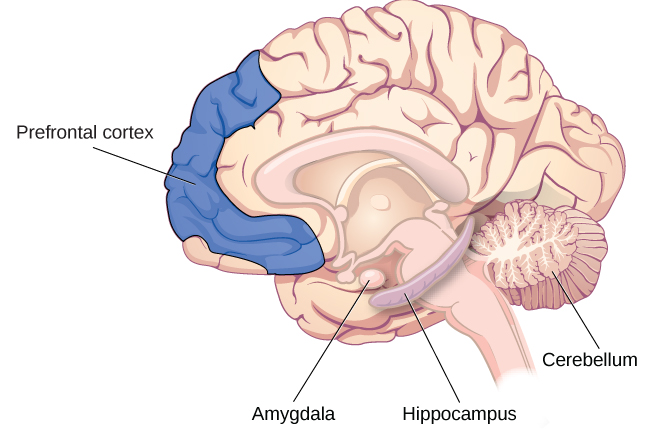

Figure 8.8図 8.8
The amygdala is involved in fear and fear memories. The hippocampus is associated with declarative and episodic memory as well as recognition memory. The cerebellum plays a role in processing procedural memories, such as how to play the piano. The prefrontal cortex appears to be involved in remembering semantic tasks.
扁桃体は、恐怖と恐怖の記憶にかかわっている。海馬は、宣言的記憶やエピソード記憶、さらに再認記憶と関連している。小脳は、ピアノの弾き方のような手続き記憶の処理に役割を果たしている。前頭前野は、意味的な課題を記憶することにかかわっているようである。
The Amygdala扁桃体
First, let’s look at the role of the amygdala in memory formation. The main job of the amygdala is to regulate emotions, such as fear and aggression (Figure 8.8). The amygdala plays a part in how memories are stored because storage is influenced by stress hormones. For example, one researcher experimented with rats and the fear response (Josselyn, 2010). Using Pavlovian conditioning, a neutral tone was paired with a foot shock to the rats. This produced a fear memory in the rats. After being conditioned, each time they heard the tone, they would freeze (a defense response in rats), indicating a memory for the impending shock. Then the researchers induced cell death in neurons in the lateral amygdala, which is the specific area of the brain responsible for fear memories. They found the fear memory faded (became extinct). Because of its role in processing emotional information, the amygdala is also involved in memory consolidation: the process of transferring new learning into long-term memory. The amygdala seems to facilitate encoding memories at a deeper level when the event is emotionally arousing.
英語のヒント
まず、記憶の形成において扁桃体が果たす役割を見てみよう。扁桃体の主な仕事は、恐怖や攻撃のような感情を調整することである(図8.8)。記憶の貯蔵はストレスホルモンの影響を受けるので、扁桃体は記憶がどのように貯蔵されるかに関与している。たとえば、ある研究者は、ラットと恐怖反応を用いた実験を行った(Josselyn, 2010)。パヴロフ型条件づけの手続きを用いて、中性の音を、ラットの足に与える電気ショックと対にした。これによって、ラットに恐怖の記憶が生じた。条件づけの後、ラットはその音を聞くたびにすくむ(ラットの防御反応)ようになり、差し迫ったショックについての記憶があることを示した。次に研究者は、恐怖の記憶を担う脳の特定の領域である扁桃体外側核のニューロンに、細胞死を引き起こした。すると、恐怖の記憶が薄れた(消去された)ことが分かった。扁桃体は、感情的な情報を処理する役割を担っているため、記憶の固定化、すなわち新たに学習したことを長期記憶へ移す過程にもかかわっている。出来事が感情的な覚醒をもたらすものであるとき、扁桃体は、記憶をより深いレベルで符号化するのを促すようである。
The Hippocampus海馬
Another group of researchers also experimented with rats to learn how the hippocampus functions in memory processing (Figure 8.8). They created lesions in the hippocampi of the rats, and found that the rats demonstrated memory impairment on various tasks, such as object recognition and maze running. They concluded that the hippocampus is involved in memory, specifically normal recognition memory as well as spatial memory (when the memory tasks are like recall tests) (Clark, Zola, & Squire, 2000). Another job of the hippocampus is to project information to cortical regions that give memories meaning and connect them with other memories. It also plays a part in memory consolidation: the process of transferring new learning into long-term memory.
英語のヒント
別の研究者グループも、記憶の処理において海馬がどのように機能するのかを知るために、ラットを使った実験を行った(図8.8)。彼らはラットの海馬に損傷をつくり、ラットが物体の再認や迷路の走行など、さまざまな課題で記憶障害を示すことを見いだした。そして、海馬は記憶、具体的には正常な再認記憶と、空間記憶(記憶課題が再生テストに似ている場合)にかかわっていると結論づけた(Clark, Zola, & Squire, 2000)。海馬のもう一つの仕事は、記憶に意味を与え、ほかの記憶と結びつける皮質の領域へ、情報を送ることである。海馬はまた、記憶の固定化、すなわち新たに学習したことを長期記憶へ移す過程にも関与している。
Injury to this area leaves us unable to process new declarative memories. One famous patient, known for years only as H. M., had both his left and right temporal lobes (hippocampi) removed in an attempt to help control the seizures he had been suffering from for years (Corkin, Amaral, González, Johnson, & Hyman, 1997). As a result, his declarative memory was significantly affected, and he could not form new semantic knowledge. He lost the ability to form new memories, yet he could still remember information and events that had occurred prior to the surgery.
英語のヒント
この領域が損傷を受けると、私たちは新しい宣言的記憶を処理できなくなる。長年H・Mとしてのみ知られていたある有名な患者は、何年も苦しんでいた発作を抑える助けになるようにと、左右両方の側頭葉(海馬)を切除された(Corkin, Amaral, González, Johnson, & Hyman, 1997)。その結果、彼の宣言的記憶は大きな影響を受け、新しい意味的知識を形成できなくなった。彼は新しい記憶を形成する能力を失ったが、手術以前の情報や出来事は依然として思い出すことができた。