第5章感覚と知覚
5.6 Gestalt Principles of Perception5.6 知覚におけるゲシュタルトの原理
Learning Objectives学習目標
By the end of this section, you will be able to:
この節を学び終えると、次のことができるようになる。
- Explain the figure-ground relationship図と地の関係を説明する
- Define Gestalt principles of groupingゲシュタルトの群化の原理を定義する
- Describe how perceptual set is influenced by an individual’s characteristics and mental state知覚的構えが、個人の特徴や心的状態からどのように影響を受けるかを説明する
In the early part of the 20th century, Max Wertheimer published a paper demonstrating that individuals perceived motion in rapidly flickering static images—an insight that came to him as he used a child’s toy tachistoscope. Wertheimer, and his assistants Wolfgang Köhler and Kurt Koffka, who later became his partners, believed that perception involved more than simply combining sensory stimuli. This belief led to a new movement within the field of psychology known as Gestalt psychology. The word gestalt literally means form or pattern, but its use reflects the idea that the whole is different from the sum of its parts. In other words, the brain creates a perception that is more than simply the sum of available sensory inputs, and it does so in predictable ways. Gestalt psychologists translated these predictable ways into principles by which we organize sensory information. As a result, Gestalt psychology has been extremely influential in the area of sensation and perception (Rock & Palmer, 1990).
英語のヒント
20世紀の初め、マックス・ヴェルトハイマーは、すばやく点滅する静止画像の中に人が動きを知覚することを示した論文を発表した。これは、彼が子ども用のおもちゃのタキストスコープを使っていたときに得た洞察だった。ヴェルトハイマーと、その助手で、のちに共同研究者となったヴォルフガング・ケーラーとクルト・コフカは、知覚には感覚刺激を単に組み合わせる以上のことが含まれていると考えた。この考えから、心理学の分野の中に、ゲシュタルト心理学として知られる新しい運動が生まれた。ゲシュタルトという語は、文字どおりには形やパターンを意味する。しかしこの語の使い方には、全体はその部分の総和とは異なる、という考えが反映されている。言い換えれば、脳は、手に入る感覚入力を単に足し合わせた以上の知覚をつくり出し、しかもそれを予測可能なやり方で行う。ゲシュタルト心理学者たちは、この予測可能なやり方を、私たちが感覚情報をまとめ上げるときの原理として定式化した。その結果、ゲシュタルト心理学は、感覚と知覚の領域できわめて大きな影響力を持ってきた(Rock & Palmer, 1990)。
One Gestalt principle is the figure-ground relationship. According to this principle, we tend to segment our visual world into figure and ground. Figure is the object or person that is the focus of the visual field, while the ground is the background. As Figure 5.25 shows, our perception can vary tremendously, depending on what is perceived as figure and what is perceived as ground. Presumably, our ability to interpret sensory information depends on what we label as figure and what we label as ground in any particular case, although this assumption has been called into question (Peterson & Gibson, 1994; Vecera & O’Reilly, 1998).
英語のヒント
ゲシュタルトの原理の一つに、図と地の関係がある。この原理によれば、私たちは視覚的な世界を図と地に分ける傾向がある。図とは視野の中で焦点となる物や人のことであり、地とは背景のことである。図5.25が示すように、何が図として知覚され、何が地として知覚されるかによって、私たちの知覚は非常に大きく変わりうる。おそらく、感覚情報を解釈する私たちの能力は、個々の場合に何を図とみなし、何を地とみなすかによって決まるのだろう。ただし、この想定には疑問も投げかけられている(Peterson & Gibson, 1994; Vecera & O’Reilly, 1998)。
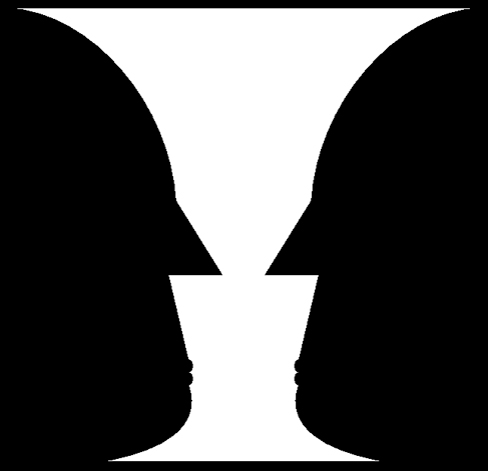
Figure 5.25図 5.25
The concept of figure-ground relationship explains why this image can be perceived either as a vase or as a pair of faces.
図と地の関係という概念によって、この画像が花瓶としても一対の顔としても知覚されうる理由が説明できる。
Another Gestalt principle for organizing sensory stimuli into meaningful perception is proximity. This principle asserts that things that are close to one another tend to be grouped together, as Figure 5.26 illustrates.
英語のヒント
感覚刺激をまとめ上げて意味のある知覚にするための、もう一つのゲシュタルトの原理は近接である。図5.26に示すように、この原理は、互いに近くにあるものはひとまとまりにされる傾向がある、と主張する。
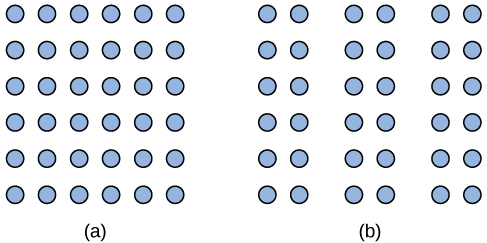
Figure 5.26図 5.26
The Gestalt principle of proximity suggests that you see (a) one block of dots on the left side and (b) three columns on the right side.
ゲシュタルトの近接の原理からすると、あなたには(a)左側ではひとかたまりの点のブロックが、(b)右側では3つの列が見えることになる。
How we read something provides another illustration of the proximity concept. For example, we read this sentence like this, notl iket hiso rt hat. We group the letters of a given word together because there are no spaces between the letters, and we perceive words because there are spaces between each word. Here are some more examples: Cany oum akes enseo ft hiss entence? What doth es e wor dsmea n?
英語のヒント
私たちが何かを読むやり方も、近接の概念を示すもう一つの例になる。たとえば私たちは、この英文を書かれているとおりに読むのであって、notl iket hiso rt hat のようには読まない。ある単語の文字どうしをひとまとまりにするのは文字のあいだに空白がないからであり、単語を知覚するのは単語と単語のあいだに空白があるからである。さらにいくつか例を挙げよう。Cany oum akes enseo ft hiss entence? What doth es e wor dsmea n?
We might also use the principle of similarity to group things in our visual fields. According to this principle, things that are alike tend to be grouped together (Figure 5.27). For example, when watching a football game, we tend to group individuals based on the colors of their uniforms. When watching an offensive drive, we can get a sense of the two teams simply by grouping along this dimension.
英語のヒント
私たちはまた、類同の原理を使って、視野の中のものをまとめることもあるだろう。この原理によれば、互いに似ているものはひとまとまりにされる傾向がある(図5.27)。たとえばアメリカンフットボールの試合を見ているとき、私たちはユニフォームの色に基づいて人をまとめる傾向がある。攻撃側が前進していく場面を見ているときには、この観点に沿ってまとめるだけで、二つのチームのおおよその見当がつく。
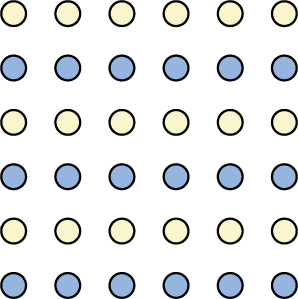
Figure 5.27図 5.27
When looking at this array of dots, we likely perceive alternating rows of colors. We are grouping these dots according to the principle of similarity.
この点の配列を見ると、私たちはおそらく、色の違う行が交互に並んでいると知覚する。このとき私たちは、類同の原理に従って点をまとめているのである。
Two additional Gestalt principles are the law of continuity (or good continuation) and closure. The law of continuity suggests that we are more likely to perceive continuous, smooth flowing lines rather than jagged, broken lines (Figure 5.28). The principle of closure states that we organize our perceptions into complete objects rather than as a series of parts (Figure 5.29).
英語のヒント
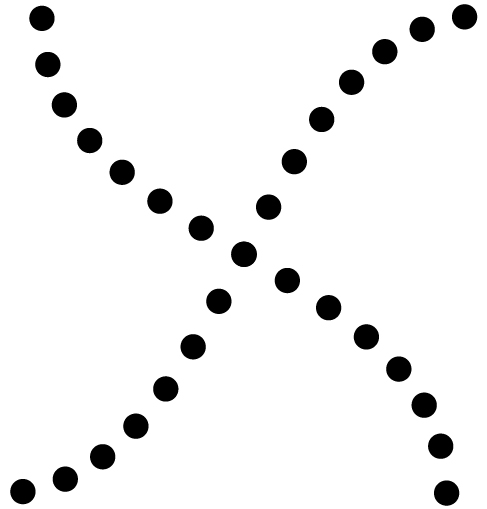
Figure 5.28図 5.28
Good continuation would suggest that we are more likely to perceive this as two overlapping lines, rather than four lines meeting in the center.
よい連続の原理からすると、私たちはこれを、中心で出会う4本の線ではなく、重なり合う2本の線として知覚する可能性が高いと考えられる。



Figure 5.29図 5.29
Closure suggests that we will perceive a complete circle and rectangle rather than a series of segments.
閉合によれば、私たちは、一連の線分ではなく、完全な円と長方形を知覚するだろう。
According to Gestalt theorists, pattern perception, or our ability to discriminate among different figures and shapes, occurs by following the principles described above. You probably feel fairly certain that your perception accurately matches the real world, but this is not always the case. Our perceptions are based on perceptual hypotheses: educated guesses that we make while interpreting sensory information. These hypotheses are informed by a number of factors, including our personalities, experiences, and expectations. We use these hypotheses to generate our perceptual set. For instance, research has demonstrated that those who are given verbal priming produce a biased interpretation of complex ambiguous figures (Goolkasian & Woodberry, 2010).
英語のヒント
ゲシュタルト理論家たちによれば、パターン知覚、すなわちさまざまな図形や形を見分ける能力は、上で述べた原理に従うことによって生じる。あなたはおそらく、自分の知覚は現実の世界と正確に一致していると、かなり確信しているだろう。しかし、いつもそうだとは限らない。私たちの知覚は知覚仮説に基づいている。知覚仮説とは、感覚情報を解釈する際に私たちが立てる、根拠のある推測である。こうした仮説は、パーソナリティ、経験、期待など、いくつもの要因によって形づくられる。私たちはこれらの仮説を用いて、知覚的構えをつくり出す。たとえば、言語的プライミングを与えられた人は、複雑な多義図形について偏った解釈をすることが、研究によって示されている(Goolkasian & Woodberry, 2010)。