第5章感覚と知覚
5.5 The Other Senses5.5 その他の感覚
Learning Objectives学習目標
By the end of this section, you will be able to:
この節を学び終えると、次のことができるようになる。
- Describe the basic functions of the chemical senses化学感覚の基本的な機能を説明する
- Explain the basic functions of the somatosensory, nociceptive, and thermoceptive sensory systems体性感覚系、侵害受容系、温度感覚系の基本的な機能を説明する
- Describe the basic functions of the vestibular, proprioceptive, and kinesthetic sensory systems前庭感覚系、固有受容感覚系、運動感覚系の基本的な機能を説明する
Vision and hearing have received an incredible amount of attention from researchers over the years. While there is still much to be learned about how these sensory systems work, we have a much better understanding of them than of our other sensory modalities. In this section, we will explore our chemical senses (taste and smell) and our body senses (touch, temperature, pain, balance, and body position).
英語のヒント
視覚と聴覚は、長年にわたって研究者から非常に大きな注目を集めてきた。これらの感覚系の働きについてはまだ学ぶべきことが多く残っているものの、私たちはこの二つを、ほかの感覚様相よりもはるかによく理解している。この節では、化学感覚(味覚と嗅覚)と身体感覚(触覚、温度、痛み、平衡、身体の位置)を探っていく。
The Chemical Senses化学感覚
Taste (gustation) and smell (olfaction) are called chemical senses because both have sensory receptors that respond to molecules in the food we eat or in the air we breathe. There is a pronounced interaction between our chemical senses. For example, when we describe the flavor of a given food, we are really referring to both gustatory and olfactory properties of the food working in combination.
英語のヒント
味(味覚)とにおい(嗅覚)が化学感覚と呼ばれるのは、どちらも、私たちが食べる食物や呼吸する空気に含まれる分子に反応する感覚受容器を持っているからである。化学感覚どうしのあいだには、はっきりとした相互作用がある。たとえば、ある食べ物の風味を言い表すとき、私たちが実際に指しているのは、その食べ物の味覚的な性質と嗅覚的な性質の両方が組み合わさって働いたものである。
Taste (Gustation)味覚
You have learned since elementary school that there are four basic groupings of taste: sweet, salty, sour, and bitter. Research demonstrates, however, that we have at least six taste groupings. Umami is our fifth taste. Umami is actually a Japanese word that roughly translates to yummy, and it is associated with a taste for monosodium glutamate (Kinnamon & Vandenbeuch, 2009). There is also a growing body of experimental evidence suggesting that we possess a taste for the fatty content of a given food (Mizushige, Inoue, & Fushiki, 2007).
英語のヒント
あなたは小学校のころから、味には甘味、塩味、酸味、苦味という四つの基本的な分類があると教わってきた。しかし研究は、私たちには少なくとも六つの味の分類があることを示している。うま味は5番目の味である。「うま味」は実は日本語の言葉で、英語ではおおよそ「yummy(おいしい)」と訳される。うま味は、グルタミン酸ナトリウムに対する味覚と関連している(Kinnamon & Vandenbeuch, 2009)。また、私たちがある食べ物に含まれる脂肪分に対する味覚を持っていることを示唆する実験的証拠も、増えつつある(Mizushige, Inoue, & Fushiki, 2007)。
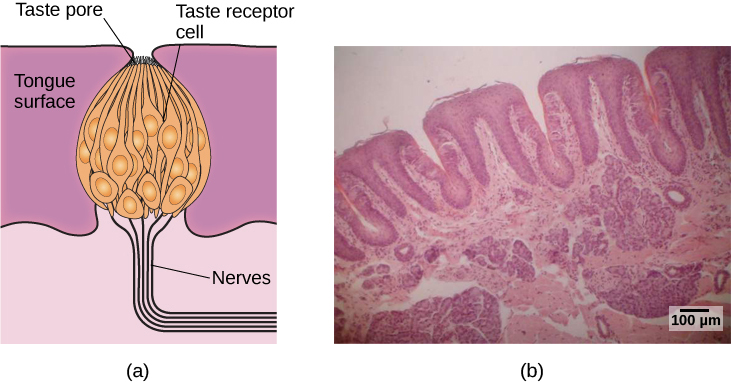
Molecules from the food and beverages we consume dissolve in our saliva and interact with taste receptors on our tongue and in our mouth and throat. Taste buds are formed by groupings of taste receptor cells with hair-like extensions that protrude into the central pore of the taste bud (Figure 5.21). Taste buds have a life cycle of ten days to two weeks, so even destroying some by burning your tongue won’t have any long-term effect; they just grow right back. Taste molecules bind to receptors on this extension and cause chemical changes within the sensory cell that result in neural impulses being transmitted to the brain via different nerves, depending on where the receptor is located. Taste information is transmitted to the medulla, thalamus, and limbic system, and to the gustatory cortex, which is tucked underneath the overlap between the frontal and temporal lobes (Maffei, Haley, & Fontanini, 2012; Roper, 2013).
英語のヒント
私たちが口にする食べ物や飲み物に含まれる分子は、唾液に溶け、舌の上や口・のどの中にある味覚受容体と相互作用する。味蕾は、毛のような突起を持つ味覚受容細胞が集まってできており、その突起は味蕾の中央にある孔へと突き出している(図5.21)。味蕾の寿命は10日から2週間なので、舌をやけどしていくつかを壊してしまったとしても、長く続く影響は何も残らない。すぐにまた生えてくるだけである。味の分子は、この突起の上にある受容体に結合し、感覚細胞の中に化学的な変化を引き起こす。その変化の結果、神経インパルスが、受容体の位置に応じて異なる神経を通って脳へ伝えられる。味の情報は、延髄、視床、大脳辺縁系、そして味覚野へと伝えられる。味覚野は、前頭葉と側頭葉が重なり合う部分の下に隠れるように位置している(Maffei, Haley, & Fontanini, 2012; Roper, 2013)。
OpenStax, Rice University; Psychology 2e. (credit a: modification of work by Jonas Töle; credit b: scale-bar data from Matt Russell) · CC BY 4.0 · Source出典
Figure 5.21図 5.21
(a) Taste buds are composed of a number of individual taste receptors cells that transmit information to nerves. (b) This micrograph shows a close-up view of the tongue’s surface. (credit a: modification of work by Jonas Töle; credit b: scale-bar data from Matt Russell)
(a)味蕾は、神経へ情報を伝える多数の個々の味覚受容細胞から成る。(b)この顕微鏡写真は、舌の表面を拡大して写したものである。(出典a:Jonas Töleの作品を改変、出典b:スケールバーのデータはMatt Russellによる)
Smell (Olfaction)嗅覚
Olfactory receptor cells are located in a mucous membrane at the top of the nose. Small hair-like extensions from these receptors serve as the sites for odor molecules dissolved in the mucus to interact with chemical receptors located on these extensions (Figure 5.22). Once an odor molecule has bound a given receptor, chemical changes within the cell result in signals being sent to the olfactory bulb: a bulb-like structure at the tip of the frontal lobe where the olfactory nerves begin. From the olfactory bulb, information is sent to regions of the limbic system and to the primary olfactory cortex, which is located very near the gustatory cortex (Lodovichi & Belluscio, 2012; Spors et al., 2013).
英語のヒント
嗅細胞は、鼻の上部の粘膜の中に位置している。嗅細胞から伸びる毛のような小さな突起は、粘液に溶けたにおいの分子が、突起の上にある化学受容体と相互作用する場になっている(図5.22)。においの分子がいったん特定の受容体に結合すると、細胞の中で化学的な変化が起こり、その結果、信号が嗅球へ送られる。嗅球とは、前頭葉の先端にある球根のような構造で、嗅神経はここから始まる。情報は嗅球から、大脳辺縁系の各領域と一次嗅覚野へ送られる。一次嗅覚野は、味覚野のすぐ近くに位置している(Lodovichi & Belluscio, 2012; Spors et al., 2013)。
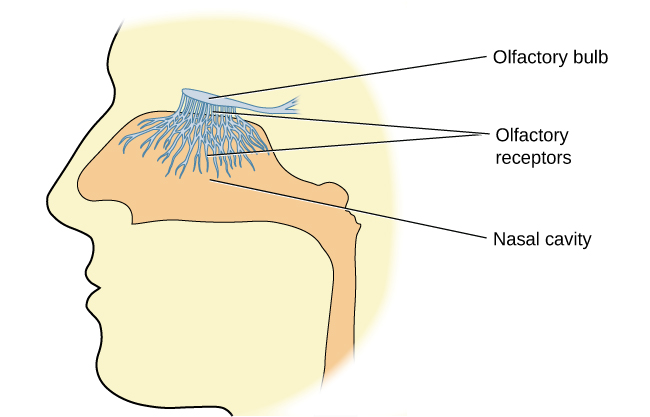


Figure 5.22図 5.22
Olfactory receptors are the hair-like parts that extend from the olfactory bulb into the mucous membrane of the nasal cavity.
嗅細胞は、嗅球から鼻腔の粘膜へと伸びる、毛のような部分である。
There is tremendous variation in the sensitivity of the olfactory systems of different species. We often think of dogs as having far superior olfactory systems than our own, and indeed, dogs can do some remarkable things with their noses. There is some evidence to suggest that dogs can “smell” dangerous drops in blood glucose levels as well as cancerous tumors (Wells, 2010). Dogs’ extraordinary olfactory abilities may be due to the increased number of functional genes for olfactory receptors (between 800 and 1200), compared to the fewer than 400 observed in humans and other primates (Niimura & Nei, 2007).
英語のヒント
嗅覚系の感度は、種によって非常に大きく異なる。私たちはよく、イヌは自分たちよりもはるかに優れた嗅覚系を持っていると考える。そして実際、イヌは鼻を使って驚くようなことをいくつもやってのけられる。イヌは血糖値の危険な低下や、がん性の腫瘍を「嗅ぎ分ける」ことができる、と示唆する証拠もいくつかある(Wells, 2010)。イヌの並外れた嗅覚能力は、嗅覚受容体の機能遺伝子の数が、ヒトやほかの霊長類で観察される400未満と比べて多い(800〜1200)ことによるのかもしれない(Niimura & Nei, 2007)。
Many species respond to chemical messages, known as pheromones, sent by another individual (Wysocki & Preti, 2004). Pheromonal communication often involves providing information about the reproductive status of a potential mate. So, for example, when a female rat is ready to mate, it secretes pheromonal signals that draw attention from nearby male rats. Pheromonal activation is actually an important component in eliciting sexual behavior in the male rat (Furlow, 1996, 2012; Purvis & Haynes, 1972; Sachs, 1997). There has also been a good deal of research (and controversy) about pheromones in humans (Comfort, 1971; Russell, 1976; Wolfgang-Kimball, 1992; Weller, 1998).
英語のヒント
多くの種は、ほかの個体が送る、フェロモンとして知られる化学的なメッセージに反応する(Wysocki & Preti, 2004)。フェロモンによるコミュニケーションでは、多くの場合、交尾相手の候補の繁殖の状態についての情報が伝えられる。たとえば、メスのラットは交尾の準備が整うと、フェロモンの信号を分泌し、それが近くにいるオスのラットの注意を引く。フェロモンによる活性化は、実はオスのラットの性行動を引き起こすうえで重要な要素である(Furlow, 1996, 2012; Purvis & Haynes, 1972; Sachs, 1997)。ヒトのフェロモンについても、かなりの量の研究(そして論争)が行われてきた(Comfort, 1971; Russell, 1976; Wolfgang-Kimball, 1992; Weller, 1998)。