第5章感覚と知覚
Color and Depth Perception色と奥行きの知覚
We do not see the world in black and white; neither do we see it as two-dimensional (2-D) or flat (just height and width, no depth). Let’s look at how color vision works and how we perceive three dimensions (height, width, and depth).
英語のヒント
私たちは世界を白黒で見ているわけではない。また、世界を二次元(2-D)、つまり平面的なもの(高さと幅だけで奥行きがない)として見ているわけでもない。色覚がどのように働き、私たちが三つの次元(高さ、幅、奥行き)をどのように知覚するのかを見ていこう。
Color Vision色覚
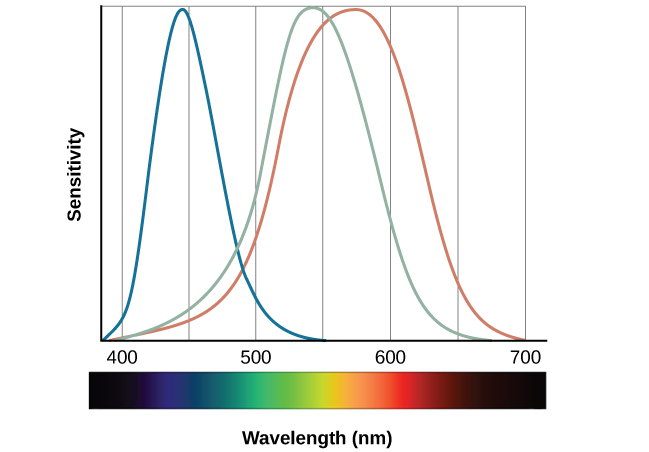
Normal-sighted individuals have three different types of cones that mediate color vision. Each of these cone types is maximally sensitive to a slightly different wavelength of light. According to the trichromatic theory of color vision, shown in Figure 5.14, all colors in the spectrum can be produced by combining red, green, and blue. The three types of cones are each receptive to one of the colors.
英語のヒント
正常な視覚を持つ人には、色覚を担う3種類の錐体がある。それぞれの種類の錐体は、少しずつ異なる波長の光に対して最も感度が高い。図5.14に示す色覚の三色説によれば、スペクトルのすべての色は、赤、緑、青を組み合わせることでつくり出せる。3種類の錐体は、それぞれがこれらの色のうちの一つを受容する。
OpenStax, Rice University; Psychology 2e. (credit: modification of work by Vanessa Ezekowitz) · CC BY 4.0 · Source出典
Figure 5.14図 5.14
This figure illustrates the different sensitivities for the three cone types found in a normal-sighted individual. (credit: modification of work by Vanessa Ezekowitz)
この図は、正常な視覚を持つ人に見られる3種類の錐体の、それぞれ異なる感度を示している。(出典:Vanessa Ezekowitzの作品を改変)
The trichromatic theory of color vision is not the only theory—another major theory of color vision is known as the opponent-process theory. According to this theory, color is coded in opponent pairs: black-white, yellow-blue, and green-red. The basic idea is that some cells of the visual system are excited by one of the opponent colors and inhibited by the other. So, a cell that was excited by wavelengths associated with green would be inhibited by wavelengths associated with red, and vice versa. One of the implications of opponent processing is that we do not experience greenish-reds or yellowish-blues as colors. Another implication is that this leads to the experience of negative afterimages. An afterimage describes the continuation of a visual sensation after removal of the stimulus. For example, when you stare briefly at the sun and then look away from it, you may still perceive a spot of light although the stimulus (the sun) has been removed. When color is involved in the stimulus, the color pairings identified in the opponent-process theory lead to a negative afterimage. You can test this concept using the flag in Figure 5.16.
英語のヒント
色覚の三色説は唯一の理論ではない。色覚のもう一つの主要な理論は、反対色説として知られている。この理論によれば、色は、黒と白、黄と青、緑と赤という反対色の対として符号化される。基本的な考え方は、視覚系の一部の細胞が、対になった反対色の一方によって興奮し、もう一方によって抑制される、というものである。したがって、緑と結びついた波長によって興奮する細胞は、赤と結びついた波長によって抑制されることになり、その逆も成り立つ。反対色処理から導かれることの一つは、私たちが緑がかった赤や黄色がかった青を色として経験しない、ということである。もう一つは、反対色処理が陰性残像の経験につながるということである。残像とは、刺激が取り除かれたあとも視覚的な感覚が続くことをいう。たとえば、太陽を短い時間じっと見つめてから目をそらすと、刺激(太陽)はすでに取り除かれているのに、光の点がまだ見えることがある。刺激に色がかかわっている場合には、反対色説で特定されている色の対によって陰性残像が生じる。この考え方は、図5.16の旗を使って確かめられる。
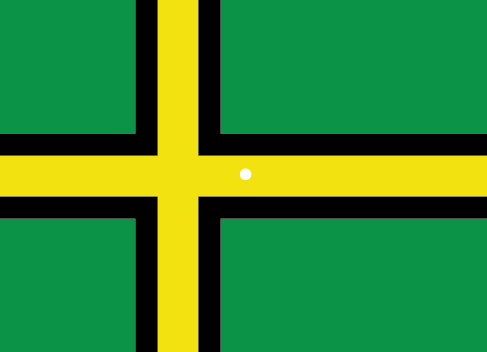


Figure 5.16図 5.16
Stare at the white dot for 30–60 seconds and then move your eyes to a blank piece of white paper. What do you see? This is known as a negative afterimage, and it provides empirical support for the opponent-process theory of color vision.
白い点を30〜60秒間じっと見つめてから、何も書かれていない白い紙に目を移してみよう。何が見えるだろうか。これは陰性残像として知られており、色覚の反対色説を支持する実証的な証拠となる。
But these two theories—the trichromatic theory of color vision and the opponent-process theory—are not mutually exclusive. Research has shown that they just apply to different levels of the nervous system. For visual processing on the retina, trichromatic theory applies: the cones are responsive to three different wavelengths that represent red, blue, and green. But once the signal moves past the retina on its way to the brain, the cells respond in a way consistent with opponent-process theory (Land, 1959; Kaiser, 1997).
英語のヒント
しかし、この二つの理論、つまり色覚の三色説と反対色説は、互いに相いれないものではない。研究によって、二つの理論は神経系の異なるレベルに当てはまるにすぎないことが示されている。網膜での視覚処理には三色説が当てはまる。錐体は、赤、青、緑を表す三つの異なる波長に反応する。しかし、信号が網膜を越えて脳へ向かうと、細胞は反対色説と一致するしかたで反応する(Land, 1959; Kaiser, 1997)。