第5章感覚と知覚
Sound Localization音の定位
The ability to locate sound in our environments is an important part of hearing. Localizing sound could be considered similar to the way that we perceive depth in our visual fields. Like the monocular and binocular cues that provided information about depth, the auditory system uses both monaural (one-eared) and binaural (two-eared) cues to localize sound.
英語のヒント
周囲の環境の中で音の位置を突き止める能力は、聴覚の重要な一部である。音の定位は、視野の中で奥行きを知覚するしかたと似たものと考えられるだろう。奥行きについての情報を与える単眼手がかりや両眼手がかりと同じように、聴覚系も、単耳(片方の耳の)手がかりと両耳(二つの耳の)手がかりの両方を使って音を定位する。
Each pinna interacts with incoming sound waves differently, depending on the sound’s source relative to our bodies. This interaction provides a monaural cue that is helpful in locating sounds that occur above or below and in front or behind us. The sound waves received by your two ears from sounds that come from directly above, below, in front, or behind you would be identical; therefore, monaural cues are essential (Grothe, Pecka, & McAlpine, 2010).
英語のヒント
耳介はそれぞれ、体から見て音源がどこにあるかによって、入ってくる音波と異なるしかたで相互作用する。この相互作用が単耳手がかりとなり、上や下、前や後ろで生じる音の位置を突き止めるのに役立つ。真上、真下、真正面、真後ろから来る音については、二つの耳が受け取る音波は同じになるだろう。そのため、単耳手がかりが不可欠なのである(Grothe, Pecka, & McAlpine, 2010)。
Binaural cues, on the other hand, provide information on the location of a sound along a horizontal axis by relying on differences in patterns of vibration of the eardrum between our two ears. If a sound comes from an off-center location, it creates two types of binaural cues: interaural level differences and interaural timing differences. Interaural level difference refers to the fact that a sound coming from the right side of your body is more intense at your right ear than at your left ear because of the attenuation of the sound wave as it passes through your head. Interaural timing difference refers to the small difference in the time at which a given sound wave arrives at each ear (Figure 5.19). Certain brain areas monitor these differences to construct where along a horizontal axis a sound originates (Grothe et al., 2010).
英語のヒント
一方、両耳手がかりは、左右の耳のあいだでの鼓膜の振動パターンの違いに基づいて、水平軸に沿った音の位置についての情報を与える。音が中心からずれた位置から来ると、二種類の両耳手がかり、すなわち両耳間音圧差と両耳間時間差が生じる。両耳間音圧差とは、体の右側から来た音が、頭を通り抜けるあいだに音波が減衰するために、左耳でよりも右耳で強くなるという事実を指す。両耳間時間差とは、ある音波がそれぞれの耳に届く時刻のわずかな違いを指す(図5.19)。脳の特定の領域がこれらの違いを監視し、音が水平軸上のどこから発しているかを組み立てている(Grothe et al., 2010)。
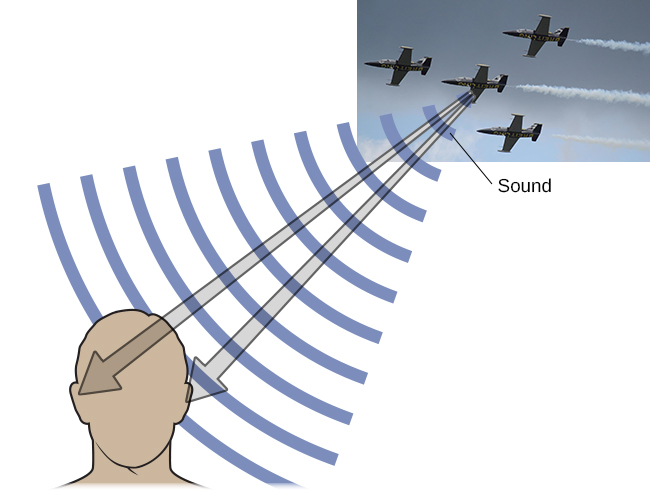
OpenStax, Rice University; Psychology 2e. (credit "plane": modification of work by Max Pfandl) · CC BY 4.0 · Source出典

Figure 5.19図 5.19
Localizing sound involves the use of both monaural and binaural cues. (credit "plane": modification of work by Max Pfandl)
音の定位には、単耳手がかりと両耳手がかりの両方が使われる。(出典「飛行機」:Max Pfandlの作品を改変)
Hearing Loss難聴
Deafness is the partial or complete inability to hear. Some people are born without hearing, which is known as congenital deafness. Other people suffer from conductive hearing loss, which is due to a problem delivering sound energy to the cochlea. Causes for conductive hearing loss include blockage of the ear canal, a hole in the tympanic membrane, problems with the ossicles, or fluid in the space between the eardrum and cochlea. Another group of people suffer from sensorineural hearing loss, which is the most common form of hearing loss. Sensorineural hearing loss can be caused by many factors, such as aging, head or acoustic trauma, infections and diseases (such as measles or mumps), medications, environmental effects such as noise exposure (noise-induced hearing loss, as shown in Figure 5.20), tumors, and toxins (such as those found in certain solvents and metals).
英語のヒント
聾とは、部分的または完全に聞くことができない状態である。生まれつき聴覚のない人もおり、これは先天性聾と呼ばれる。伝音難聴に苦しむ人もいる。伝音難聴は、音のエネルギーを蝸牛に届ける過程に問題があるために起こる。伝音難聴の原因には、外耳道の閉塞、鼓膜の穴、耳小骨の問題、鼓膜と蝸牛のあいだの空間にたまった液体などがある。また別の人々は、難聴の中で最も一般的な形である感音難聴に苦しんでいる。感音難聴は多くの要因によって引き起こされうる。たとえば、加齢、頭部外傷や音響外傷、感染症や病気(はしかやおたふくかぜなど)、薬剤、騒音への曝露のような環境の影響(図5.20に示す騒音性難聴)、腫瘍、毒物(特定の溶剤や金属に含まれるものなど)である。
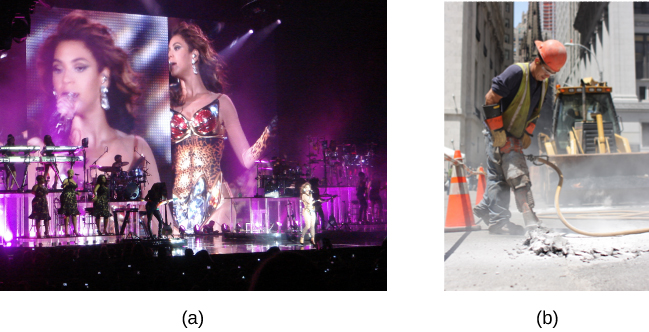
OpenStax, Rice University; Psychology 2e. (credit a: modification of work by "GillyBerlin_Flickr"/Flickr; credit b: modification of work by Nick Allen) · CC BY 4.0 · Source出典

Figure 5.20図 5.20
Environmental factors that can lead to sensorineural hearing loss include regular exposure to loud music or construction equipment. (a) Musical performers and (b) construction workers are at risk for this type of hearing loss. (credit a: modification of work by "GillyBerlin_Flickr"/Flickr; credit b: modification of work by Nick Allen)
感音難聴につながりうる環境要因には、大音量の音楽や建設機械の音に日常的にさらされることがある。(a)音楽の演奏者や(b)建設作業員は、この種の難聴になる危険がある。(出典a:“GillyBerlin_Flickr”/Flickrの作品を改変、出典b:Nick Allenの作品を改変)
Given the mechanical nature by which the sound wave stimulus is transmitted from the eardrum through the ossicles to the oval window of the cochlea, some degree of hearing loss is inevitable. With conductive hearing loss, hearing problems are associated with a failure in the vibration of the eardrum and/or movement of the ossicles. These problems are often dealt with through devices like hearing aids that amplify incoming sound waves to make vibration of the eardrum and movement of the ossicles more likely to occur.
英語のヒント
音波という刺激は、鼓膜から耳小骨を経て蝸牛の卵円窓へと、機械的なしくみによって伝えられる。伝達がこのように機械的であることを考えれば、ある程度の難聴は避けられない。伝音難聴では、聞こえの問題は、鼓膜の振動と耳小骨の動きの一方または両方がうまくいかないことと関連している。こうした問題には、補聴器のような装置で対処することが多い。補聴器は入ってくる音波を増幅し、鼓膜の振動と耳小骨の動きが起こりやすくなるようにする。
When the hearing problem is associated with a failure to transmit neural signals from the cochlea to the brain, it is called sensorineural hearing loss. One disease that results in sensorineural hearing loss is Ménière's disease. Although not well understood, Ménière's disease results in a degeneration of inner ear structures that can lead to hearing loss, tinnitus (constant ringing or buzzing), vertigo (a sense of spinning), and an increase in pressure within the inner ear (Semaan & Megerian, 2011). This kind of loss cannot be treated with hearing aids, but some individuals might be candidates for a cochlear implant as a treatment option. Cochlear implants are electronic devices that consist of a microphone, a speech processor, and an electrode array. The device receives incoming sound information and directly stimulates the auditory nerve to transmit information to the brain.
英語のヒント
聞こえの問題が、蝸牛から脳へ神経信号を伝えられないことと関連している場合、それは感音難聴と呼ばれる。感音難聴をもたらす病気の一つにメニエール病がある。メニエール病はよく解明されていないが、内耳の構造の変性をもたらし、それが難聴、耳鳴り(キーンやブーンという音が絶えず聞こえること)、回転性めまい(ぐるぐる回る感覚)、内耳の圧力の上昇につながりうる(Semaan & Megerian, 2011)。この種の難聴は補聴器では治療できないが、治療の選択肢として人工内耳の適応となる人もいるかもしれない。人工内耳は、マイク、音声処理装置、電極アレイからなる電子装置である。この装置は入ってくる音の情報を受け取り、聴神経を直接刺激して、脳へ情報を伝える。