第5章感覚と知覚
5.2 Waves and Wavelengths5.2 波と波長
Learning Objectives学習目標
By the end of this section, you will be able to:
この節を学び終えると、次のことができるようになる。
- Describe important physical features of wave forms波形の重要な物理的特徴を説明する
- Show how physical properties of light waves are associated with perceptual experience光の波の物理的な性質が、知覚経験とどのように結びついているかを示す
- Show how physical properties of sound waves are associated with perceptual experience音波の物理的な性質が、知覚経験とどのように結びついているかを示す
Visual and auditory stimuli both occur in the form of waves. Although the two stimuli are very different in terms of composition, wave forms share similar characteristics that are especially important to our visual and auditory perceptions. In this section, we describe the physical properties of the waves as well as the perceptual experiences associated with them.
英語のヒント
視覚刺激と聴覚刺激は、どちらも波という形で生じる。この二つの刺激は、何から成り立っているかという点ではまったく異なるが、波形としては似た特徴を共有しており、それらの特徴は私たちの視覚と聴覚の知覚にとってとりわけ重要である。この節では、波の物理的な性質と、それに結びついた知覚経験について述べる。
Amplitude and Wavelength振幅と波長
Two physical characteristics of a wave are amplitude and wavelength (Figure 5.5). The amplitude of a wave is the distance from the center line to the top point of the crest or the bottom point of the trough. Wavelength refers to the length of a wave from one peak to the next.
英語のヒント
波の物理的な特徴のうちの二つが、振幅と波長である(図5.5)。波の振幅とは、中心線から山の頂点まで、または谷の底までの距離である。波長とは、一つの山から次の山までの波の長さを指す。
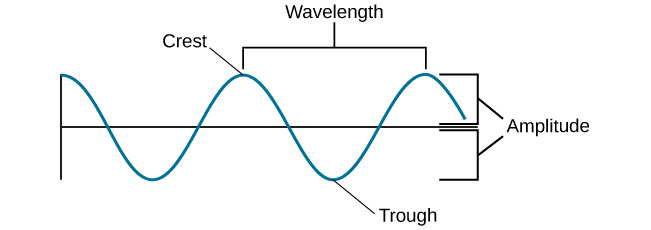
Figure 5.5図 5.5
The amplitude or height of a wave is measured from the peak to the trough. The wavelength is measured from peak to peak.
波の振幅、つまり高さは、山から谷まで測られる。波長は山から山まで測られる。
Wavelength is directly related to the frequency of a given wave form. Frequency refers to the number of waves that pass a given point in a given time period and is often expressed in terms of hertz (Hz), or cycles per second. Longer wavelengths will have lower frequencies, and shorter wavelengths will have higher frequencies (Figure 5.6).
英語のヒント
波長は、ある波形の周波数と直接関係している。周波数とは、一定の時間内にある一点を通過する波の数を指し、しばしばヘルツ(Hz)、すなわち1秒あたりのサイクル数で表される。波長が長いほど周波数は低くなり、波長が短いほど周波数は高くなる(図5.6)。
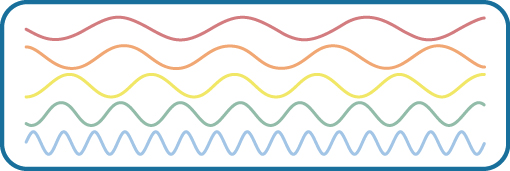
Figure 5.6図 5.6
This figure illustrates waves of differing wavelengths/frequencies. At the top of the figure, the red wave has a long wavelength/short frequency. Moving from top to bottom, the wavelengths decrease and frequencies increase.
この図は、波長/周波数の異なる波を示している。図の一番上にある赤い波は、波長が長い/周波数が低い。上から下へ行くにつれて、波長は短くなり、周波数は高くなる。
Light Waves光の波
The visible spectrum is the portion of the larger electromagnetic spectrum that we can see. As Figure 5.7 shows, the electromagnetic spectrum encompasses all of the electromagnetic radiation that occurs in our environment and includes gamma rays, x-rays, ultraviolet light, visible light, infrared light, microwaves, and radio waves. The visible spectrum in humans is associated with wavelengths that range from 380 to 740 nm—a very small distance, since a nanometer (nm) is one billionth of a meter. Other species can detect other portions of the electromagnetic spectrum. For instance, honeybees can see light in the ultraviolet range (Wakakuwa, Stavenga, & Arikawa, 2007), and some snakes can detect infrared radiation in addition to more traditional visual light cues (Chen, Deng, Brauth, Ding, & Tang, 2012; Hartline, Kass, & Loop, 1978).
英語のヒント
可視スペクトルとは、より大きな電磁スペクトルのうち、私たちが見ることのできる部分である。図5.7が示すように、電磁スペクトルは、私たちの環境の中に生じるすべての電磁放射を包含しており、ガンマ線、X線、紫外線、可視光線、赤外線、マイクロ波、電波を含む。人間の可視スペクトルは、380〜740 nmの範囲にある波長に対応している。ナノメートル(nm)は10億分の1メートルなので、これはごくわずかな距離である。ほかの種は、電磁スペクトルのほかの部分を感知できる。たとえば、ミツバチには紫外線の範囲の光が見え(Wakakuwa, Stavenga, & Arikawa, 2007)、一部のヘビは、より一般的な、光による視覚的手がかりに加えて、赤外線放射も感知できる(Chen, Deng, Brauth, Ding, & Tang, 2012; Hartline, Kass, & Loop, 1978)。
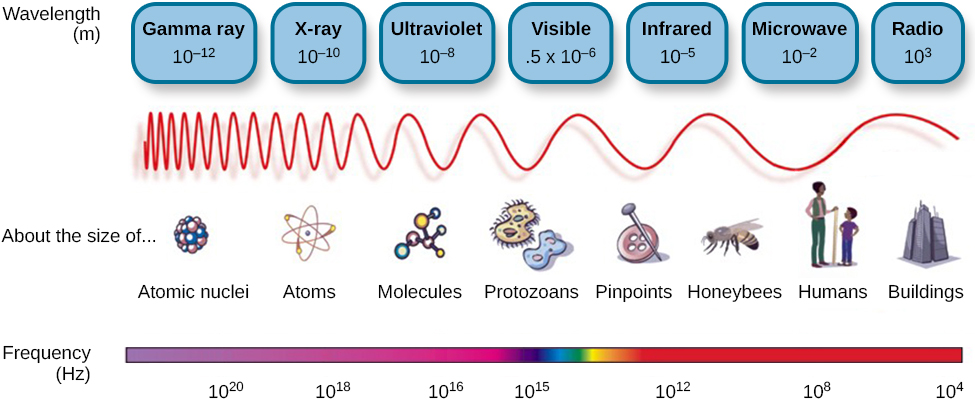


Figure 5.7図 5.7
Light that is visible to humans makes up only a small portion of the electromagnetic spectrum.
人間に見える光は、電磁スペクトルのごく一部を占めるにすぎない。
In humans, light wavelength is associated with perception of color (Figure 5.8). Within the visible spectrum, our experience of red is associated with longer wavelengths, greens are intermediate, and blues and violets are shorter in wavelength. (An easy way to remember this is the mnemonic ROYGBIV: red, orange, yellow, green, blue, indigo, violet.) The amplitude of light waves is associated with our experience of brightness or intensity of color, with larger amplitudes appearing brighter.
英語のヒント
人間では、光の波長は色の知覚と結びついている(図5.8)。可視スペクトルの中では、私たちが経験する赤はより長い波長と結びついており、緑は中間の波長、青や紫はより短い波長である。(これを覚える簡単な方法は、ROYGBIV、すなわちred(赤)、orange(橙)、yellow(黄)、green(緑)、blue(青)、indigo(藍)、violet(紫)という覚え方である。)光の波の振幅は、明るさ、あるいは色の強さの経験と結びついており、振幅が大きいほど明るく見える。

OpenStax, Rice University; Psychology 2e. (credit: modification of work by Johannes Ahlmann) · CC BY 4.0 · Source出典

Figure 5.8図 5.8
Different wavelengths of light are associated with our perception of different colors. (credit: modification of work by Johannes Ahlmann)
光の異なる波長は、異なる色の知覚と結びついている。(出典:Johannes Ahlmannの作品を改変)
Sound Waves音波
Like light waves, the physical properties of sound waves are associated with various aspects of our perception of sound. The frequency of a sound wave is associated with our perception of that sound’s pitch. High-frequency sound waves are perceived as high-pitched sounds, while low-frequency sound waves are perceived as low-pitched sounds. The audible range of sound frequencies is between 20 and 20000 Hz, with greatest sensitivity to those frequencies that fall in the middle of this range.
英語のヒント
光の波と同じように、音波の物理的な性質も、音の知覚のさまざまな側面と結びついている。音波の周波数は、その音の高さの知覚と結びついている。周波数の高い音波は高い音として知覚され、周波数の低い音波は低い音として知覚される。音の周波数の可聴範囲は20〜20000 Hzであり、この範囲の中ほどにある周波数に対して感度が最も高い。
As was the case with the visible spectrum, other species show differences in their audible ranges. For instance, chickens have a very limited audible range, from 125 to 2000 Hz. Mice have an audible range from 1000 to 91000 Hz, and the beluga whale’s audible range is from 1000 to 123000 Hz. Our pet dogs and cats have audible ranges of about 70–45000 Hz and 45–64000 Hz, respectively (Strain, 2003).
英語のヒント
可視スペクトルの場合と同じように、ほかの種では可聴範囲に違いが見られる。たとえば、ニワトリの可聴範囲は125〜2000 Hzと、非常に限られている。ネズミの可聴範囲は1000〜91000 Hzで、シロイルカ(ベルーガ)の可聴範囲は1000〜123000 Hzである。私たちがペットとして飼うイヌとネコの可聴範囲は、それぞれおよそ70〜45000 Hz、45〜64000 Hzである(Strain, 2003)。
The loudness of a given sound is closely associated with the amplitude of the sound wave. Higher amplitudes are associated with louder sounds. Loudness is measured in terms of decibels (dB), a logarithmic unit of sound intensity. A typical conversation would correlate with 60 dB; a rock concert might check in at 120 dB (Figure 5.9). A whisper 5 feet away or rustling leaves are at the low end of our hearing range; sounds like a window air conditioner, a normal conversation, and even heavy traffic or a vacuum cleaner are within a tolerable range. However, there is the potential for hearing damage from about 80 dB to 130 dB: These are sounds of a food processor, power lawnmower, heavy truck (25 feet away), subway train (20 feet away), live rock music, and a jackhammer. About one-third of all hearing loss is due to noise exposure, and the louder the sound, the shorter the exposure needed to cause hearing damage (Le, Straatman, Lea, & Westerberg, 2017). Listening to music through earbuds at maximum volume (around 100–105 decibels) can cause noise-induced hearing loss after 15 minutes of exposure. Although listening to music at maximum volume may not seem to cause damage, it increases the risk of age-related hearing loss (Kujawa & Liberman, 2006). The threshold for pain is about 130 dB, a jet plane taking off or a revolver firing at close range (Dunkle, 1982).
英語のヒント
ある音の大きさは、その音波の振幅と密接に結びついている。より大きな振幅は、より大きな音と結びついている。音の大きさはデシベル(dB)という、音の強さを表す対数の単位で測られる。典型的な会話は60 dBに相当するだろう。ロックコンサートなら120 dBに達するかもしれない(図5.9)。5フィート離れたところでのささやき声や、木の葉がそよぐ音は、私たちの聴覚範囲の下端にある。窓用エアコン、ふつうの会話、さらには交通量の多い道路の騒音や掃除機といった音は、耐えられる範囲に収まる。しかし、およそ80 dBから130 dBでは、聴覚が損傷を受ける可能性がある。フードプロセッサー、動力式の芝刈り機、大型トラック(25フィート離れたところ)、地下鉄の電車(20フィート離れたところ)、ロックの生演奏、削岩機の音がこれに当たる。難聴全体のおよそ3分の1は騒音への曝露によるものであり、音が大きいほど、聴覚の損傷を引き起こすのに必要な曝露時間は短くなる(Le, Straatman, Lea, & Westerberg, 2017)。イヤホンを使って最大音量(約100〜105デシベル)で音楽を聴くと、15分間の曝露で騒音性難聴が起こりうる。最大音量で音楽を聴くことは、損傷を引き起こすようには見えないかもしれないが、加齢性難聴のリスクを高める(Kujawa & Liberman, 2006)。痛みの閾値はおよそ130 dBで、これは離陸するジェット機の音や、至近距離でのリボルバーの発砲音に当たる(Dunkle, 1982)。
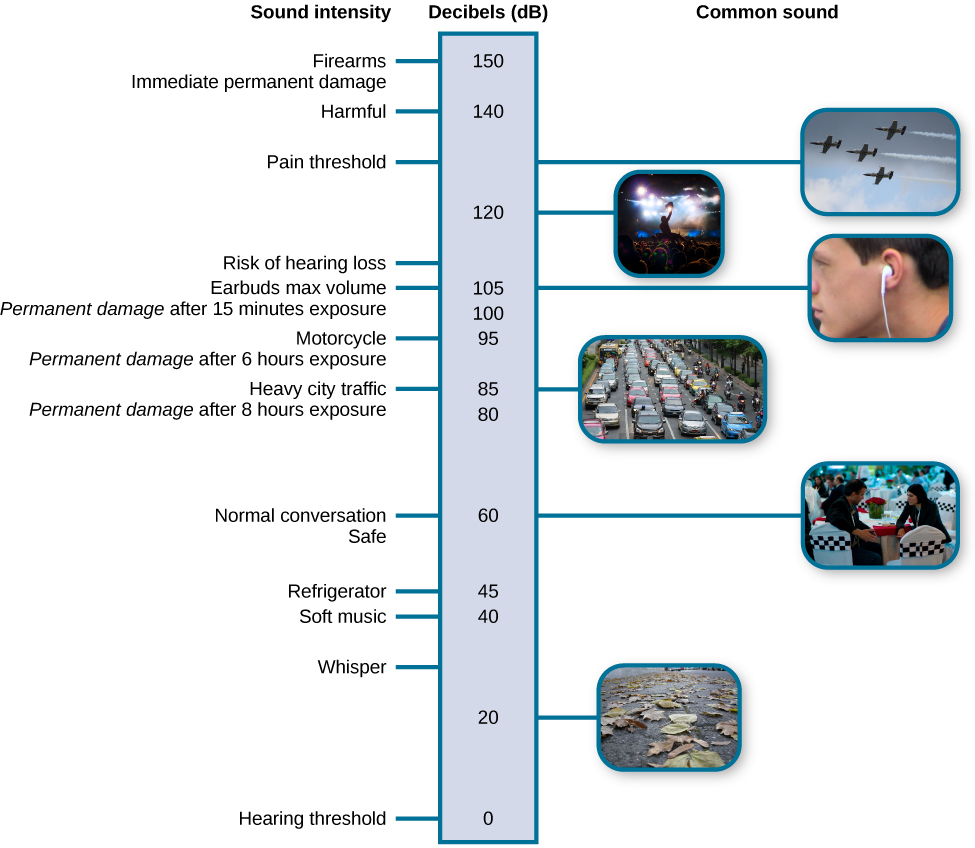
OpenStax, Rice University; Psychology 2e. (credit "planes": modification of work by Max Pfandl; credit "crowd": modification of work by Christian Holmér; credit: "earbuds": modification of work by "Skinny Guy Lover_Flickr"/Flickr; credit "traffic": modification of work by "quinntheislander_Pixabay"/Pixabay; credit "talking": modification of work by Joi Ito; credit "leaves": modification of work by Aurelijus Valeiša) · CC BY 4.0 · Source出典

Figure 5.9図 5.9
This figure illustrates the loudness of common sounds. (credit "planes": modification of work by Max Pfandl; credit "crowd": modification of work by Christian Holmér; credit: "earbuds": modification of work by "Skinny Guy Lover_Flickr"/Flickr; credit "traffic": modification of work by "quinntheislander_Pixabay"/Pixabay; credit "talking": modification of work by Joi Ito; credit "leaves": modification of work by Aurelijus Valeiša)
この図は、よくある音の大きさを示している。(出典「飛行機」:Max Pfandlの作品を改変、出典「群衆」:Christian Holmérの作品を改変、出典「イヤホン」:“Skinny Guy Lover_Flickr”/Flickrの作品を改変、出典「交通」:“quinntheislander_Pixabay”/Pixabayの作品を改変、出典「会話」:Joi Itoの作品を改変、出典「木の葉」:Aurelijus Valeišaの作品を改変)
Although wave amplitude is generally associated with loudness, there is some interaction between frequency and amplitude in our perception of loudness within the audible range. For example, a 10 Hz sound wave is inaudible no matter the amplitude of the wave. A 1000 Hz sound wave, on the other hand, would vary dramatically in terms of perceived loudness as the amplitude of the wave increased.
英語のヒント
波の振幅は一般に音の大きさと結びついているが、可聴範囲の中での音の大きさの知覚には、周波数と振幅のあいだにいくらかの相互作用がある。たとえば、10 Hzの音波は、波の振幅がどれほどであっても聞こえない。一方、1000 Hzの音波では、波の振幅が大きくなるにつれて、知覚される音の大きさが劇的に変わるだろう。
Of course, different musical instruments can play the same musical note at the same level of loudness, yet they still sound quite different. This is known as the timbre of a sound. Timbre refers to a sound’s purity, and it is affected by the complex interplay of frequency, amplitude, and timing of sound waves.
英語のヒント
もちろん、異なる楽器は同じ音を同じ大きさで奏でることができるが、それでもなお、それぞれの音はまったく違って聞こえる。これは、その音の音色と呼ばれる。音色とは音の純粋さを指し、音波の周波数、振幅、タイミングの複雑な相互作用によって影響を受ける。