第5章感覚と知覚
Perception知覚
While our sensory receptors are constantly collecting information from the environment, it is ultimately how we interpret that information that affects how we interact with the world. Perception refers to the way sensory information is organized, interpreted, and consciously experienced. Perception involves both bottom-up and top-down processing. Bottom-up processing refers to sensory information from a stimulus in the environment driving a process, and top-down processing refers to knowledge and expectancy driving a process, as shown in Figure 5.2 (Egeth & Yantis, 1997; Fine & Minnery, 2009; Yantis & Egeth, 1999).
英語のヒント
私たちの感覚受容器は絶えず環境から情報を集めているが、私たちが世界とどのようにかかわるかに影響を与えるのは、結局のところ、その情報を私たちがどう解釈するかである。知覚とは、感覚情報が体制化され、解釈され、意識的に経験されるあり方を指す。知覚には、ボトムアップ処理とトップダウン処理の両方がかかわっている。図5.2に示すように、ボトムアップ処理とは、環境の中の刺激から来る感覚情報が処理を駆動することを指し、トップダウン処理とは、知識や予期が処理を駆動することを指す(Egeth & Yantis, 1997; Fine & Minnery, 2009; Yantis & Egeth, 1999)。
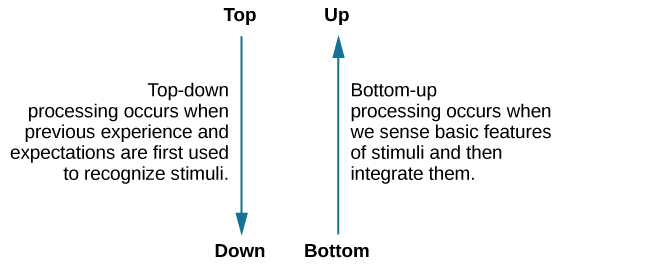
Figure 5.2図 5.2
Top-down and bottom-up are ways we process our perceptions.
トップダウンとボトムアップは、私たちが知覚を処理するやり方である。
Imagine that you and some friends are sitting in a crowded restaurant eating lunch and talking. It is very noisy, and you are concentrating on your friend’s face to hear what they are saying, then the sound of breaking glass and clang of metal pans hitting the floor rings out. The server dropped a large tray of food. Although you were attending to your meal and conversation, that crashing sound would likely get through your attentional filters and capture your attention. You would have no choice but to notice it. That attentional capture would be caused by the sound from the environment: it would be bottom-up.
英語のヒント
あなたが何人かの友人と、混み合ったレストランで座って昼食をとりながら話しているところを想像してほしい。店内はとても騒がしく、あなたは友人の言っていることを聞き取ろうと、その顔に集中している。そのとき、ガラスの割れる音と、金属の鍋が床にぶつかるガシャンという音が響きわたる。給仕係が料理を載せた大きなトレーを落としたのだ。あなたは食事と会話に注意を向けていたが、そのけたたましい音はおそらく注意のフィルターを通り抜け、あなたの注意をとらえるだろう。あなたはそれに気づくしかないはずだ。この注意の捕捉は、環境からの音によって引き起こされることになる。つまり、ボトムアップなのである。
Alternatively, top-down processes are generally goal directed, slow, deliberate, effortful, and under your control (Fine & Minnery, 2009; Miller & Cohen, 2001; Miller & D'Esposito, 2005). For instance, if you misplaced your keys, how would you look for them? If you had a yellow key fob, you would probably look for yellowness of a certain size in specific locations, such as on the counter, coffee table, and other similar places. You would not look for yellowness on your ceiling fan, because you know keys are not normally lying on top of a ceiling fan. That act of searching for a certain size of yellowness in some locations and not others would be top-down—under your control and based on your experience.
英語のヒント
これに対してトップダウン処理は、一般に目標指向的で、ゆっくりしており、意図的で、努力を要し、自分の制御下にある(Fine & Minnery, 2009; Miller & Cohen, 2001; Miller & D'Esposito, 2005)。たとえば、鍵をどこかに置き忘れたとしたら、あなたはどのように探すだろうか。黄色いキーホルダーを付けていたなら、おそらく、カウンターの上やコーヒーテーブル、そのほかそれに似た場所など、特定の場所で、一定の大きさの黄色いものを探すだろう。シーリングファンの上で黄色いものを探すことはないだろう。鍵はふつうシーリングファンの上に置かれてはいないと知っているからである。ある場所では一定の大きさの黄色を探し、ほかの場所では探さないというこの行為は、トップダウンのものといえる。つまり、自分の制御下にあり、自分の経験に基づいている。
One way to think of this concept is that sensation is a physical process, whereas perception is psychological. For example, upon walking into a kitchen and smelling the scent of baking cinnamon rolls, the sensation is the scent receptors detecting the odor of cinnamon, but the perception may be “Mmm, this smells like the bread Grandma used to bake when the family gathered for holidays.”
英語のヒント
この概念についての一つの考え方は、感覚が物理的な過程であるのに対して、知覚は心理的な過程だ、というものである。たとえば、台所に入ってシナモンロールが焼けるにおいをかいだとき、感覚とは、においの受容器がシナモンのにおいを検出することである。しかし、知覚は「ああ、家族が祝日に集まったとき、おばあちゃんがよく焼いていたパンみたいなにおいだ」というものかもしれない。
Although our perceptions are built from sensations, not all sensations result in perception. In fact, we often don’t perceive stimuli that remain relatively constant over prolonged periods of time. This is known as sensory adaptation. Imagine going to a city that you have never visited. You check in to the hotel, but when you get to your room, there is a road construction sign with a bright flashing light outside your window. Unfortunately, there are no other rooms available, so you are stuck with a flashing light. You decide to watch television to unwind. The flashing light was extremely annoying when you first entered your room. It was as if someone was continually turning a bright yellow spotlight on and off in your room, but after watching television for a short while, you no longer notice the light flashing. The light is still flashing and filling your room with yellow light every few seconds, and the photoreceptors in your eyes still sense the light, but you no longer perceive the rapid changes in lighting conditions. That you no longer perceive the flashing light demonstrates sensory adaptation and shows that while closely associated, sensation and perception are different.
英語のヒント
私たちの知覚は感覚から組み立てられるが、すべての感覚が知覚につながるわけではない。実際、長い時間にわたって比較的一定のままの刺激を、私たちはしばしば知覚しない。これは感覚順応として知られている。一度も訪れたことのない街に行ったと想像してほしい。ホテルにチェックインしたが、部屋に着いてみると、窓の外に、明るく点滅するライトの付いた道路工事の標識がある。あいにくほかに空いている部屋はなく、あなたは点滅するライトを我慢するしかない。くつろごうと、あなたはテレビを見ることにする。部屋に入ったばかりのときには、点滅するライトはひどくわずらわしかった。まるで誰かが部屋の中で、明るい黄色のスポットライトをつけたり消したりし続けているかのようだった。ところが、しばらくテレビを見ていると、もうライトの点滅には気づかなくなっている。ライトは今も点滅し、数秒ごとに部屋を黄色い光で満たしている。目の中の視細胞も、今なおその光を感じとっている。それでも、あなたはもはや照明の状態の急激な変化を知覚していない。点滅するライトをもう知覚していないということは、感覚順応を示しており、また、感覚と知覚は密接に結びついてはいるものの、別のものであることを示している。
There is another factor that affects sensation and perception: attention. Attention plays a significant role in determining what is sensed versus what is perceived. Imagine you are at a party full of music, chatter, and laughter. You get involved in an interesting conversation with a friend, and you tune out all the background noise. If someone interrupted you to ask what song had just finished playing, you would probably be unable to answer that question.
英語のヒント
感覚と知覚に影響を与える要因は、ほかにもある。注意である。注意は、感じとられるものと知覚されるものとを分けるうえで、重要な役割を果たしている。音楽とおしゃべりと笑い声にあふれたパーティーに、あなたがいると想像してほしい。あなたは友人との面白い会話に夢中になり、周りの雑音をすべて締め出す。もし誰かが話をさえぎって、たった今終わった曲は何だったかと尋ねたら、あなたはおそらくその質問に答えられないだろう。
One of the most interesting demonstrations of how important attention is in determining our perception of the environment occurred in a famous study conducted by Daniel Simons and Christopher Chabris (1999). In this study, participants watched a video of people dressed in black and white passing basketballs. Participants were asked to count the number of times the team dressed in white passed the ball. During the video, a person dressed in a black gorilla costume walks among the two teams. You would think that someone would notice the gorilla, right? Nearly half of the people who watched the video didn’t notice the gorilla at all, despite the fact that he was clearly visible for nine seconds. Because participants were so focused on the number of times the team dressed in white was passing the ball, they completely tuned out other visual information. Inattentional blindness is the failure to notice something that is completely visible because the person was actively attending to something else and did not pay attention to other things (Mack & Rock, 1998; Simons & Chabris, 1999).
英語のヒント
環境についての私たちの知覚を決めるうえで、注意がどれほど重要かを示す最も興味深い実証の一つは、ダニエル・シモンズとクリストファー・チャブリス(1999)が行った有名な研究の中で得られた。この研究では、参加者は、黒い服と白い服を着た人々がバスケットボールをパスし合う動画を見た。参加者は、白い服を着たチームがボールをパスした回数を数えるよう求められた。動画の途中で、黒いゴリラの着ぐるみを着た人物が、二つのチームのあいだを歩いていく。誰かはきっとゴリラに気づくだろう、と思うのではないだろうか。ところが、動画を見た人のほぼ半数は、ゴリラが9秒間はっきりと見えていたにもかかわらず、まったく気づかなかった。参加者は、白い服のチームがボールをパスしている回数にあまりにも集中していたため、ほかの視覚情報を完全に締め出してしまったのである。非注意性盲目とは、完全に見えている何かに気づかないことであり、その人がほかの何かに積極的に注意を向けていて、ほかのものに注意を払っていなかったために起こる(Mack & Rock, 1998; Simons & Chabris, 1999)。
In a similar experiment, researchers tested inattentional blindness by asking participants to observe images moving across a computer screen. They were instructed to focus on either white or black objects, disregarding the other color. When a red cross passed across the screen, about one third of subjects did not notice it (Figure 5.3) (Most, Simons, Scholl, & Chabris, 2000).
英語のヒント
同様の実験で、研究者たちは、コンピューター画面上を動いていく画像を観察するよう参加者に求めることで、非注意性盲目を調べた。参加者は、白と黒のどちらか一方の物体に集中し、もう一方の色は無視するよう指示された。赤い十字が画面を横切ったとき、対象者の約3分の1はそれに気づかなかった(図5.3)(Most, Simons, Scholl, & Chabris, 2000)。
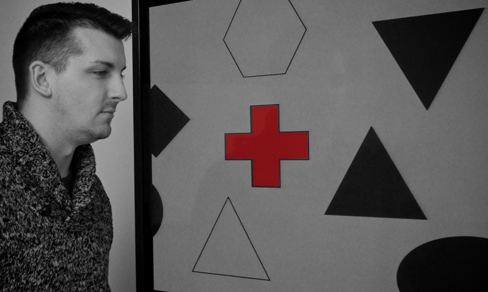
Figure 5.3図 5.3
Nearly one third of participants in a study did not notice that a red cross passed on the screen because their attention was focused on the black or white figures. (credit: Cory Zanker)
ある研究では、参加者のほぼ3分の1が、赤い十字が画面上を通過したことに気づかなかった。注意が黒または白の図形に集中していたためである。(出典:Cory Zanker)
Motivation can also affect perception. Have you ever been expecting a really important phone call and, while taking a shower, you think you hear the phone ringing, only to discover that it is not? If so, then you have experienced how motivation to detect a meaningful stimulus can shift our ability to discriminate between a true sensory stimulus and background noise. The ability to identify a stimulus when it is embedded in a distracting background is called signal detection theory. This might also explain why a mother is awakened by a quiet murmur from her baby but not by other sounds that occur while she is asleep. Signal detection theory has practical applications, such as increasing air traffic controller accuracy. Controllers need to be able to detect planes among many signals (blips) that appear on the radar screen and follow those planes as they move through the sky. In fact, the original work of the researcher who developed signal detection theory was focused on improving the sensitivity of air traffic controllers to plane blips (Swets, 1964).
英語のヒント
動機づけもまた、知覚に影響を与えうる。とても大事な電話を待っていて、シャワーを浴びている最中に電話が鳴るのが聞こえた気がしたのに、実際には鳴っていなかった、という経験はないだろうか。もしあるなら、あなたは、意味のある刺激を検出しようとする動機づけが、本当の感覚刺激と背景の雑音とを区別する能力をいかに変えうるかを経験したことになる。気を散らす背景の中に埋もれた刺激を見分ける能力は、信号検出理論と呼ばれる。これによって、母親が、眠っているあいだに起こるほかの物音では目を覚まさないのに、赤ちゃんのかすかな声では目を覚ます理由も説明できるかもしれない。信号検出理論には、航空管制官の正確さを高めることなど、実用的な応用がある。管制官は、レーダー画面に現れる多くの信号(輝点)の中から航空機を検出し、その航空機が空を移動していくのを追えなければならない。実際、信号検出理論を開発した研究者のもともとの研究は、航空機の輝点に対する航空管制官の感度を高めることに焦点を当てていた(Swets, 1964)。
Our perceptions can also be affected by our beliefs, values, prejudices, expectations, and life experiences. As you will see later in this chapter, individuals who are deprived of the experience of binocular vision during critical periods of development have trouble perceiving depth (Fawcett, Wang, & Birch, 2005). The shared experiences of people within a given cultural context can have pronounced effects on perception. For example, Marshall Segall, Donald Campbell, and Melville Herskovits (1963) published the results of a multinational study in which they demonstrated that individuals from Western cultures were more prone to experience certain types of visual illusions than individuals from non-Western cultures, and vice versa. One such illusion that Westerners were more likely to experience was the Müller-Lyer illusion (Figure 5.4): The lines appear to be different lengths, but they are actually the same length.
英語のヒント
私たちの知覚は、信念、価値観、偏見、予期、人生経験によっても影響を受けうる。この章の後半で見るように、発達の臨界期に両眼視の経験を奪われた人は、奥行きの知覚に困難を抱える(Fawcett, Wang, & Birch, 2005)。ある文化的文脈の中で人々が共有している経験は、知覚に顕著な影響を及ぼしうる。たとえば、マーシャル・シーガル、ドナルド・キャンベル、メルヴィル・ハースコヴィッツ(1963)は多国間研究の結果を発表し、西洋文化出身の人は非西洋文化出身の人よりも、ある種の錯視を経験する傾向が強く、またその逆もあることを示した。西洋人のほうが経験する可能性の高かった錯視の一つが、ミュラー・リヤー錯視である(図5.4)。線の長さが違って見えるが、実際には同じ長さなのである。
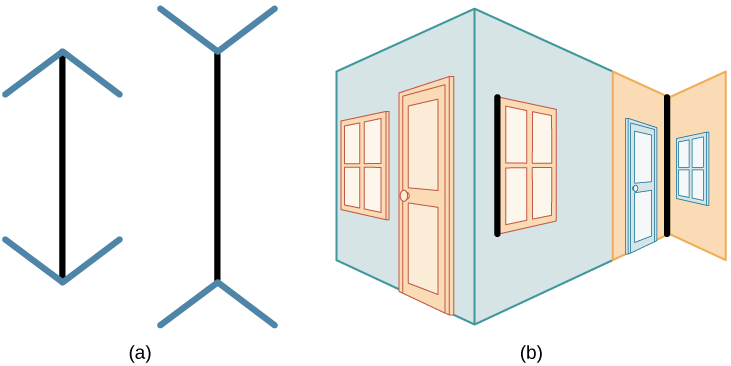


Figure 5.4図 5.4
In the Müller-Lyer illusion, lines appear to be different lengths although they are identical. (a) Arrows at the ends of lines may make the line on the right appear longer, although the lines are the same length. (b) When applied to a three-dimensional image, the line on the right again may appear longer although both black lines are the same length.
ミュラー・リヤー錯視では、線は同一であるにもかかわらず、長さが違って見える。(a)線の端にある矢印のために、線の長さは同じなのに、右側の線のほうが長く見えることがある。(b)3次元の画像に当てはめた場合も、2本の黒い線は同じ長さなのに、やはり右側の線のほうが長く見えることがある。
These perceptual differences were consistent with differences in the types of environmental features experienced on a regular basis by people in a given cultural context. People in Western cultures, for example, have a perceptual context of buildings with straight lines, what Segall’s study called a carpentered world (Segall et al., 1966). In contrast, people from certain non-Western cultures with an uncarpentered view, such as the Zulu of South Africa, whose villages are made up of round huts arranged in circles, are less susceptible to this illusion (Segall et al., 1999). It is not just vision that is affected by cultural factors. Indeed, research has demonstrated that the ability to identify an odor, and rate its pleasantness and its intensity, varies cross-culturally (Ayabe-Kanamura, Saito, Distel, Martínez-Gómez, & Hudson, 1998).
英語のヒント
こうした知覚の違いは、ある文化的文脈の中の人々がふだん経験している環境の特徴の種類の違いと一致していた。たとえば、西洋文化の人々は、直線でできた建物という知覚的文脈を持っている。シーガルの研究が「大工仕事の世界」と呼んだものである(Segall et al., 1966)。これに対して、大工仕事の施されていない景観の中で暮らす一部の非西洋文化の人々、たとえば、円形に並べられた丸い小屋が村をなす南アフリカのズールー族は、この錯視の影響を受ける度合いが小さい(Segall et al., 1999)。文化的な要因の影響を受けるのは、視覚だけではない。実際、においを識別し、その快さと強さを評定する能力が文化によって異なることが、研究によって示されている(Ayabe-Kanamura, Saito, Distel, Martínez-Gómez, & Hudson, 1998)。
Children described as thrill seekers are more likely to show taste preferences for intense sour flavors (Liem, Westerbeek, Wolterink, Kok, & de Graaf, 2004), which suggests that basic aspects of personality might affect perception. Furthermore, individuals who hold positive attitudes toward reduced-fat foods are more likely to rate foods labeled as reduced fat as tasting better than people who have less positive attitudes about these products (Aaron, Mela, & Evans, 1994).
英語のヒント
スリルを求めるタイプとされる子どもは、強い酸味への味覚の嗜好を示す可能性が高い(Liem, Westerbeek, Wolterink, Kok, & de Graaf, 2004)。このことは、パーソナリティの基本的な側面が知覚に影響を与えているかもしれないことを示唆している。さらに、低脂肪食品に好意的な態度を持つ人は、こうした製品に対する態度があまり好意的でない人に比べて、低脂肪と表示された食品をよりおいしいと評定する可能性が高い(Aaron, Mela, & Evans, 1994)。