第5章感覚と知覚
5.4 Hearing5.4 聴覚
Learning Objectives学習目標
By the end of this section, you will be able to:
この節を学び終えると、次のことができるようになる。
- Describe the basic anatomy and function of the auditory system聴覚系の基本的な解剖学的構造と機能を述べる
- Explain how we encode and perceive pitch私たちが音の高さをどのように符号化し、知覚しているのかを説明する
- Discuss how we localize sound私たちがどのように音を定位しているのかを論じる
Our auditory system converts pressure waves into meaningful sounds. This translates into our ability to hear the sounds of nature, to appreciate the beauty of music, and to communicate with one another through spoken language. This section will provide an overview of the basic anatomy and function of the auditory system. It will include a discussion of how the sensory stimulus is translated into neural impulses, where in the brain that information is processed, how we perceive pitch, and how we know where sound is coming from.
英語のヒント
私たちの聴覚系は、圧力の波を意味のある音に変換する。このはたらきがあるからこそ、私たちは自然の音を聞き、音楽の美しさを味わい、話し言葉を通して互いに意思を伝え合える。この節では、聴覚系の基本的な解剖学的構造と機能を概観する。そこでは、感覚刺激がどのように神経インパルスへと変換されるのか、その情報が脳のどこで処理されるのか、私たちが音の高さをどのように知覚するのか、そして音がどこから来ているのかをどのようにして知るのかを論じる。
Anatomy of the Auditory System聴覚系の解剖学的構造
The ear can be separated into multiple sections. The outer ear includes the pinna, which is the visible part of the ear that protrudes from our heads, the auditory canal, and the tympanic membrane, or eardrum. The middle ear contains three tiny bones known as the ossicles, which are named the malleus (or hammer), incus (or anvil), and the stapes (or stirrup). The inner ear contains the semi-circular canals, which are involved in balance and movement (the vestibular sense), and the cochlea. The cochlea is a fluid-filled, snail-shaped structure that contains the sensory receptor cells (hair cells) of the auditory system (Figure 5.18).
英語のヒント
耳はいくつかの部分に分けられる。外耳には、頭から突き出ている耳の目に見える部分である耳介、外耳道、そして鼓膜が含まれる。中耳には耳小骨と呼ばれる三つの小さな骨があり、ツチ骨、キヌタ骨、アブミ骨と名づけられている(それぞれ槌、金床、あぶみとも呼ばれる)。内耳には、平衡と運動の感覚(前庭感覚)にかかわる三半規管と、蝸牛がある。蝸牛は液体で満たされたカタツムリ形の構造で、聴覚系の感覚受容細胞(有毛細胞)を含んでいる(図5.18)。
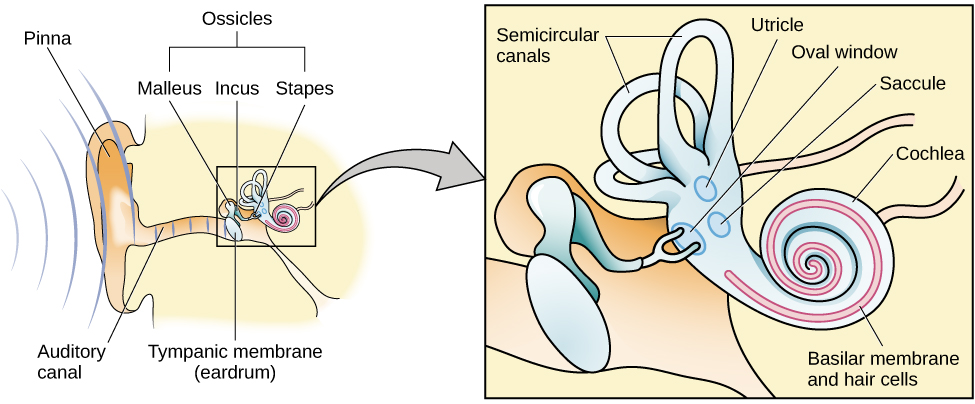

Figure 5.18図 5.18
The ear is divided into outer (pinna and tympanic membrane), middle (the three ossicles: malleus, incus, and stapes), and inner (cochlea and basilar membrane) divisions.
耳は、外耳(耳介と鼓膜)、中耳(三つの耳小骨:ツチ骨、キヌタ骨、アブミ骨)、内耳(蝸牛と基底膜)に分けられる。
Sound waves travel along the auditory canal and strike the tympanic membrane, causing it to vibrate. This vibration results in movement of the three ossicles. As the ossicles move, the stapes presses into a thin membrane of the cochlea known as the oval window. As the stapes presses into the oval window, the fluid inside the cochlea begins to move, which in turn stimulates hair cells, which are auditory receptor cells of the inner ear embedded in the basilar membrane. The basilar membrane is a thin strip of tissue within the cochlea.
英語のヒント
音波は外耳道を進んで鼓膜に当たり、鼓膜を振動させる。この振動によって三つの耳小骨が動く。耳小骨が動くと、アブミ骨が、卵円窓と呼ばれる蝸牛の薄い膜を押し込む。アブミ骨が卵円窓を押し込むと、蝸牛の中の液体が動きはじめ、それが今度は有毛細胞を刺激する。有毛細胞は、基底膜に埋め込まれた内耳の聴覚受容細胞である。基底膜は、蝸牛の中にある帯状の薄い組織である。
The activation of hair cells is a mechanical process: the stimulation of the hair cell ultimately leads to activation of the cell. As hair cells become activated, they generate neural impulses that travel along the auditory nerve to the brain. Auditory information is shuttled to the inferior colliculus, the medial geniculate nucleus of the thalamus, and finally to the auditory cortex in the temporal lobe of the brain for processing. Like the visual system, there is also evidence suggesting that information about auditory recognition and localization is processed in parallel streams (Rauschecker & Tian, 2000; Renier et al., 2009).
英語のヒント
有毛細胞の活性化は機械的な過程である。有毛細胞が刺激されると、それが最終的にその細胞の活性化につながる。有毛細胞は活性化すると神経インパルスを生み出し、そのインパルスが聴神経を通って脳へ伝わる。聴覚情報は下丘、視床の内側膝状体へと送られ、最後に脳の側頭葉にある聴覚野に届いて処理される。視覚系と同じように、聴覚でも、音の認識と定位についての情報が並列の経路で処理されていることを示唆する証拠がある(Rauschecker & Tian, 2000; Renier et al., 2009)。
Pitch Perception音の高さの知覚
Different frequencies of sound waves are associated with differences in our perception of the pitch of those sounds. Low-frequency sounds are lower pitched, and high-frequency sounds are higher pitched. How does the auditory system differentiate among various pitches?
英語のヒント
音波の周波数の違いは、その音の高さについての私たちの知覚の違いと結びついている。周波数の低い音ほど低く聞こえ、周波数の高い音ほど高く聞こえる。では、聴覚系はさまざまな音の高さをどのように区別しているのだろうか。
Several theories have been proposed to account for pitch perception. We’ll discuss two of them here: temporal theory and place theory. The temporal theory of pitch perception asserts that frequency is coded by the activity level of a sensory neuron. This would mean that a given hair cell would fire action potentials related to the frequency of the sound wave. While this is a very intuitive explanation, we detect such a broad range of frequencies (20–20,000 Hz) that the frequency of action potentials fired by hair cells cannot account for the entire range. Because of properties related to sodium channels on the neuronal membrane that are involved in action potentials, there is a point at which a cell cannot fire any faster (Shamma, 2001).
英語のヒント
音の高さの知覚を説明するために、いくつかの理論が提唱されてきた。ここではそのうちの二つ、時間説と場所説を取り上げる。音の高さ知覚の時間説は、周波数は感覚ニューロンの活動水準によって符号化されると主張する。これに従えば、ある有毛細胞は、音波の周波数に関連した活動電位を発火することになるだろう。これはとても直観的な説明だが、私たちが検出する周波数の範囲は非常に広い(20〜20,000 Hz)ため、有毛細胞が発火する活動電位の頻度では、その範囲全体を説明できない。活動電位にかかわる、ニューロンの膜上のナトリウムチャネルの性質のために、細胞がそれ以上速く発火できなくなる点があるのである(Shamma, 2001)。
The place theory of pitch perception suggests that different portions of the basilar membrane are sensitive to sounds of different frequencies. More specifically, the base of the basilar membrane responds best to high frequencies and the tip of the basilar membrane responds best to low frequencies. Therefore, hair cells that are in the base portion would be labeled as high-pitch receptors, while those in the tip of basilar membrane would be labeled as low-pitch receptors (Shamma, 2001).
英語のヒント
音の高さ知覚の場所説は、基底膜の異なる部分が、それぞれ異なる周波数の音に対して感受性を持つとする。より具体的には、基底膜の基部は高い周波数に最もよく反応し、基底膜の先端は低い周波数に最もよく反応する。したがって、基部にある有毛細胞は高音の受容器、基底膜の先端にある有毛細胞は低音の受容器と位置づけられることになる(Shamma, 2001)。
In reality, both theories explain different aspects of pitch perception. At frequencies up to about 4000 Hz, it is clear that both the rate of action potentials and place contribute to our perception of pitch. However, much higher frequency sounds can only be encoded using place cues (Shamma, 2001).
英語のヒント
実際には、二つの理論はどちらも、音の高さの知覚の異なる側面を説明している。約4000 Hzまでの周波数では、活動電位の頻度と場所の両方が音の高さの知覚に寄与していることは明らかである。しかし、それよりはるかに高い周波数の音は、場所の手がかりによってしか符号化できない(Shamma, 2001)。