第5章感覚と知覚
Touch, Thermoception, and Nociception触覚、温度感覚、侵害受容
A number of receptors are distributed throughout the skin to respond to various touch-related stimuli (Figure 5.23). These receptors include Meissner’s corpuscles, Pacinian corpuscles, Merkel’s disks, and Ruffini corpuscles. Meissner’s corpuscles respond to pressure and lower frequency vibrations, and Pacinian corpuscles detect transient pressure and higher frequency vibrations. Merkel’s disks respond to light pressure, while Ruffini corpuscles detect stretch (Abraira & Ginty, 2013).
英語のヒント
皮膚全体には、触覚にかかわるさまざまな刺激に反応するために、多くの受容器が分布している(図5.23)。こうした受容器には、マイスナー小体、パチニ小体、メルケル盤、ルフィニ小体がある。マイスナー小体は圧力と比較的低い周波数の振動に反応し、パチニ小体は一時的な圧力と比較的高い周波数の振動を検出する。メルケル盤が軽い圧力に反応するのに対して、ルフィニ小体は伸張を検出する(Abraira & Ginty, 2013)。
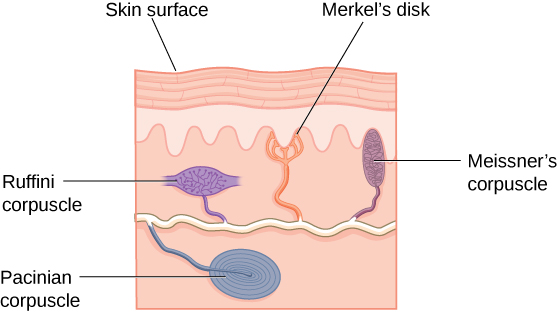
Figure 5.23図 5.23
There are many types of sensory receptors located in the skin, each attuned to specific touch-related stimuli.
皮膚には多くの種類の感覚受容器があり、それぞれが触覚にかかわる特定の刺激に反応するよう調整されている。
In addition to the receptors located in the skin, there are also a number of free nerve endings that serve sensory functions. These nerve endings respond to a variety of different types of touch-related stimuli and serve as sensory receptors for both thermoception (temperature perception) and nociception (a signal indicating potential harm and maybe pain) (Garland, 2012; Petho & Reeh, 2012; Spray, 1986). Sensory information collected from the receptors and free nerve endings travels up the spinal cord and is transmitted to regions of the medulla, thalamus, and ultimately to the somatosensory cortex, which is located in the postcentral gyrus of the parietal lobe.
英語のヒント
皮膚にある受容器に加えて、感覚の機能を果たす自由神経終末も数多くある。これらの神経終末は、触覚にかかわるさまざまな種類の刺激に反応し、温度感覚(温度の知覚)と侵害受容(害が及ぶ可能性、そしておそらくは痛みを示す信号)の両方の感覚受容器として働く(Garland, 2012; Petho & Reeh, 2012; Spray, 1986)。受容器と自由神経終末から集められた感覚情報は、脊髄を上っていき、延髄や視床の各領域へ、そして最終的には体性感覚野へと伝えられる。体性感覚野は、頭頂葉の中心後回にある。
Pain Perception痛みの知覚
Pain is an unpleasant experience that involves both physical and psychological components. Feeling pain is quite adaptive because it makes us aware of an injury, and it motivates us to remove ourselves from the cause of that injury. In addition, pain also makes us less likely to suffer additional injury because we will be gentler with our injured body parts.
英語のヒント
痛みは、身体的な要素と心理的な要素の両方を含む不快な経験である。痛みを感じることは、かなり適応的である。痛みによって私たちはけがに気づき、そのけがの原因から身を遠ざけようという動機が生まれるからである。さらに痛みがあると、けがをした体の部分をより優しく扱うようになるため、さらなるけがを負う可能性も低くなる。
Generally speaking, pain can be considered to be neuropathic or inflammatory in nature. Pain that signals some type of tissue damage is known as inflammatory pain. In some situations, pain results from damage to neurons of either the peripheral or central nervous system. As a result, pain signals that are sent to the brain get exaggerated. This type of pain is known as neuropathic pain. Multiple treatment options for pain relief range from relaxation therapy to the use of analgesic medications to deep brain stimulation. The most effective treatment option for a given individual will depend on a number of considerations, including the severity and persistence of the pain and any medical/psychological conditions.
英語のヒント
一般的に言えば、痛みはその性質上、神経障害性のものか炎症性のものかのどちらかと考えられる。何らかの組織の損傷を知らせる痛みは、炎症性疼痛として知られる。状況によっては、末梢神経系か中枢神経系のどちらかのニューロンの損傷から痛みが生じることがある。その結果、脳へ送られる痛みの信号が誇張される。この種の痛みは、神経障害性疼痛として知られる。痛みを和らげるための治療の選択肢は数多くあり、リラクセーション療法から鎮痛薬の使用、さらには脳深部刺激まで幅がある。ある人にとって最も効果的な治療の選択肢は、痛みの重さや持続性、何らかの医学的・心理的な状態の有無など、いくつもの考慮事項によって決まるだろう。
Some individuals are born without the ability to feel pain. This very rare genetic disorder is known as congenital insensitivity to pain (or congenital analgesia). While those with congenital analgesia can detect differences in temperature and pressure, they cannot experience pain. As a result, they often suffer significant injuries. Young children have serious mouth and tongue injuries because they have bitten themselves repeatedly. Not surprisingly, individuals suffering from this disorder have much shorter life expectancies due to their injuries and secondary infections of injured sites (U.S. National Library of Medicine, 2013).
英語のヒント
生まれつき痛みを感じる能力を持たない人もいる。この非常にまれな遺伝性の障害は、先天性無痛症として知られる。先天性無痛症の人は、温度や圧力の違いを感じ取ることはできるものの、痛みを経験することはできない。その結果、大きなけがを負うことが多い。幼い子どもは、自分で自分を何度もかんでしまったために、口や舌に深刻なけがを負っている。当然ながら、この障害を持つ人は、けがや、けがをした部位の二次感染のために、平均余命がはるかに短い(U.S. National Library of Medicine, 2013)。
The Vestibular Sense, Proprioception, and Kinesthesia前庭感覚、固有受容感覚、運動感覚
The vestibular sense contributes to our ability to maintain balance and body posture. As Figure 5.24 shows, the major sensory organs (utricle, saccule, and the three semicircular canals) of this system are located next to the cochlea in the inner ear. The vestibular organs are fluid-filled and have hair cells, similar to the ones found in the auditory system, which respond to movement of the head and gravitational forces. When these hair cells are stimulated, they send signals to the brain via the vestibular nerve. Although we may not be consciously aware of our vestibular system’s sensory information under normal circumstances, its importance is apparent when we experience motion sickness and/or dizziness related to infections of the inner ear (Khan & Chang, 2013).
英語のヒント
前庭感覚は、平衡と身体の姿勢を保つ能力に寄与している。図5.24に示すように、この感覚系の主な感覚器官(卵形嚢、球形嚢、三半規管)は、内耳の中で蝸牛の隣に位置している。前庭器官は液体で満たされており、聴覚系に見られるものと似た有毛細胞を持っている。この有毛細胞は、頭の動きや重力に反応する。これらの有毛細胞は、刺激されると、前庭神経を通って脳へ信号を送る。ふだんの状況では、私たちは前庭系からの感覚情報を意識していないかもしれない。しかし、内耳の感染症に関連した乗り物酔いやめまいを経験すると、その重要性がはっきりする(Khan & Chang, 2013)。
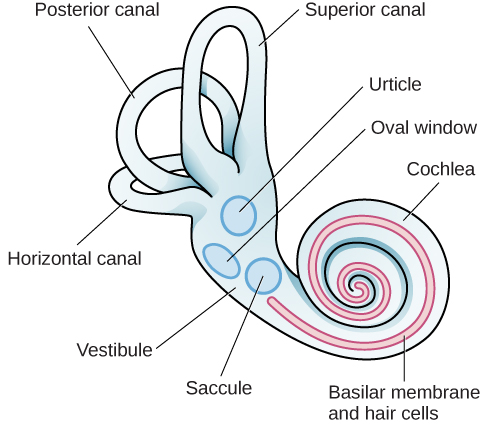


Figure 5.24図 5.24
The major sensory organs of the vestibular system are located next to the cochlea in the inner ear. These include the utricle, saccule, and the three semicircular canals (posterior, superior, and horizontal).
前庭系の主な感覚器官は、内耳の中で蝸牛の隣に位置している。これには卵形嚢、球形嚢、三半規管(後半規管、上半規管、水平半規管)が含まれる。
In addition to maintaining balance, the vestibular system collects information critical for controlling movement and the reflexes that move various parts of our bodies to compensate for changes in body position. Therefore, both proprioception (perception of body position) and kinesthesia (perception of the body’s movement through space) interact with information provided by the vestibular system.
英語のヒント
前庭系は、平衡を保つことに加えて、運動の制御や、体の位置の変化を補うために体のさまざまな部分を動かす反射の制御に欠かせない情報を集めている。したがって、固有受容感覚(身体の位置の知覚)と運動感覚(空間の中での身体の動きの知覚)はどちらも、前庭系から提供される情報と相互作用している。
These sensory systems also gather information from receptors that respond to stretch and tension in muscles, joints, skin, and tendons (Lackner & DiZio, 2005; Proske, 2006; Proske & Gandevia, 2012). Proprioceptive and kinesthetic information travels to the brain via the spinal column. Several cortical regions in addition to the cerebellum receive information from and send information to the sensory organs of the proprioceptive and kinesthetic systems.
英語のヒント
これらの感覚系は、筋肉、関節、皮膚、腱の伸張や張力に反応する受容器からも情報を集めている(Lackner & DiZio, 2005; Proske, 2006; Proske & Gandevia, 2012)。固有受容感覚と運動感覚の情報は、脊柱を通って脳へ伝わる。小脳に加えていくつかの皮質領域が、固有受容感覚系と運動感覚系の感覚器官から情報を受け取り、またそこへ情報を送っている。