第3章生物心理学
3.5 The Endocrine System3.5 内分泌系
Learning Objectives学習目標
By the end of this section, you will be able to:
この節を学び終えると、次のことができるようになる。
- Identify the major glands of the endocrine system内分泌系の主な腺を特定する
- Identify the hormones secreted by each glandそれぞれの腺が分泌するホルモンを特定する
- Describe each hormone’s role in regulating bodily functions身体機能の調節において、それぞれのホルモンが果たす役割を説明する
The endocrine system consists of a series of glands that produce chemical substances known as hormones (Figure 3.30). Like neurotransmitters, hormones are chemical messengers that must bind to a receptor in order to send their signal. However, unlike neurotransmitters, which are released in close proximity to cells with their receptors, hormones are secreted into the bloodstream and travel throughout the body, affecting any cells that contain receptors for them. Thus, whereas neurotransmitters’ effects are localized, the effects of hormones are widespread. Also, hormones are slower to take effect, and tend to be longer lasting.
英語のヒント
内分泌系は、ホルモンと呼ばれる化学物質をつくる一連の腺から成る(図3.30)。ホルモンも神経伝達物質と同じく化学伝達物質であり、信号を送るためには受容体に結合しなければならない。しかし、神経伝達物質が、その受容体を持つ細胞のすぐ近くで放出されるのとは違って、ホルモンは血流中に分泌されて全身をめぐり、そのホルモンの受容体を持つ細胞であれば、どの細胞にも作用する。したがって、神経伝達物質の効果が局所的であるのに対し、ホルモンの効果は広範囲に及ぶ。また、ホルモンは効果が現れるのがより遅く、その効果はより長く続く傾向がある。
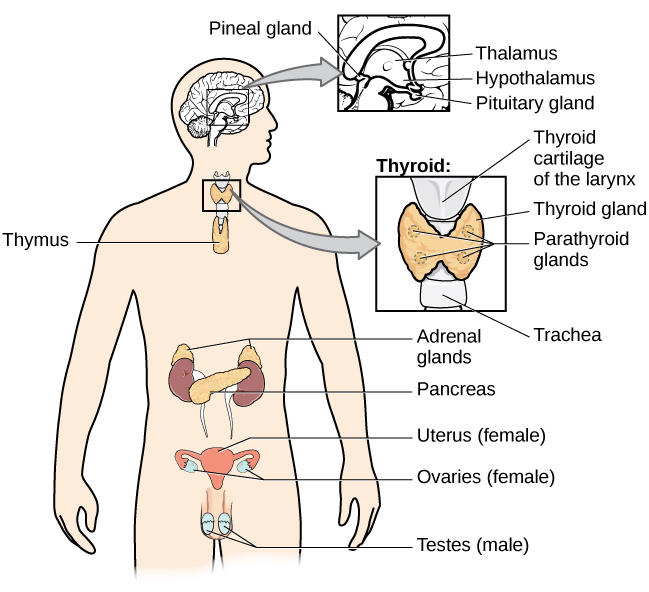

Figure 3.30図 3.30
The major glands of the endocrine system are shown.
内分泌系の主な腺を示す。
Hormones are involved in regulating all sorts of bodily functions, and they are ultimately controlled through interactions between the hypothalamus (in the central nervous system) and the pituitary gland (in the endocrine system). Imbalances in hormones are related to a number of disorders. This section explores some of the major glands that make up the endocrine system and the hormones secreted by these glands (Table 3.2).
英語のヒント
ホルモンはあらゆる種類の身体機能の調節にかかわっており、最終的には、視床下部(中枢神経系にある)と下垂体(内分泌系にある)の相互作用を通して制御されている。ホルモンの不均衡は、さまざまな障害と関連している。この節では、内分泌系を構成する主な腺のいくつかと、それらの腺が分泌するホルモンを見ていく(表3.2)。
Major Glands主な腺
The pituitary gland descends from the hypothalamus at the base of the brain, and acts in close association with it. The pituitary is often referred to as the “master gland” because its messenger hormones control all the other glands in the endocrine system, although it mostly carries out instructions from the hypothalamus. In addition to messenger hormones, the pituitary also secretes growth hormone, endorphins for pain relief, and a number of key hormones that regulate fluid levels in the body.
英語のヒント
下垂体は、脳の底部で視床下部から下に垂れ下がっており、視床下部と密接に連携して働く。下垂体はしばしば「マスター腺」と呼ばれる。下垂体の伝令ホルモンが、内分泌系のほかのすべての腺を制御しているからである。ただし、その下垂体も、たいていは視床下部からの指令を実行している。下垂体は伝令ホルモンのほかに、成長ホルモン、痛みを和らげるエンドルフィン、そして体内の水分量を調節するいくつかの重要なホルモンも分泌する。
Located in the neck, the thyroid gland releases hormones that regulate growth, metabolism, and appetite. In hyperthyroidism, the thyroid secretes too much of the hormone thyroxine, causing agitation, bulging eyes, and weight loss. One cause of hyperthyroidism is Graves' disease, an autoimmune disease in which one’s own body attacks itself. In hypothyroidism, reduced hormone levels cause sufferers to experience tiredness, and they often complain of feeling cold. Fortunately, thyroid disorders are often treatable with medications that help reestablish a balance in the hormones secreted by the thyroid.
英語のヒント
首にある甲状腺は、成長、代謝、食欲を調節するホルモンを放出する。甲状腺機能亢進症では、甲状腺がチロキシンというホルモンを過剰に分泌し、焦燥感、眼球の突出、体重減少を引き起こす。甲状腺機能亢進症の原因の一つはバセドウ病で、これは自分の体が自分自身を攻撃する自己免疫疾患である。甲状腺機能低下症では、ホルモンの濃度が下がることで、患者は疲労感を覚え、寒さを訴えることも多い。幸い、甲状腺の障害は、甲状腺が分泌するホルモンのバランスを取り戻す助けとなる薬によって、治療できることが多い。
The adrenal glands sit atop our kidneys and secrete hormones involved in the stress response, such as epinephrine (adrenaline) and norepinephrine (noradrenaline). The pancreas is an internal organ that secretes hormones that regulate blood sugar levels: insulin and glucagon. These pancreatic hormones are essential for maintaining stable levels of blood sugar throughout the day by lowering blood glucose levels (insulin) or raising them (glucagon). People who suffer from diabetes do not produce enough insulin; therefore, they must take medications that stimulate or replace insulin production, and they must closely control the amount of sugars and carbohydrates they consume.
英語のヒント
副腎は腎臓の上にあり、エピネフリン(アドレナリン)やノルエピネフリン(ノルアドレナリン)など、ストレス反応にかかわるホルモンを分泌する。膵臓は、血糖値を調節するホルモンであるインスリンとグルカゴンを分泌する内臓である。これらの膵臓ホルモンは、血糖値を下げたり(インスリン)上げたり(グルカゴン)することで、一日を通して血糖値を安定した状態に保つのに欠かせない。糖尿病を患う人では、インスリンが十分につくられない。そのため、インスリンの産生を促す薬や、それに代わる薬を服用しなければならず、また、摂取する糖と炭水化物の量を注意深く管理しなければならない。
The gonads secrete sexual hormones, which are important in reproduction, and mediate both sexual motivation and behavior. The female gonads are the ovaries; the male gonads are the testes. Ovaries secrete estrogens and progesterone, and the testes secrete androgens, such as testosterone.
英語のヒント
生殖腺は性ホルモンを分泌する。性ホルモンは生殖において重要であり、性的動機づけと性行動の両方を媒介する。女性の生殖腺は卵巣、男性の生殖腺は精巣である。卵巣はエストロゲンとプロゲステロンを分泌し、精巣はテストステロンなどのアンドロゲンを分泌する。
Major Endocrine Glands and Associated Hormone Functions 主な内分泌腺と関連するホルモンの機能 |
||
|---|---|---|
Endocrine Gland 内分泌腺 |
Associated Hormones 関連するホルモン |
Function 機能 |
Pituitary 下垂体 |
Growth hormone, releasing and inhibiting hormones (such as thyroid stimulating hormone) 成長ホルモン、放出ホルモンと抑制ホルモン(甲状腺刺激ホルモンなど) |
Regulate growth, regulate hormone release 成長を調節する、ホルモンの放出を調節する |
Thyroid 甲状腺 |
Thyroxine, triiodothyronine チロキシン、トリヨードチロニン |
Regulate metabolism and appetite 代謝と食欲を調節する |
Pineal 松果体 |
Melatonin メラトニン |
Regulate some biological rhythms such as sleep cycles 睡眠周期など、一部の生体リズムを調節する |
Adrenal 副腎 |
Epinephrine, norepinephrine エピネフリン、ノルエピネフリン |
Stress response, increase metabolic activities ストレス反応、代謝活動を高める |
Pancreas 膵臓 |
Insulin, glucagon インスリン、グルカゴン |
Regulate blood sugar levels 血糖値を調節する |
Ovaries 卵巣 |
Estrogen, progesterone エストロゲン、プロゲステロン |
Mediate sexual motivation and behavior, reproduction 性的動機づけと性行動、生殖を媒介する |
Testes 精巣 |
Androgens, such as testosterone テストステロンなどのアンドロゲン |
Mediate sexual motivation and behavior, reproduction 性的動機づけと性行動、生殖を媒介する |