第3章生物心理学
Genetic Variation遺伝的変異
Genetic variation, the genetic difference between individuals, is what contributes to a species’ adaptation to its environment. In humans, genetic variation begins with an egg, about 100 million sperm, and fertilization. Roughly once per month, active ovaries release an egg from follicles. During the egg's journey from the ovary through the fallopian tubes, to the uterus, a sperm may fertilize the egg.
英語のヒント
遺伝的変異、つまり個体間の遺伝的な違いこそが、種がその環境に適応することに寄与するものである。人間の場合、遺伝的変異は、一つの卵と約1億個の精子、そして受精から始まる。およそ月に一度、活動している卵巣は卵胞から卵を放出する。卵が卵巣から卵管を通って子宮へと移動するあいだに、精子が卵を受精させることがある。
The egg and the sperm each contain 23 chromosomes. Chromosomes are long strings of genetic material known as deoxyribonucleic acid (DNA). DNA is a helix-shaped molecule made up of nucleotide base pairs. In each chromosome, sequences of DNA make up genes that control or partially control a number of visible characteristics, known as traits, such as eye color, hair color, and so on. A single gene may have multiple possible variations, or alleles. An allele is a specific version of a gene. So, a given gene may code for the trait of hair color, and the different alleles of that gene affect which hair color an individual has.
英語のヒント
卵と精子は、それぞれ23本の染色体を持っている。染色体は、デオキシリボ核酸(DNA)として知られる遺伝物質の長いひもである。DNAは、ヌクレオチドの塩基対からなる、らせん状の分子である。それぞれの染色体の中ではDNAの配列が遺伝子を構成しており、遺伝子は、目の色や髪の色など、特性と呼ばれる目に見える特徴の多くを制御する、あるいは部分的に制御する。一つの遺伝子に、ありうる変異型、すなわち対立遺伝子が複数あることもある。対立遺伝子とは、ある遺伝子の特定の型である。つまり、ある遺伝子が髪の色という特性を指定していることがあり、その遺伝子の異なる対立遺伝子が、個人がどの髪の色を持つかに影響する、ということである。
When a sperm and egg fuse, their 23 chromosomes combine to create a zygote with 46 chromosomes (23 pairs). Therefore, each parent contributes half the genetic information carried by the offspring; the resulting physical characteristics of the offspring (called the phenotype) are determined by the interaction of genetic material supplied by the sperm and egg (called the genotype). A person’s genotype is the genetic makeup of that individual. Phenotype, on the other hand, refers to the individual’s inherited physical characteristics, which are a combination of genetic and environmental influences (Figure 3.4).
英語のヒント
精子と卵が融合すると、それぞれの23本の染色体が合わさって、46本(23対)の染色体を持つ接合子ができる。したがって、両親はそれぞれ、子が持つ遺伝情報の半分ずつを提供することになる。その結果として生じる子の身体的特徴(表現型と呼ばれる)は、精子と卵が提供する遺伝物質(遺伝子型と呼ばれる)の相互作用によって決まる。人の遺伝子型とは、その個人の遺伝的構成である。一方、表現型とは、その個人が受け継いだ身体的特徴を指し、それは遺伝の影響と環境の影響が組み合わさったものである(図3.4)。
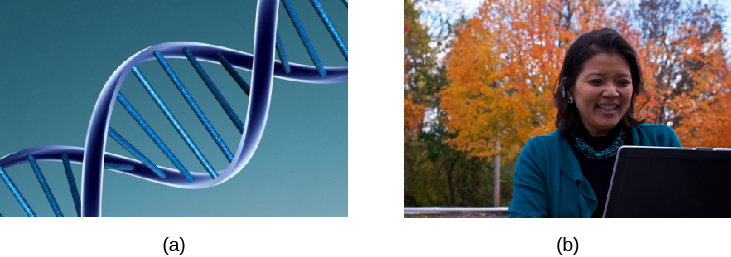
OpenStax, Rice University; Psychology 2e. (credit a: modification of work by Caroline Davis; credit b: modification of work by Cory Zanker) · CC BY 4.0 · Source出典
Figure 3.4図 3.4
(a) Genotype refers to the genetic makeup of an individual based on the genetic material (DNA) inherited from one’s genetic contributors. (b) Phenotype describes an individual’s observable characteristics, such as hair color, skin color, height, and build. (credit a: modification of work by Caroline Davis; credit b: modification of work by Cory Zanker)
(a)遺伝子型とは、遺伝上の提供者から受け継いだ遺伝物質(DNA)に基づく、個人の遺伝的構成を指す。(b)表現型とは、髪の色、肌の色、身長、体格など、個人の観察可能な特徴を表すものである。(出典a:Caroline Davisの作品を改変、出典b:Cory Zankerの作品を改変)
Note that, in genetics and reproduction, "parent" is often used to describe the individual organisms that contribute genetic material to offspring, usually in the form of gamete cells (sperm and egg). The concept of a genetic parent is distinct from social and legal concepts of parenthood, and may differ from those whom people consider their parents.
英語のヒント
なお、遺伝学や生殖の文脈では、「親」という語は、子に遺伝物質を提供する個々の生物を指すのによく使われる。その提供は、通常は配偶子(精子と卵)という形で行われる。遺伝上の親という概念は、社会的・法的な親という概念とは別のものであり、人々が自分の親と考える相手とは異なる場合がある。
Most traits are controlled by multiple genes, but some traits are controlled by one gene. A characteristic like cleft chin, for example, is influenced by a single gene from each parent. In this example, we will call the gene for cleft chin “B,” and the gene for smooth chin “b.” Cleft chin is a dominant trait, which means that having the dominant allele either from one parent (Bb) or both parents (BB) will always result in the phenotype associated with the dominant allele. When someone has two copies of the same allele, they are said to be homozygous for that allele. When someone has a combination of alleles for a given gene, they are said to be heterozygous. For example, smooth chin is a recessive trait, which means that an individual will only display the smooth chin phenotype if they are homozygous for that recessive allele (bb).
英語のヒント
ほとんどの特性は複数の遺伝子によって制御されているが、一つの遺伝子によって制御される特性もある。たとえば、割れあごのような特徴は、両親それぞれから受け継ぐ一つの遺伝子の影響を受ける。この例では、割れあごの遺伝子を「B」、割れていないなめらかなあごの遺伝子を「b」と呼ぶことにしよう。割れあごは優性の特性である。つまり、優性対立遺伝子を片方の親から(Bb)でも両方の親から(BB)でも受け継いでいれば、必ず優性対立遺伝子に対応する表現型が現れる。ある人が同じ対立遺伝子を二つ持っている場合、その人はその対立遺伝子についてホモ接合であるという。ある遺伝子について異なる対立遺伝子の組み合わせを持っている場合は、ヘテロ接合であるという。たとえば、なめらかなあごは劣性の特性である。つまり、なめらかなあごの表現型が現れるのは、その人がその劣性対立遺伝子についてホモ接合(bb)である場合に限られる。
Imagine that a person with a cleft chin mates with a person with a smooth chin. What type of chin will their offspring have? The answer to that depends on which alleles each parent carries. If the person with a cleft is homozygous for cleft chin (BB), their offspring will always have cleft chin. It gets a little more complicated, however, if the person is heterozygous for this gene (Bb). Since the other person has a smooth chin—therefore homozygous for the recessive allele (bb)—we can expect the offspring to have a 50% chance of having a cleft chin and a 50% chance of having a smooth chin (Figure 3.5).
英語のヒント
割れあごの人が、なめらかなあごの人とのあいだに子をもうけたとしよう。その子はどんなあごになるだろうか。その答えは、それぞれの親がどの対立遺伝子を持っているかによって決まる。割れあごの人が割れあごについてホモ接合(BB)であれば、子は必ず割れあごになる。しかし、その人がこの遺伝子についてヘテロ接合(Bb)である場合は、少し複雑になる。もう一方の親はなめらかなあごなので、劣性対立遺伝子についてホモ接合(bb)である。したがって、子が割れあごになる確率は50%、なめらかなあごになる確率は50%と予想できる(図3.5)。
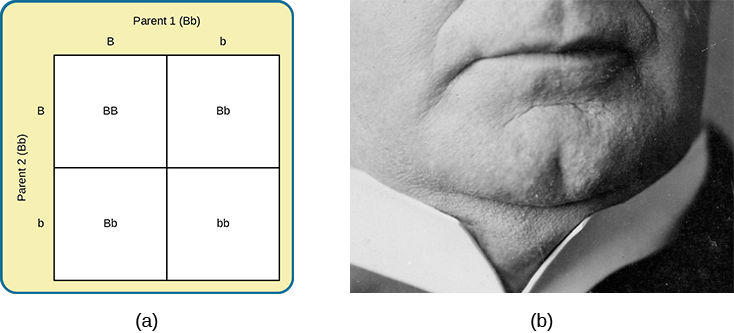
Figure 3.5図 3.5
(a) A Punnett square is a tool used to predict how genes will interact in the production of offspring. The capital B represents the dominant allele, and the lowercase b represents the recessive allele. In the example of the cleft chin, where B is cleft chin (dominant allele), wherever a pair contains the dominant allele, B, you can expect a cleft chin phenotype. You can expect a smooth chin phenotype only when there are two copies of the recessive allele, bb. (b) A cleft chin, shown here, is an inherited trait.
(a)パネットの方形は、子ができるときに遺伝子がどのように相互作用するかを予測するための道具である。大文字のBは優性対立遺伝子を、小文字のbは劣性対立遺伝子を表す。Bが割れあご(優性対立遺伝子)を表すこの割れあごの例では、組の中に優性対立遺伝子Bが含まれていればどこでも、割れあごの表現型が予想される。なめらかなあごの表現型が予想されるのは、劣性対立遺伝子が二つそろったbbの場合だけである。(b)ここに示した割れあごは、遺伝する特性である。
In sickle cell anemia, heterozygous carriers (like Luwi from the example) can develop blood resistance to malaria infection while those who are homozygous (like Sena, who did not have the genetic variant) may develop malaria, a potentially lethal blood disorder. Others who are homozygous (by having two copies of the sickle cell gene) have sickle-cell anemia, another potentially lethal blood disorder. Sickle-cell anemia is just one of many genetic disorders caused by the pairing of two recessive genes. For example, phenylketonuria (PKU) is a condition in which individuals lack an enzyme that normally converts harmful amino acids into harmless byproducts. If someone with this condition goes untreated, they will experience significant deficits in cognitive function, seizures, and an increased risk of various psychiatric disorders. Because PKU is a recessive trait, each parent must have at least one copy of the recessive allele in order to produce a child with the condition (Figure 3.6).
英語のヒント
鎌状赤血球貧血症の場合、(先の例のルウィのような)ヘテロ接合の保因者は、血液がマラリア感染への抵抗性を持つようになりうる。一方、(遺伝的変異型を持っていなかったセナのように)ホモ接合の人は、命にかかわりうる血液障害であるマラリアを発症するかもしれない。(鎌状赤血球の遺伝子を二つ持つことで)ホモ接合となっているほかの人々は、命にかかわりうるもう一つの血液障害である鎌状赤血球貧血症を抱えている。鎌状赤血球貧血症は、二つの劣性遺伝子の組み合わせによって引き起こされる多くの遺伝性障害の一つにすぎない。たとえば、フェニルケトン尿症(PKU)は、有害なアミノ酸を無害な副産物へと通常は変換する酵素が欠けている病態である。この病態を持つ人が治療を受けないままでいると、認知機能の著しい欠損、発作、さまざまな精神医学的障害のリスクの増加が生じる。PKUは劣性の特性なので、この病態を持つ子が生まれるためには、両親がそれぞれ少なくとも一つの劣性対立遺伝子を持っていなければならない(図3.6)。
So far, we have discussed traits that involve just one gene, but few human characteristics are controlled by a single gene. Most traits are polygenic: controlled by more than one gene. Height is one example of a polygenic trait, as are skin color and weight.
英語のヒント
ここまでは一つの遺伝子だけがかかわる特性を論じてきたが、一つの遺伝子によって制御される人間の特徴はほとんどない。ほとんどの特性は多遺伝子性、つまり二つ以上の遺伝子によって制御されている。身長は多遺伝子性の特性の一例であり、肌の色や体重も同様である。
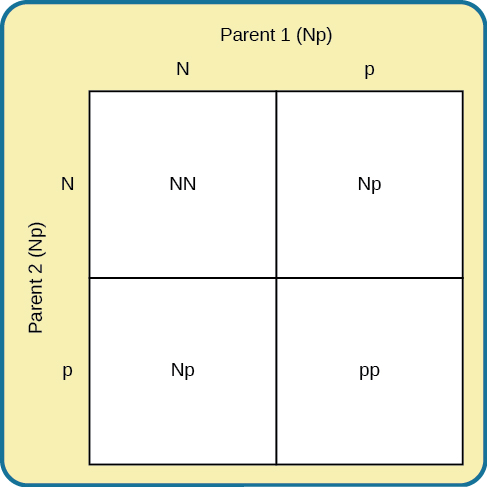


Figure 3.6図 3.6
In this Punnett square, N represents the normal allele, and p represents the recessive allele that is associated with PKU. If two individuals mate who are both heterozygous for the allele associated with PKU, their offspring have a 25% chance of expressing the PKU phenotype.
このパネットの方形では、Nは正常な対立遺伝子を、pはPKUに関連する劣性対立遺伝子を表す。PKUに関連する対立遺伝子についてともにヘテロ接合である二人のあいだに子ができる場合、その子がPKUの表現型を示す確率は25%である。
Where do harmful genes that contribute to diseases like PKU come from? Gene mutations provide one source of harmful genes. A mutation is a sudden, permanent change in a gene. While many mutations can be harmful or lethal, once in a while, a mutation benefits an individual by giving that person an advantage over those who do not have the mutation. Recall that the theory of evolution asserts that individuals best adapted to their particular environments are more likely to reproduce and pass on their genes to future generations. In order for this process to occur, there must be competition—more technically, there must be variability in genes (and resultant traits) that allow for variation in adaptability to the environment. If a population consisted of identical individuals, then any dramatic changes in the environment would affect everyone in the same way, and there would be no variation in selection. In contrast, diversity in genes and associated traits allows some individuals to perform slightly better than others when faced with environmental change. This creates a distinct advantage for individuals best suited for their environments in terms of successful reproduction and genetic transmission.
英語のヒント
PKUのような病気の原因となる有害な遺伝子は、どこから来るのだろうか。遺伝子の突然変異は、有害な遺伝子の供給源の一つである。突然変異とは、遺伝子に起こる突然の永続的な変化である。多くの突然変異は有害にも致死的にもなりうるが、ときには、突然変異を持たない人に対する優位性をその人に与えることで、突然変異が個人の利益になることもある。進化論が、それぞれの環境に最もよく適応した個体ほど、繁殖して自分の遺伝子を将来の世代に受け渡す可能性が高いと主張していることを思い出そう。この過程が起こるためには、競争がなければならない。より専門的に言えば、環境への適応力のばらつきを可能にする、遺伝子(とその結果として生じる特性)の変動性がなければならない。もしある集団が同一の個体だけから成っていたとしたら、環境の劇的な変化はどれも全員に同じように影響し、選択にばらつきは生じないだろう。これに対して、遺伝子とそれに関連する特性に多様性があれば、環境の変化に直面したときに、一部の個体がほかの個体よりもわずかにうまくやっていける。このことが、繁殖の成功と遺伝子の伝達という点で、環境に最も適した個体にはっきりとした優位性を生み出すのである。