第3章生物心理学
Other Areas of the Forebrain前脳のほかの領域
Other areas of the forebrain, located beneath the cerebral cortex, include the thalamus and the limbic system. The thalamus is a sensory relay for the brain. All of our senses, with the exception of smell, are routed through the thalamus before being directed to other areas of the brain for processing (Figure 3.22).
英語のヒント
大脳皮質の下にある前脳のほかの領域には、視床と大脳辺縁系がある。視床は脳にとっての感覚の中継所である。私たちの感覚は、嗅覚を除いてすべて、処理のために脳のほかの領域へ送られる前に視床を経由する(図3.22)。
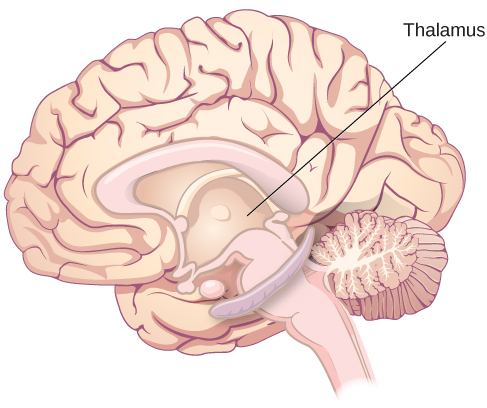
Figure 3.22図 3.22
The thalamus serves as the relay center of the brain where most senses are routed for processing.
視床は脳の中継中枢として働き、ほとんどの感覚は処理のためにここを経由する。
The limbic system is involved in processing both emotion and memory. Interestingly, the sense of smell projects directly to the limbic system; therefore, not surprisingly, smell can evoke emotional responses in ways that other sensory modalities cannot. The limbic system is made up of a number of different structures, but three of the most important are the hippocampus, the amygdala, and the hypothalamus (Figure 3.23). The hippocampus is an essential structure for learning and memory. The amygdala is involved in our experience of emotion and in tying emotional meaning to our memories. The hypothalamus regulates a number of homeostatic processes, including the regulation of body temperature, appetite, and blood pressure. The hypothalamus also serves as an interface between the nervous system and the endocrine system and in the regulation of sexual motivation and behavior.
英語のヒント
大脳辺縁系は、感情と記憶の両方の処理にかかわっている。興味深いことに、嗅覚は大脳辺縁系へ直接投射している。したがって、嗅覚が、ほかの感覚様相にはできない形で感情的な反応を呼び起こしうるのも、驚くにはあたらない。大脳辺縁系はさまざまな構造から成るが、中でも最も重要な三つは、海馬、扁桃体、視床下部である(図3.23)。海馬は学習と記憶に不可欠な構造である。扁桃体は、私たちが感情を経験することと、記憶に感情的な意味を結びつけることにかかわっている。視床下部は、体温、食欲、血圧の調節を含む、恒常性にかかわるいくつかの過程を調節している。視床下部はまた、神経系と内分泌系の間のインターフェースとして働き、性的動機づけと性行動の調節にもかかわっている。
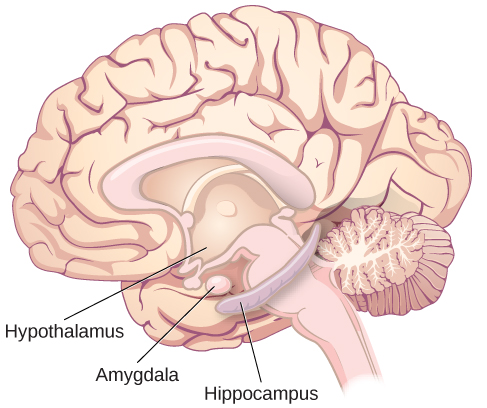
Figure 3.23図 3.23
The limbic system is involved in mediating emotional response and memory.
大脳辺縁系は、感情的な反応と記憶の媒介にかかわっている。
The Case of Henry Molaison (H.M.)ヘンリー・モレゾン(H.M.)の事例
In 1953, Henry Gustav Molaison (H. M.) was a 27-year-old man who experienced severe seizures. In an attempt to control his seizures, H. M. underwent brain surgery to remove his hippocampus and amygdala. Following the surgery, H.M’s seizures became much less severe, but he also suffered some unexpected—and devastating—consequences of the surgery: he lost his ability to form many types of new memories. For example, he was unable to learn new facts, such as who was president of the United States. He was able to learn new skills, but afterward he had no recollection of learning them. For example, while he might learn to use a computer, he would have no conscious memory of ever having used one. He could not remember new faces, and he was unable to remember events, even immediately after they occurred. Researchers were fascinated by his experience, and he is considered one of the most studied cases in medical and psychological history (Hardt, Einarsson, & Nader, 2010; Squire, 2009). Indeed, his case has provided tremendous insight into the role that the hippocampus plays in the consolidation of new learning into explicit memory.
英語のヒント
1953年、ヘンリー・グスタフ・モレゾン(H.M.)は、重い発作に苦しむ27歳の男性だった。発作を抑えようとして、H.M.は海馬と扁桃体を取り除く脳手術を受けた。手術の後、H.M.の発作はずっと軽くなったが、同時に彼は、手術による予想外の、しかも壊滅的な結果にも見舞われた。多くの種類の新しい記憶を形成する能力を失ったのである。たとえば、誰がアメリカ大統領であるかといった新しい事実を覚えられなかった。新しい技能を身につけることはできたが、後になると、それを学んだという記憶がまったくなかった。たとえば、コンピューターの使い方を覚えることはあっても、それを一度でも使ったことがあるという意識的な記憶はまったくなかっただろう。新しい顔を覚えられず、出来事も、それが起きた直後でさえ思い出せなかった。研究者たちは彼の経験に強く引きつけられ、彼は医学と心理学の歴史の中で最もよく研究された事例の一つとされている(Hardt, Einarsson, & Nader, 2010; Squire, 2009)。実際、彼の事例は、新しい学習を顕在記憶へと固定するうえで海馬が果たす役割について、きわめて大きな洞察をもたらしてきた。
Midbrain and Hindbrain Structures中脳と後脳の構造
The midbrain is comprised of structures located deep within the brain, between the forebrain and the hindbrain. The reticular formation is centered in the midbrain, but it actually extends up into the forebrain and down into the hindbrain. The reticular formation is important in regulating the sleep/wake cycle, arousal, alertness, and motor activity.
英語のヒント
中脳は、前脳と後脳の間の、脳の奥深くにある構造から成る。網様体は中脳を中心としているが、実際には、上は前脳へ、下は後脳へと広がっている。網様体は、睡眠・覚醒のサイクル、覚醒、注意力、運動活動の調節において重要である。
The substantia nigra (Latin for “black substance”) and the ventral tegmental area (VTA) are also located in the midbrain (Figure 3.24). Both regions contain cell bodies that produce the neurotransmitter dopamine, and both are critical for movement. Degeneration of the substantia nigra and VTA is involved in Parkinson’s disease. In addition, these structures are involved in mood, reward, and addiction (Berridge & Robinson, 1998; Gardner, 2011; George, Le Moal, & Koob, 2012).
英語のヒント
黒質(ラテン語で「黒い物質」の意味)と腹側被蓋野(VTA)も中脳にある(図3.24)。どちらの領域にも、神経伝達物質ドーパミンを産生する細胞体があり、どちらも運動にとってきわめて重要である。黒質とVTAの変性は、パーキンソン病にかかわっている。さらに、これらの構造は気分、報酬、依存症にもかかわっている(Berridge & Robinson, 1998; Gardner, 2011; George, Le Moal, & Koob, 2012)。
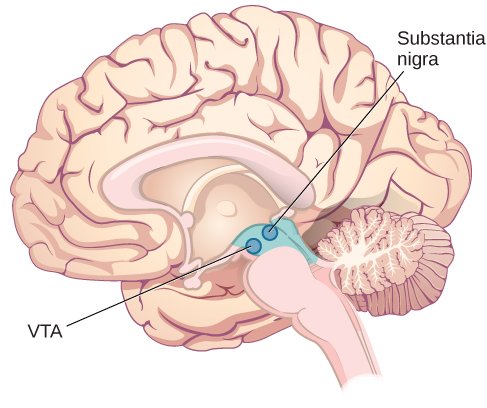
Figure 3.24図 3.24
The substantia nigra and ventral tegmental area (VTA) are located in the midbrain.
黒質と腹側被蓋野(VTA)は中脳にある。
The hindbrain is located at the back of the head and looks like an extension of the spinal cord. It contains the medulla, pons, and cerebellum (Figure 3.25). The medulla controls the automatic processes of the autonomic nervous system, such as breathing, blood pressure, and heart rate. The word pons literally means “bridge,” and as the name suggests, the pons serves to connect the hindbrain to the rest of the brain. It also is involved in regulating brain activity during sleep. The medulla, pons, and various structures are known as the brainstem, and aspects of the brainstem span both the midbrain and the hindbrain.
英語のヒント
後脳は頭の後ろ側にあり、脊髄が延長したもののように見える。後脳には延髄、橋、小脳が含まれる(図3.25)。延髄は、呼吸、血圧、心拍数など、自律神経系の自動的な過程を制御している。ponsという語は文字どおり「橋」を意味し、その名のとおり、橋は後脳を脳のほかの部分とつなぐ働きをしている。橋はまた、睡眠中の脳の活動の調節にもかかわっている。延髄、橋、そのほかのさまざまな構造は脳幹と呼ばれ、脳幹の一部は中脳と後脳の両方にまたがっている。
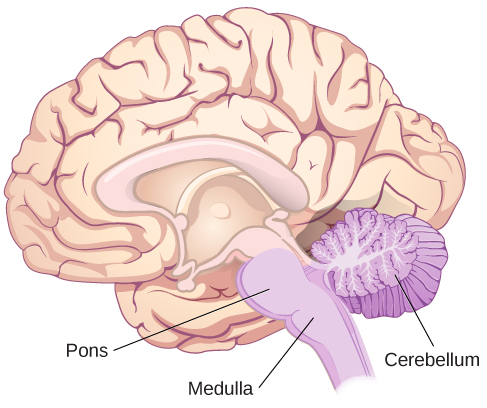


Figure 3.25図 3.25
The pons, medulla, and cerebellum make up the hindbrain.
橋、延髄、小脳が後脳を構成している。
The cerebellum (Latin for “little brain”) receives messages from muscles, tendons, joints, and structures in our ear to control balance, coordination, movement, and motor skills. The cerebellum is also thought to be an important area for processing some types of memories. In particular, procedural memory, or memory involved in learning and remembering how to perform tasks, is thought to be associated with the cerebellum. Recall that H. M. was unable to form new explicit memories, but he could learn new tasks. This is likely due to the fact that H. M.’s cerebellum remained intact.
英語のヒント
小脳(ラテン語で「小さな脳」の意味)は、筋肉、腱、関節、耳の中の構造からメッセージを受け取り、平衡、協調、運動、運動技能を制御している。小脳は、ある種の記憶の処理にとって重要な領域でもあると考えられている。とくに手続き記憶、すなわち課題の遂行のしかたを学び、覚えておくことにかかわる記憶は、小脳と関連していると考えられている。H.M.は新しい顕在記憶を形成できなかったが、新しい課題を学ぶことはできたことを思い出そう。これはおそらく、H.M.の小脳が損なわれずに残っていたためである。