第3章生物心理学
3.1 Human Genetics3.1 人間の遺伝学
Learning Objectives学習目標
By the end of this section, you will be able to:
この節を学び終えると、次のことができるようになる。
- Explain the basic principles of the theory of evolution by natural selection自然選択による進化論の基本原理を説明する
- Describe the differences between genotype and phenotype遺伝子型と表現型の違いを述べる
- Discuss how gene-environment interactions are critical for expression of physical and psychological characteristics身体的特徴と心理的特徴の発現にとって、遺伝子と環境の相互作用がいかに決定的に重要であるかを論じる
Psychological researchers study genetics in order to better understand the biological factors that contribute to certain behaviors. While all humans share certain biological mechanisms, we are each unique. And while our bodies have many of the same parts—brains and hormones and cells with genetic codes—these are expressed in a wide variety of behaviors, thoughts, and reactions.
英語のヒント
心理学の研究者が遺伝学を研究するのは、特定の行動に寄与する生物学的要因をよりよく理解するためである。人間はみな一定の生物学的な仕組みを共有しているが、私たちは一人ひとり唯一無二の存在である。また、私たちの身体には、脳、ホルモン、遺伝暗号を持つ細胞といった同じ部分が数多くあるが、それらは実に多様な行動、思考、反応となって表れる。
Why do two people infected by the same disease have different outcomes: one surviving and one succumbing to the ailment? How are genetic diseases passed through family lines? Are there genetic components to psychological disorders, such as depression or schizophrenia? To what extent might there be a psychological basis to health conditions such as childhood obesity?
英語のヒント
同じ病気に感染した二人の結果が分かれ、一人は生き延び、もう一人はその病気で命を落とすのはなぜだろうか。遺伝病は、家系を通じてどのように受け継がれていくのか。うつ病や統合失調症のような心理的障害には、遺伝的な要素があるのだろうか。小児肥満のような健康状態には、どの程度まで心理的な基盤がありうるのだろうか。
To explore these questions, let’s start by focusing on a specific genetic disorder, sickle cell anemia, and how it might manifest in two affected sisters. Sickle-cell anemia is a genetic condition in which red blood cells, which are normally round, take on a crescent-like shape (Figure 3.2). The changed shape of these cells affects how they function: sickle-shaped cells can clog blood vessels and block blood flow, leading to high fever, severe pain, swelling, and tissue damage.
英語のヒント
こうした問いを探るために、まず特定の遺伝性障害である鎌状赤血球貧血症と、それがこの病気の影響を受ける二人の姉妹にどのように現れうるかに焦点を当てることから始めよう。鎌状赤血球貧血症は、通常は丸い形をしている赤血球が三日月のような形になる遺伝性の病態である(図3.2)。細胞の形が変わると、その働きにも影響が出る。鎌状になった細胞は血管を詰まらせて血流をさえぎることがあり、その結果、高熱、激しい痛み、腫れ、組織の損傷が生じる。
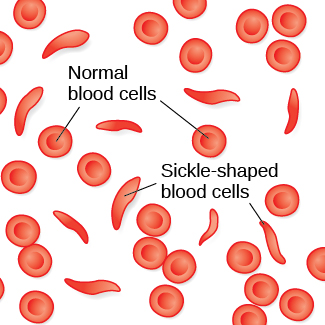
Figure 3.2図 3.2
Normal blood cells travel freely through the blood vessels, while sickle-shaped cells form blockages preventing blood flow.
正常な血球は血管の中を自由に移動するが、鎌状の細胞は詰まりをつくり、血流を妨げる。
Many people with sickle-cell anemia—and the particular genetic mutation that causes it—die at an early age. While the notion of “survival of the fittest” may suggest that people with this disorder have a low survival rate and therefore the disorder will become less common, this is not the case. Despite the negative evolutionary effects associated with this genetic mutation, the sickle-cell gene remains relatively common among people of African descent. Why is this? The explanation is illustrated with the following scenario.
英語のヒント
鎌状赤血球貧血症と、その原因となる特定の遺伝的突然変異とを持つ人の多くは、若くして亡くなる。「適者生存」という考え方からすると、この障害を持つ人は生存率が低く、そのためこの障害はしだいに少なくなっていくように思えるかもしれないが、実際はそうではない。この遺伝的突然変異には進化の上で不利な影響が伴うにもかかわらず、鎌状赤血球の遺伝子は、アフリカ系の人々のあいだで比較的よく見られるままである。なぜだろうか。その説明を、次のシナリオで示そう。
Imagine two young women—Luwi and Sena—sisters in rural Zambia, Africa. Luwi carries the gene for sickle-cell anemia; Sena does not carry the gene. Sickle-cell carriers have one copy of the sickle-cell gene but do not have full-blown sickle-cell anemia. They experience symptoms only if they are severely dehydrated or are deprived of oxygen (as in mountain climbing). Carriers are thought to be immune to malaria (an often deadly disease that is widespread in tropical climates) because changes in their blood chemistry and immune functioning prevent the malaria parasite from having its effects (Gong, Parikh, Rosenthal, & Greenhouse, 2013). However, full-blown sickle-cell anemia, with two copies of the sickle-cell gene, does not provide immunity to malaria.
英語のヒント
アフリカのザンビアの農村に暮らす姉妹、ルウィとセナという二人の若い女性を想像してほしい。ルウィは鎌状赤血球貧血症の遺伝子を持っているが、セナはその遺伝子を持っていない。鎌状赤血球の保因者は、鎌状赤血球の遺伝子を一つ持っているが、本格的な鎌状赤血球貧血症を発症してはいない。保因者に症状が出るのは、ひどい脱水状態になったときや、(登山のときのように)酸素が不足したときだけである。保因者はマラリア(熱帯の気候で広く見られ、しばしば命を奪う病気)に対して免疫があると考えられている。血液の化学的性質と免疫の働きが変化しているために、マラリア原虫がその作用を及ぼせなくなるからである(Gong, Parikh, Rosenthal, & Greenhouse, 2013)。しかし、鎌状赤血球の遺伝子を二つ持つ、本格的な鎌状赤血球貧血症の場合には、マラリアに対する免疫は得られない。
While walking home from school, both sisters are bitten by mosquitoes carrying the malaria parasite. Luwi is protected against malaria because she carries the sickle-cell mutation. Sena, on the other hand, develops malaria and dies just two weeks later. Luwi survives and eventually has children, to whom she may pass on the sickle-cell mutation.
英語のヒント
学校から歩いて帰る途中、姉妹は二人とも、マラリア原虫を持つ蚊に刺される。ルウィは鎌状赤血球の突然変異を持っているので、マラリアから守られる。一方セナはマラリアを発症し、わずか2週間後に亡くなる。ルウィは生き延び、やがて子どもを持つ。その子どもたちに、彼女は鎌状赤血球の突然変異を受け渡すかもしれない。
Malaria is rare in the United States, so the sickle-cell gene benefits nobody: the gene manifests primarily in minor health problems for carriers with one copy, or a severe full-blown disease with no health benefits for carriers with two copies. However, the situation is quite different in other parts of the world. In parts of Africa where malaria is prevalent, having the sickle-cell mutation does provide health benefits for carriers (protection from malaria).
英語のヒント
アメリカではマラリアはまれなので、鎌状赤血球の遺伝子は誰の利益にもならない。この遺伝子が現れるのは主に、一つだけ持つ保因者の場合は軽い健康上の問題として、二つ持つ人の場合は健康上の利点が何もない重い本格的な病気としてである。しかし、世界のほかの地域では状況がまったく異なる。マラリアが広まっているアフリカの一部の地域では、鎌状赤血球の突然変異を持つことは、保因者に確かに健康上の利点(マラリアからの保護)をもたらすのである。
The story of malaria fits with Charles Darwin's theory of evolution by natural selection (Figure 3.3). In simple terms, the theory states that organisms that are better suited for their environment will survive and reproduce, while those that are poorly suited for their environment will die off. In our example, we can see that, as a carrier, Luwi’s mutation is highly adaptive in her African homeland; however, if she resided in the United States (where malaria is rare), her mutation could prove costly—with a high probability of the disease in her descendants and minor health problems of her own.
英語のヒント
マラリアの話は、チャールズ・ダーウィンの自然選択による進化論とよく合う(図3.3)。簡単に言えば、この理論は、環境によりよく適した生物は生き延びて繁殖し、環境にあまり適していない生物は死に絶える、と述べている。私たちの例でいえば、保因者であるルウィの突然変異は、アフリカの故郷ではきわめて適応的であることが分かる。しかし、もし彼女が(マラリアのまれな)アメリカに住んでいるとしたら、その突然変異は高くつくものになりうる。子孫にこの病気が現れる確率が高く、彼女自身にも軽い健康上の問題が生じるからである。
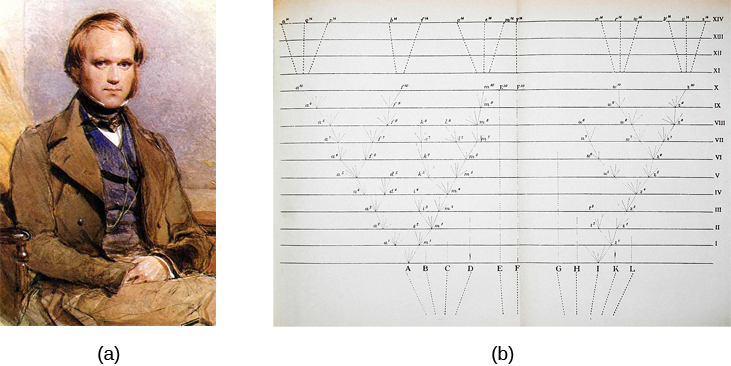


Figure 3.3図 3.3
(a) In 1859, Charles Darwin proposed his theory of evolution by natural selection in his book, On the Origin of Species. (b) The book contains just one illustration: this diagram that shows how species evolve over time through natural selection.
(a)1859年、チャールズ・ダーウィンは著書『種の起源』の中で、自然選択による進化論を提唱した。(b)この本に収められた図はただ一つ、種が自然選択を通して時間とともにどのように進化するかを示した、この図だけである。