第3章生物心理学
Gene-Environment Interactions遺伝子と環境の相互作用
Genes do not exist in a vacuum. Although we are all biological organisms, we also exist in an environment that is incredibly important in determining not only when and how our genes express themselves, but also in what combination. Each of us represents a unique interaction between our genetic makeup and our environment; range of reaction is one way to describe this interaction. Range of reaction asserts that our genes set the boundaries within which we can operate, and our environment interacts with the genes to determine where in that range we will fall. For example, if an individual’s genetic makeup predisposes them to high levels of intellectual potential and they are reared in a rich, stimulating environment, then they will be more likely to achieve full potential than if they were raised under conditions of significant deprivation. According to the concept of range of reaction, genes set definite limits on potential, and environment determines how much of that potential is achieved. Some disagree with this theory and argue that genes do not set a limit on a person’s potential with reaction norms being determined by the environment. For example, when individuals experience neglect or abuse early in life, they are more likely to exhibit adverse psychological and/or physical conditions that can last throughout their lives. These conditions may develop as a function of the negative environmental experiences in individuals from dissimilar genetic backgrounds (Miguel, Pereira, Silveira, & Meaney, 2019; Short & Baram, 2019).
英語のヒント
遺伝子は真空の中に存在しているわけではない。私たちはみな生物だが、同時に環境の中にも存在しており、その環境は、遺伝子がいつ、どのように発現するかだけでなく、どのような組み合わせで発現するかを決めるうえでも、きわめて重要である。私たちは一人ひとり、遺伝的構成と環境とのあいだの独自の相互作用を体現している。反応範囲は、この相互作用を記述する一つの方法である。反応範囲の考え方は、遺伝子は私たちが働きうる範囲の境界を定め、環境は遺伝子と相互作用して、私たちがその範囲のどこに位置するかを決める、と主張する。たとえば、ある人の遺伝的構成がその人を高い水準の知的潜在能力へと方向づけていて、しかも豊かで刺激に満ちた環境で育てられたとすれば、その人は、著しく恵まれない条件のもとで育てられた場合よりも、潜在能力を十分に発揮する可能性が高いだろう。反応範囲の概念によれば、遺伝子は潜在能力にはっきりとした限界を設け、環境はその潜在能力のどれだけが実現されるかを決める。この理論に反対し、遺伝子が人の潜在能力に限界を設けることはなく、反応規準は環境によって決まる、と論じる人もいる。たとえば、人生の早い時期にネグレクトや虐待を経験した人は、生涯続きうる心理的な不調や身体的な不調(あるいはその両方)を示す可能性が高い。こうした状態は、遺伝的背景の異なる人々において、否定的な環境経験に応じて生じうる(Miguel, Pereira, Silveira, & Meaney, 2019; Short & Baram, 2019)。
Another perspective on the interaction between genes and the environment is the concept of genetic environmental correlation. Stated simply, our genes influence our environment, and our environment influences the expression of our genes (Figure 3.7). Not only do our genes and environment interact, as in range of reaction, but they also influence one another bidirectionally. For example, the child of an NBA player would probably be exposed to basketball from an early age. Such exposure might allow the child to realize their full genetic, athletic potential. Thus, the parents’ genes, which the child shares, influence the child’s environment, and that environment, in turn, is well suited to support the child’s genetic potential.
英語のヒント
遺伝子と環境の相互作用についてのもう一つの視点は、遺伝−環境相関という概念である。簡単に言えば、遺伝子は環境に影響し、環境は遺伝子の発現に影響する(図3.7)。反応範囲の場合のように遺伝子と環境が相互作用するだけでなく、両者は双方向に影響し合うのである。たとえば、NBA選手の子どもは、おそらく幼いころからバスケットボールに触れることになるだろう。そうした経験によって、その子は遺伝的・運動的な潜在能力を十分に発揮できるようになるかもしれない。このように、子も共有している親の遺伝子が子の環境に影響し、今度はその環境が、子の遺伝的な潜在能力を支えるのによく適したものになっているのである。
OpenStax, Rice University; Psychology 2e. (credit "puzzle": modification of work by Cory Zanker) · CC BY 4.0 · Source出典

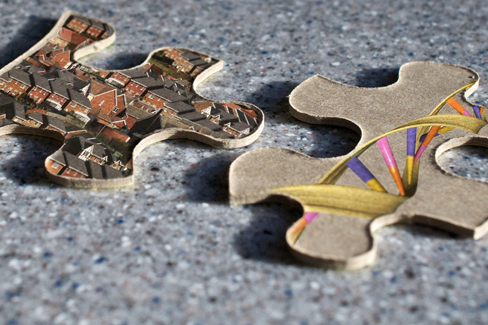
Figure 3.7図 3.7
Nature and nurture work together like complex pieces of a human puzzle. The interaction of our environment and genes makes us the individuals we are. (credit "puzzle": modification of work by Cory Zanker)
生まれと育ちは、人間というパズルの複雑なピースのように、ともに働く。環境と遺伝子の相互作用が、私たちを今の私たちにしている。(出典「パズル」:Cory Zankerの作品を改変)
In another approach to gene-environment interactions, the field of epigenetics looks beyond the genotype itself and studies how the same genotype can be expressed in different ways. In other words, researchers study how the same genotype can lead to very different phenotypes. As mentioned earlier, gene expression is often influenced by environmental context in ways that are not entirely obvious. For instance, identical twins share the same genetic information (identical twins develop from a single fertilized egg that split, so the genetic material is exactly the same in each; in contrast, fraternal twins usually result from two different eggs fertilized by different sperm, so the genetic material varies as with non-twin siblings). But even with identical genes, there remains an incredible amount of variability in how gene expression can unfold over the course of each twin’s life. Sometimes, one twin will develop a disease and the other will not. In one example, Aliya, an identical twin, died from cancer at age 7, but her twin, now 19 years old, has never had cancer. Although these individuals share an identical genotype, their phenotypes differ as a result of how that genetic information is expressed over time and through their unique environmental interactions. The epigenetic perspective is very different from range of reaction, because here the genotype is not fixed and limited.
英語のヒント
遺伝子と環境の相互作用へのもう一つのアプローチとして、エピジェネティクスの分野は、遺伝子型そのものの先に目を向け、同じ遺伝子型がどのようにして異なる形で発現しうるかを研究する。言い換えれば、研究者たちは、同じ遺伝子型がどのようにしてまったく異なる表現型につながりうるかを研究するのである。先に述べたように、遺伝子の発現は、必ずしもはっきりとは分からない形で、環境の文脈の影響を受けることが多い。たとえば、一卵性双生児は同じ遺伝情報を共有している(一卵性双生児は分裂した一つの受精卵から発生するので、それぞれの遺伝物質はまったく同じである。これに対して、二卵性双生児は通常、別々の精子によって受精した二つの異なる卵から生じるので、遺伝物質は双子でないきょうだいと同じように異なる)。しかし、遺伝子が同一であっても、それぞれの双子の生涯を通じて遺伝子の発現がどのように展開しうるかには、驚くほど大きなばらつきが残る。双子の一方が病気を発症し、もう一方は発症しないこともある。ある例では、一卵性双生児のアリヤは7歳でがんのために亡くなったが、双子のきょうだいは現在19歳で、一度もがんにかかったことがない。この二人は同一の遺伝子型を共有しているが、その遺伝情報が時間の経過の中で、また二人それぞれの独自の環境との相互作用を通して、どのように発現するかによって、表現型が異なっている。エピジェネティクスの視点は反応範囲とは大きく異なる。ここでは遺伝子型が固定されておらず、限界も定められていないからである。
Genes affect more than our physical characteristics. Indeed, scientists have found genetic linkages to a number of behavioral characteristics, ranging from basic personality traits to sexual orientation to spirituality (for examples, see Mustanski et al., 2005; Comings, Gonzales, Saucier, Johnson, & MacMurray, 2000). Genes are also associated with temperament and a number of psychological disorders, such as depression and schizophrenia. So while it is true that genes provide the biological blueprints for our cells, tissues, organs, and body, they also have a significant impact on our experiences and our behaviors.
英語のヒント
遺伝子が影響を及ぼすのは、身体的な特徴だけではない。実際、科学者たちは、基本的なパーソナリティ特性から性的指向、スピリチュアリティに至るまで、さまざまな行動上の特徴に遺伝的なつながりがあることを見いだしてきた(例として、Mustanski et al., 2005; Comings, Gonzales, Saucier, Johnson, & MacMurray, 2000を参照)。遺伝子はまた、気質や、うつ病や統合失調症などの多くの心理的障害とも関連している。つまり、遺伝子が細胞、組織、器官、身体の生物学的な設計図となっているのは確かだが、遺伝子は私たちの経験や行動にも大きな影響を与えているのである。
Let’s look at the following findings regarding schizophrenia in light of our three views of gene-environment interactions. Which view do you think best explains this evidence?
英語のヒント
統合失調症についての次の研究結果を、遺伝子と環境の相互作用についての三つの見方に照らして見てみよう。この証拠を最もよく説明しているのは、どの見方だと思うか。
In a 2004 study by Tienari and colleagues, adoptees whose biological mothers had schizophrenia and who had been raised in a disturbed family environment were much more likely to develop schizophrenia or another psychotic disorder than were any of the other groups in the study:
英語のヒント
ティエナリらによる2004年の研究では、生物学上の母親が統合失調症で、なおかつ乱れた家庭環境で育てられた養子は、この研究のほかのどの群と比べても、統合失調症やほかの精神病性障害を発症する可能性がはるかに高かった。
- Of adoptees whose biological mothers had schizophrenia (high genetic risk) and who were raised in disturbed family environments, 36.8% were likely to develop schizophrenia.生物学上の母親が統合失調症で(遺伝的リスクが高い)、乱れた家庭環境で育てられた養子では、統合失調症を発症する確率が36.8%であった。
- Of adoptees whose biological mothers had schizophrenia (high genetic risk) and who were raised in healthy family environments, 5.8% were likely to develop schizophrenia.生物学上の母親が統合失調症で(遺伝的リスクが高い)、健全な家庭環境で育てられた養子では、統合失調症を発症する確率が5.8%であった。
- Of adoptees with a low genetic risk (whose mothers did not have schizophrenia) and who were raised in disturbed family environments, 5.3% were likely to develop schizophrenia.遺伝的リスクが低く(母親が統合失調症ではなかった)、乱れた家庭環境で育てられた養子では、統合失調症を発症する確率が5.3%であった。
- Of adoptees with a low genetic risk (whose mothers did not have schizophrenia) and who were raised in healthy family environments, 4.8% were likely to develop schizophrenia.遺伝的リスクが低く(母親が統合失調症ではなかった)、健全な家庭環境で育てられた養子では、統合失調症を発症する確率が4.8%であった。
The study shows that adoptees with high genetic risk were most likely to develop schizophrenia if they were raised in disturbed home environments. This research lends credibility to the notion that both genetic vulnerability and environmental stress are necessary for schizophrenia to develop, and that genes alone do not tell the full tale.
英語のヒント
この研究は、遺伝的リスクの高い養子は、乱れた家庭環境で育てられた場合に、統合失調症を発症する可能性が最も高かったことを示している。この研究は、統合失調症が発症するには遺伝的な脆弱性と環境によるストレスの両方が必要であり、遺伝子だけでは話のすべてを語れない、という考えに信憑性を与えている。