第3章生物心理学
Forebrain Structures前脳の構造
The two hemispheres of the cerebral cortex are part of the forebrain (Figure 3.17), which is the largest part of the brain. The forebrain contains the cerebral cortex and a number of other structures that lie beneath the cortex (called subcortical structures): thalamus, hypothalamus, pituitary gland, and the limbic system (a collection of structures). The cerebral cortex, which is the outer surface of the brain, is associated with higher level processes such as consciousness, thought, emotion, reasoning, language, and memory. Each cerebral hemisphere can be subdivided into four lobes, each associated with different functions.
英語のヒント
大脳皮質の二つの半球は前脳の一部であり(図3.17)、前脳は脳の最大の部分である。前脳には、大脳皮質と、皮質の下にあるほかのいくつかの構造(皮質下構造と呼ばれる)が含まれる。視床、視床下部、下垂体、そして大脳辺縁系(いくつかの構造の集まり)である。大脳皮質は脳の外側の表面であり、意識、思考、感情、推論、言語、記憶といった高次の過程と関連している。大脳の各半球は四つの脳葉に細分でき、それぞれの脳葉が異なる機能と関連している。
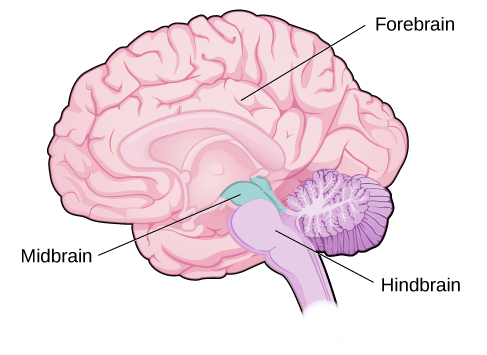
Figure 3.17図 3.17
The brain and its parts can be divided into three main categories: the forebrain, midbrain, and hindbrain.
脳とその部位は、前脳、中脳、後脳という三つの主な区分に分けられる。
Lobes of the Brain脳葉
The four lobes of the brain are the frontal, parietal, temporal, and occipital lobes (Figure 3.18). The frontal lobe is located in the forward part of the brain, extending back to a fissure known as the central sulcus. The frontal lobe is involved in reasoning, motor control, emotion, and language. It contains the motor cortex, which is involved in planning and coordinating movement; the prefrontal cortex, which is responsible for higher-level cognitive functioning; and Broca’s area, which is essential for language production.
英語のヒント
四つの脳葉は、前頭葉、頭頂葉、側頭葉、後頭葉である(図3.18)。前頭葉は脳の前方の部分にあり、中心溝と呼ばれる裂け目まで後ろへ広がっている。前頭葉は、推論、運動の制御、感情、言語にかかわっている。前頭葉には、運動の計画と協調にかかわる運動野、高次の認知機能を担う前頭前野、そして言語の産出に不可欠なブローカ野が含まれる。
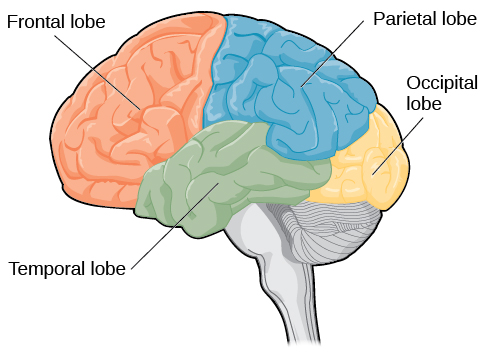
Figure 3.18図 3.18
The lobes of the brain are shown.
脳葉を示す。
People who suffer damage to Broca’s area have great difficulty producing language of any form (Figure 3.18). For example, Padma was an electrical engineer who was socially active and a caring, involved parent. About twenty years ago, she was in a car accident and suffered damage to her Broca’s area. She completely lost the ability to speak and form any kind of meaningful language. There is nothing wrong with her mouth or her vocal cords, but she is unable to produce words. She can follow directions but can’t respond verbally, and she can read but no longer write. She can do routine tasks like running to the market to buy milk, but she could not communicate verbally if a situation called for it.
英語のヒント
ブローカ野に損傷を負った人は、どのような形であれ言語を産出することが非常に難しくなる(図3.18)。たとえばパドマは電気技術者で、社会的に活発に活動し、思いやりがあって子育てにも積極的にかかわる親だった。約20年前、彼女は自動車事故にあい、ブローカ野に損傷を負った。話す能力と、意味のある言語をどんな形であれ組み立てる能力を、完全に失った。口や声帯にはどこも異常がないのに、言葉を発することができない。指示に従うことはできるが言葉で応じることはできず、読むことはできるがもはや書くことはできない。牛乳を買いに店まで出かけるといった日常的な作業はできるが、そうする必要のある状況になったとしても、言葉で意思を伝えることはできないだろう。
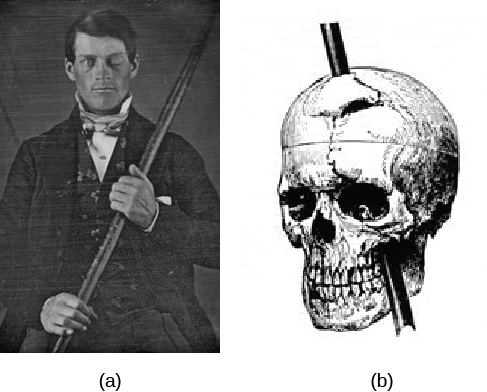
Probably the most famous case of frontal lobe damage is that of a man by the name of Phineas Gage. On September 13, 1848, Gage (age 25) was working as a railroad foreman in Vermont. He and his crew were using an iron rod to tamp explosives down into a blasting hole to remove rock along the railway’s path. Unfortunately, the iron rod created a spark and caused the rod to explode out of the blasting hole, into Gage’s face, and through his skull (Figure 3.19). Although lying in a pool of his own blood with brain matter emerging from his head, Gage was conscious and able to get up, walk, and speak. But in the months following his accident, people noticed that his personality had changed. Many of his friends described him as no longer being himself. Before the accident, it was said that Gage was a well-mannered, soft-spoken man, but he began to behave in odd and inappropriate ways after the accident. Such changes in personality would be consistent with loss of impulse control—a frontal lobe function.
英語のヒント
前頭葉の損傷の例として最も有名なのは、おそらくフィニアス・ゲージという名の男性の例である。1848年9月13日、ゲージ(25歳)はバーモント州で鉄道工事の現場監督として働いていた。彼と作業員たちは、線路の通り道にある岩を取り除くため、鉄の棒を使って発破孔に爆薬を突き固めていた。不運にも、鉄の棒が火花を起こし、そのせいで棒が発破孔から勢いよく飛び出して、ゲージの顔に突き刺さり、頭蓋骨を貫通した(図3.19)。自分の血だまりの中に横たわり、頭から脳の組織がはみ出していたにもかかわらず、ゲージは意識があり、起き上がり、歩き、話すことができた。しかし事故後の数か月のうちに、人々は彼のパーソナリティが変わってしまったことに気づいた。友人の多くは、彼はもはや以前の彼ではないと語った。事故の前、ゲージは礼儀正しく穏やかな話し方をする男性だったと言われていたが、事故の後は奇妙で不適切な振る舞いをするようになった。こうしたパーソナリティの変化は、前頭葉の機能である衝動の制御が失われたことと一致するだろう。
Beyond the damage to the frontal lobe itself, subsequent investigations into the rod's path also identified probable damage to pathways between the frontal lobe and other brain structures, including the limbic system. With connections between the planning functions of the frontal lobe and the emotional processes of the limbic system severed, Gage had difficulty controlling his emotional impulses.
英語のヒント
前頭葉そのものの損傷に加えて、棒が通った経路についてのその後の調査では、前頭葉と、大脳辺縁系を含むほかの脳構造とを結ぶ経路にも、損傷があった可能性が高いことが明らかになった。前頭葉の計画機能と大脳辺縁系の感情処理とのつながりが断たれたことで、ゲージは感情的な衝動を抑えることが難しくなったのである。
However, there is some evidence suggesting that the dramatic changes in Gage’s personality were exaggerated and embellished. Gage's case occurred in the midst of a 19th century debate over localization—regarding whether certain areas of the brain are associated with particular functions. On the basis of extremely limited information about Gage, the extent of his injury, and his life before and after the accident, scientists tended to find support for their own views, on whichever side of the debate they fell (Macmillan, 1999).
英語のヒント
しかし、ゲージのパーソナリティの劇的な変化は誇張され、脚色されていたことを示唆する証拠もある。ゲージの事例が起きたのは、機能の局在、すなわち脳の特定の領域が特定の機能と関連しているのかどうかをめぐる19世紀の論争のさなかだった。ゲージ本人、そのけがの程度、事故前後の生活についてのきわめて限られた情報をもとに、科学者たちは、論争のどちらの側に立っていたにせよ、自分自身の見解を支持する材料を見いだす傾向があった(Macmillan, 1999)。
OpenStax, Rice University; Psychology 2e. (credit a: modification of work by Jack and Beverly Wilgus) · CC BY 4.0 · Source出典
Figure 3.19図 3.19
(a) Phineas Gage holds the iron rod that penetrated his skull in an 1848 railroad construction accident. (b) Gage’s prefrontal cortex was severely damaged in the left hemisphere. The rod entered Gage’s face on the left side, passed behind his eye, and exited through the top of his skull, before landing about 80 feet away. (credit a: modification of work by Jack and Beverly Wilgus)
(a)1848年の鉄道建設工事の事故で自分の頭蓋骨を貫いた鉄の棒を手にするフィニアス・ゲージ。(b)ゲージの前頭前野は、左半球でひどく損傷した。棒はゲージの顔の左側から入り、目の後ろを通って頭蓋骨の上部から抜け、約80フィート先に落ちた。(出典a:Jack and Beverly Wilgusの作品を改変)
The brain’s parietal lobe is located immediately behind the frontal lobe, and is involved in processing information from the body’s senses. It contains the somatosensory cortex, which is essential for processing sensory information from across the body, such as touch, temperature, and pain. The somatosensory cortex is an area of the brain which processes touch and sensation. The somatosensory cortex is fascinating because each different area of the cortex processes sensations from a different part of your body. Furthermore, the larger the surface area of the specific body part and the greater amount of nerves in that body part, the larger the area dedicated to processing sensation from that body part in the somatosensory cortex. For example, fingers take up a lot more space than toes. As you can notice from (Figure 3.20), the amount of space to process sensation from fingers is much greater than that of toes.
英語のヒント
脳の頭頂葉は前頭葉のすぐ後ろにあり、体の感覚からの情報の処理にかかわっている。頭頂葉には体性感覚野が含まれる。体性感覚野は、触覚、温度、痛みなど、全身からの感覚情報を処理するのに不可欠である。体性感覚野は、触覚や感覚を処理する脳の領域である。体性感覚野が興味深いのは、皮質のそれぞれの領域が、体の異なる部位からの感覚を処理しているからである。さらに、体のある部位の表面積が大きいほど、またその部位にある神経の量が多いほど、体性感覚野の中でその部位からの感覚の処理に割り当てられる領域は大きくなる。たとえば、手の指は足の指よりもはるかに広い領域を占めている。図3.20から分かるように、手の指からの感覚を処理するための領域は、足の指のそれよりもずっと大きい。
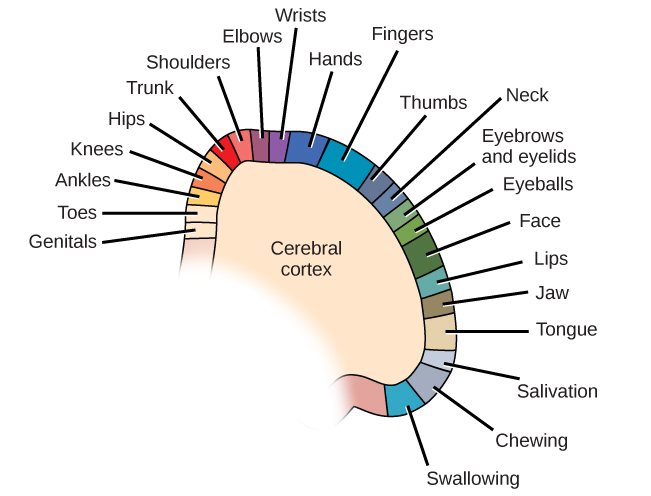
Figure 3.20図 3.20
Spatial relationships in the body are mirrored in the organization of the somatosensory cortex.
体の空間的な位置関係は、体性感覚野の構成に映し出されている。
The temporal lobe is located on the side of the head (temporal means “near the temples”), and is associated with hearing, memory, emotion, and some aspects of language. The auditory cortex, the main area responsible for processing auditory information, is located within the temporal lobe. Wernicke’s area, important for speech comprehension, is also located here. Whereas individuals with damage to Broca’s area have difficulty producing language, those with damage to Wernicke’s area can produce sensible language, but they are unable to understand it (Figure 3.21).
英語のヒント
側頭葉は頭の側面にあり(temporalは「こめかみの近くの」という意味である)、聴覚、記憶、感情、そして言語のいくつかの側面と関連している。聴覚情報の処理を担う主な領域である聴覚野は、側頭葉の中にある。話し言葉の理解に重要なウェルニッケ野も、ここにある。ブローカ野に損傷のある人が言語の産出に困難を抱えるのに対し、ウェルニッケ野に損傷のある人は、意味の通る言語を産出できるものの、それを理解できない(図3.21)。
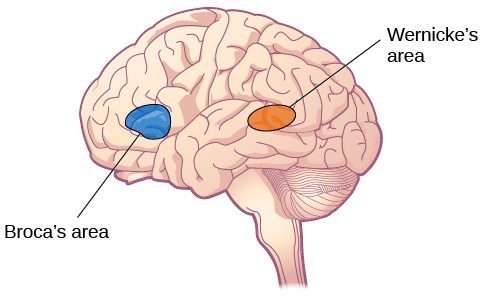


Figure 3.21図 3.21
Damage to either Broca’s area or Wernicke’s area can result in language deficits. The types of deficits are very different, however, depending on which area is affected.
ブローカ野とウェルニッケ野のどちらが損傷しても、言語の欠損が生じうる。しかし、欠損の種類は、どちらの領域が影響を受けたかによって大きく異なる。
The occipital lobe is located at the very back of the brain, and contains the primary visual cortex, which is responsible for interpreting incoming visual information. The occipital cortex is organized retinotopically, which means there is a close relationship between the position of an object in a person’s visual field and the position of that object’s representation on the cortex. You will learn much more about how visual information is processed in the occipital lobe when you study sensation and perception.
英語のヒント
後頭葉は脳のいちばん後ろにあり、一次視覚野を含んでいる。一次視覚野は、入ってくる視覚情報の解釈を担っている。後頭葉の皮質は網膜部位対応的に構成されている。つまり、人の視野の中での物体の位置と、その物体が皮質上で表象される位置との間に、密接な関係がある。視覚情報が後頭葉でどのように処理されるかについては、感覚と知覚を学ぶときに、さらに詳しく学ぶことになる。