第3章生物心理学
3.2 Cells of the Nervous System3.2 神経系の細胞
Learning Objectives学習目標
By the end of this section, you will be able to:
この節を学び終えると、次のことができるようになる。
- Identify the basic parts of a neuronニューロンの基本的な部位を特定する
- Describe how neurons communicate with each otherニューロンどうしがどのように情報を伝え合うかを説明する
- Explain how drugs act as agonists or antagonists for a given neurotransmitter system薬物が、ある神経伝達物質系に対してアゴニストやアンタゴニストとしてどのように働くかを説明する
Psychologists striving to understand the human mind may study the nervous system. Learning how the body's cells and organs function can help us understand the biological basis of human psychology. The nervous system is composed of two basic cell types: glial cells (also known as glia) and neurons. Glial cells are traditionally thought to play a supportive role to neurons, both physically and metabolically. Glial cells provide scaffolding on which the nervous system is built, help neurons line up closely with each other to allow neuronal communication, provide insulation to neurons, transport nutrients and waste products, and mediate immune responses. For years, researchers believed that there were many more glial cells than neurons; however, more recent work from Suzanna Herculano-Houzel's laboratory has called this long-standing assumption into question and has provided important evidence that there may be a nearly 1:1 ratio of glia cells to neurons. This is important because it suggests that human brains are more similar to other primate brains than previously thought (Azevedo et al, 2009; Herculano-Houzel, 2012; Herculano-Houzel, 2009). Neurons, on the other hand, serve as interconnected information processors that are essential for all of the tasks of the nervous system. This section briefly describes the structure and function of neurons.
英語のヒント
人間の心を理解しようと努める心理学者は、神経系を研究することがある。体の細胞や器官がどのように働くのかを学ぶことは、人間の心理の生物学的な基盤を理解する助けになりうる。神経系は、グリア細胞(グリアとも呼ばれる)とニューロンという、二つの基本的な種類の細胞から成る。グリア細胞は従来、物理的にも代謝の面でも、ニューロンを支える役割を果たすと考えられている。グリア細胞は、神経系が組み立てられる足場となり、ニューロンどうしが密に並んでニューロン間の情報伝達ができるように助け、ニューロンを絶縁し、栄養素と老廃物を運び、免疫反応を仲介する。長年、研究者たちは、グリア細胞がニューロンよりもはるかに多いと考えていた。しかし、スザーナ・エルクラーノ=アウゼルの研究室によるより最近の研究は、この長年の想定に疑問を投げかけ、グリア細胞とニューロンの比がほぼ1対1である可能性を示す重要な証拠をもたらした。これが重要なのは、人間の脳が、これまで考えられていたよりもほかの霊長類の脳に似ていることを示唆するからである(Azevedo et al, 2009; Herculano-Houzel, 2012; Herculano-Houzel, 2009)。一方、ニューロンは、互いにつながり合った情報処理装置として働き、神経系のあらゆる仕事に欠かせない。この節では、ニューロンの構造と機能を簡単に説明する。
Neuron Structureニューロンの構造
Neurons are the central building blocks of the nervous system, 100 billion strong at birth. Like all cells, neurons consist of several different parts, each serving a specialized function (Figure 3.8). A neuron’s outer surface is made up of a semipermeable membrane. This membrane allows smaller molecules and molecules without an electrical charge to pass through it, while stopping larger or highly charged molecules.
英語のヒント
ニューロンは神経系の中心的な構成単位であり、生まれたときには1000億個にのぼる。すべての細胞と同じく、ニューロンもいくつかの異なる部分から成り、それぞれの部分が特化した機能を担っている(図3.8)。ニューロンの外側の表面は、半透膜でできている。この膜は、より小さな分子や電荷を持たない分子は通過させる一方で、より大きな分子や強い電荷を帯びた分子は止める。
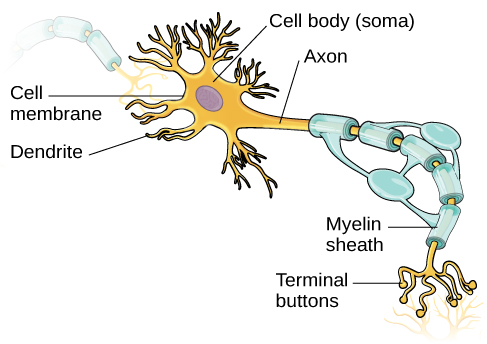

Figure 3.8図 3.8
This illustration shows a prototypical neuron, which is being myelinated by a glial cell.
この図は、グリア細胞によって髄鞘化されつつある典型的なニューロンを示している。
The nucleus of the neuron is located in the soma, or cell body. The soma has branching extensions known as dendrites. The neuron is a small information processor, and dendrites serve as input sites where signals are received from other neurons. These signals are transmitted electrically across the soma and down a major extension from the soma known as the axon, which ends at multiple terminal buttons. The terminal buttons contain synaptic vesicles that house neurotransmitters, the chemical messengers of the nervous system.
英語のヒント
ニューロンの核は、細胞体(ソーマ)の中にある。細胞体には、樹状突起と呼ばれる枝分かれした突起がある。ニューロンは小さな情報処理装置であり、樹状突起は、ほかのニューロンからの信号を受け取る入力部位として働く。これらの信号は、電気的に細胞体を横切り、さらに細胞体から伸びる軸索と呼ばれる主要な突起を下って伝えられる。軸索の先は、多数の終末ボタンで終わっている。終末ボタンにはシナプス小胞が含まれており、シナプス小胞は、神経系の化学的な伝達役である神経伝達物質を蓄えている。
Axons range in length from a fraction of an inch to several feet. In some axons, glial cells form a fatty substance known as the myelin sheath, which coats the axon and acts as an insulator, increasing the speed at which the signal travels. The myelin sheath is not continuous and there are small gaps that occur down the length of the axon. These gaps in the myelin sheath are known as the Nodes of Ranvier. The myelin sheath is crucial for the normal operation of the neurons within the nervous system: the loss of the insulation it provides can be detrimental to normal function. To understand how this works, let’s consider an example. PKU, a genetic disorder discussed earlier, causes a reduction in myelin and abnormalities in white matter cortical and subcortical structures. The disorder is associated with a variety of issues including severe cognitive deficits, exaggerated reflexes, and seizures (Anderson & Leuzzi, 2010; Huttenlocher, 2000). Another disorder, multiple sclerosis (MS), an autoimmune disorder, involves a large-scale loss of the myelin sheath on axons throughout the nervous system. The resulting interference in the electrical signal prevents the quick transmittal of information by neurons and can lead to a number of symptoms, such as dizziness, fatigue, loss of motor control, and sexual dysfunction. While some treatments may help to modify the course of the disease and manage certain symptoms, there is currently no known cure for multiple sclerosis.
英語のヒント
軸索の長さは、1インチに満たないものから数フィートに及ぶものまでさまざまである。一部の軸索では、グリア細胞が髄鞘(ミエリン鞘)と呼ばれる脂肪性の物質をつくる。髄鞘は軸索を覆って絶縁体として働き、信号が伝わる速さを高める。髄鞘は途切れずに続いているわけではなく、軸索の長さに沿って小さな隙間がところどころにある。髄鞘のこうした隙間は、ランヴィエ絞輪と呼ばれる。髄鞘は、神経系の中でニューロンが正常に働くために欠かせない。髄鞘がもたらす絶縁が失われると、正常な機能が損なわれうるのである。このことがどのように作用するのかを理解するために、一つの例を考えてみよう。前に取り上げた遺伝性の障害であるPKUは、ミエリンの減少と、皮質および皮質下の白質構造の異常を引き起こす。この障害は、重度の認知機能の欠損、過剰な反射、発作など、さまざまな問題と関連している(Anderson & Leuzzi, 2010; Huttenlocher, 2000)。別の障害である多発性硬化症(MS)は自己免疫性の障害で、神経系全体にわたって、軸索を覆う髄鞘が大規模に失われる。その結果として電気信号が妨げられるため、ニューロンによる情報のすばやい伝達ができなくなり、めまい、疲労、運動制御の喪失、性機能不全など、多くの症状が生じうる。病気の経過を変えたり特定の症状に対処したりするのに役立つかもしれない治療法はあるものの、多発性硬化症を治す方法は、現在のところ知られていない。
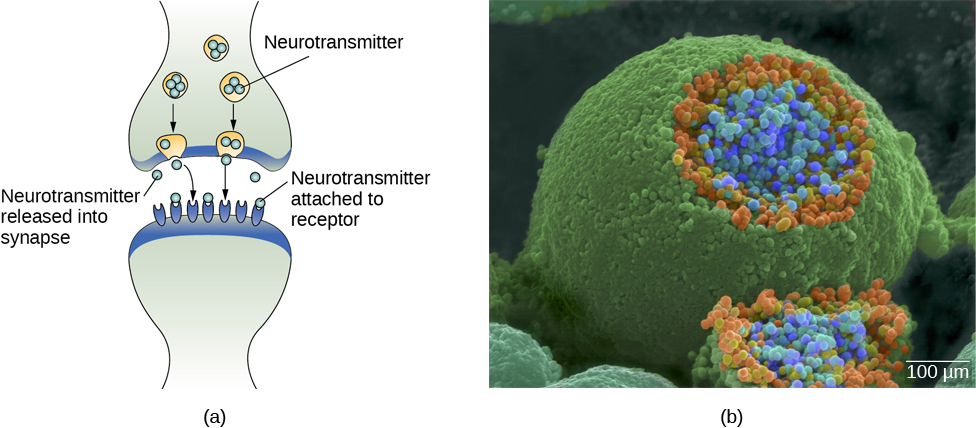
In healthy individuals, the neuronal signal moves rapidly down the axon to the terminal buttons, where synaptic vesicles release neurotransmitters into the synaptic cleft (Figure 3.9). The synaptic cleft is a very small space between two neurons and is an important site where communication between neurons occurs. Once neurotransmitters are released into the synaptic cleft, they travel across it and bind with corresponding receptors on the dendrite of an adjacent neuron. Receptors, proteins on the cell surface where neurotransmitters attach, vary in shape, with different shapes “matching” different neurotransmitters.
英語のヒント
健康な人では、ニューロンの信号は軸索をすばやく下って終末ボタンに達し、そこでシナプス小胞が神経伝達物質をシナプス間隙に放出する(図3.9)。シナプス間隙は二つのニューロンのあいだにあるごく小さな空間で、ニューロンどうしの情報伝達が行われる重要な場所である。神経伝達物質はシナプス間隙に放出されると、間隙を渡り、隣接するニューロンの樹状突起にある、対応する受容体と結合する。受容体は、神経伝達物質が付着する細胞表面のタンパク質であり、その形はさまざまで、異なる形が異なる神経伝達物質に「合う」ようになっている。
How does a neurotransmitter “know” which receptor to bind to? The neurotransmitter and the receptor have what is referred to as a lock-and-key relationship—specific neurotransmitters fit specific receptors similar to how a key fits a lock. The neurotransmitter binds to any receptor that it fits.
英語のヒント
神経伝達物質は、どの受容体と結合すればよいのかを、どうやって「知る」のだろうか。神経伝達物質と受容体は、いわゆる鍵と鍵穴の関係にある。鍵が鍵穴に合うのと同じように、特定の神経伝達物質は特定の受容体に合う。神経伝達物質は、自分が合う受容体であれば、どの受容体とも結合する。
OpenStax, Rice University; Psychology 2e. (credit b: modification of work by Tina Carvalho, NIH-NIGMS; scale-bar data from Matt Russell) · CC BY 4.0 · Source出典

Figure 3.9図 3.9
(a) The synaptic cleft is the space between the terminal button of one neuron and the dendrite of another neuron. (b) In this pseudo-colored image from a scanning electron microscope, a terminal button (green) has been opened to reveal the synaptic vesicles (orange and blue) inside. Each vesicle contains about 10,000 neurotransmitter molecules. (credit b: modification of work by Tina Carvalho, NIH-NIGMS; scale-bar data from Matt Russell)
(a)シナプス間隙は、あるニューロンの終末ボタンと、別のニューロンの樹状突起とのあいだの空間である。(b)走査型電子顕微鏡によるこの疑似カラー画像では、終末ボタン(緑)が開かれ、内部のシナプス小胞(オレンジと青)が見えている。一つひとつの小胞には、約10,000個の神経伝達物質の分子が含まれている。(出典b:Tina Carvalho, NIH-NIGMSの作品を改変、スケールバーのデータ:Matt Russell)