第3章生物心理学
3.3 Parts of the Nervous System3.3 神経系の区分
Learning Objectives学習目標
By the end of this section, you will be able to:
この節を学び終えると、次のことができるようになる。
- Describe the difference between the central and peripheral nervous systems中枢神経系と末梢神経系の違いを説明する
- Explain the difference between the somatic and autonomic nervous systems体性神経系と自律神経系の違いを説明する
- Differentiate between the sympathetic and parasympathetic divisions of the autonomic nervous system自律神経系の交感神経系と副交感神経系を区別する
The nervous system can be divided into two major subdivisions: the central nervous system (CNS) and the peripheral nervous system (PNS), shown in Figure 3.13. The CNS is comprised of the brain and spinal cord; the PNS connects the CNS to the rest of the body. In this section, we focus on the peripheral nervous system; later, we look at the brain and spinal cord.
英語のヒント
神経系は、図3.13に示すように、中枢神経系(CNS)と末梢神経系(PNS)という二つの大きな区分に分けられる。CNSは脳と脊髄から成り、PNSはCNSを体のほかの部分とつないでいる。この節では末梢神経系を中心に扱い、脳と脊髄については後で見ていく。
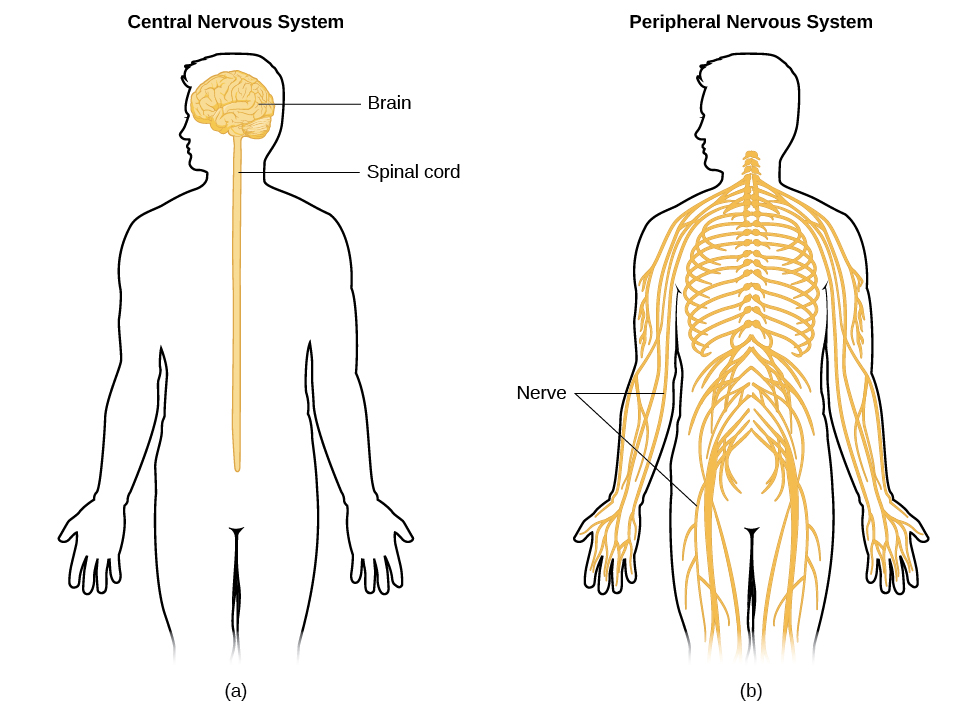
Figure 3.13図 3.13
The nervous system is divided into two major parts: (a) the Central Nervous System and (b) the Peripheral Nervous System.
神経系は二つの大きな部分に分けられる。(a)中枢神経系と(b)末梢神経系である。
Peripheral Nervous System末梢神経系
The peripheral nervous system is made up of thick bundles of axons, called nerves, carrying messages back and forth between the CNS and the muscles, organs, and senses in the periphery of the body (i.e., everything outside the CNS). The PNS has two major subdivisions: the somatic nervous system and the autonomic nervous system.
英語のヒント
末梢神経系は、神経と呼ばれる軸索の太い束から成る。神経は、CNSと、体の末梢(つまりCNSの外にあるすべて)にある筋肉、器官、感覚器とのあいだで、メッセージを行き来させている。PNSには、体性神経系と自律神経系という二つの大きな区分がある。
The somatic nervous system is associated with activities traditionally thought of as conscious or voluntary. It is involved in the relay of sensory and motor information to and from the CNS; therefore, it consists of motor neurons and sensory neurons. Motor neurons, carrying instructions from the CNS to the muscles, are efferent fibers (efferent means “moving away from”). Sensory neurons, carrying sensory information to the CNS, are afferent fibers (afferent means “moving toward”). A helpful way to remember this is that efferent = exit and afferent = arrive. Each nerve is basically a bundle of neurons forming a two-way superhighway, containing thousands of axons, both efferent and afferent.
英語のヒント
体性神経系は、伝統的に意識的、あるいは随意的なものと考えられてきた活動と関連している。体性神経系は、CNSに出入りする感覚情報と運動情報の中継にかかわっており、そのため運動ニューロンと感覚ニューロンから成る。運動ニューロンは、CNSから筋肉へ指令を運ぶ遠心性線維である(efferentは「〜から離れていく」という意味)。感覚ニューロンは、感覚情報をCNSへ運ぶ求心性線維である(afferentは「〜へ向かっていく」という意味)。覚え方としては、efferent=exit(出ていく)、afferent=arrive(到着する)とするとよい。一つ一つの神経は、基本的にはニューロンの束であり、遠心性と求心性の両方の軸索を何千本も含んで、双方向の高速道路をつくっている。
The autonomic nervous system controls our internal organs and glands and is generally considered to be outside the realm of voluntary control. It can be further subdivided into the sympathetic and parasympathetic divisions (Figure 3.14). The sympathetic nervous system is involved in preparing the body for stress-related activities; the parasympathetic nervous system is associated with returning the body to routine, day-to-day operations. The two systems have complementary functions, operating in tandem to maintain the body’s homeostasis. Homeostasis is a state of equilibrium, or balance, in which biological conditions (such as body temperature) are maintained at optimal levels.
英語のヒント
自律神経系は内臓と腺を制御しており、一般に、随意的な制御の及ぶ範囲の外にあると考えられている。自律神経系は、さらに交感神経系と副交感神経系に分けられる(図3.14)。交感神経系は、ストレスに関連する活動に向けて体を準備させることにかかわっている。副交感神経系は、体をふだんの日常的な働きに戻すことと関連している。二つの神経系は相補的な機能を持ち、連携して働くことで体の恒常性を保っている。恒常性とは平衡、すなわちバランスのとれた状態であり、そこでは生物学的な条件(体温など)が最適な水準に保たれている。
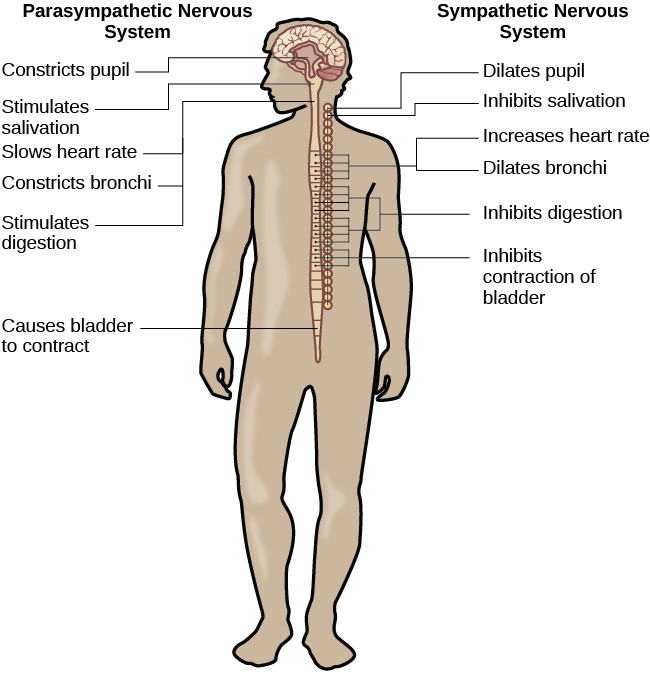


Figure 3.14図 3.14
The sympathetic and parasympathetic divisions of the autonomic nervous system have the opposite effects on various systems.
自律神経系の交感神経系と副交感神経系は、体のさまざまな器官系に対して互いに反対の作用を及ぼす。
The sympathetic nervous system is activated when we are faced with stressful or high-arousal situations. The activity of this system was adaptive for our ancestors, increasing their chances of survival. Imagine, for example, that one of our early ancestors, out hunting small game, suddenly disturbs a large bear with her cubs. At that moment, the hunter's body undergoes a series of changes—a direct function of sympathetic activation—preparing them to face the threat. The pupils dilate, the heart rate and blood pressure increase, the bladder relaxes, and the liver releases glucose; adrenaline surges into the bloodstream. This constellation of physiological changes, known as the fight or flight response, allows the body access to energy reserves and heightened sensory capacity so that it might fight off a threat or run away to safety.
英語のヒント
交感神経系は、ストレスの多い状況や覚醒水準の高い状況に直面したときに活性化される。この系の活動は私たちの祖先にとって適応的であり、彼らが生き延びる可能性を高めた。たとえば、小さな獲物を狩りに出ていた初期の祖先の一人が、子グマを連れた大きなクマを突然驚かせてしまったところを想像してみよう。その瞬間、狩人の体には一連の変化が起こり(これは交感神経の活性化が直接もたらすものである)、脅威に立ち向かう準備が整えられる。瞳孔が広がり、心拍数と血圧が上がり、膀胱がゆるみ、肝臓がグルコースを放出する。アドレナリンが血流に一気に流れ込む。闘争・逃走反応として知られるこの一連の生理的変化によって、体はエネルギーの蓄えと高められた感覚能力を利用できるようになる。脅威を撃退したり、安全な場所へ逃げたりするためである。
While it is clear that such a response would be critical for survival for our ancestors, who lived in a world full of real physical threats, many of the high-arousal situations we face in the modern world are more psychological in nature. For example, think about how you feel when you have to stand up and give a presentation in front of a roomful of people, or right before taking a big test. You are in no real physical danger in those situations, and yet you have evolved to respond to a perceived threat with the fight or flight response. This kind of response is not nearly as adaptive in the modern world; in fact, we suffer negative health consequences when faced constantly with psychological threats that we can neither fight nor flee. Recent research suggests that an increase in susceptibility to heart disease (Chandola, Brunner, & Marmot, 2006) and impaired function of the immune system (Glaser & Kiecolt-Glaser, 2005) are among the many negative consequences of persistent and repeated exposure to stressful situations. Some of this tendency for stress reactivity can be wired by early experiences of trauma.
英語のヒント
そのような反応が、現実の身体的な脅威に満ちた世界に生きていた私たちの祖先にとって、生存に決定的に重要だっただろうことは明らかである。しかし、現代の世界で私たちが直面する覚醒水準の高い状況の多くは、むしろ心理的な性質のものである。たとえば、大勢の人がいる部屋で立ち上がって発表をしなければならないときや、大事な試験を受ける直前に、自分がどう感じるかを考えてみよう。そうした状況で、現実の身体的な危険にさらされているわけではない。それでも人は、脅威と知覚したものに闘争・逃走反応で応じるように進化してきた。この種の反応は、現代の世界ではとうてい同じほど適応的とはいえない。実際、闘うことも逃げることもできない心理的な脅威に絶えず直面していると、私たちは健康面で悪い結果をこうむる。最近の研究は、心臓病へのかかりやすさの増大(Chandola, Brunner, & Marmot, 2006)や免疫系の機能低下(Glaser & Kiecolt-Glaser, 2005)が、ストレスの多い状況に持続的かつ繰り返しさらされることがもたらす多くの悪い結果に含まれることを示唆している。このようなストレス反応性の傾向の一部は、幼いころのトラウマ体験によって神経に組み込まれうる。
Once the threat has been resolved, the parasympathetic nervous system takes over and returns bodily functions to a relaxed state. Our hunter’s heart rate and blood pressure return to normal, the pupils constrict, bladder control is restored, and the liver begins to store glucose in the form of glycogen for future use. These restorative processes are associated with activation of the parasympathetic nervous system.
英語のヒント
脅威が解消されると、副交感神経系が引き継ぎ、体の機能をリラックスした状態に戻す。先ほどの狩人の心拍数と血圧は正常に戻り、瞳孔は縮み、膀胱の制御が回復し、肝臓は将来の使用に備えてグルコースをグリコーゲンの形で蓄えはじめる。こうした回復の過程は、副交感神経系の活性化と関連している。