第22章原子The Atom原書 p.743–794
22.4 Nuclear Fission and Fusion22.4 核分裂と核融合
SECTION LEARNING OBJECTIVES By the end of this section, you will be able to do the following:
この節の学習目標 この節を終えると、次のことができるようになる。
• Explain nuclear fission• Explain nuclear fusion• Describe how the processes of fission and fusion work in nuclear weapons and in generating nuclear power
・核分裂を説明する・核融合を説明する・核兵器と原子力発電で、分裂と融合の過程がどうはたらくかを述べる
Section Key Termsこの節の重要語
The previous section dealt with naturally occurring nuclear decay. Without human intervention, some nuclei will change composition in order to achieve a stable equilibrium. This section delves into a less-natural process. Knowing that energy can be emitted in various forms of nuclear change, is it possible to create a nuclear reaction through our own intervention? The answer to this question is yes. Through two distinct methods, humankind has discovered multiple ways of manipulating the atom to release its internal energy.
前の節では自然に起こる核の崩壊を扱った。人が手を出さなくても、ある種の原子核は安定な釣り合いに達するために組成を変える。この節では、もっと自然でない過程に踏み込む。核の変化のさまざまな形でエネルギーが放たれると知ったうえで、私たち自身の手で核反応を起こすことはできるのか。この問いの答えは「できる」である。二つのはっきり違うやり方で、人類は原子を操ってその内部のエネルギーを取り出す道をいくつも見つけてきた。
chain reactioncritical massliquid drop modelnuclear fissionnuclear fusionproton-proton cycle
連鎖反応 臨界質量 液滴模型核分裂 核融合 陽子・陽子連鎖
Nuclear Fission核分裂
In simplest terms, nuclear fission is the splitting of an atomic bond. Given that it requires great energy separate two nucleons, it may come as a surprise to learn that splitting a nucleus can release vast potential energy. And although it is true that huge amounts of energy can be released, considerable effort is needed to do so in practice.
最も簡単に言えば、核分裂とは原子の結合を割ることである。二つの核子を引き離すのに大きなエネルギーが要ることを思えば、原子核を割るとぼう大な位置エネルギーが放たれると聞いて驚くかもしれない。そして巨大なエネルギーが放たれるのは本当だが、実際にそれを起こすにはかなりの手間が要る。
An unstable atom will naturally decay, but it may take millions of years to do so. As a result, a physical catalyst is necessary to produce useful energy through nuclear fission. The catalyst typically occurs in the form of a free neutron, projected directly at the nucleus of a high-mass atom.
不安定な原子はいずれ自然に崩壊するが、そうなるまでに何百万年もかかることがある。したがって核分裂で役に立つエネルギーを作るには、物理的なきっかけが要る。そのきっかけはふつう自由な中性子の形をとり、質量の大きな原子の原子核にまっすぐ撃ち込まれる。
As shown in Figure 22.26, a neutron strike can cause the nucleus to elongate, much like a drop of liquid water. This is why the model is known as the liquid drop model. As the nucleus elongates, nucleons are no longer so tightly packed, and the repulsive electromagnetic force can overcome the short-range strong nuclear force. The imbalance of forces can result in the two ends of the drop flying apart, with some of the nuclear binding energy released to the surroundings.
図22.26に示すように、中性子があたると原子核は液体の水の滴のように伸びうる。このモデルが液滴模型と呼ばれるのはそのためである。原子核が伸びると核子はもうぎっしり詰まってはおらず、反発する電磁気の力が、届く範囲の短い強い核力に打ち勝てるようになる。力の釣り合いが崩れると、滴の両端が飛び離れ、核の結合エネルギーの一部がまわりへ放たれる。
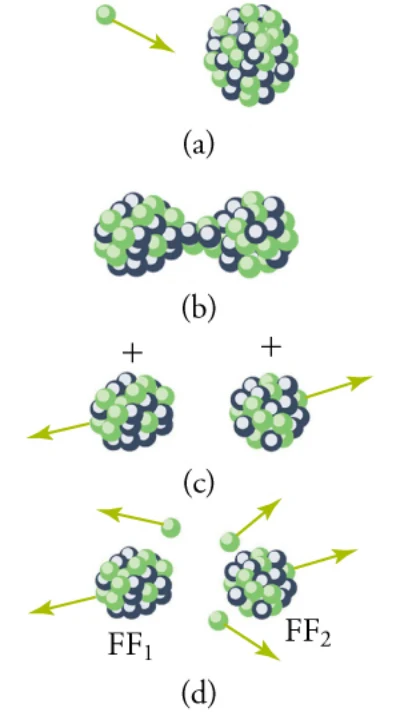
liquid drop, the nucleus deforms and begins to narrow in the middle. Since fewer nucleons are in contact, the repulsive Coulomb force is able to break the nucleus into two parts with some neutrons also flying away.
液滴のようにふるまい、原子核はゆがんで真ん中がくびれ始める。触れ合う核子が減るので、反発するクーロン力が原子核を二つに割り、いくつかの中性子も飛び出す。
As you can imagine, the consequences of the nuclei splitting are substantial. When a nucleus is split, it is not only energy that is released, but a small number of neutrons as well. Those neutrons have the potential to cause further fission in other nuclei, especially if they are directed back toward the other nuclei by a dense shield or neutron reflector (see part (d) of Figure 22.26).
想像がつくとおり、原子核が割れることの結果は大きい。原子核が割れるとき、放たれるのはエネルギーだけでなく、少数の中性子も出る。これらの中性子は、他の原子核でさらなる分裂を起こしうる。とくに、密な覆いや中性子反射体で他の原子核のほうへ戻されるとそうである(図22.26の(d)を見よ)。
However, not every neutron produced by fission induces further fission. Some neutrons escape the fissionable material, while others interact with a nucleus without making it split. We can enhance the number of fissions produced by neutrons by having a large amount of fissionable material as well as a neutron reflector. The minimum amount necessary for self-sustained fission of a given nuclide is called its critical mass. Some nuclides, such as 239Pu, produce more neutrons per fission than others, such as 235U. Additionally, some nuclides are easier to make fission than others. In particular, 235U and 239Pu are easier to fission than the much more abundant 238U. Both factors affect critical mass, which is smallest for 239Pu. The self-sustained fission of nuclei is commonly referred to as a chain reaction, as shown in Figure 22.27.
しかし、分裂で作られた中性子のすべてがさらなる分裂を起こすわけではない。分裂しうる材料から逃げる中性子もあれば、原子核と相互作用しても割らせない中性子もある。分裂しうる材料を大量に用意し、中性子反射体を使えば、中性子が起こす分裂の数を増やせる。ある核種で分裂が自分で続くのに要る最小の量を、その臨界質量という。239Puのように、235Uなど他の核種より一回の分裂で多くの中性子を出す核種もある。さらに、分裂させやすい核種とそうでない核種がある。とくに235Uと239Puは、はるかに豊富な238Uより分裂させやすい。どちらの要素も臨界質量に効き、臨界質量は239Puで最も小さい。原子核の分裂が自分で続くことは、ふつう連鎖反応と呼ばれる(図22.27)。
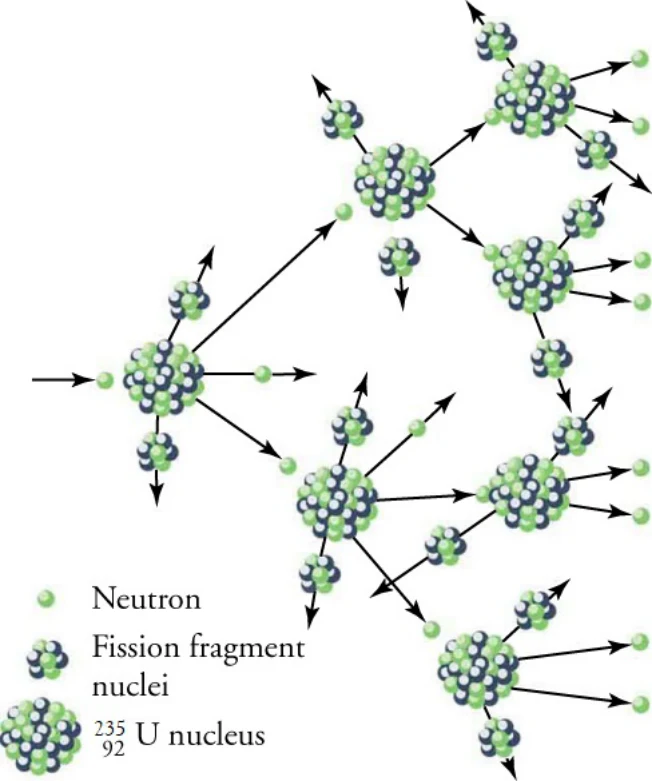
A chain reaction can have runaway results. If each atomic split results in two nuclei producing a new fission, the number of nuclear reactions will increase exponentially. One fission will produce two atoms, the next round of fission will create four atoms, the third round eight atoms, and so on. Of course, each time fission occurs, more energy will be emitted, further increasing the power of the atomic reaction. And that is just if two neutrons create fission reactions each round. Perhaps you can now see why so many people consider atomic energy to be an exciting energy source!
連鎖反応は暴走しうる。原子が一回割れるたびに二つの原子核が新たな分裂を起こすなら、核反応の数は指数的に増える。一回の分裂で二つの原子ができ、次の回の分裂で四つ、三回目で八つ、というふうに続く。もちろん分裂が起こるたびにさらにエネルギーが放たれ、原子の反応の力はいっそう増す。しかもこれは、毎回二つの中性子だけが分裂の反応を起こす場合の話である。なぜこれほど多くの人が原子のエネルギーをわくわくするエネルギー源とみなすのか、もうわかるだろう。
To make a self-sustained nuclear fission reactor with 235U, it is necessary to slow down the neutrons. Water is very effective at this, since neutrons collide with protons in water molecules and lose energy. Figure 22.28 shows a schematic of a reactor design called the pressurized water reactor.
235Uで自分で続く核分裂の炉を作るには、中性子を遅くしなければならない。水はこれに非常に効く。中性子が水の分子の中の陽子と衝突してエネルギーを失うからである。図22.28は、加圧水型原子炉と呼ばれる炉の設計の略図である。
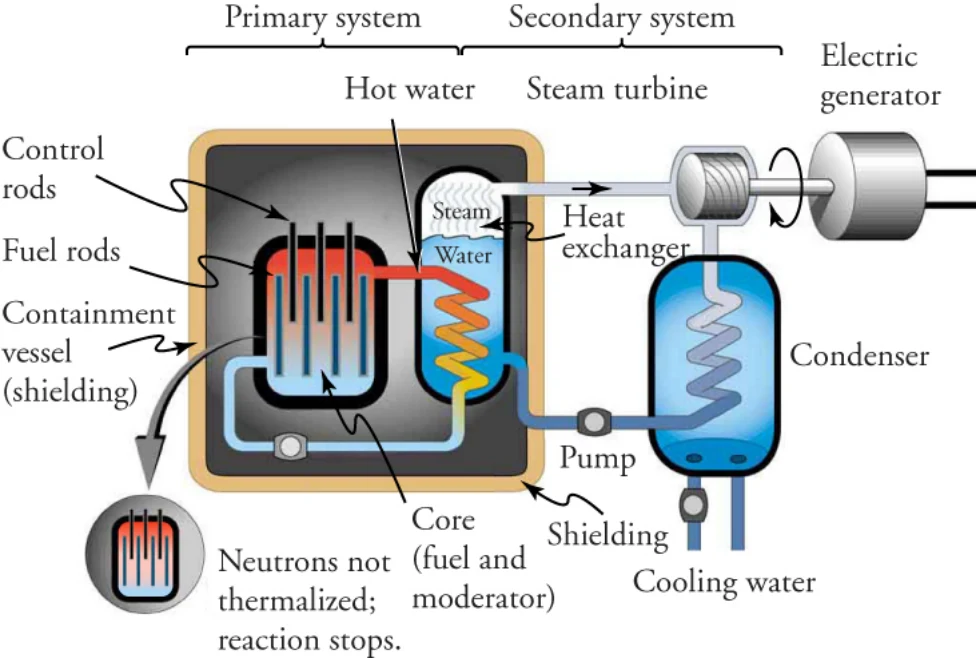
Control rods containing nuclides that very strongly absorb neutrons are used to adjust neutron flux. To produce large amounts of power, reactors contain hundreds to thousands of critical masses, and the chain reaction easily becomes self-sustaining. Neutron flux must be carefully regulated to avoid an out-of-control exponential increase in the rate of fission.
中性子を非常によく吸収する核種を含む制御棒が、中性子の流れを調節するのに使われる。大きな出力を出すため、原子炉は臨界質量の数百倍から数千倍を収めており、連鎖反応は容易に自分で続くようになる。分裂の速さが制御を失って指数的に増えるのを避けるため、中性子の流れは注意深く調節されなければならない。
Control rods help prevent overheating, perhaps even a meltdown or explosive disassembly. The water that is used to slow down neutrons, necessary to get them to induce fission in 235U, and achieve criticality, provides a negative feedback for temperature increase. In case the reactor overheats and boils the water to steam or is breached, the absence of water kills the chain reaction. Considerable heat, however, can still be generated by the reactor’s radioactive fission products. Other safety features, thus, need to be incorporated in the event of a loss of coolant accident, including auxiliary cooling water and pumps.
制御棒は過熱を、場合によっては炉心溶融や爆発的な破壊まで防ぐのに役立つ。235Uに分裂を起こさせ臨界に達させるために中性子を遅くするのに使う水は、温度上昇に対する負のはたらき返しを与える。炉が過熱して水が蒸気になって沸き飛んだり、炉が破れたりした場合、水がなくなることで連鎖反応は止まる。それでも、炉の放射性の分裂生成物からかなりの熱が出続けうる。したがって、冷却材喪失事故に備えて、補助の冷却水とポンプを含む他の安全のしくみも組み込む必要がある。
Energies in Nuclear Fission The following are two interesting facts to consider:
核分裂でのエネルギー 次の二つの事実は興味深い。
• The average fission reaction produces 200 MeV of energy.• If you were to measure the mass of the products of a nuclear reaction, you would find that their mass was slightly less than the mass of the original nucleus.
・平均的な分裂の反応は200 MeVのエネルギーを出す。・核反応の生成物の質量を測ると、もとの原子核の質量よりわずかに小さいことがわかる。
How are those things possible? Doesn’t the fission reaction’s production of energy violate the conservation of energy? Furthermore, doesn’t the loss in mass in the reaction violate the conservation of mass? Those are important questions, and they can both be answered with one of the most famous equations in scientific history.
どうしてそんなことがありうるのか。分裂の反応がエネルギーを作るのは、エネルギー保存を破ってはいないのか。さらに、反応で質量が減るのは質量保存を破ってはいないのか。これらは重要な問いであり、どちらも科学の歴史で最も有名な式の一つで答えられる。
Recall that, according to Einstein’s theory, energy and mass are essentially the same thing. In the case of fission, the mass of the products is less than that of the reactants because the missing mass appears in the form of the energy released in the reaction, with a constant value of c2 Joules of energy converted for each kilogram of material. The value of c2 is substantial—from Einstein’s equation, the amount of energy in just 1 gram of mass would be enough to support the average U.S. citizen for more than 270 years! The example below will show you how a mass-energy transformation of this type takes place.
アインシュタインの理論によれば、エネルギーと質量は本質的に同じものだったことを思い出そう。分裂の場合、生成物の質量が反応物より小さいのは、失われた質量が反応で放たれるエネルギーの形で現れるからであり、材料1キログラムあたりc2ジュールのエネルギーに変わるという一定の値をとる。c2の値は大きい——アインシュタインの式によれば、わずか1グラムの質量に含まれるエネルギーは、平均的なアメリカ市民を270年以上養えるほどである。次の例題で、この型の質量とエネルギーの変換がどう起こるかを見よう。
Calculating Energy from a Kilogram of Fissionable Fuel Calculate the amount of energy produced by the fission of 1.00 kg of , given the average fission reaction of
分裂しうる燃料1キログラムからのエネルギーを計算する 平均的な分裂の反応が次であるとして、1.00 kgのの分裂で作られるエネルギーの量を計算せよ。
Strategy方針
The total energy produced is the number of atoms times the given energy per fission. We should therefore find the number of atoms in 1.00 kg.
作られる全エネルギーは、の原子の数に、一回の分裂あたりの与えられたエネルギーを掛けたものである。したがって1.00 kgの中のの原子の数を求めるべきである。
Solution解答
The number of atoms in 1.00 kg is Avogadro’s number times the number of moles. One mole of has a mass of 235.04 g; thus, there are . The number of atoms is therefore
1.00 kgの中のの原子の数は、アヴォガドロ数にモル数を掛けたものである。1モルの質量は235.04 gなので、である。したがっての原子の数は
So the total energy released is
よって放たれる全エネルギーは
Discussion考察
The result is another impressively large amount of energy, equivalent to about 14,000 barrels of crude oil or 600,000 gallons of gasoline. But, it is only one fourth the energy produced by the fusion of a kilogram of a mixture of deuterium and tritium. Even though each fission reaction yields about ten times the energy of a fusion reaction, the energy per kilogram of fission fuel is less, because there are far fewer moles per kilogram of the heavy nuclides. Fission fuel is also much scarcer than fusion fuel, and less than 1 percent of uranium (the 235 U) is readily usable.
この結果もまた目をみはる大きなエネルギーで、原油およそ1万4000バレル、ガソリン60万ガロンに相当する。しかしそれは、重水素と三重水素の混ざったもの1キログラムの融合で作られるエネルギーの4分の1にすぎない。一回の分裂の反応は融合の反応のおよそ10倍のエネルギーを出すが、分裂の燃料1キログラムあたりのエネルギーは小さい。重い核種は1キログラムあたりのモル数がはるかに少ないからである。分裂の燃料は融合の燃料よりずっと乏しくもあり、ウランのうちすぐに使えるのは1パーセント未満(235U)である。
VIRTUAL PHYSICSシミュレーションNuclear Fission核分裂
Start a chain reaction, or introduce nonradioactive isotopes to prevent one in this simulation (https://openstax.org/l/16fission). Use the applet to control energy production in a nuclear reactor!
この模擬実験(https://openstax.org/l/16fission)で連鎖反応を始めたり、放射性でない同位体を入れて連鎖反応を防いだりしてみよう。アプレットを使って原子炉のエネルギーの出方を制御しよう。
Nuclear Fusion核融合
Nuclear fusion is defined as the combining, or fusing, of two nuclei and, the combining of nuclei also results in an emission of energy. For many, the concept is counterintuitive. After all, if energy is released when a nucleus is split, how can it also be released when nucleons are combined together? The difference between fission and fusion, which results from the size of the nuclei involved, will be addressed next.
核融合とは二つの原子核が合わさること、すなわち融合することと定められ、原子核が合わさるときにもエネルギーが放たれる。多くの人にとって、この考えは直感に反する。原子核を割るときにエネルギーが放たれるなら、核子を合わせるときにもエネルギーが放たれるとはどういうことか。分裂と融合の違いは、関わる原子核の大きさから生じる。それを次に扱う。
Remember that the structure of a nucleus is based on the interplay of the compressive nuclear strong force and the repulsive electromagnetic force. For nuclei that are less massive than iron, the nuclear force is actually stronger than that of the Coulomb force. As a result, when a low-mass nucleus absorbs nucleons, the added neutrons and protons bind the nucleus more tightly. The increased nuclear strong force does work on the nucleus, and energy is released.
原子核の構造が、押し縮める強い核力と反発する電磁気の力のせめぎ合いにもとづいていたことを思い出そう。鉄より軽い原子核では、核力は実はクーロン力より強い。したがって質量の小さな原子核が核子を吸収すると、加わった中性子と陽子は原子核をより強く結びつける。増した強い核力が原子核に仕事をし、エネルギーが放たれる。
Once the size of the created nucleus exceeds that of iron, the short-ranging nuclear force does not have the ability to bind a nucleus more tightly, and the emission of energy ceases. In fact, for fusion to occur for elements of greater mass than iron, energy must be added to the system! Figure 22.29 shows an energy-mass curve commonly used to describe nuclear reactions. Notice the location of iron (Fe) on the graph. All low-mass nuclei to the left of iron release energy through fusion, while all high-mass particles to the right of iron produce energy through fission.
できた原子核の大きさが鉄を超えると、届く範囲の短い核力はもう原子核をより強く結びつけられなくなり、エネルギーの放出は止まる。実際、鉄より重い元素で融合を起こすには、系にエネルギーを加えなければならない。図22.29は、核反応を述べるのによく使われるエネルギーと質量の曲線を示す。グラフでの鉄(Fe)の位置に注意せよ。鉄より左のすべての質量の小さな原子核は融合でエネルギーを放ち、鉄より右のすべての質量の大きな粒子は分裂でエネルギーを作る。
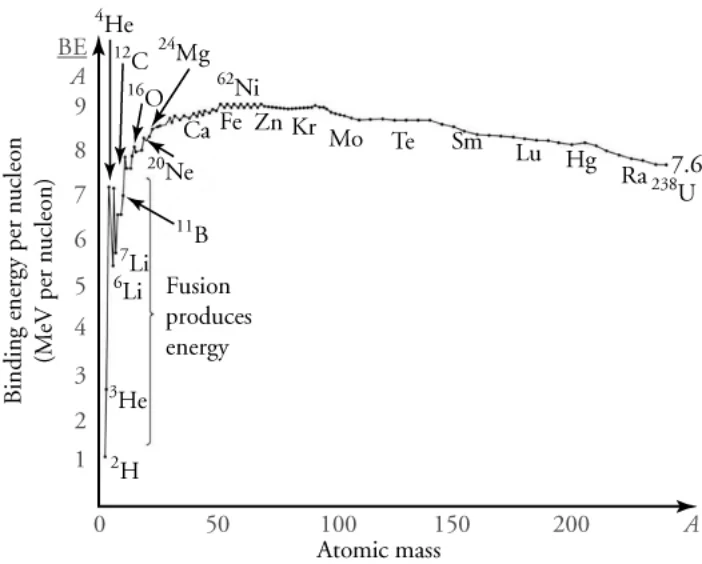
TIPS FOR SUCCESS Just as it is not possible for the elements to the left of iron in the figure to naturally fission, it is not possible for elements to the right of iron to naturally undergo fusion, as that process would require the addition of energy to occur. Furthermore, notice that elements commonly discussed in fission and fusion are elements that can provide the greatest change in binding energy, such as uranium and hydrogen.Iron’s location on the energy-mass curve is important, and explains a number of its characteristics, including its role as an elemental endpoint in fusion reactions in stars.
学習のポイント 図で鉄より左の元素が自然には分裂しえないのと同じように、鉄より右の元素は自然には融合しえない。その過程にはエネルギーを加える必要があるからである。さらに、分裂と融合でよく話に出る元素は、結合エネルギーの変化を最も大きくできる元素——ウランや水素——であることに注意せよ。エネルギーと質量の曲線での鉄の位置は重要で、星の中の融合の反応で元素としての終着点になることを含め、鉄のいくつもの特徴を説明する。
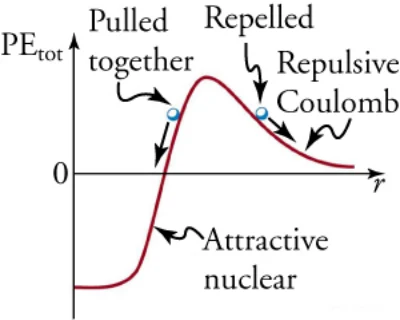
The major obstruction to fusion is the Coulomb repulsion force between nuclei. Since the attractive nuclear force that can fuse nuclei together is short ranged, the repulsion of like positive charges must be overcome in order to get nuclei close enough to induce fusion. Figure 22.30 shows an approximate graph of the potential energy between two nuclei as a function of the distance between their centers. The graph resembles a hill with a well in its center. A ball rolled to the left must have enough kinetic energy to get over the hump before it falls into the deeper well with a net gain in energy. So it is with fusion. If the nuclei are given enough kinetic energy to overcome the electric potential energy due to repulsion, then they can combine, release energy, and fall into a deep well. One way to accomplish that end is to heat fusion fuel to high temperatures so that the kinetic energy of thermal motion is sufficient to get the nuclei together.
融合の最大の妨げは、原子核どうしのクーロンの反発の力である。原子核を融合させうる引き合う核力は届く範囲が短いので、融合を起こせるほど原子核を近づけるには、同じ正の電荷どうしの反発に打ち勝たなければならない。図22.30は、二つの原子核の位置エネルギーを、中心どうしの距離の関数としておおよそ描いたグラフである。グラフは真ん中に井戸のある丘のような形をしている。左へ転がされた球は、こぶを越えるだけの運動エネルギーを持たなければ、その先の深い井戸へ落ちてエネルギーを正味で得ることはできない。融合も同じである。反発による電気の位置エネルギーに打ち勝つだけの運動エネルギーが原子核に与えられれば、原子核は合わさり、エネルギーを放って深い井戸へ落ちる。それを実現する一つの道は、融合の燃料を高温に熱し、熱運動の運動エネルギーで原子核どうしを近づけることである。
You might think that, in our Sun, nuclei are constantly coming into contact and fusing. However, this is only partially true. Only at the Sun’s core are the particles close enough and the temperature high enough for fusion to occur!
太陽の中では、原子核がたえず触れ合って融合していると思うかもしれない。しかしそれは半分しか正しくない。粒子が十分に近づき、温度が融合を起こすほど高いのは、太陽の芯だけである。
In the series of reactions below, the Sun produces energy by fusing protons, or hydrogen nuclei ( , by far the Sun’s most abundant nuclide) into helium nuclei . The principal sequence of fusion reactions forms what is called the proton-proton cycle
以下の一連の反応で、太陽は陽子、すなわち水素の原子核(、太陽で群を抜いて豊富な核種)をヘリウムの原子核へ融合させてエネルギーを作る。融合の反応の主な流れは陽子・陽子連鎖と呼ばれるものを作る。
where stands for a positron and is an electron neutrino. The energy in parentheses is released by the reaction. Note that the first two reactions must occur twice for the third to be possible, so the cycle consumes six protons ( ) but gives back two. Furthermore, the two positrons produced will find two electrons and annihilate to form four more rays, for a total of six. The overall cycle is thus
ここでは陽電子、は電子ニュートリノを表す。括弧の中のエネルギーが反応で放たれる。三番目の反応が起こるには初めの二つの反応が二度ずつ起こらなければならないので、この連鎖は陽子()を六つ消費して二つ返すことに注意せよ。さらに、作られた二つの陽電子は二つの電子と出会って対消滅し、線をさらに四つ作るので、合わせて六つになる。全体の連鎖はしたがって
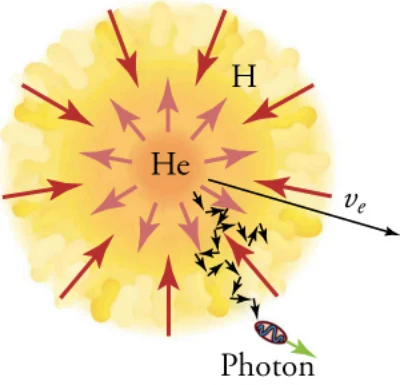
where the 26.7 MeV includes the annihilation energy of the positrons and electrons and is distributed among all the reaction products. The solar interior is dense, and the reactions occur deep in the Sun where temperatures are highest. It takes about 32,000 years for the energy to diffuse to the surface and radiate away. However, the neutrinos can carry their energy out of the Sun in less than two seconds, because they interact so weakly with other matter. Negative feedback in the Sun acts as a thermostat to regulate the overall energy output. For instance, if the interior of the Sun becomes hotter than normal, the reaction rate increases, producing energy that expands the interior. The expansion cools it and lowers the reaction rate. Conversely, if the interior becomes too cool, it contracts, increasing the temperature and therefore the reaction rate (see Figure 22.31). Stars like the Sun are stable for billions of years, until a significant fraction of their hydrogen has been depleted.
となり、この26.7 MeVには陽電子と電子の対消滅のエネルギーが含まれ、すべての反応生成物に分け与えられる。太陽の内部は密で、反応は温度が最も高い太陽の深部で起こる。エネルギーが表面まで拡散して放射されるまでにはおよそ3万2000年かかる。しかしニュートリノは他の物質とほとんど相互作用しないので、2秒足らずでエネルギーを太陽の外へ運び出せる。太陽の中の負のはたらき返しは、全体のエネルギーの出力を調節する温度調節器としてはたらく。たとえば太陽の内部がふつうより熱くなると反応の速さが増し、生じたエネルギーが内部を膨らませる。膨らめば冷えて反応の速さが下がる。逆に内部が冷えすぎると縮み、温度が上がって反応の速さが増す(図22.31を見よ)。太陽のような星は、水素のかなりの部分を使い果たすまで何十億年も安定でいる。
Nuclear Weapons and Nuclear Power核兵器と原子力
The world was in political turmoil when fission was discovered in 1938. Compounding the troubles, the possibility of a self-sustained chain reaction was immediately recognized by leading scientists the world over. The enormous energy known to be in nuclei, but considered inaccessible, now seemed to be available on a large scale.
1938年に核分裂が発見されたとき、世界は政治の激動のただ中にあった。困ったことに、自分で続く連鎖反応の可能性が、世界中の一流の科学者にただちに見抜かれた。原子核の中にあるとは知られていたが手が届かないと思われていた巨大なエネルギーが、いまや大規模に使えるように見えた。
Within months after the announcement of the discovery of fission, Adolf Hitler banned the export of uranium from newly occupied Czechoslovakia. It seemed that the possible military value of uranium had been recognized in Nazi Germany, and that a serious effort to build a nuclear bomb had begun.
核分裂の発見が公にされて数か月のうちに、アドルフ・ヒトラーは占領したばかりのチェコスロヴァキアからのウランの輸出を禁じた。ナチス・ドイツでウランの軍事的な価値が見抜かれ、核爆弾を作る本格的な取り組みが始まったように見えた。
Alarmed scientists, many of whom fled Nazi Germany, decided to take action. None was more famous or revered than Einstein. It was felt that his help was needed to get the American government to make a serious effort at constructing nuclear weapons as a matter of survival. Leo Szilard, a Hungarian physicist who had emigrated to America, took a draft of a letter to Einstein, who, although a pacifist, signed the final version. The letter was for President Franklin Roosevelt, warning of the German potential to build extremely powerful bombs of a new type. It was sent in August of 1939, just before the German invasion of Poland that marked the start of World War II.
警戒した科学者たち——その多くはナチス・ドイツから逃れてきた人々だった——は行動を起こすことにした。アインシュタインほど有名で敬われた人はいなかった。生き残りのためにアメリカ政府に核兵器の建造へ本腰を入れさせるには、彼の助けが要ると考えられた。アメリカへ移っていたハンガリーの物理学者レオ・シラードが手紙の草稿をアインシュタインのもとへ持って行き、平和主義者だったアインシュタインも最終版に署名した。手紙はフランクリン・ローズヴェルト大統領あてで、新しい型のきわめて強力な爆弾をドイツが作りうると警告するものだった。手紙は1939年8月、第二次世界大戦の始まりとなるドイツのポーランド侵攻の直前に送られた。
It was not until December 6, 1941, the day before the Japanese attack on Pearl Harbor, that the United States made a massive commitment to building a nuclear bomb. The top secret Manhattan Project was a crash program aimed at beating the Germans. It was carried out in remote locations, such as Los Alamos, New Mexico, whenever possible,
アメリカが核爆弾の建造に大々的に乗り出したのは、日本の真珠湾攻撃の前日である1941年12月6日になってからだった。極秘のマンハッタン計画は、ドイツに先んじることをねらった突貫の計画だった。可能なかぎりニューメキシコ州ロスアラモスのような人里離れた場所で進められ、
and eventually came to cost billions of dollars and employ the efforts of more than 100,000 people. J. Robert Oppenheimer (1904–1967), a talented physicist, was chosen to head the project. The first major step was made by Enrico Fermi and his group in December 1942, when they completed the first self-sustaining nuclear reactor. This first atomic pile, built in a squash court at the University of Chicago, proved that a fission chain reaction was possible.
最終的には何十億ドルもかかり、10万人を超える人手を動かした。有能な物理学者J・ロバート・オッペンハイマー(1904–1967)が計画の長に選ばれた。最初の大きな一歩は1942年12月、エンリコ・フェルミとその一団が、自分で続く最初の原子炉を完成させたことだった。シカゴ大学のスカッシュのコートに作られたこの最初の原子の積み重ねは、核分裂の連鎖反応が可能であることを証明した。
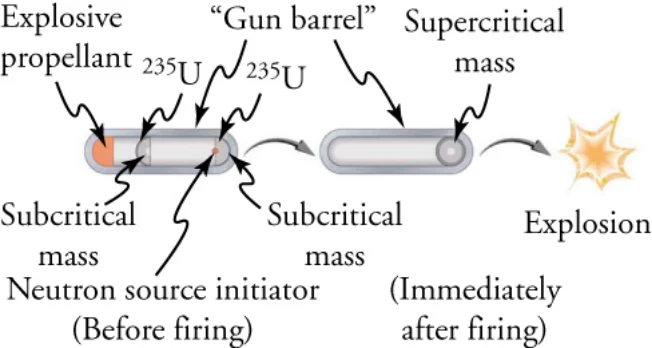
Plutonium was recognized as easier to fission with neutrons and, hence, a superior fission material very early in the Manhattan Project. Plutonium availability was uncertain, and so a uranium bomb was developed simultaneously. Figure 22.32 shows a gun-type bomb, which takes two subcritical uranium masses and shoots them together. To get an appreciable yield, the critical mass must be held together by the explosive charges inside the cannon barrel for a few microseconds. Since the buildup of the uranium chain reaction is relatively slow, the device to bring the critical mass together can be relatively simple. Owing to the fact that the rate of spontaneous fission is low, a neutron source is at the center the assembled critical mass.
プルトニウムは中性子で分裂させやすく、したがって優れた分裂の材料であることが、マンハッタン計画のごく初期に見抜かれていた。プルトニウムが手に入るかは不確かだったので、ウランの爆弾も同時に開発された。図22.32は砲身型の爆弾を示す。臨界に満たない二つのウランの塊を撃ち合わせるものである。目立った威力を出すには、臨界質量が砲身の中の爆薬によって数マイクロ秒のあいだ一つにまとめられていなければならない。ウランの連鎖反応の立ち上がりは比較的ゆっくりなので、臨界質量を合わせる装置は比較的簡単でよい。ひとりでに起こる分裂の割合が低いため、組み上がった臨界質量の中心には中性子の線源が置かれる。
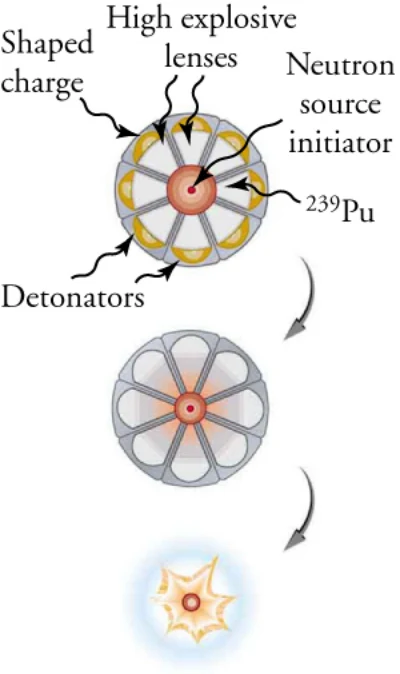
Plutonium’s special properties necessitated a more sophisticated critical mass assembly, shown schematically in Figure 22.33. A spherical mass of plutonium is surrounded by shaped charges (high explosives that focus their blast) that implode the plutonium, crushing it into a smaller volume to form a critical mass. The implosion technique is faster and more effective, because it compresses three-dimensionally rather than one-dimensionally as in the gun-type bomb. Again, a neutron source is included to initiate the chain reaction.
プルトニウムの特別な性質のために、臨界質量の組み上げにはもっと手の込んだやり方が要った。図22.33に略図で示す。プルトニウムの球の塊を、成形炸薬(爆風を一点に集める高性能爆薬)で囲み、プルトニウムを内側へ爆縮させて、より小さな体積へ押し潰し臨界質量を作る。爆縮のやり方は、砲身型の爆弾のように一方向ではなく三方向から押し縮めるので、より速く効果的である。ここでも連鎖反応を始めるために中性子の線源が組み込まれている。
Owing to its complexity, the plutonium bomb needed to be tested before there could be any attempt to use it. On
込み入った仕組みのため、プルトニウム爆弾は使う試みの前に実験する必要があった。
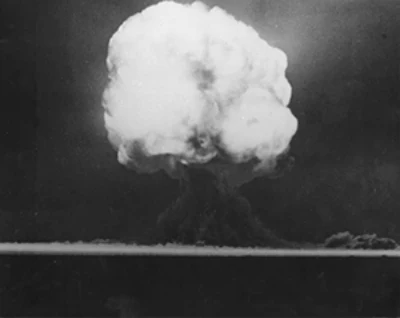
July 16, 1945, the test named Trinity was conducted in the isolated Alamogordo Desert in New Mexico, about 200 miles south of Los Alamos (see Figure 22.34). A new age had begun. The yield of the Trinity device was about 10 kilotons (kT), the equivalent of 5,000 of the largest conventional bombs.
1945年7月16日、ロスアラモスの南およそ200マイルにある人里離れたニューメキシコ州アラモゴードの砂漠で、トリニティと名づけられた実験が行われた(図22.34を見よ)。新しい時代が始まった。トリニティの装置の威力はおよそ10キロトン(kT)、最大級の通常爆弾5000発分にあたった。
Although Germany surrendered on May 7, 1945, Japan had been steadfastly refusing to surrender for many months, resulting large numbers of civilian and military casualties. Invasion plans by the Allies estimated a million casualties of their own and untold losses of Japanese lives. The bomb was viewed as a way to end the war. The first bomb used was a gun-type uranium bomb dropped on Hiroshima on August 6 by the United States. Its yield of about 15 kT destroyed the city and killed an estimated 80,000 people, with 100,000 more being seriously injured. The second bomb was an implosion-type plutonium bomb dropped on Nagasaki only three days later. Its 20-kT yield killed at least 50,000 people, something less than Hiroshima because of the hilly terrain and the fact that it was a few kilometers off target. The Japanese were told that one bomb a week would be dropped until they surrendered unconditionally, which they did on August 14. In actuality, the United States had only enough plutonium for one more bomb, as yet unassembled.
ドイツは1945年5月7日に降伏したが、日本は何か月ものあいだ断固として降伏を拒み続け、民間人と軍人に多くの犠牲が出ていた。連合国の侵攻の計画では、自軍に100万人の死傷者が出、日本側にも計り知れない命の損失が出ると見積もられていた。爆弾は戦争を終わらせる手段とみなされた。最初に使われた爆弾は砲身型のウラン爆弾で、8月6日にアメリカが広島へ投下した。およそ15 kTの威力は都市を壊滅させ、推定8万人を死なせ、さらに10万人が重傷を負った。二発目は爆縮型のプルトニウム爆弾で、わずか三日後に長崎へ投下された。20 kTの威力は少なくとも5万人を死なせた。広島より少ないのは、起伏の多い地形と、目標から数キロずれていたことによる。日本には、無条件降伏するまで週に一発の爆弾を落とすと伝えられ、日本は8月14日に降伏した。実際には、アメリカにはもう一発分のプルトニウムしかなく、それもまだ組み立てられていなかった。
Knowing that fusion produces several times more energy per kilogram of fuel than fission, some scientists pursued the idea of constructing a fusion bomb. The first such bomb was detonated by the United States several years after the first fission bombs, on October 31, 1952, at Eniwetok Atoll in the Pacific Ocean. It had a yield of 10 megatons (MT), about 670 times that of the fission bomb that destroyed Hiroshima. The Soviet Union followed with a fusion device of its own in August 1953, and a weapons race, beyond the aim of this text to discuss, continued until the end of the Cold War.
融合は燃料1キログラムあたり分裂の何倍ものエネルギーを出すと知って、融合の爆弾を作る考えを追った科学者もいた。その最初の爆弾は、最初の分裂爆弾から数年後の1952年10月31日、太平洋のエニウェトク環礁でアメリカによって爆発させられた。威力は10メガトン(MT)、広島を壊滅させた分裂爆弾のおよそ670倍だった。ソ連も1953年8月に自国の融合の装置で続き、この本で論じる範囲を超える兵器の競争が冷戦の終わりまで続いた。
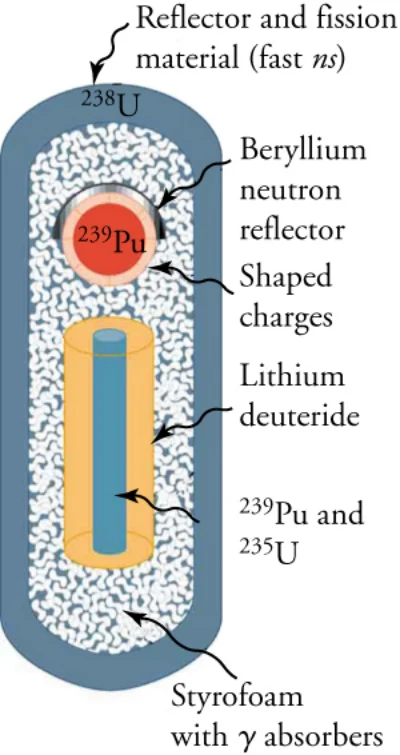
Figure 22.35 shows a simple diagram of how a thermonuclear bomb is constructed. A fission bomb is exploded next to fusion fuel in the solid form of lithium deuteride. Before the shock wave blows it apart, rays heat and compress the fuel, and neutrons create tritium through the reaction . Additional fusion and fission fuels are enclosed in a dense shell of . At the same time that the uranium shell reflects the neutrons back into the fuel to enhance its fusion, the fast-moving neutrons cause the plentiful and inexpensive to fission, part of what allows thermonuclear bombs to be so large.
図22.35は、熱核爆弾がどう作られているかの簡単な図である。分裂爆弾が、固体の重水素化リチウムの形の融合の燃料のすぐ隣で爆発する。衝撃波が吹き飛ばす前に、線が燃料を熱して押し縮め、中性子が反応で三重水素を作る。さらに融合と分裂の燃料が、密なの殻に包まれている。ウランの殻が中性子を燃料へ反射して融合を高めるのと同時に、速く動く中性子が、豊富で安いを分裂させる。熱核爆弾がこれほど大きくなれるのは、その一端による。
Of course, not all applications of nuclear physics are as destructive as the weapons described above. Hundreds of nuclear fission power plants around the world attest to the fact that controlled fission is both practical and economical. Given growing concerns over global warming, nuclear power is often seen as a viable alternative to energy derived from fossil fuels.
もちろん、核物理の応用のすべてが上に述べた兵器のように破壊的なわけではない。世界中に数百ある核分裂の発電所は、制御された分裂が実用的で採算にも合うことを示している。地球温暖化への懸念が高まる中、原子力はしばしば化石燃料由来のエネルギーに代わりうるものと見られている。
Fusion Reactors For decades, fusion reactors have been deemed the energy of the future. A safer, cleaner, and more abundant potential source of energy than its fission counterpart, images of the fusion reactor have been conjured up each time the need for a renewable, environmentally friendly resource is discussed. Now, after more than half a century of speculating, some scientists believe that fusion reactors are nearly here.
核融合炉 何十年ものあいだ、核融合炉は未来のエネルギーとされてきた。分裂の相手より安全で、きれいで、資源も豊富なエネルギー源になりうるとして、再生でき環境にやさしい資源の必要が論じられるたびに、核融合炉の姿が思い浮かべられてきた。半世紀を超える推測ののち、いま一部の科学者は、核融合炉はもうすぐそこまで来ていると考えている。
In creating energy by combining atomic nuclei, the fusion reaction holds many advantages over fission. First, fusion reactions are more efficient, releasing 3 to 4 times more energy than fission per gram of fuel. Furthermore, unlike fission reactions that require heavy elements like uranium that are difficult to obtain, fusion requires light elements that are abundant in nature. The greatest advantage of the fusion reaction, however, is in its ability to be controlled. While traditional nuclear reactors create worries about meltdowns and radioactive waste, neither is a substantial concern with the fusion reaction. Consider that fusion reactions require a large amount of energy to overcome the repulsive Coulomb force and that the byproducts of a fusion reaction are largely limited to helium nuclei.
原子核を合わせてエネルギーを作るという点で、融合の反応は分裂に比べて多くの利点を持つ。第一に、融合の反応は効率がよく、燃料1グラムあたり分裂の3倍から4倍のエネルギーを放つ。さらに、手に入れにくいウランのような重い元素を要する分裂の反応と違い、融合は自然に豊富にある軽い元素を要する。しかし融合の反応の最大の利点は、制御できることにある。従来の原子炉では炉心溶融や放射性廃棄物が心配されるが、融合の反応ではどちらも大きな懸念ではない。融合の反応は反発するクーロン力に打ち勝つのに大きなエネルギーを要すること、融合の反応の副産物がおおむねヘリウムの原子核に限られることを考えてみればよい。
In order for fusion to occur, hydrogen isotopes of deuterium and tritium must be acquired. While deuterium can easily be gathered from ocean water, tritium is slightly more difficult to come by, though it can be manufactured from Earth’s abundant lithium. Once acquired, the hydrogen isotopes are injected into an empty vessel and subjected to temperature and pressure great enough to mimic the conditions at the core of our Sun. Using carefully controlled high-frequency radio waves, the hydrogen isotopes are broken into plasma and further controlled through an electromagnetic field. As the electromagnetic field continues to exert pressure on the hydrogen plasma, enough energy is supplied to cause the hydrogen plasma to fuse into helium.
融合を起こすには、水素の同位体である重水素と三重水素を手に入れなければならない。重水素は海水から容易に集められるが、三重水素はやや手に入れにくい。もっとも、地球に豊富なリチウムから作ることはできる。手に入れた水素の同位体は空の容器へ入れられ、太陽の芯の条件をまねられるほど高い温度と圧力にさらされる。注意深く制御された高い振動数の電波を使って、水素の同位体はプラズマに分けられ、さらに電磁場で制御される。電磁場が水素のプラズマに圧力をかけ続けるうちに、水素のプラズマがヘリウムへ融合するだけのエネルギーが与えられる。
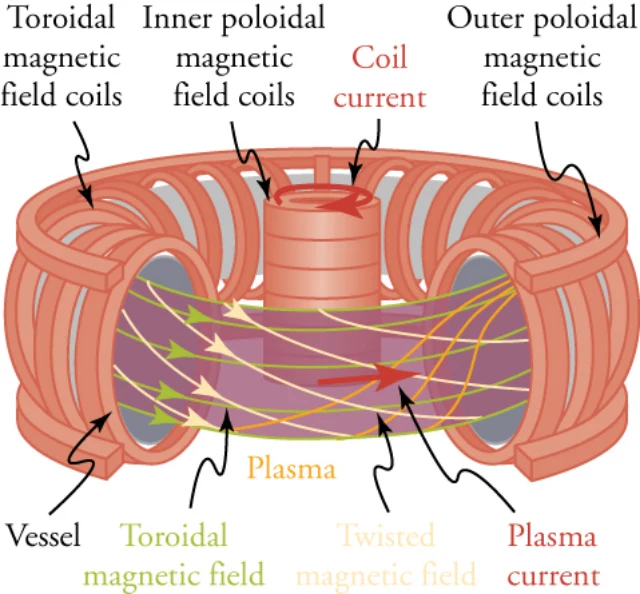
Once the plasma fuses, high-velocity neutrons are ejected from the newly formed helium atoms. Those high velocity neutrons, carrying the excess energy stored within bonds of the original hydrogen, are able to travel unaffected by the applied magnetic field. In doing so, they strike a barrier around the nuclear reactor, transforming their excess energy to heat. The heat is then harvested to make steam that drives turbines. Hydrogen’s tremendous power is now usable!
プラズマが融合すると、できたばかりのヘリウム原子から高速の中性子が放り出される。もとの水素の結合に蓄えられていた余分なエネルギーを運ぶこれらの高速の中性子は、かけられた磁場に影響されずに進める。そうして原子炉のまわりの壁にあたり、余分なエネルギーを熱に変える。その熱を取り出して蒸気を作り、タービンを回す。こうして水素の途方もない力が使えるようになる。
The historical concern with nuclear fusion reactors is that the energy required to control the electromagnetic field is greater than the energy harvested from the hydrogen atoms. However, recent research by both Lockheed Martin engineers and scientists at the Lawrence Livermore National Laboratory has yielded exciting theoretical improvements in efficiency. At the time of this writing, a test facility called ITER (International Thermonuclear Experimental Reactor) is being constructed in southern France. A joint venture of the European Union, the United States, Japan, Russia, China, South Korea, and India, ITER is designed for further study into the future of nuclear fusion energy production.
核融合炉について歴史的に心配されてきたのは、電磁場を制御するのに要るエネルギーが、水素原子から取り出せるエネルギーより大きいという点である。しかし近年、ロッキード・マーティンの技術者とローレンス・リバモア国立研究所の科学者の双方の研究が、効率について理論上のわくわくする改善をもたらしている。この本を書いている時点で、ITER(国際熱核融合実験炉)という実験施設が南フランスに建設中である。欧州連合・アメリカ・日本・ロシア・中国・韓国・インドの共同事業であるITERは、核融合によるエネルギー生産の未来をさらに研究するために設計されている。