第22章原子The Atom原書 p.743–794
22.1 The Structure of the Atom22.1 原子の構造
SECTION LEARNING OBJECTIVES By the end of this section, you will be able to do the following:
この節の学習目標 この節を終えると、次のことができるようになる。
• Describe Rutherford’s experiment and his model of the atom• Describe emission and absorption spectra of atoms• Describe the Bohr model of the atom• Calculate the energy of electrons when they change energy levels• Calculate the frequency and wavelength of emitted photons when electrons change energy levels• Describe the quantum model of the atom
・ラザフォードの実験と、彼の原子のモデルを述べる・原子の輝線スペクトルと吸収スペクトルを述べる・原子のボーアモデルを述べる・電子がエネルギー準位を移るときのエネルギーを計算する・電子がエネルギー準位を移るときに放たれる光子の振動数と波長を計算する・原子の量子モデルを述べる
Section Key Termsこの節の重要語
How do we know that atoms are really there if we cannot see them with our own eyes? While often taken for granted, our knowledge of the existence and structure of atoms is the result of centuries of contemplation and
自分の目で見られないのに、原子が本当にあるとどうしてわかるのか。当たり前のこととして扱われがちだが、原子の存在と構造についての私たちの知識は、何世紀もの
energy-level diagramexcited stateFraunhofer linesground stateHeisenberg Uncertainty Principlehydrogen-like atomsplanetary model of the atomRutherford scatteringRydberg constant
エネルギー準位図 励起状態 フラウンホーファー線基底状態 ハイゼンベルクの不確定性原理 水素に似た原子原子の惑星モデル ラザフォード散乱 リュードベリ定数
experimentation. The earliest known speculation on the atom dates back to the fifth century B.C., when Greek philosophers Leucippus and Democritus contemplated whether a substance could be divided without limit into ever smaller pieces. Since then, scientists such as John Dalton (1766–1844), Amadeo Avogadro (1776–1856), and Dmitri Mendeleev (1834–1907) helped to discover the properties of that fundamental structure of matter. While much could be written about any number of important scientific philosophers, this section will focus on the role played by Ernest Rutherford (1871–1937). Though his understanding of our most elemental matter is rooted in the success of countless prior investigations, his surprising discovery about the interior of the atom is most fundamental in explaining so many well-known phenomena.
思索と実験の結果である。原子についての知られる最も古い推測は紀元前5世紀にさかのぼる。ギリシアの哲学者レウキッポスとデモクリトスが、物質を限りなく小さな断片へ分け続けられるかを考えたときである。それ以来、ジョン・ドルトン(1766–1844)、アメデオ・アヴォガドロ(1776–1856)、ドミトリ・メンデレーエフ(1834–1907)といった科学者が、物質の根本の構造の性質を明らかにするのを助けた。多くの重要な科学の思索家について書けることは山ほどあるが、この節ではアーネスト・ラザフォード(1871–1937)の果たした役割に絞る。最も基本的な物質についての彼の理解は、数えきれない先行研究の成功に根ざしてはいるが、原子の内部についての彼の驚くべき発見こそが、よく知られた多くの現象を説明するうえで最も根本的である。
Rutherford’s Experimentラザフォードの実験
In the early 1900’s, the plum pudding model was the accepted model of the atom. Proposed in 1904 by J. J. Thomson, the model suggested that the atom was a spherical ball of positive charge, with negatively charged electrons scattered evenly throughout. In that model, the positive charges made up the pudding, while the electrons acted as isolated plums. During its short life, the model could be used to explain why most particles were neutral, although with an unbalanced number of plums, electrically charged atoms could exist.
1900年代の初め、原子の構造を説明する考え方としてブドウパン模型が受け入れられていた。J・J・トムソンが1904年に提案したこの模型では、原子は球状に広がった正電荷からなり、その中に負電荷を持つ電子が散らばっていると考える。正電荷の広がりをパンの生地、電子を生地に埋め込まれた干しブドウにたとえた名前である。この模型は、正負の電荷が釣り合えば原子が中性になることを説明できた。また、電子の数が過不足になると、原子は電荷を持つと説明できた。
When Ernest Rutherford began his gold foil experiment in 1909, it is unlikely that anyone would have expected that the plum pudding model would be challenged. However, using a radioactive source, a thin sheet of gold foil, and a phosphorescent screen, Rutherford would uncover something so great that he would later call it “the most incredible event that has ever happened to me in my life”[James, L. K. (1993). Nobel Laureates in Chemistry, 1901–1992. Washington, DC: American Chemical Society.]
1909年にアーネスト・ラザフォードが金箔の実験を始めたとき、ブドウパン模型が揺らぐと思った者はまずいなかっただろう。しかしラザフォードは、放射性の線源、薄い金箔、蛍光板を使って、のちに「私の人生で起きた最も信じがたい出来事」と呼ぶほどの大きな発見をする。[James, L. K. (1993). Nobel Laureates in Chemistry, 1901–1992. Washington, DC: American Chemical Society.]
The experiment that Rutherford designed is shown in Figure 22.2. As you can see in, a radioactive source was placed in a lead container with a hole in one side to produce a beam of positively charged helium particles, called alpha particles. Then, a thin gold foil sheet was placed in the beam. When the high-energy alpha particles passed through the gold foil, they were scattered. The scattering was observed from the bright spots they produced when they struck the phosphor screen.
ラザフォードが組んだ実験を図22.2に示す。図のとおり、放射性の線源を、片側に穴のあいた鉛の容器に入れ、正に帯電したヘリウムの粒子——アルファ粒子と呼ばれる——の束を作る。次に、その束の中に薄い金箔の板を置く。高いエネルギーのアルファ粒子が金箔を通り抜けると、散乱された。散乱は、粒子が蛍光板にあたって作る明るい点で観測された。
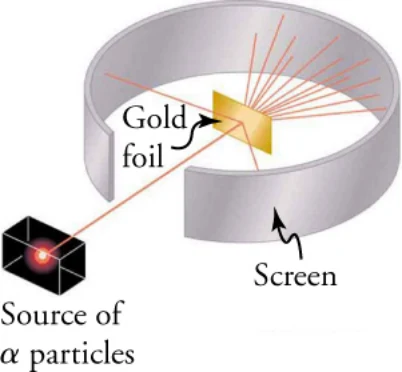
The expectation of the plum pudding model was that the high-energy alpha particles would be scattered only slightly by the presence of the gold sheet. Because the energy of the alpha particles was much higher than those typically associated with atoms, the alpha particles should have passed through the thin foil much like a supersonic bowling ball would crash through a few dozen rows of bowling pins. Any deflection was expected to be minor, and due primarily to the electrostatic Coulomb force between the alpha particles and the foil’s interior electric charges.
ブドウパン模型からの予想は、高エネルギーのアルファ粒子が金の板があってもわずかしか散乱されないというものだった。アルファ粒子のエネルギーは原子にふつう結びつくエネルギーよりずっと高いので、アルファ粒子は、超音速のボウリングの球が何十列ものピンをなぎ倒して通り抜けるように、薄い箔を通り抜けるはずだった。曲がりがあるとしてもわずかで、主にアルファ粒子と箔の内部の電荷とのあいだの静電気のクーロン力によるものと考えられた。
However, the true result was nothing of the sort. While the majority of alpha particles passed through the foil unobstructed, Rutherford and his collaborators Hans Geiger and Ernest Marsden found that alpha particles occasionally were scattered to large angles, and some even came back in the direction from which they came! The result, called Rutherford scattering, implied that the gold nuclei were actually very small when compared with the size of the gold atom. As shown in Figure 22.3, the dense nucleus is surrounded by mostly empty space of the atom, an idea verified by the fact that only 1 in 8,000 particles was scattered backward.
しかし実際の結果はまるで違った。大半のアルファ粒子は妨げられずに箔を通り抜けたが、ラザフォードと共同研究者のハンス・ガイガーおよびアーネスト・マースデンは、アルファ粒子がときどき大きな角度へ散乱され、中には来た方向へ戻ってくるものさえあることを見つけた。この結果はラザフォード散乱と呼ばれ、金の原子核が金の原子の大きさに比べて実は非常に小さいことを意味した。図22.3に示すように、詰まった原子核のまわりは原子のほとんど空っぽの空間で囲まれている。この考えは、後ろへ散乱される粒子が8000個に1個しかなかったという事実で裏づけられた。
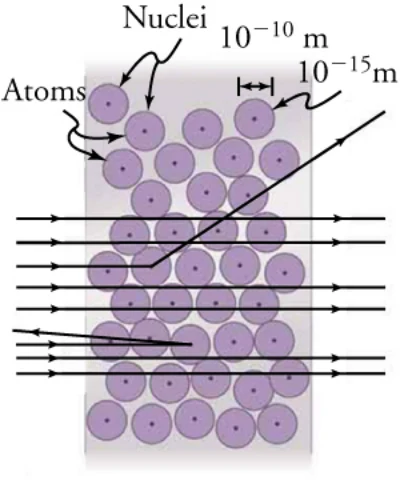
Although the results of the experiment were published by his colleagues in 1909, it took Rutherford two years to convince himself of their meaning. Rutherford later wrote: “It was almost as incredible as if you fired a 15-inch shell at a piece of tissue paper and it came back and hit you. On consideration, I realized that this scattering backwards ... [meant] ... the greatest part of the mass of the atom was concentrated in a tiny nucleus.” In 1911, Rutherford published his analysis together with a proposed model of the atom, which was in part based on Geiger’s work from the previous year. As a result of the paper, the size of the nucleus was determined to be about m, or 100,000 times smaller than the atom. That implies a huge density, on the order of g/cm3, much greater than any macroscopic matter.
実験の結果は1909年に同僚たちによって発表されたが、ラザフォードがその意味を自分で納得するには2年かかった。彼はのちにこう書いている。「それは、15インチ砲弾を薄紙に撃ち込んだら跳ね返ってきて自分にあたった、というくらい信じがたいことだった。考えてみて、この後ろ向きの散乱は……原子の質量の大部分が小さな核に集まっていることを意味する、と気づいた」。1911年、ラザフォードは自分の分析を、前年のガイガーの仕事に一部もとづく原子のモデルの提案とともに発表した。この論文の結果、原子核の大きさはおよそ m、つまり原子の10万分の1と定められた。それは g/cm3の桁という巨大な密度を意味し、どんな巨視的な物質よりはるかに大きい。
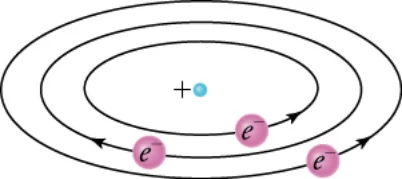
Based on the size and mass of the nucleus revealed by his experiment, as well as the mass of electrons, Rutherford proposed the planetary model of the atom. The planetary model of the atom pictures low-mass electrons orbiting a large-mass nucleus. The sizes of the electron orbits are large compared with the size of the nucleus, and most of the atom is a vacuum. The model is analogous to how low-mass planets in our solar system orbit the large-mass Sun. In the atom, the attractive Coulomb force is analogous to gravitation in the planetary system (see Figure 22.4).
実験で明らかになった原子核の大きさと質量、および電子の質量にもとづいて、ラザフォードは原子の惑星モデルを提案した。原子の惑星モデルは、質量の小さな電子が質量の大きな原子核のまわりを回る絵を描く。電子の軌道の大きさは原子核の大きさに比べて大きく、原子のほとんどは真空である。このモデルは、太陽系で質量の小さな惑星が質量の大きな太陽のまわりを回るのと似ている。原子では、引き合うクーロン力が惑星系での重力にあたる(図22.4を見よ)。
VIRTUAL PHYSICSシミュレーションRutherford Scatteringラザフォード散乱
How did Rutherford figure out the structure of the atom without being able to see it? Explore the answer through this simulation (https://openstax.org/l/28rutherford) of the famous experiment in which he disproved the plum pudding model by observing alpha particles bouncing off atoms and determining that they must have a small core.
ラザフォードは原子を見ることができないのに、どうやってその構造を突き止めたのか。アルファ粒子が原子ではね返るのを観察して原子には小さな芯があるはずだと定め、ブドウパン模型を覆した有名な実験を、この模擬実験(https://openstax.org/l/28rutherford)で探ってみよう。
TIPS FOR SUCCESS As you progress through the model of the atom, consider the effect that experimentation has on the scientific process. Ask yourself the following: What would our model of the atom be without Rutherford’s gold foil experiment? What further understanding of the atom would not have been gained? How would that affect our current technologies? Though often confusing, experiments taking place today to further understand composition of the atom could perhaps have a similar effect.
学習のポイント 原子のモデルを学び進めながら、実験が科学の営みに与える影響を考えてみよう。次のように自問するとよい。ラザフォードの金箔の実験がなかったら、私たちの原子のモデルはどうなっていただろうか。原子についてのどんな理解が得られなかっただろうか。それは今の技術にどう影響しただろうか。しばしばわかりにくいが、原子の成り立ちをさらに解き明かすために今日行われている実験も、同じような影響を持ちうる。
Absorption and Emission Spectra吸収スペクトルと輝線スペクトル
In 1900, Max Planck recognized that all energy radiated from a source is emitted by atoms in quantum states. How would that radical idea relate to the interior of an atom? The answer was first found by investigating the spectrum of light or emission spectrum produced when a gas is highly energized.
1900年、マックス・プランクは、源から放射されるエネルギーはすべて量子状態にある原子から放たれると見抜いた。この過激な考えは、原子の内部とどう関わるのか。答えはまず、気体を強く励起したときに生じる光のスペクトル、すなわち輝線スペクトルを調べることで見つかった。
Figure 22.5 shows how to isolate the emission spectrum of one such gas. The gas is placed in the discharge tube at the left, where it is energized to the point at which it begins to radiate energy or emit light. The radiated light is channeled by a thin slit and then passed through a diffraction grating, which will separate the light into its constituent wavelengths. The separated light will then strike the photographic film on the right.
図22.5は、そうした気体の輝線スペクトルを取り出すやり方を示す。気体は左の放電管に入れられ、そこでエネルギーを与えられて放射を始める、つまり光を出す。放射された光は細いすきまで絞られ、それから回折格子を通る。回折格子は光をそれを作る波長へ分ける。分かれた光は右側の写真の膜にあたる。
The line spectrum shown in part (b) of Figure 22.5 is the output shown on the film for excited iron. Note that this spectrum is not continuous but discrete. In other words, only particular wavelengths are emitted by the iron source. Why would that be the case?
図22.5の(b)に示す線スペクトルは、励起された鉄について膜に出た結果である。このスペクトルは連続ではなく離散的であることに注意せよ。言いかえれば、鉄の線源からは特定の波長しか放たれない。なぜそうなるのか。
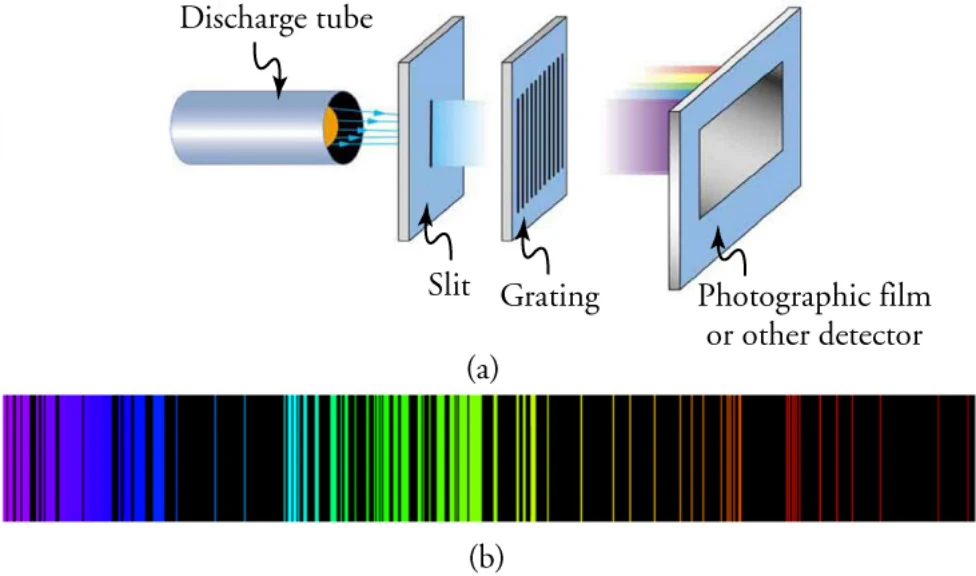
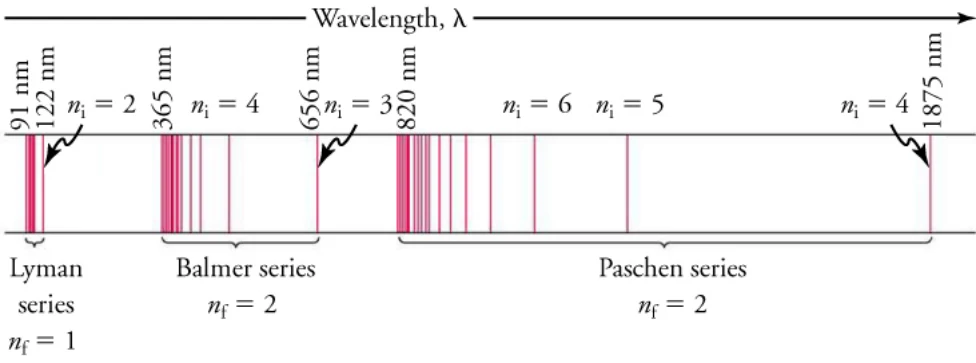
The spectrum of light created by excited iron shows a variety of discrete wavelengths emitted within the visible spectrum. Each element, when excited to the appropriate degree, will create a discrete emission spectrum as in part (b) of Figure 22.5. However, the wavelengths emitted will vary from element to element. The emission spectrum for iron was chosen for Figure 22.5 solely because a substantial portion of its emission spectrum is within the visible spectrum. Figure 22.6 shows the emission spectrum for hydrogen. Note that, while discrete, a large portion of hydrogen emission takes place in the ultraviolet and infrared regions.
励起された鉄が作る光のスペクトルは、可視のスペクトルの中に放たれるさまざまな離散的な波長を示す。どの元素も、適切な程度に励起されると、図22.5の(b)のような離散的な輝線スペクトルを作る。ただし放たれる波長は元素ごとに違う。図22.5に鉄の輝線スペクトルを選んだのは、その輝線スペクトルのかなりの部分が可視のスペクトルの中にあるという理由だけである。図22.6は水素の輝線スペクトルを示す。離散的ではあるが、水素の放射の大部分は紫外と赤外の領域で起こることに注意せよ。
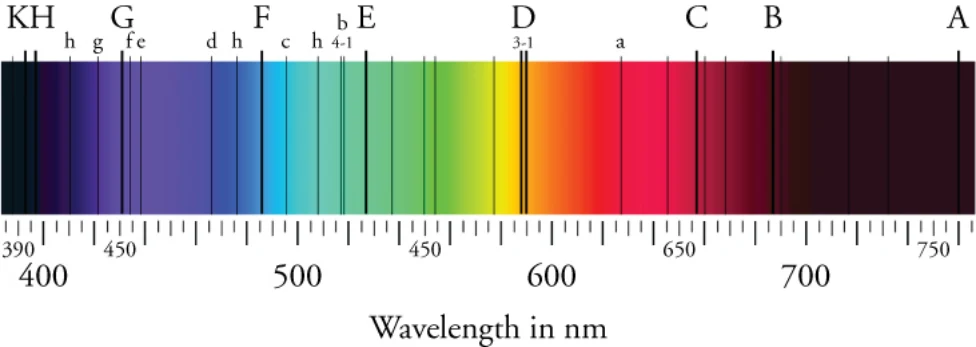
Just as an emission spectrum shows all discrete wavelengths emitted by a gas, an absorption spectrum will show all light that is absorbed by a gas. Black lines exist where the wavelengths are absorbed, with the remainder of the spectrum lit by light is free to pass through. What relationship do you think exists between the black lines of a gas’s absorption spectrum and the colored lines of its emission spectrum? Figure 22.7 shows the absorption spectrum of the Sun. The black lines are called Fraunhofer lines, and they correspond to the wavelengths absorbed by gases in the Sun’s exterior.
輝線スペクトルが気体から放たれる離散的な波長をすべて示すのと同じように、吸収スペクトルは気体に吸収される光をすべて示す。波長が吸収されるところに黒い線が現れ、スペクトルの残りは自由に通り抜ける光で明るい。気体の吸収スペクトルの黒い線と、その輝線スペクトルの色のついた線とのあいだには、どんな関係があると思うか。図22.7は太陽の吸収スペクトルを示す。黒い線はフラウンホーファー線と呼ばれ、太陽の外側の気体に吸収される波長に対応する。
Bohr’s Explanation of the Hydrogen Spectrum水素のスペクトルについてのボーアの説明
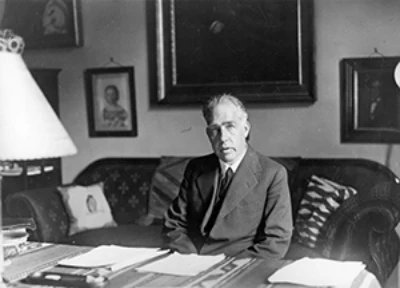
To tie the unique signatures of emission spectra to the composition of the atom itself would require clever thinking. Niels Bohr (1885–1962), a Danish physicist, did just that, by making immediate use of Rutherford’s planetary model of the atom. Bohr, shown in Figure 22.8, became convinced of its validity and spent part of 1912 at Rutherford’s laboratory. In 1913, after returning to Copenhagen, he began publishing his theory of the simplest atom, hydrogen, based on Rutherford’s planetary model.
輝線スペクトルという固有の指紋を、原子そのものの成り立ちに結びつけるには、賢い考えが要った。デンマークの物理学者ニールス・ボーア(1885–1962)がそれをやってのけた。彼はラザフォードの原子の惑星モデルをただちに使った。図22.8のボーアは、そのモデルの正しさを確信し、1912年の一部をラザフォードの研究室で過ごした。1913年、コペンハーゲンに戻ったのち、ラザフォードの惑星モデルにもとづいて、最も簡単な原子である水素についての理論を発表し始めた。
Bohr was able to derive the formula for the hydrogen spectrum using basic physics, the planetary model of the atom, and some very important new conjectures. His first conjecture was that only certain orbits are allowed: In other words, in an atom, the orbits of electrons are quantized. Each quantized orbit has a different distinct energy, and electrons can move to a higher orbit by absorbing energy or drop to a lower orbit by emitting energy. Because of the quantized orbits, the amount of energy emitted or absorbed must also be quantized, producing the discrete spectra seen in Figure 22.5 and Figure 22.7. In equation form, the amount of energy absorbed or emitted can be found as
ボーアは、基本的な物理と原子の惑星モデル、そしていくつかの非常に重要な新しい仮定を使って、水素のスペクトルの式を導くことができた。第一の仮定は、ある種の軌道だけが許されるというものだった。言いかえれば、原子の中で電子の軌道は量子化されている。量子化されたそれぞれの軌道は異なるはっきりしたエネルギーを持ち、電子はエネルギーを吸収して高い軌道へ移り、エネルギーを放って低い軌道へ落ちることができる。軌道が量子化されているので、放たれたり吸収されたりするエネルギーの量も量子化されていなければならず、図22.5や図22.7に見られる離散的なスペクトルを作る。式の形にすると、吸収または放出されるエネルギーの量は次のように求められる。
where refers to the energy of the initial quantized orbit, and refers to the energy of the final orbits.
ここでは初めの量子化された軌道のエネルギー、は終わりの軌道のエネルギーを指す。
Furthermore, the wavelength emitted can be found using the equation
さらに、放たれる波長は次の式で求められる。
and relating the wavelength to the frequency found using the equation , where v corresponds to the speed of light.
そして、式で求まる振動数に波長を関係づける。ここでvは光の速さにあたる。
It makes sense that energy is involved in changing orbits. For example, a burst of energy is required for a satellite to climb to a higher orbit. What is not expected is that atomic orbits should be quantized. Quantization is not observed for satellites or planets, which can have any orbit, given the proper energy (see Figure 22.9).
軌道を変えるのにエネルギーが関わるのは道理にかなっている。たとえば人工衛星が高い軌道へ上がるにはエネルギーの噴射が要る。予想されないのは、原子の軌道が量子化されているという点である。人工衛星や惑星には量子化は見られず、適切なエネルギーさえあればどんな軌道でも取れる(図22.9を見よ)。
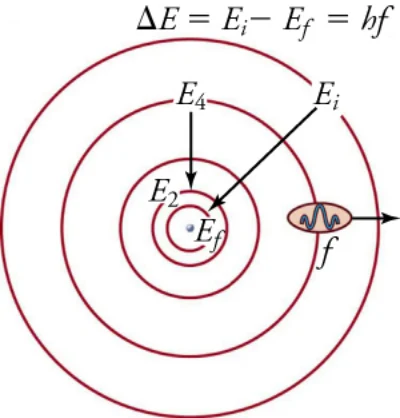
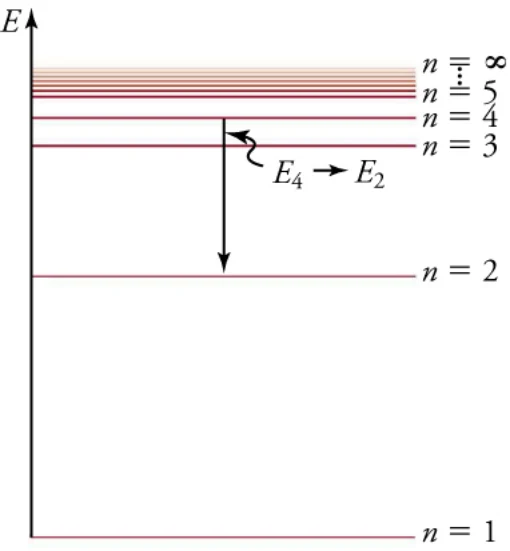
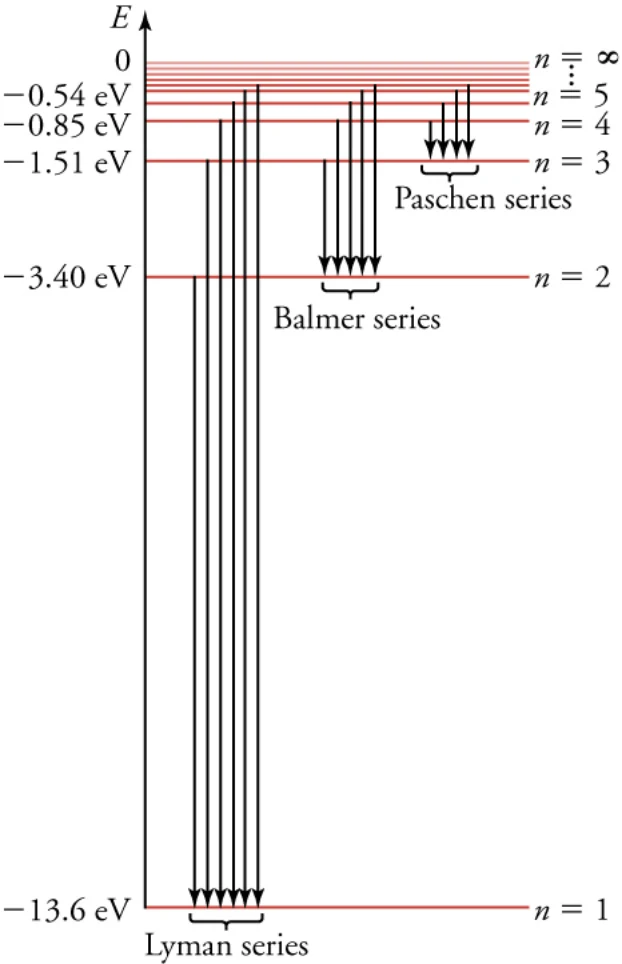
Figure 22.10 shows an energy-level diagram, a convenient way to display energy states. Each of the horizontal lines corresponds to the energy of an electron in a different orbital. Energy is plotted vertically with the lowest or ground state at the bottom and with excited states above. The vertical arrow downwards shows energy being emitted out of the atom due to an electron dropping from one excited state to another. That would correspond to a line shown on the atom’s emission spectrum. The Lyman series shown in Figure 22.6 results from electrons dropping to the ground state, while the Balmer and Paschen series result to electrons dropping to the n = 2 and n = 3 states, respectively.
図22.10はエネルギー準位図を示す。エネルギーの状態を表す便利なやり方である。水平な線のそれぞれが、異なる軌道にある電子のエネルギーに対応する。エネルギーは縦にとり、最も低い状態すなわち基底状態を下に、励起状態をその上に置く。下向きの縦の矢印は、電子が一つの励起状態から別の状態へ落ちることで原子からエネルギーが放たれることを示す。それは原子の輝線スペクトルに現れる線に対応する。図22.6に示したライマン系列は電子が基底状態へ落ちることから生じ、バルマー系列とパッシェン系列はそれぞれ電子がn = 2とn = 3の状態へ落ちることから生じる。
Energy and Wavelength of Emitted Hydrogen Spectra放たれる水素のスペクトルのエネルギーと波長
The energy associated with a particular orbital of a hydrogen atom can be found using the equation
水素原子のある軌道に結びつくエネルギーは、次の式で求められる。
where n corresponds to the orbital value from the atom’s nucleus. The negative value in the equation is based upon a baseline energy of zero when the electron is infinitely far from the atom. As a result, the negative value shows that energy is necessary to free the electron from its orbital state. The minimum energy to free the electron is also referred to as its binding energy. The equation is only valid for atoms with single electrons in their orbital shells (like hydrogen). For ionized atoms similar to hydrogen, the following formula may be used.
ここでnは原子核から数えた軌道の値にあたる。式の負の値は、電子が原子から無限に遠いときのエネルギーを基準の0とすることにもとづく。したがって負の値は、電子を軌道の状態から解き放つにはエネルギーが要ることを示す。電子を解き放つのに要る最小のエネルギーは、その結合エネルギーとも呼ばれる。この式は、軌道の殻に電子が一つしかない原子(水素のような)にだけ有効である。水素に似たイオン化した原子には、次の式が使える。
Please note that corresponds to –13.6 eV, as mentioned earlier. Additionally, refers to the atomic number of the element studied. The atomic number is the number of protons in the nucleus—it is different for each element. The above equation is derived from some basic physics principles, namely conservation of energy, conservation of angular momentum, Coulomb’s law, and centripetal force. There are three derivations that result in the orbital energy equations, and they are shown below. While you can use the energy equations without understanding the derivations, they will help to remind you of just how valuable those fundamental concepts are.
は先に述べたとおり–13.6 eVにあたることに注意せよ。または調べる元素の原子番号を指す。原子番号は原子核の中の陽子の数であり、元素ごとに違う。上の式は、エネルギー保存・角運動量保存・クーロンの法則・向心力という基本的な物理の原理から導かれる。軌道のエネルギーの式に至る導出は三つあり、以下に示す。導出を理解しなくてもエネルギーの式は使えるが、導出は、これらの基本の考えがどれほど価値あるものかを思い出させてくれる。
Derivation 1 (Finding the Radius of an Orbital) One primary difference between the planetary model of the solar system and the planetary model of the atom is the cause of the circular motion. While gravitation causes the motion of orbiting planets around an interior star, the Coulomb force is responsible for the circular shape of the electron’s orbit. The magnitude of the centripetal force is
導出1(軌道の半径を求める) 太陽系の惑星モデルと原子の惑星モデルの大きな違いの一つは、円運動の原因である。内側の恒星のまわりを回る惑星の運動を起こすのは重力だが、電子の軌道が円になるのはクーロン力による。向心力の大きさは
, while the magnitude of the Coulomb force is . The assumption here is that the nucleus is more massive than the stationary electron, and the electron orbits about it. That is consistent with the planetary model of the atom. Equating the Coulomb force and the centripetal force,
であり、クーロン力の大きさはである。ここでは、原子核は静止した電子より重く、電子がそのまわりを回ると仮定している。それは原子の惑星モデルと辻褄が合う。クーロン力と向心力を等しいと置くと、
which yields
これから次が得られる。
Derivation 2 (Finding the Velocity of the Orbiting Electron) Bohr was clever enough to find a way to calculate the electron orbital energies in hydrogen. That was an important first step that has been improved upon, but it is well worth repeating here, because it does correctly describe many characteristics of hydrogen. Assuming circular orbits, Bohr proposed that the angular momentum L of an electron in its orbit is also quantized, that is, it has only specific, discrete values. The value for L is given by the formula
導出2(回る電子の速さを求める) ボーアは、水素の電子の軌道のエネルギーを計算する道を見つけるほど賢かった。それは重要な第一歩であり、その後改良されてはいるが、水素の多くの特徴を正しく述べているので、ここで繰り返す価値は十分にある。円軌道を仮定して、ボーアは電子の軌道の角運動量Lもまた量子化されている、つまり特定の離散的な値しか取らないと提案した。Lの値は次の式で与えられる。
where L is the angular momentum, me is the electron’s mass, rn is the radius of the n th orbit, and h is Planck’s constant. Note that angular momentum is . For a small object at a radius r, , and , so that
ここでLは角運動量、meは電子の質量、rnはn番目の軌道の半径、hはプランク定数である。角運動量はであることに注意せよ。半径rにある小さな物についてはかつなので、
Quantization says that the value of mvr can only be equal to h / 2, 2h / 2, 3h / 2, etc.
量子化とは、mvrの値がh/2、2h/2、3h/2などにしかなれないということである。
At the time, Bohr himself did not know why angular momentum should be quantized, but by using that assumption, he was able to calculate the energies in the hydrogen spectrum, something no one else had done at the time.
当時ボーア自身、なぜ角運動量が量子化されるのかは知らなかった。しかしこの仮定を使うことで、当時ほかの誰にもできなかった水素のスペクトルのエネルギーの計算ができた。
Derivation 3 (Finding the Energy of the Orbiting Electron) To get the electron orbital energies, we start by noting that the electron energy is the sum of its kinetic and potential energy.
導出3(回る電子のエネルギーを求める) 電子の軌道のエネルギーを得るために、まず電子のエネルギーが運動エネルギーと位置エネルギーの和であることに注意する。
Kinetic energy is the familiar , assuming the electron is not moving at a relativistic speed. Potential energy for the electron is electrical, or , where V is the potential due to the nucleus, which looks like a point charge. The nucleus has a positive charge ; thus, , recalling an earlier equation for the potential due to a point charge from the chapter on Electricity and Magnetism. Since the electron’s charge is negative, we see that Substituting the expressions for KE and PE,
運動エネルギーはおなじみのである。電子が相対論的な速さで動いていないとする。電子の位置エネルギーは電気的なものでである。ここでVは原子核による電位であり、原子核は点電荷のように見える。原子核は正の電荷を持つ。したがってとなる。電気と磁気の章で出てきた点電荷による電位の式を思い出そう。電子の電荷は負なので、となる。KEとPEの式を代入すると、
Now we solve for rn and v using the equation for angular momentum , giving
ここで角運動量の式を使ってrnとvについて解くと、
and
および
Substituting the expression for rn and v into the above expressions for energy (KE and PE), and performing algebraic manipulation, yields
rnとvの式を上のエネルギー(KEとPE)の式に代入し、式を整理すると、
for the orbital energies of hydrogen-like atoms. Here, Eo is the ground-state energy (n = 1) for hydrogen (Z = 1) and is given by
が得られる。これが水素に似た原子の軌道のエネルギーである。ここでEoは水素(Z = 1)の基底状態(n = 1)のエネルギーで、次で与えられる。
Thus, for hydrogen,
したがって水素については、
The relationship between orbital energies and orbital states for the hydrogen atom can be seen in Figure 22.11.
水素原子の軌道のエネルギーと軌道の状態の関係は、図22.11に見ることができる。
A hydrogen atom is struck by a photon. How much energy must be absorbed from the photon to raise the electron of the hydrogen atom from its ground state to its second orbital? Strategy
水素原子に光子があたる。水素原子の電子を基底状態から二番目の軌道へ上げるには、光子からどれだけのエネルギーを吸収しなければならないか。 方針
The hydrogen atom has an atomic number of Z =1. Raising the electron from the ground state to its second orbital will increase its orbital level from n = 1 to n =2. The energy determined will be measured in electron-volts.
水素原子の原子番号はZ = 1である。電子を基底状態から二番目の軌道へ上げると、軌道の準位はn = 1からn = 2になる。求めるエネルギーは電子ボルトで測る。
Solution解答
The amount of energy necessary to cause the change in electron state is the difference between the final and initial energies of the electron. The final energy state of the electron can be found using
電子の状態を変えるのに要るエネルギーの量は、電子の終わりのエネルギーと初めのエネルギーの差である。電子の終わりのエネルギーの状態は次の式で求められる。
Knowing the n and Z values for the hydrogen atom, and knowing that Eo = –13.6 eV, the result is
水素原子のnとZの値を知り、Eo = –13.6 eVであることを知っていれば、結果は
The original amount of energy associated with the electron is equivalent to the ground state orbital, or
電子にもともと結びついているエネルギーの量は基底状態の軌道に等しく、
The amount of energy necessary to change the orbital state of the electron can be found by determining the electron’s change in energy.
電子の軌道の状態を変えるのに要るエネルギーの量は、電子のエネルギーの変化を求めればわかる。
Discussion考察
The energy required to change the orbital state of the electron is positive. That means that for the electron to move to a state with greater energy, energy must be added to the atom. Should the electron drop back down to its original energy state, a change of –10.2 eV would take place, and 10.2 eV of energy would be emitted from the atom. Just as only quantum amounts of energy may be absorbed by the atom, only quantum amounts of energy can be emitted from the atom. That helps to explain many of the quantum light effects that you have learned about previously.
電子の軌道の状態を変えるのに要るエネルギーは正である。つまり、電子がよりエネルギーの大きい状態へ移るには、原子にエネルギーを加えなければならない。もし電子がもとのエネルギーの状態へ落ちれば、–10.2 eVの変化が起こり、10.2 eVのエネルギーが原子から放たれる。原子が吸収できるのが量子の分量のエネルギーだけであるのと同じように、原子から放たれるのも量子の分量のエネルギーだけである。これは、これまでに学んだ光の量子的な効果の多くを説明するのに役立つ。
Characteristic X-Ray Energy Calculate the approximate energy of an X-ray emitted for an n = 2 to n = 1 transition in a tungsten anode in an X-ray tube. Strategy
特性X線のエネルギー X線管のタングステンの陽極で、n = 2からn = 1への移り変わりで放たれるX線のおよそのエネルギーを計算せよ。 方針
How do we calculate energies in a multiple-electron atom? In the case of characteristic X-rays, the following approximate calculation is reasonable. Characteristic X-rays are produced when an inner-shell vacancy is filled. Inner-shell electrons are nearer the nucleus than others in an atom and thus feel little net effect from the others. That is similar to what happens inside a charged conductor, where its excess charge is distributed over the surface so that it produces no electric field inside. It is reasonable to assume the inner-shell electrons have hydrogen-like energies, as given by
電子が複数ある原子でエネルギーをどう計算するか。特性X線の場合は、次のような近似の計算が妥当である。特性X線は、内側の殻の空きが埋められるときに生じる。内側の殻の電子は原子の中で他の電子より原子核に近く、したがって他の電子から受ける正味の影響はほとんどない。それは帯電した導体の内部で起こることと似ている。導体では余分な電荷が表面に分布し、内部に電場を作らない。内側の殻の電子は、次の式で与えられる水素に似たエネルギーを持つと考えてよい。
For tungsten, Z = 74, so that the effective charge is 73.
タングステンではZ = 74なので、実効の電荷は73である。
Solution解答
The amount of energy given off as an X-ray is found using
X線として放たれるエネルギーの量は次の式で求める。
where
ここで
and
および
Thus,
したがって、
Discussion考察
753This large photon energy is typical of characteristic X-rays from heavy elements. It is large compared with other atomic emissions because it is produced when an inner-shell vacancy is filled, and inner-shell electrons are tightly bound. Characteristic X-ray energies become progressively larger for heavier elements because their energy increases approximately as Z2. Significant accelerating voltage is needed to create such inner-shell vacancies, because other shells are filled and you cannot simply bump one electron to a higher filled shell. You must remove it from the atom completely. In the case of tungsten, at least 72.5 kV is needed. Tungsten is a common anode material in X-ray tubes; so much of the energy of the impinging electrons is absorbed, raising its temperature, that a high-melting-point material like tungsten is required.
この大きな光子のエネルギーは、重い元素からの特性X線に典型的なものである。他の原子の放射に比べて大きいのは、内側の殻の空きが埋められるときに生じ、内側の殻の電子が強く束縛されているからである。特性X線のエネルギーは、そのエネルギーがおよそZ2に比例して増えるため、重い元素ほど次第に大きくなる。そうした内側の殻の空きを作るには、かなりの加速電圧が要る。他の殻は埋まっており、電子を一つ、すでに埋まった上の殻へ押し上げるわけにはいかないからである。原子から完全に取り除かなければならない。タングステンの場合、少なくとも72.5 kVが要る。タングステンはX線管でよく使われる陽極の材料である。ぶつかってくる電子のエネルギーの多くが吸収されて温度が上がるので、タングステンのような融点の高い材料が要るのである。
The wavelength of light emitted by an atom can also be determined through basic derivations. Let us consider the energy of a photon emitted from a hydrogen atom in a downward transition, given by the equation
原子が放つ光の波長も、基本的な導出で定められる。下向きの移り変わりで水素原子から放たれる光子のエネルギーを考えよう。それは次の式で与えられる。
Substituting , we get
を代入すると、
Dividing both sides of the equation by hc gives us an expression for ,
両辺をhcで割ると、の式が得られる。
It can be shown that
さらに次が示せる。
where R is the Rydberg constant.
ここでRはリュードベリ定数である。
Simplified, the formula for determining emitted wavelength can now be written as
整理すると、放たれる波長を求める式は次のように書ける。
What wavelength of light is emitted by an electron dropping from the third orbital to the ground state of a hydrogen atom? Strategy
水素原子で電子が三番目の軌道から基底状態へ落ちるとき、放たれる光の波長はいくらか。 方針
The ground state of a hydrogen atom is considered the first orbital of the atom. As a result, nf = 1 and ni = 3. The Rydberg constant has already been determined and will be constant regardless of atom chosen.
水素原子の基底状態は、その原子の一番目の軌道とみなす。したがってnf = 1、ni = 3である。リュードベリ定数はすでに定まっており、どの原子を選んでも一定である。
Solution解答
For the equation above, calculate wavelength based on the known energy states.
上の式について、わかっているエネルギーの状態から波長を計算する。
Rearranging the equation for wavelength yields
波長について式を整理すると、
Discussion考察
This wavelength corresponds to light in the ultraviolet spectrum. As a result, we would not be able to see the photon of light emitted when an electron drops from its third to first energy state. However, it is worth noting that by supplying light of wavelength precisely 102.6 nm, we can cause the electron in hydrogen to move from its first to its third orbital state.
この波長は紫外のスペクトルの光にあたる。したがって、電子が三番目のエネルギーの状態から一番目へ落ちるときに放たれる光の光子は、私たちには見えない。ただし、波長ちょうど102.6 nmの光を与えれば、水素の電子を一番目から三番目の軌道の状態へ移せることは注目に値する。
Limits of Bohr’s Theory and the Quantum Model of the Atomボーアの理論の限界と原子の量子モデル
There are limits to Bohr’s theory. It does not account for the interaction of bound electrons, so it cannot be fully applied to multielectron atoms, even one as simple as the two-electron helium atom. Bohr’s model is what we call semiclassical. The orbits are quantized (nonclassical) but are assumed to be simple circular paths (classical). As quantum mechanics was developed, it became clear that there are no well-defined orbits; rather, there are clouds of probability. Additionally, Bohr’s theory did not explain that some spectral lines are doublets or split into two when examined closely. While we shall examine a few of those aspects of quantum mechanics in more detail, it should be kept in mind that Bohr did not fail. Rather, he made very important steps along the path to greater knowledge and laid the foundation for all of atomic physics that has since evolved.
ボーアの理論には限界がある。束縛された電子どうしの相互作用を扱えないので、電子が複数ある原子には——たとえ電子が二つのヘリウム原子のように簡単なものでも——そのまま当てはめられない。ボーアのモデルは半古典的と呼ばれるものである。軌道は量子化されている(古典的でない)が、単純な円の道すじだと仮定されている(古典的)。量子力学が発展するにつれ、はっきり定まった軌道などなく、あるのは確率の雲だということが明らかになった。さらにボーアの理論は、いくつかのスペクトル線が二重線であること、詳しく調べると二つに分かれることを説明しなかった。量子力学のそうした面のいくつかをこれから詳しく見ていくが、ボーアが失敗したわけではないことは心に留めておくべきである。むしろ彼は、より深い知識への道すじで非常に重要な一歩を進め、その後発展したすべての原子物理の土台を築いたのである。
DeBroglie’s Waves Following Bohr’s initial work on the hydrogen atom, a decade was to pass before Louis de Broglie proposed that matter has wave properties. The wave-like properties of matter were subsequently confirmed by observations of electron interference when scattered from crystals. Electrons can exist only in locations where they interfere constructively. How does that affect electrons in atomic orbits? When an electron is bound to an atom, its wavelength must fit into a small space, something like a standing wave on a string (see Figure 22.12). Orbits in which an electron can constructively interfere with itself are allowed. All orbits in which constructive interference cannot occur are not able to exist. Thus, only certain orbits are allowed. The wave nature of an electron, according to de Broglie, is why the orbits are quantized!
ド・ブロイの波 水素原子についてのボーアの最初の仕事のあと、ルイ・ド・ブロイが物質は波の性質を持つと提案するまでには10年を要した。物質の波らしい性質は、その後、結晶で散乱された電子の干渉の観測によって確かめられた。電子は、強め合う干渉が起こる場所にしか存在できない。それは原子の軌道にある電子にどう効くのか。電子が原子に束縛されると、その波長は狭い空間に収まらなければならない。弦の上の定常波のようなものである(図22.12を見よ)。電子が自分自身と強め合う干渉をできる軌道が許される。強め合う干渉が起こりえない軌道はすべて存在できない。こうして、ある種の軌道だけが許される。ド・ブロイによれば、電子の波としての性質こそが、軌道が量子化されている理由なのである。
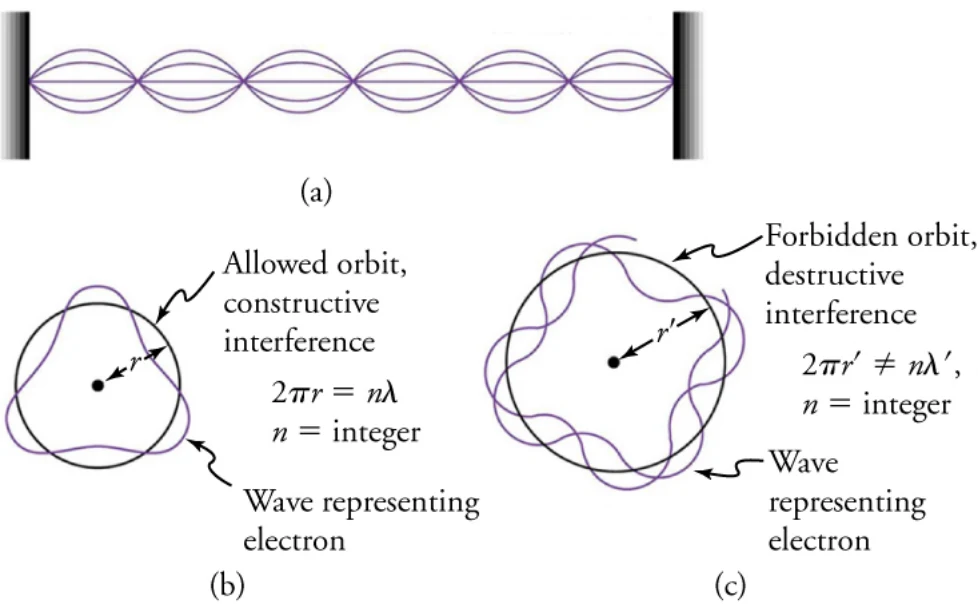
For a circular orbit, constructive interference occurs when the electron’s wavelength fits neatly into the circumference, so that wave crests always align with crests and wave troughs align with troughs, as shown in Figure 22.12(b). More precisely, when an integral multiple of the electron’s wavelength equals the circumference of the orbit, constructive interference is obtained. In equation form, the condition for constructive interference and an allowed electron orbit is
円軌道では、電子の波長がちょうど円周に収まるとき、図22.12(b)のように波の山がつねに山と重なり、谷が谷と重なって、強め合う干渉が起こる。より正確には、電子の波長の整数倍が軌道の円周に等しいとき、強め合う干渉が得られる。式の形にすると、強め合う干渉、すなわち許される電子の軌道の条件は
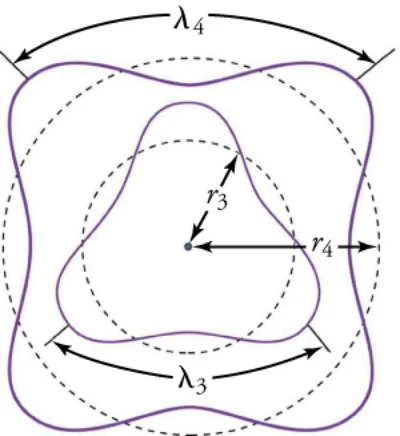
where is the electron’s wavelength and rn is the radius of that circular orbit. Figure 22.13 shows the third and fourth orbitals of a hydrogen atom.
ここでは電子の波長、rnはその円軌道の半径である。図22.13は水素原子の三番目と四番目の軌道を示す。
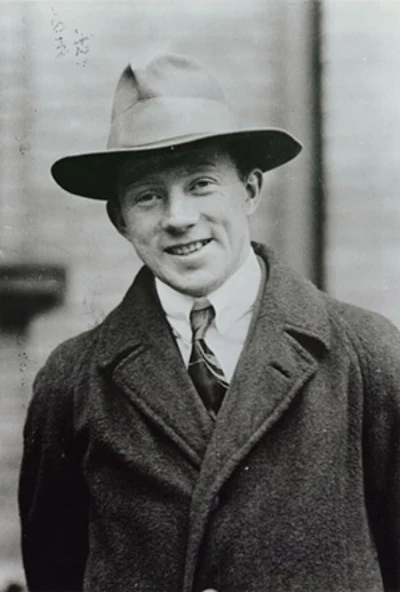
Heisenberg Uncertainty How does determining the location of an electron change its trajectory? The answer is fundamentally important—measurement affects the system being observed. It is impossible to measure a physical quantity exactly, and greater precision in measuring one quantity produces less precision in measuring a related quantity. It was Werner Heisenberg who first stated that limit to knowledge in 1929 as a result of his work on quantum mechanics and the wave characteristics of all particles (see Figure 22.14).
ハイゼンベルクの不確定性 電子の位置を定めることが、その道すじをどう変えるのか。この答えは根本的に重要である——測定は観測される系に影響する。物理量を正確に測ることはできず、ある量をより精密に測ると、それに関係する量の測定の精度は落ちる。この知識の限界を最初に述べたのはヴェルナー・ハイゼンベルクで、1929年、量子力学とあらゆる粒子の波としての特徴についての仕事の結果であった(図22.14を見よ)。
For example, you can measure the position of a moving electron by scattering light or other electrons from it. However, by doing so, you are giving the electron energy, and therefore imparting momentum to it. As a result, the momentum of the electron is affected and cannot be determined precisely. This change in momentum could be anywhere from close to zero up to the relative momentum of the electron ( ). Note that, in this case, the particle is an electron, but the principle applies to any particle.
たとえば、動いている電子に光や他の電子をあてて散乱させれば、その位置を測れる。しかしそうすることで、電子にエネルギーを与え、したがって運動量を与えてしまう。その結果、電子の運動量は影響を受け、正確には定められない。この運動量の変化は、ほぼ0から電子の相対的な運動量()までのどこかになりうる。この場合の粒子は電子だが、この原理はどんな粒子にも当てはまることに注意せよ。
Viewing the electron through the model of wave-particle duality, Heisenberg recognized that, because a wave is not located at one fixed point in space, there is an uncertainty associated with any electron’s position. That uncertainty in position, , is approximately equal to the wavelength of the particle. That is, . There is an interesting trade-off between position and momentum. The uncertainty in an electron’s position can be reduced by using a shorter-wavelength electron, since . But shortening the wavelength increases the uncertainty in momentum, since . Conversely, the uncertainty in momentum can be reduced by using a longer-
電子を波と粒子の二重性のモデルで見て、ハイゼンベルクは、波は空間の一点に定まっていないので、どんな電子の位置にも不確かさが伴うと見抜いた。位置の不確かさは、およそその粒子の波長に等しい。すなわちである。位置と運動量のあいだには面白い取引がある。なので、波長の短い電子を使えば電子の位置の不確かさは減らせる。しかしなので、波長を短くすると運動量の不確かさが増える。逆に、波長の長い
wavelength electron, but that increases the uncertainty in position. Mathematically, you can express the trade-off by multiplying the uncertainties. The wavelength cancels, leaving
電子を使えば運動量の不確かさは減らせるが、そうすると位置の不確かさが増える。数式では、この取引は不確かさどうしを掛けることで表せる。波長が消えて、次が残る。
Therefore, if one uncertainty is reduced, the other must increase so that their product is . With the use of advanced mathematics, Heisenberg showed that the best that can be done in a simultaneous measurement of position and momentum is
したがって、一方の不確かさを減らせば、積がになるようもう一方は増えなければならない。進んだ数学を使って、ハイゼンベルクは位置と運動量を同時に測るときにできる最良のことが次であると示した。
That relationship is known as the Heisenberg uncertainty principle.
この関係はハイゼンベルクの不確定性原理として知られる。
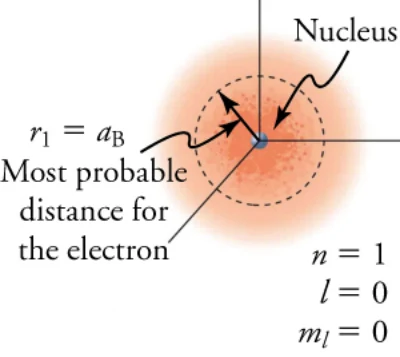
The Quantum Model of the Atom Because of the wave characteristic of matter, the idea of well-defined orbits gives way to a model in which there is a cloud of probability, consistent with Heisenberg’s uncertainty principle. Figure 22.15 shows how the principle applies to the ground state of hydrogen. If you try to follow the electron in some well-defined orbit using a probe that has a wavelength small enough to measure position accurately, you will instead knock the electron out of its orbit. Each measurement of the electron’s position will find it to be in a definite location somewhere near the nucleus. Repeated measurements reveal a cloud of probability like that in the figure, with each speck the location determined by a single measurement. There is not a well-defined, circular-orbit type of distribution. Nature again proves to be different on a small scale than on a macroscopic scale.
原子の量子モデル 物質が波の性質を持つため、はっきり定まった軌道という考えは、ハイゼンベルクの不確定性原理と辻褄の合う、確率の雲というモデルに道をゆずる。図22.15は、この原理が水素の基底状態にどう当てはまるかを示す。位置を正確に測れるほど波長の短い探りを使って、はっきり定まった軌道の上で電子を追おうとすれば、かえって電子を軌道からたたき出してしまう。電子の位置を測るたびに、電子は原子核の近くのどこか一定の場所に見つかる。測定を繰り返すと、図のような確率の雲が現れる。一つ一つの点が、一回の測定で定まった位置である。はっきり定まった円軌道のような分布はない。自然はまたしても、小さな尺度では巨視的な尺度と違うことを示す。
VIRTUAL PHYSICSシミュレーションModels of the Hydrogen Atom水素原子のモデル
Access multimedia content (http://openstax.org/books/physics/pages/22-1-the-structure-of-the-atom) How did scientists figure out the structure of atoms without looking at them? Try out different models by shooting light at the atom. Use this simulation to see how the prediction of the model matches the experimental results.
マルチメディアの内容を見る(http://openstax.org/books/physics/pages/22-1-the-structure-of-the-atom) 科学者は原子を見ずに、どうやってその構造を突き止めたのか。原子に光を撃ち込んで、いろいろなモデルを試してみよう。この模擬実験で、モデルの予測が実験の結果とどう合うかを見よう。
Check Your Understanding理解の確認
1Alpha particles are positively charged. What influence did their charge have on the gold foil experiment?a. The positively charged alpha particles were attracted by the attractive electrostatic force from the positive nuclei of the gold atoms.b. The positively charged alpha particles were scattered by the attractive electrostatic force from the positive nuclei of the gold atoms.c. The positively charged alpha particles were scattered by the repulsive electrostatic force from the positive nuclei of the gold atoms.d. The positively charged alpha particles were attracted by the repulsive electrostatic force from the
1アルファ粒子は正に帯電している。その電荷は金箔の実験にどんな影響を与えたか。a. 正に帯電したアルファ粒子は、金の原子の正の原子核からの引き合う静電気の力に引かれた。b. 正に帯電したアルファ粒子は、金の原子の正の原子核からの引き合う静電気の力で散乱された。c. 正に帯電したアルファ粒子は、金の原子の正の原子核からの反発する静電気の力で散乱された。d. 正に帯電したアルファ粒子は、金の原子の正の原子核からの
positive nuclei of the gold atoms.
反発する静電気の力に引かれた。