第22章原子The Atom原書 p.743–794
22.2 Nuclear Forces and Radioactivity22.2 核力と放射能
SECTION LEARNING OBJECTIVES By the end of this section, you will be able to do the following:
この節の学習目標 この節を終えると、次のことができるようになる。
• Describe the structure and forces present within the nucleus• Explain the three types of radiation• Write nuclear equations associated with the various types of radioactive decay
・原子核の中の構造とそこにはたらく力を述べる・三種類の放射線を説明する・さまざまな型の放射性崩壊に対応する核反応式を書く
Section Key Termsこの節の重要語
There is an ongoing quest to find the substructures of matter. At one time, it was thought that atoms would be the ultimate substructure. However, just when the first direct evidence of atoms was obtained, it became clear that they have a substructure and a tiny nucleus. The nucleus itself has spectacular characteristics. For example, certain nuclei are unstable, and their decay emits radiations with energies millions of times greater than atomic energies. Some of the mysteries of nature, such as why the core of Earth remains molten and how the Sun produces its energy, are explained by nuclear phenomena. The exploration of radioactivity and the nucleus has revealed new fundamental particles, forces, and conservation laws. That exploration has evolved into a search for further underlying structures, such as quarks. In this section, we will explore the fundamentals of the nucleus and nuclear radioactivity.
物質のさらに細かい構造を探す試みは今も続いている。かつては原子が究極の構造だと思われていた。しかし原子の最初の直接の証拠が得られたちょうどそのとき、原子にもさらに細かい構造と小さな核があることが明らかになった。原子核そのものが目をみはる特徴を持つ。たとえば、ある種の原子核は不安定で、その崩壊は原子のエネルギーの何百万倍ものエネルギーを持つ放射線を放つ。地球の芯がなぜ溶けたままなのか、太陽はどうやってエネルギーを作るのかといった自然の謎のいくつかは、核の現象で説明される。放射能と原子核の探究は、新しい基本の粒子・力・保存則を明らかにした。その探究は、クォークのようなさらに底にある構造の探索へと発展した。この節では、原子核と核の放射能の基本を探る。
alpha decayatomic numberbeta decaygamma decayGeiger tubeisotopemass numbernucleonsradioactiveradioactive decayradioactivityscintillatorstrong nuclear forcetransmutation
アルファ崩壊 原子番号 ベータ崩壊 ガンマ崩壊 ガイガー管同位体 質量数 核子 放射性の 放射性崩壊放射能 シンチレータ 強い核力 核変換
The Structure of the Nucleus原子核の構造
At this point, you are likely familiar with the neutron and proton, the two fundamental particles that make up the nucleus of an atom. Those two particles, collectively called nucleons, make up the small interior portion of the atom. Both particles have nearly the same mass, although the neutron is about two parts in 1,000 more massive. The mass of a proton is equivalent to 1,836 electrons, while the mass of a neutron is equivalent to that of 1,839 electrons. That said, each of the particles is significantly more massive than the electron.
ここまで来れば、原子核を作る二つの基本の粒子、中性子と陽子にはなじみがあるだろう。この二つの粒子はまとめて核子と呼ばれ、原子の内部の小さな部分を作る。両者の質量はほぼ同じだが、中性子のほうが1000分の2ほど重い。陽子の質量は電子1836個分、中性子の質量は電子1839個分にあたる。とはいえ、どちらの粒子も電子よりはるかに重い。
When describing the mass of objects on the scale of nucleons and atoms, it is most reasonable to measure their mass in terms of atoms. The atomic mass unit (u) was originally defined so that a neutral carbon atom would have a mass of exactly 12 u. Given that protons and neutrons are approximately the same mass, that there are six protons and six neutrons in a carbon atom, and that the mass of an electron is minuscule in comparison, measuring this way allows for both protons and neutrons to have masses close to 1 u. Table 22.1 shows the mass of protons, neutrons, and electrons on the new scale.
核子や原子の尺度で物の質量を述べるときは、原子を単位として測るのが最も理にかなっている。原子質量単位(u)はもともと、中性の炭素原子の質量がちょうど12 uになるように定められた。陽子と中性子の質量はほぼ同じで、炭素原子には陽子が6個と中性子が6個あり、電子の質量はそれに比べてごく小さいので、このやり方で測れば陽子も中性子も1 uに近い質量になる。表22.1は、この新しい尺度での陽子・中性子・電子の質量を示す。
TIPS FOR SUCCESS For most conceptual situations, the difference in mass between the proton and neutron is insubstantial. In fact, for calculations that require fewer than four significant digits, both the proton and neutron masses may be considered equivalent to one atomic mass unit. However, when determining the amount of energy released in a nuclear reaction, as in Alpha Decay Energy Found from Nuclear Masses, the difference in mass cannot be ignored.
学習のポイント ほとんどの概念的な場面では、陽子と中性子の質量の差は問題にならない。実際、有効数字が4桁より少なくてよい計算では、陽子の質量も中性子の質量も1原子質量単位と考えてよい。しかし「核の質量から求めるアルファ崩壊のエネルギー」のように、核反応で放たれるエネルギーの量を求めるときは、この質量の差を無視できない。
Another other useful mass unit on the atomic scale is the . While rarely used in most contexts, it is convenient when one uses the equation , as will be addressed later in this text.
原子の尺度でもう一つ役に立つ質量の単位はである。たいていの場面ではほとんど使われないが、この本で後に扱う式を使うときには便利である。
To more completely characterize nuclei, let us also consider two other important quantities: the atomic number and the mass number. The atomic number, Z, represents the number of protons within a nucleus. That value determines the elemental quality of each atom. Every carbon atom, for instance, has a Z value of 6, whereas every oxygen atom has a Z value of 8. For clarification, only oxygen atoms may have a Z value of 8. If the Z value is not 8, the atom cannot be oxygen.
原子核をより完全に特徴づけるために、もう二つの重要な量、原子番号と質量数も考えよう。原子番号Zは、原子核の中の陽子の数を表す。この値がそれぞれの原子の元素としての性質を決める。たとえばどの炭素原子もZの値は6であり、どの酸素原子もZの値は8である。はっきり言えば、Zの値が8になりうるのは酸素原子だけである。Zの値が8でなければ、その原子は酸素ではありえない。
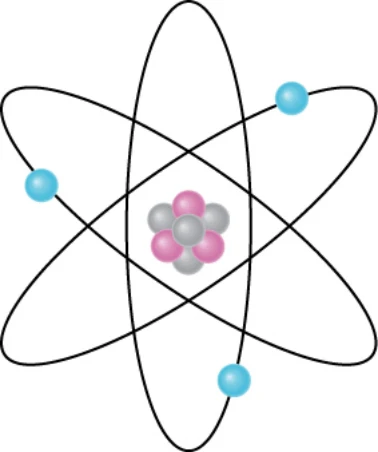
The mass number, A, represents the total number of protons and neutrons, or nucleons, within an atom. For an ordinary carbon atom the mass number would be 12, as there are typically six neutrons accompanying the six protons within the atom. In the case of carbon, the mass would be exactly 12 u. For oxygen, with a mass number of 16, the atomic mass is 15.994915 u. Of course, the difference is minor and can be ignored for most scenarios. Again, because the mass of an electron is so small compared to the nucleons, the mass number and the atomic mass can be essentially equivalent. Figure 22.16 shows an example of Lithium-7, which has an atomic number of 3 and a mass number of 7.
質量数Aは、原子の中の陽子と中性子、すなわち核子の総数を表す。ふつうの炭素原子では、原子の中の6個の陽子にふつう6個の中性子が伴うので、質量数は12になる。炭素の場合、質量はちょうど12 uである。質量数16の酸素では、原子の質量は15.994915 uである。もちろん差はわずかで、たいていの場面では無視できる。ここでも、電子の質量は核子に比べて非常に小さいので、質量数と原子の質量はほぼ同じと見てよい。図22.16は、原子番号3、質量数7のリチウム7の例を示す。
How does the mass number help to differentiate one atom from another? If each atom of carbon has an atomic number of 6, then what is the value of including the mass number at all? The intent of the mass number is to differentiate between various isotopes of an atom. The term isotope refers to the variation of atoms based upon the number of neutrons within their nucleus. While it is most common for there to be six neutrons accompanying the six protons within a carbon atom, it is possible to find carbon atoms with seven neutrons or eight neutrons. Those carbon atoms are respectively referred to as carbon-13 and carbon-14 atoms, with their mass numbers being their primary distinction. The isotope distinction is an important one to make, as the number of neutrons within an atom can affect a number of its properties, not the least of which is nuclear stability.
炭素原子はどれも原子番号が6なのに、なぜ質量数も必要なのだろうか。それは、同じ元素の同位体を区別するためである。同位体は、陽子の数が同じで、中性子の数が異なる原子を指す。最も普通の炭素原子は、陽子6個と中性子6個を持つ。中性子が7個なら炭素13、8個なら炭素14である。質量数はそれぞれ13と14になる。中性子の数は、特に原子核の安定性をはじめ、原子のいくつかの性質に関わるため、この区別は重要である。
To more easily identify various atoms, their atomic number and mass number are typically written in a form of representation called the nuclide. The nuclide form appears as follows: , where X is the atomic symbol and N
さまざまな原子をより簡単に見分けるために、原子番号と質量数はふつう核種という表し方で書かれる。核種の形は次のようになる。。ここでXは元素記号、Nは
represents the number of neutrons.
中性子の数を表す。
Let us look at a few examples of nuclides expressed in the notation. The nucleus of the simplest atom,
の記法で表した核種の例をいくつか見よう。最も簡単な原子である
hydrogen, is a single proton, or (the zero for no neutrons is often omitted). To check the symbol, refer to the periodic table—you see that the atomic number Z of hydrogen is 1. Since you are given that there are no neutrons, the mass number A is also 1. There is a scarce form of hydrogen found in nature called deuterium; its nucleus has one proton and one neutron and, hence, twice the mass of common hydrogen. The symbol for deuterium is, thus,
水素の原子核は陽子一つ、すなわちである(中性子が0であることを示す0はしばしば省かれる)。記号を確かめるには周期表を見ればよい——水素の原子番号Zは1だとわかる。中性子はないと与えられているので、質量数Aも1である。自然界にはまれな形の水素があり、重水素と呼ばれる。その原子核は陽子一つと中性子一つを持ち、したがってふつうの水素の2倍の質量を持つ。重水素の記号はしたがって
. An even rarer—and radioactive—form of hydrogen is called tritium, since it has a single proton and two neutrons, and it is written . The three varieties of hydrogen have nearly identical chemistries, but the nuclei differ greatly in mass, stability, and other characteristics. Again, the different nuclei are referred to as isotopes of the same element.
である。さらにまれで、しかも放射性の水素は三重水素と呼ばれ、陽子一つと中性子二つを持ち、と書かれる。三種類の水素の化学的な性質はほぼ同じだが、原子核は質量・安定性・その他の特徴で大きく違う。ここでも、これらの違う原子核は同じ元素の同位体と呼ばれる。
There is some redundancy in the symbols A, X, Z, and N. If the element X is known, then Z can be found in a periodic table. If both A and X are known, then N can also be determined by first finding Z; then, N = A – Z. Thus the simpler notation for nuclides is
記号A、X、Z、Nには重なりがある。元素Xがわかっていれば、Zは周期表で調べられる。AとXの両方がわかっていれば、まずZを求め、N = A – ZでNも定まる。したがって核種のより簡単な記法は
which is sufficient and is most commonly used. For example, in this simpler notation, the three isotopes of hydrogen are , , and . For , should we need to know, we can determine that Z = 92 for uranium from the periodic table, and thus, N = 238 − 92 = 146.
であり、これで十分で、最もよく使われる。たとえばこの簡単な記法では、水素の三つの同位体は、、である。については、必要なら周期表からウランのZ = 92を求め、N = 238 − 92 = 146と定められる。
Radioactivity and Nuclear Forces放射能と核力
In 1896, the French physicist Antoine Henri Becquerel (1852–1908) noticed something strange. When a uranium-rich mineral called pitchblende was placed on a completely opaque envelope containing a photographic plate, it darkened spots on the photographic plate.. Becquerel reasoned that the pitchblende must emit invisible rays capable of penetrating the opaque material. Stranger still was that no light was shining on the pitchblende, which means that the pitchblende was emitting the invisible rays continuously without having any energy input! There is an apparent violation of the law of conservation of energy, one that scientists can now explain using Einstein’s famous equation It was soon evident that Becquerel’s rays originate in the nuclei of the atoms and have other unique characteristics.
1896年、フランスの物理学者アントワーヌ・アンリ・ベクレル(1852–1908)は奇妙なことに気づいた。閃ウラン鉱というウランを多く含む鉱物を、写真乾板の入った完全に光を通さない封筒の上に置くと、乾板に黒い点ができたのである。ベクレルは、閃ウラン鉱は光を通さない物を突き抜けられる見えない線を出しているにちがいないと考えた。さらに奇妙なのは、閃ウラン鉱には光が当たっていなかったことである。つまり閃ウラン鉱は、エネルギーを与えられずに見えない線を出し続けていた。これは一見エネルギー保存の法則を破っているが、今日の科学者はアインシュタインの有名な式を使って説明できる。ベクレルの線は原子の核から出ており、ほかにも独特の性質を持つことがまもなく明らかになった。
To this point, most reactions you have studied have been chemical reactions, which are reactions involving the electrons surrounding the atoms. However, two types of experimental evidence implied that Becquerel’s rays did not originate with electrons, but instead within the nucleus of an atom.
ここまでに学んだ反応のほとんどは化学反応であり、それは原子を取り巻く電子が関わる反応である。しかし二種類の実験の証拠から、ベクレルの線は電子から生じるのではなく、原子核の中から生じることが示された。
First, the radiation is found to be only associated with certain elements, such as uranium. Whether uranium was in the form of an element or compound was irrelevant to its radiation. In addition, the presence of radiation does not vary with temperature, pressure, or ionization state of the uranium atom. Since all of those factors affect electrons in an atom, the radiation cannot come from electron transitions, as atomic spectra do.
第一に、この放射はウランなど特定の元素にだけ結びついていることがわかった。ウランが単体の形であっても化合物であっても、その放射には関係がなかった。さらに、放射の有無は温度・圧力・ウラン原子のイオン化の状態によって変わらない。これらの要素はどれも原子の電子に影響するので、この放射は原子スペクトルのような電子の移り変わりからは来えない。
The huge energy emitted during each event is the second piece of evidence that the radiation cannot be atomic. Nuclear radiation has energies on the order of 106 eV per event, which is much greater than typical atomic energies that are a few eV, such as those observed in spectra and chemical reactions, and more than ten times as high as the most energetic X-rays.
一つ一つの出来事で放たれるエネルギーが巨大であることが、この放射が原子のものではありえない第二の証拠である。核の放射は一件あたり106 eVの桁のエネルギーを持ち、スペクトルや化学反応で見られる数eVという典型的な原子のエネルギーよりはるかに大きく、最もエネルギーの高いX線の10倍を超える。
But why would reactions within the nucleus take place? And what would cause an apparently stable structure to begin emitting energy? Was there something special about Becquerel’s uranium-rich pitchblende? To answer those questions, it is necessary to look into the structure of the nucleus. Though it is perhaps surprising, you will find that many of the same principles that we observe on a macroscopic level still apply to the nucleus.
だが、なぜ原子核の中で反応が起こるのか。見たところ安定した構造が、何をきっかけにエネルギーを放ち始めるのか。ベクレルのウランに富んだ閃ウラン鉱には何か特別なところがあったのか。これらの問いに答えるには、原子核の構造を覗く必要がある。意外かもしれないが、巨視的な水準で見られるのと同じ原理の多くが原子核にも当てはまることがわかるだろう。
Nuclear Stability A variety of experiments indicate that a nucleus behaves something like a tightly packed ball of nucleons, as illustrated in Figure 22.17. Those nucleons have large kinetic energies and, thus, move rapidly in very close contact. Nucleons can be separated by a large force, such as in a collision with another nucleus, but strongly resist being pushed closer together. The most compelling evidence that nucleons are closely packed in a nucleus is that the radius of a nucleus, r, is found to be approximately
原子核の安定性 さまざまな実験から、原子核は図22.17のように核子がぎっしり詰まった球のようにふるまうことが示される。核子は大きな運動エネルギーを持ち、したがってごく近くで触れ合いながら速く動く。他の原子核との衝突など大きな力があれば核子を引き離せるが、さらに近くへ押し込もうとすると強く抵抗する。核子が原子核の中でぎっしり詰まっている最も説得力のある証拠は、原子核の半径rがおよそ次のようになるという事実である。
where 1.2 femtometer (fm) and A is the mass number of the nucleus.
ここでは1.2フェムトメートル(fm)、Aは原子核の質量数である。
Note that . Since many nuclei are spherical, and the volume of a sphere is , we see that
であることに注意せよ。多くの原子核は球形で、球の体積はなので、
—that is, the volume of a nucleus is proportional to the number of nucleons in it. That is what you expect if you pack nucleons so close that there is no empty space between them.
となる——つまり原子核の体積は、その中の核子の数に比例する。核子のあいだに空きがないほどぎっしり詰めれば、そうなるはずである。
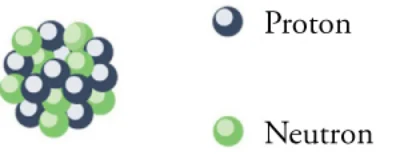
So what forces hold a nucleus together? After all, the nucleus is very small and its protons, being positive, should exert tremendous repulsive forces on one another. Considering that, it seems that the nucleus would be forced apart, not together!
では、どんな力が原子核をまとめているのか。何しろ原子核は非常に小さく、その中の陽子は正なので、互いにものすごい反発の力を及ぼすはずである。それを考えると、原子核はまとまるどころか吹き飛ばされそうに思える。
The answer is that a previously unknown force holds the nucleus together and makes it into a tightly packed ball of nucleons. This force is known as the strong nuclear force. The strong force has such a short range that it quickly fall to zero over a distance of only 10–15 meters. However, like glue, it is very strong when the nucleons get close to one another.
答えは、それまで知られていなかった力が原子核をまとめ、核子のぎっしり詰まった球にしているというものである。この力は強い核力として知られる。強い力は届く範囲がきわめて短く、わずか10-15メートルの距離で急速に0へ落ちる。しかし糊のように、核子どうしが近づくと非常に強い。
The balancing of the electromagnetic force with the nuclear forces is what allows the nucleus to maintain its spherical shape. If, for any reason, the electromagnetic force should overcome the nuclear force, components of the nucleus would be projected outward, creating the very radiation that Becquerel discovered!
電磁気の力と核力の釣り合いこそが、原子核が球の形を保っていられる理由である。もし何かの理由で電磁気の力が核力に打ち勝てば、原子核の部品が外へ投げ出され、まさにベクレルが見つけた放射線が生じる。
Understanding why the nucleus would break apart can be partially explained using Table 22.2. The balance between the strong nuclear force and the electromagnetic force is a tenuous one. Recall that the attractive strong nuclear force exists between any two nucleons and acts over a very short range while the weaker repulsive electromagnetic force only acts between protons, although over a larger range. Considering the interactions, an imperfect balance between neutrons and protons can result in a nuclear reaction, with the result of regaining equilibrium.
原子核がなぜ壊れるかは、表22.2を使ってある程度説明できる。強い核力と電磁気の力の釣り合いは危ういものである。引き合う強い核力はどの二つの核子のあいだにもはたらき、届く範囲が非常に短いこと、一方で弱い反発の電磁気の力は陽子どうしのあいだにしかはたらかないが、届く範囲は長いことを思い出そう。これらの作用を考えると、中性子と陽子の釣り合いが崩れていれば核反応が起こり、その結果として釣り合いが取り戻されることになる。
The radiation discovered by Becquerel was due to the large number of protons present in his uranium-rich pitchblende. In short, the large number of protons caused the electromagnetic force to be greater than the strong nuclear force. To regain stability, the nucleus needed to undergo a nuclear reaction called alpha (α) decay.
ベクレルが見つけた放射線は、彼のウランに富んだ閃ウラン鉱に陽子が多数あったことによる。要するに、陽子が多数あったために電磁気の力が強い核力を上回った。安定を取り戻すために、原子核はアルファ(α)崩壊と呼ばれる核反応を起こす必要があったのである。
The Three Types of Radiation三種類の放射線
Radioactivity refers to the act of emitting particles or energy from the nucleus. When the uranium nucleus emits energetic nucleons in Becquerel’s experiment, the radioactive process causes the nucleus to alter in structure. The alteration is called radioactive decay. Any substance that undergoes radioactive decay is said to be radioactive. That those terms share a root with the term radiation should not be too surprising, as they all relate to the transmission of energy.
放射能とは、原子核から粒子やエネルギーを放つはたらきを指す。ベクレルの実験でウランの原子核がエネルギーの高い核子を放つとき、この放射性の過程は原子核の構造を変える。この変化を放射性崩壊という。放射性崩壊を起こす物質は放射性であるという。これらの語が放射(radiation)と語根を同じくするのは驚くにあたらない。どれもエネルギーの伝わりに関わるからである。
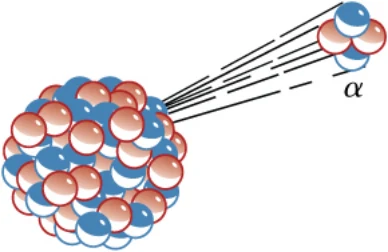
Alpha Decay Alpha decay refers to the type of decay that takes place when too many protons exist in the nucleus. It is the most common type of decay and causes the nucleus to regain equilibrium between its two competing internal forces. During alpha decay, the nucleus ejects two protons and two neutrons, allowing the strong nuclear force to regain balance with the repulsive electromagnetic force. The nuclear equation for an alpha decay process can be shown as follows.
アルファ崩壊 アルファ崩壊とは、原子核の中に陽子が多すぎるときに起こる崩壊の型を指す。最もよくある崩壊の型であり、原子核の中で競い合う二つの力の釣り合いを取り戻させる。アルファ崩壊では、原子核が陽子二つと中性子二つを放り出し、強い核力が反発する電磁気の力との釣り合いを取り戻せるようにする。アルファ崩壊の過程の核反応式は次のように書ける。
Three things to note as a result of the above equation:
上の式から気づくことが三つある。
1. By ejecting an alpha particle, the original nuclide decreases in atomic number. That means that Becquerel’s uranium nucleus, upon decaying, is actually transformed into thorium, two atomic numbers lower on the periodic table! The process of changing elemental composition is called transmutation.2. Note that the two protons and two neutrons ejected from the nucleus combine to form a helium nucleus. Shortly after decay, the ejected helium ion typically acquires two electrons to become a stable helium atom.3. Finally, it is important to see that, despite the elemental change, physical conservation still takes place. The mass number of the new element and the alpha particle together equal the mass number of the original element. Also, the net charge of all particles involved remains the same before and after the transmutation.
1. アルファ粒子を放り出すことで、もとの核種は原子番号が減る。つまりベクレルのウランの原子核は、崩壊すると周期表で原子番号が二つ低いトリウムに変わってしまうのである。元素としての成り立ちが変わるこの過程を核変換という。2. 原子核から放り出された陽子二つと中性子二つが合わさってヘリウムの原子核を作ることに注意せよ。崩壊のすぐあと、放り出されたヘリウムのイオンはふつう電子を二つ得て、安定なヘリウム原子になる。3. 最後に、元素が変わっても物理的な保存はやはり成り立つことを見てとるのが大事である。新しい元素の質量数とアルファ粒子の質量数の和は、もとの元素の質量数に等しい。また、関わるすべての粒子の正味の電荷は、核変換の前後で変わらない。
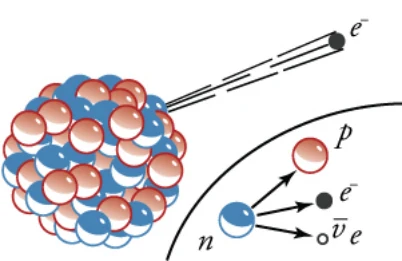
Beta Decay Like alpha decay, beta ( ) decay also takes place when there is an imbalance between neutrons and protons within the nucleus. For beta decay, however, a neutron is transformed into a proton and electron or vice versa. The transformation allows for the total mass number of the atom to remain the same, although the atomic number will increase by one (or decrease by one). Once again, the transformation of the neutron allows for a rebalancing of the strong nuclear and electromagnetic forces. The nuclear equation for a beta decay process is shown below.
ベータ崩壊 アルファ崩壊と同じく、ベータ()崩壊も原子核の中で中性子と陽子の釣り合いが崩れているときに起こる。ただしベータ崩壊では、中性子が陽子と電子に変わる、あるいはその逆が起こる。この変化によって原子の質量数の合計は変わらないが、原子番号は一つ増える(または一つ減る)。ここでも中性子の変化によって、強い核力と電磁気の力の釣り合いが取り直される。ベータ崩壊の過程の核反応式を以下に示す。
The symbol in the equation above stands for a high-energy particle called the neutrino. A nucleus may also emit a positron, and in that case Z decreases and N increases. It is beyond the scope of this section and will be discussed in further detail in the chapter on particles. It is worth noting, however, that the mass number and charge in all beta-decay reactions are conserved.
上の式の記号は、ニュートリノと呼ばれるエネルギーの高い粒子を表す。原子核は陽電子を放つこともあり、その場合はZが減ってNが増える。それはこの節の範囲を超えるので、粒子の章でさらに詳しく論じる。ただし、どのベータ崩壊の反応でも質量数と電荷が保存されることは覚えておく価値がある。
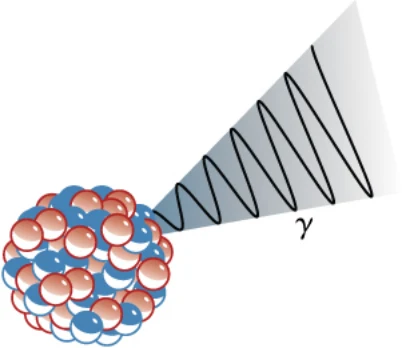
Gamma Decay Gamma decay is a unique form of radiation that does not involve balancing forces within the nucleus. Gamma decay occurs when a nucleus drops from an excited state to the ground state. Recall that such a change in energy state will release energy from the nucleus in the form of a photon. The energy associated with the photon emitted is so great that its wavelength is shorter than that of an X-ray. Its nuclear equation is as follows.
ガンマ崩壊 ガンマ崩壊は独特の形の放射で、原子核の中の力の釣り合いは関わらない。ガンマ崩壊は、原子核が励起状態から基底状態へ落ちるときに起こる。そうしたエネルギーの状態の変化は、光子の形で原子核からエネルギーを放つことを思い出そう。放たれる光子に結びつくエネルギーは非常に大きく、その波長はX線より短い。核反応式は次のとおりである。
Creating a Decay Equation Write the complete decay equation in notation for beta decay producing . Refer to the periodic table for values of Z. Strategy
崩壊の式を作る を生じるベータ崩壊について、の記法で完全な崩壊の式を書け。Zの値は周期表を見よ。 方針
Beta decay results in an increase in atomic number. As a result, the original (or parent) nucleus, must have an atomic number of one fewer proton.
ベータ崩壊では原子番号が増える。したがってもとの(親の)原子核は、陽子が一つ少ない原子番号を持つはずである。
Solution解答
The equation for beta decay is as follows
ベータ崩壊の式は次のとおりである。
Considering that barium is the product (or daughter) nucleus and has an atomic number of 56, the original nucleus must be of an atomic number of 55. That corresponds to cesium, or Cs.
バリウムが生成物(娘の)原子核で原子番号が56であることを考えると、もとの原子核の原子番号は55のはずである。それはセシウム、すなわちCsにあたる。
The number of neutrons in the parent cesium and daughter barium can be determined by subtracting the atomic number from the mass number (137 – 55 for cesium, 137 – 56 for barium). Substitute those values for the N and N – 1 subscripts in the above equation.
親のセシウムと娘のバリウムの中性子の数は、質量数から原子番号を引けば求まる(セシウムでは137 – 55、バリウムでは137 – 56)。これらの値を上の式のNとN – 1の添字に入れる。
Discussion考察
The terms parent and daughter nucleus refer to the reactants and products of a nuclear reaction. The terminology is not just used in this example, but in all nuclear reaction examples. The cesium-137 nuclear reaction poses a significant health risk, as its chemistry is similar to that of potassium and sodium, and so it can easily be concentrated in your cells if ingested.
親の原子核・娘の原子核という語は、核反応の反応物と生成物を指す。この言い方はこの例だけでなく、核反応のすべての例で使われる。セシウム137の核反応は健康に大きな危険をもたらす。その化学的な性質はカリウムやナトリウムに似ており、飲み込むと体の細胞に容易に濃く溜まりうるからである。
Alpha Decay Energy Found from Nuclear Masses Find the energy emitted in the decay of 239Pu. Strategy核の質量から求めるアルファ崩壊のエネルギー 239Puの崩壊で放たれるエネルギーを求めよ。 方針
Nuclear reaction energy, such as released in decay, can be found using the equation . We must first find , the difference in mass between the parent nucleus and the products of the decay.
崩壊で放たれるような核反応のエネルギーは、式で求められる。まず、すなわち親の原子核と崩壊の生成物との質量の差を求めなければならない。
The mass of pertinent particles is as follows
関係する粒子の質量は次のとおりである。
239Pu: 239.052157 u
239Pu: 239.052157 u
235U: 235.043924 u
235U: 235.043924 u
4He: 4.002602 u.
4He: 4.002602 u
Solution解答
The decay equation for 239Pu is
239Puの崩壊の式は
Determine the amount of mass lost between the parent and daughter nuclei.
親と娘の原子核のあいだで失われる質量の量を求める。
Now we can find E by entering into the equation.
これで、式にを入れてEを求められる。
And knowing that , we can find that
そしてであることを知っていれば、次が求まる。
Discussion考察
The energy released in this decay is in the MeV range, about 106 times as great as typical chemical reaction energies, consistent with previous discussions. Most of the energy becomes kinetic energy of the particle (or 4He nucleus), which moves away at high speed.
この崩壊で放たれるエネルギーはMeVの範囲であり、典型的な化学反応のエネルギーのおよそ106倍で、これまでの議論と辻褄が合う。エネルギーのほとんどは粒子(すなわち4Heの原子核)の運動エネルギーになり、それが高速で飛び去る。
The energy carried away by the recoil of the 235U nucleus is much smaller, in order to conserve momentum. The 235U nucleus can be left in an excited state to later emit photons ( rays). The decay is spontaneous and releases energy, because the products have less mass than the parent nucleus.
運動量を保存するため、235Uの原子核の跳ね返りが運び去るエネルギーははるかに小さい。235Uの原子核は励起状態に残され、のちに光子(線)を放つことがある。生成物のほうが親の原子核より質量が小さいので、この崩壊はひとりでに起こり、エネルギーを放つ。
Properties of Radiation放射線の性質
The charges of the three radiated particles differ. Alpha particles, with two protons, carry a net charge of +2. Beta particles, with one electron, carry a net charge of –1. Meanwhile, gamma rays are solely photons, or light, and carry no charge. The difference in charge plays an important role in how the three radiations affect surrounding substances.
放たれる三種類の粒子の電荷は違う。アルファ粒子は陽子を二つ持つので、正味の電荷は+2である。ベータ粒子は電子一つなので、正味の電荷は–1である。一方ガンマ線は光子、すなわち光そのものであり、電荷を持たない。この電荷の違いは、三種類の放射線がまわりの物質にどう影響するかで重要な役割を果たす。
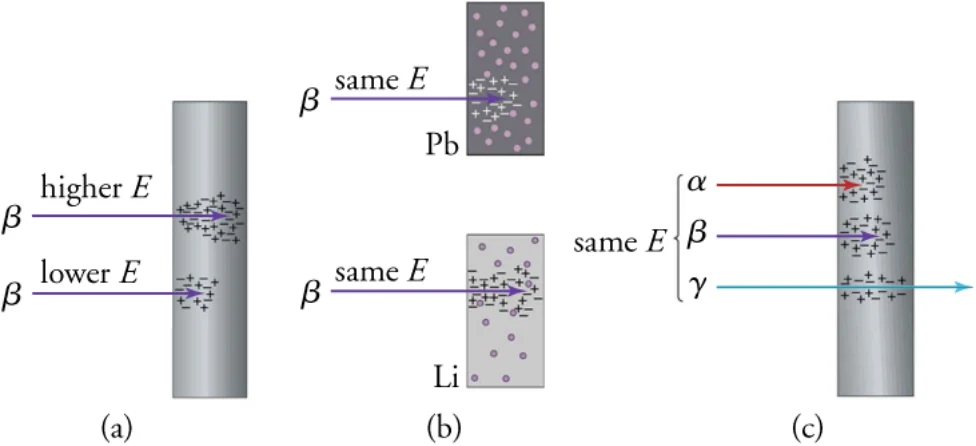
Alpha particles, being highly charged, will quickly interact with ions in the air and electrons within metals. As a result, they have a short range and short penetrating distance in most materials. Beta particles, being slightly less charged, have a larger range and larger penetrating distance. Gamma rays, on the other hand, have little electric interaction with particles and travel much farther. Two diagrams below show the importance of difference in penetration. Table 22.3 shows the distance of radiation penetration, and Figure 22.21 shows the influence various factors have on radiation penetration distance.
アルファ粒子は電荷が大きいので、空気中のイオンや金属の中の電子とすぐに相互作用する。その結果、ほとんどの材料の中で届く範囲も突き抜ける距離も短い。ベータ粒子は電荷がやや小さいので、届く範囲も突き抜ける距離も長い。一方ガンマ線は粒子との電気的な相互作用がほとんどなく、はるかに遠くまで進む。以下の二つの図は、突き抜け方の違いの大切さを示す。表22.3は放射線が突き抜ける距離を示し、図22.21はさまざまな要素が突き抜ける距離に与える影響を示す。
Radiation Detectors The first direct detection of radiation was Becquerel’s darkened photographic plate. Photographic film is still the most common detector of ionizing radiation, being used routinely in medical and dental X-rays. Nuclear radiation can also be captured on film, as seen in Figure 22.22. The mechanism for film exposure by radiation is similar to that by photons. A quantum of energy from a radioactive particle interacts with the emulsion and alters it chemically, thus exposing the film. Provided the radiation has more than the few eV of energy needed to induce the chemical change, the chemical alteration will occur. The amount of film darkening is related to the type of radiation and amount of exposure. The process is not 100 percent efficient, since not all incident radiation interacts and not all interactions produce the chemical change.
放射線の検出器 放射線の最初の直接の検出は、ベクレルの黒くなった写真乾板だった。写真の膜は今も電離放射線の最もよくある検出器であり、医科と歯科のX線で日常的に使われている。図22.22に見るように、核の放射線も膜に写せる。放射線による膜の露光の仕組みは、光子によるものと似ている。放射性の粒子からの一かたまりのエネルギーが乳剤と相互作用し、それを化学的に変えて膜を感光させる。放射線が、化学変化を起こすのに要る数eVを超えるエネルギーを持ちさえすれば、化学変化は起こる。膜の黒くなり方は、放射線の型と浴びた量に関係する。この過程は100パーセント効率がよいわけではない。入ってくる放射線のすべてが相互作用するわけではなく、相互作用のすべてが化学変化を起こすわけでもないからである。

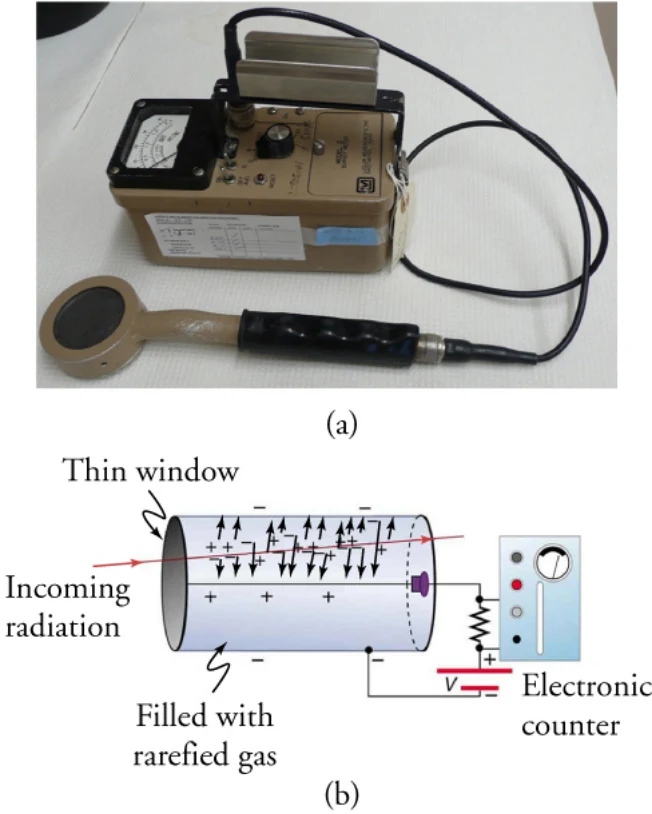
Another very common radiation detector is the Geiger tube. The clicking and buzzing sound we hear in dramatizations and documentaries, as well as in our own physics labs, is usually an audio output of events detected by a Geiger counter. These relatively inexpensive radiation detectors are based on the simple and sturdy Geiger tube, shown schematically in Figure 22.23. A conducting cylinder with a wire along its axis is filled with an insulating gas so that a voltage applied between the cylinder and wire produces almost no current. Ionizing radiation passing through the tube produces free ion pairs that are attracted to the wire and cylinder, forming a current that is detected as a count. Not every particle is detected, since some radiation can pass through without producing enough ionization. However, Geiger counters are very useful in producing a prompt output that reveals the existence and relative intensity of ionizing radiation.
もう一つ非常によく使われる放射線の検出器がガイガー管である。ドラマや記録映像で、また自分たちの物理の実験室で聞くカチカチ、ブーンという音は、たいていガイガー計数管が検出した出来事の音の出力である。この比較的安い放射線の検出器は、図22.23に略図で示す簡単で丈夫なガイガー管にもとづく。軸に沿って線を張った導体の円筒に絶縁性の気体を満たすと、円筒と線のあいだに電圧をかけてもほとんど電流が流れない。管を通り抜ける電離放射線は自由なイオン対を作り、それが線と円筒に引かれて電流となり、一件として検出される。すべての粒子が検出されるわけではない。十分な電離を起こさずに通り抜ける放射線もあるからである。しかしガイガー計数管は、電離放射線の有無と相対的な強さを知らせる素早い出力を出すのに非常に役立つ。
Another radiation detection method records light produced when radiation interacts with materials. The energy of the radiation is sufficient to excite atoms in a material that may fluoresce, such as the phosphor used by Rutherford’s group. Materials called scintillators use a more complex process to convert radiation energy into light. Scintillators may be liquid or solid, and they can be very efficient. Their light output can provide information about the energy, charge, and type of radiation. Scintillator light flashes are very brief in duration, allowing the detection of a huge number of particles in short periods of time. Scintillation detectors are used in a variety of research and diagnostic applications. Among those are the detection of the radiation from distant galaxies using satellite-mounted equipment and the detection of exotic particles in accelerator laboratories.
もう一つの放射線の検出法は、放射線が材料と相互作用するときに出る光を記録する。放射線のエネルギーは、ラザフォードの一団が使った蛍光体のように、蛍光を出しうる材料の原子を励起するのに十分である。シンチレータと呼ばれる材料は、もっと込み入った過程で放射線のエネルギーを光に変える。シンチレータには液体のものも固体のものもあり、非常に効率がよいものもある。その光の出力は、放射線のエネルギー・電荷・型についての情報を与えうる。シンチレータの光の閃きは持続がごく短いので、短い時間に膨大な数の粒子を検出できる。シンチレーション検出器はさまざまな研究と診断に使われる。その中には、人工衛星に載せた装置による遠い銀河からの放射線の検出や、加速器の研究所での風変わりな粒子の検出がある。
VIRTUAL PHYSICSシミュレーションBeta Decayベータ崩壊
Watch beta decay occur (https://openstax.org/l/21betadecayvid) for a collection of nuclei or for an individual nucleus. With this applet, individuals or groups of students can compare half-lives!
原子核の集まりについて、あるいは一つの原子核について、ベータ崩壊が起こるのを見よう(https://openstax.org/l/21betadecayvid)。このアプレットで、個人でも班でも半減期を比べられる。
Check Your Understanding理解の確認
2What leads scientists to infer that the nuclear strong force exists?a. A strong force must hold all the electrons outside the nucleus of an atom.b. A strong force must counteract the highly attractive Coulomb force in the nucleus.
2科学者が強い核力の存在を推し量る根拠は何か。a. 原子核の外にあるすべての電子を強い力がつなぎとめているはずだから。b. 原子核の中で非常に強く引き合うクーロン力に強い力が対抗しているはずだから。
c. A strong force must hold all the neutrons together inside the nucleus.d. A strong force must counteract the highly repulsive Coulomb force between protons in the nucleus.
c. 原子核の中ですべての中性子を強い力がまとめているはずだから。d. 原子核の中の陽子どうしの非常に強く反発するクーロン力に強い力が対抗しているはずだから。