第22章原子The Atom原書 p.743–794
22.3 Half Life and Radiometric Dating22.3 半減期と放射年代測定
SECTION LEARNING OBJECTIVES By the end of this section, you will be able to do the following:
この節の学習目標 この節を終えると、次のことができるようになる。
• Explain radioactive half-life and its role in radiometric dating• Calculate radioactive half-life and solve problems associated with radiometric dating
・放射性の半減期と、それが放射年代測定で果たす役割を説明する・放射性の半減期を計算し、放射年代測定に関わる問題を解く
Section Key Termsこの節の重要語
activitybecquerelcarbon-14 datingdecay constanthalf-liferadioactive dating
放射能の強さ ベクレル 炭素14年代測定崩壊定数 半減期 放射年代測定
Half-Life and the Rate of Radioactive Decay半減期と放射性崩壊の速さ
Unstable nuclei decay. However, some nuclides decay faster than others. For example, radium and polonium, discovered by Marie and Pierre Curie, decay faster than uranium. That means they have shorter lifetimes, producing a greater rate of decay. Here we will explore half-life and activity, the quantitative terms for lifetime and rate of decay.
不安定な原子核は崩壊する。ただし、ある核種は他の核種より速く崩壊する。たとえばマリーとピエール・キュリーが見つけたラジウムとポロニウムは、ウランより速く崩壊する。つまり寿命が短く、崩壊の速さが大きい。ここでは、寿命と崩壊の速さを量として表す半減期と放射能の強さを見ていく。
Why do we use the term like half-life rather than lifetime? The answer can be found by examining Figure 22.24, which shows how the number of radioactive nuclei in a sample decreases with time. The time in which half of the original number of nuclei decay is defined as the half-life, . After one half-life passes, half of the remaining nuclei will decay in the next half-life. Then, half of that amount in turn decays in the following half-life. Therefore, the number of radioactive nuclei decreases from N to N / 2 in one half-life, to N / 4 in the next, to N / 8 in the next, and so on. Nuclear decay is an example of a purely statistical process.
なぜ寿命ではなく半減期という語を使うのか。答えは図22.24を見ればわかる。この図は、試料の中の放射性の原子核の数が時とともにどう減るかを示す。もとの数の半分の原子核が崩壊するまでの時間を半減期と定める。半減期が一つ過ぎたあと、残った原子核の半分が次の半減期で崩壊する。次にその量の半分が、さらに次の半減期で崩壊する。したがって放射性の原子核の数は、一つ目の半減期でNからN/2へ、次にN/4へ、次にN/8へと減っていく。核の崩壊は純粋に統計的な過程の一例である。
TIPS FOR SUCCESS A more precise definition of half-life is that each nucleus has a 50 percent chance of surviving for a time equal to one half-life. If an individual nucleus survives through that time, it still has a 50 percent chance of surviving through another half-life. Even if it happens to survive hundreds of half-lives, it still has a 50 percent chance of surviving through one more. Therefore, the decay of a nucleus is like random coin flipping. The chance of heads is 50 percent, no matter what has happened before.The probability concept aligns with the traditional definition of half-life. Provided the number of nuclei is reasonably large, half of the original nuclei should decay during one half-life period.
学習のポイント 半減期のより正確な定め方は、それぞれの原子核が、半減期に等しい時間を生き延びる確率を50パーセント持つ、というものである。ある原子核がその時間を生き延びたとしても、次の半減期を生き延びる確率はやはり50パーセントである。たまたま何百もの半減期を生き延びたとしても、もう一つを生き延びる確率はやはり50パーセントである。したがって原子核の崩壊は、でたらめなコイン投げのようなものである。それまでに何が起きていようと、表が出る確率は50パーセントである。この確率の考えは、昔ながらの半減期の定め方と食い違わない。原子核の数がそこそこ多ければ、一つの半減期のあいだにもとの原子核の半分が崩壊するはずである。
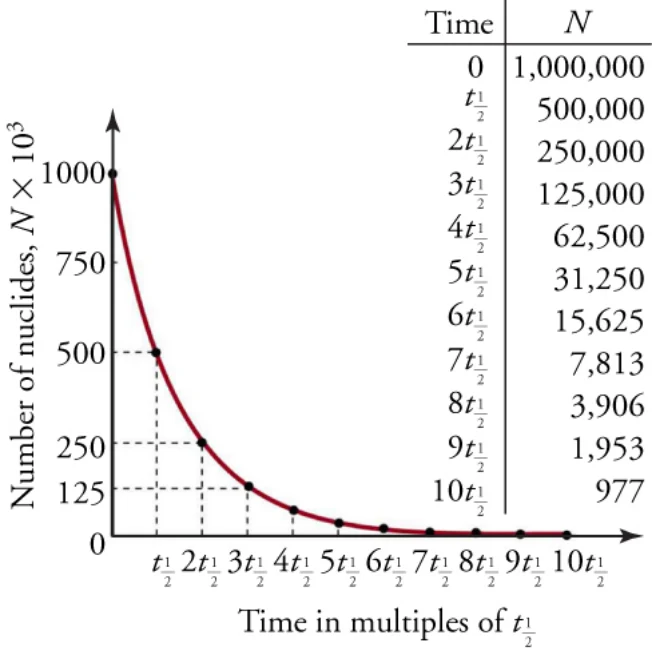
of its original value. Half of what remains decays in the next half-life, and half of that in the next, and so on. This is exponential decay, as seen in the graph of the number of nuclei present as a function of time.
半分になる。残った分の半分が次の半減期で崩壊し、さらにその半分が次で崩壊する、というふうに続く。これは指数的な減り方であり、存在する原子核の数を時間の関数として描いたグラフに見てとれる。
The following equation gives the quantitative relationship between the original number of nuclei present at time zero and the number at a later time t
次の式は、時刻0にあった原子核のもとの数と、のちの時刻tでの数との量的な関係を与える。
where e = 2.71828... is the base of the natural logarithm, and is the decay constant for the nuclide. The shorter the half-life, the larger is the value of , and the faster the exponential decreases with time. The decay constant can be found with the equation
ここでe = 2.71828…は自然対数の底、はその核種の崩壊定数である。半減期が短いほどの値は大きく、指数関数は時とともに速く減る。崩壊定数は次の式で求められる。
Activity, the Rate of Decay放射能の強さ——崩壊の速さ
What do we mean when we say a source is highly radioactive? Generally, it means the number of decays per unit time is very high. We define activity R to be the rate of decay expressed in decays per unit time. In equation form, this is
線源の放射能が強いというとき、何を意味しているのか。ふつうは、単位時間あたりの崩壊の数が非常に多いということである。放射能の強さRを、単位時間あたりの崩壊の数で表した崩壊の速さと定める。式の形にすると次のようになる。
where is the number of decays that occur in time .
ここでは時間のあいだに起こる崩壊の数である。
Activity can also be determined through the equation
放射能の強さは次の式でも求められる。
which shows that as the amount of radiative material (N) decreases, the rate of decay decreases as well.
これは、放射性の物質の量(N)が減れば崩壊の速さも減ることを示す。
The SI unit for activity is one decay per second and it is given the name becquerel (Bq) in honor of the discoverer of radioactivity. That is,
放射能の強さのSI単位は毎秒1崩壊で、放射能の発見者にちなんでベクレル(Bq)という名がついている。すなわち、
Activity R is often expressed in other units, such as decays per minute or decays per year. One of the most common units for activity is the curie (Ci), defined to be the activity of 1 g of 226Ra, in honor of Marie Curie’s work with radium. The definition of the curie is
放射能の強さRは、毎分の崩壊数や毎年の崩壊数など、他の単位で表されることも多い。最もよく使われる単位の一つがキュリー(Ci)で、マリー・キュリーのラジウムの仕事にちなみ、226Ra 1 gの放射能の強さと定められる。キュリーの定めは
or decays per second.
すなわち毎秒回の崩壊である。
Radiometric Dating放射年代測定
Radioactive dating or radiometric dating is a clever use of naturally occurring radioactivity. Its most familiar application is carbon-14 dating. Carbon-14 is an isotope of carbon that is produced when solar neutrinos strike particles within the atmosphere. Radioactive carbon has the same chemistry as stable carbon, and so it mixes into the biosphere, where it is consumed and becomes part of every living organism. Carbon-14 has an abundance of 1.3 parts per trillion of normal carbon, so if you know the number of carbon nuclei in an object (perhaps determined by mass and Avogadro’s number), you can multiply that number by to find the number of nuclei within the object. Over time, carbon-14 will naturally decay back to with a half-life of 5,730 years (note that this is an example of beta decay). When an organism dies, carbon exchange with the environment ceases, and is not replenished. By comparing the abundance of in an artifact, such as mummy wrappings, with the normal abundance in living tissue, it is possible to determine the artifact’s age (or time since death). Carbon-14 dating can be used for biological tissues as old as 50 or 60 thousand years, but is most accurate for younger samples, since the abundance of nuclei in them is greater.
放射年代測定は、自然にある放射能の巧みな使い方である。最もなじみのある応用は炭素14年代測定である。炭素14は炭素の同位体で、太陽からのニュートリノが大気中の粒子にあたるときに作られる。放射性の炭素は安定な炭素と化学的な性質が同じなので、生物圏に混じり、取り込まれてあらゆる生き物の一部になる。炭素14はふつうの炭素の1兆分の1.3の割合で存在するので、ある物の中の炭素の原子核の数がわかれば(質量とアヴォガドロ数から求められる)、その数にを掛けて、その中のの原子核の数を求められる。時がたつと、炭素14は半減期5730年で自然にもとのへ崩壊する(これはベータ崩壊の例であることに注意)。生き物が死ぬと環境との炭素のやりとりが止まり、は補われなくなる。ミイラの包み布のような遺物のの割合を、生きた組織でのふつうの割合と比べれば、その遺物の年代(すなわち死んでからの時間)を定められる。炭素14年代測定は5万年から6万年前までの生物の組織に使えるが、若い試料ほどの原子核の割合が大きいので正確である。
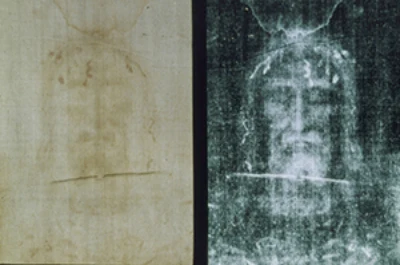
One of the most famous cases of carbon-14 dating involves the Shroud of Turin, a long piece of fabric purported to be the burial shroud of Jesus (see Figure 22.25). This relic was first displayed in Turin in 1354 and was denounced as a fraud at that time by a French bishop. Its remarkable negative imprint of an apparently crucified body resembles the then-accepted image of Jesus. As a result, the relic has been remained controversial throughout the centuries. Carbon-14 dating was not performed on the shroud until 1988, when the process had been refined to the point where only a small amount of material needed to be destroyed. Samples were tested at three independent laboratories, each being given four pieces of cloth, with only one unidentified piece from the shroud, to avoid prejudice. All three laboratories found samples of the shroud contain 92 percent of the found in living tissues, allowing the shroud to be dated (see How Old is the Shroud of Turin?).
炭素14年代測定の最も有名な例の一つがトリノの聖骸布である。イエスの埋葬布とされる長い布である(図22.25を見よ)。この聖遺物は1354年にトリノで初めて公開され、そのときフランスの司教に偽物だと断じられた。磔にされたらしい体の見事な陰画の写しは、当時受け入れられていたイエスの姿に似ている。そのため、この聖遺物は何世紀にもわたって論争の的であり続けた。聖骸布の炭素14年代測定は1988年まで行われなかった。その時点で手法が磨かれ、ごく少量の材料を壊すだけで済むようになったからである。試料は独立した三つの研究所で調べられ、それぞれに四枚の布が渡されたが、そのうち聖骸布のものは一枚だけで、しかもどれかは知らされなかった——先入観を避けるためである。三つの研究所はいずれも、聖骸布の試料が生きた組織にあるの92パーセントを含むことを見つけ、聖骸布の年代を定められるようにした(「トリノの聖骸布は何年前のものか」を見よ)。
Carbon-11 Decay Carbon-11 has a half-life of 20.334 min. (a) What is the decay constant for carbon-11?If 1 kg of carbon-11 sample exists at the beginning of an hour, (b) how much material will remain at the end of the hour and (c) what will be the decay activity at that time?Strategy
炭素11の崩壊 炭素11の半減期は20.334分である。(a)炭素11の崩壊定数はいくらか。1時間の初めに1 kgの炭素11の試料があるとして、(b)1時間の終わりに残る量はいくらか、(c)そのときの崩壊の放射能の強さはいくらか。方針
Since refers to the amount of carbon-11 at the start, then after one half-life, the amount of carbon-11 remaining will be The decay constant is equivalent to the probability that a nucleus will decay each second. As a result, the half-life will need to be converted to seconds.
は初めの炭素11の量を指すので、一つの半減期のあと、残る炭素11の量はになる。崩壊定数は、原子核が毎秒崩壊する確率に等しい。したがって半減期を秒に直す必要がある。
Solution解答
(a)
(a)
Since half of the carbon-11 remains after one half-life, .
一つの半減期のあと炭素11は半分残るので、である。
Take the natural logarithm of each side to isolate the decay constant.
両辺の自然対数をとって崩壊定数を取り出す。
Convert the 20.334 min to seconds.
20.334分を秒に直す。
(b) The amount of material after one hour can be found by using the equation
(b) 1時間後の物質の量は次の式で求められる。
with t converted into seconds and NO written as 1,000 g
tを秒に直し、NOを1000 gと書く。
(c) The decay activity after one hour can be found by using the equation
(c) 1時間後の崩壊の放射能の強さは次の式で求められる。
for the mass value after one hour.
1時間後の質量の値を使う。
Discussion考察
(a) The decay constant shows that 0.0568 percent of the nuclei in a carbon-11 sample will decay each second. Another way of considering the decay constant is that a given carbon-11 nuclei has a 0.0568 percent probability of decaying each second. The decay of carbon-11 allows it to be used in positron emission topography (PET) scans; however, its 20.334 min half-life does pose challenges for its administration.
(a)崩壊定数は、炭素11の試料の原子核の0.0568パーセントが毎秒崩壊することを示す。崩壊定数の別の見方として、ある炭素11の原子核が毎秒崩壊する確率が0.0568パーセントだと考えてもよい。炭素11の崩壊のおかげで、それは陽電子放出断層撮影(PET)に使える。ただし20.334分という半減期は、投与のうえで難しさをもたらす。
(b) One hour is nearly three full half-lives of the carbon-11 nucleus. As a result, one would expect the amount of sample remaining to be approximately one eighth of the original amount. The 129.4 g remaining is just a bit larger than one-eighth, which is sensible given a half-life of just over 20 min.
(b)1時間は炭素11の原子核のほぼ三つ分の半減期にあたる。したがって残る試料の量は、もとの量のおよそ8分の1になると予想される。残った129.4 gは8分の1より少しだけ大きく、半減期が20分をわずかに超えることを考えれば道理にかなっている。
(c) Label analysis shows that the unit of Becquerel is sensible, as there are 0.0735 g of carbon-11 decaying each second. That is smaller amount than at the beginning of the hour, when
(c)単位の見方からもベクレルという単位が理にかなっているとわかる。毎秒0.0735 gの炭素11が崩壊しているからである。これは1時間の初めより少ない量である。そのときは毎秒
g of carbon-11 were decaying each second.
gの炭素11が崩壊していた。
How Old is the Shroud of Turin? Calculate the age of the Shroud of Turin given that the amount of found in it is 92 percent of that in living tissue. Strategy
トリノの聖骸布は何年前のものか 聖骸布に見つかったの量が生きた組織の92パーセントであるとして、聖骸布の年代を計算せよ。 方針
Because 92 percent of the remains, . Therefore, the equation can be used to find . We also know that the half-life of is 5,730 years, and so once is known, we can find and then find t as requested. Here, we assume that the decrease in is solely due to nuclear decay.
の92パーセントが残っているので、である。したがって式を使ってを求められる。またの半減期が5730年であることもわかっているので、がわかればを求め、そこから求められているtを求められる。ここでは、が減るのはもっぱら核の崩壊によるとする。
Solution解答
Solving the equation for gives
式をについて解くと
Thus,
したがって、
Taking the natural logarithm of both sides of the equation yields
両辺の自然対数をとると
so that
よって
Rearranging to isolate t gives
tについて整理すると
Now, the equation can be used to find for . Solving for and substituting the known half-life gives
ここで、式を使ってのを求められる。について解き、わかっている半減期を入れると
We enter that value into the previous equation to find t.
この値を先ほどの式に入れてtを求める。
Discussion考察
This dates the material in the shroud to 1988–690 = 1300. Our calculation is only accurate to two digits, so that the year is rounded to 1300. The values obtained at the three independent laboratories gave a weighted average date of 1320 ± 60. That uncertainty is typical of carbon-14 dating and is due to the small amount of 14 C in living tissues, the amount of material available, and experimental uncertainties (reduced by having three independent measurements). That said, is it notable that the carbon-14 date is consistent with the first record of the shroud’s existence and certainly inconsistent with the period in which Jesus lived.
これにより聖骸布の材料の年代は1988–690 = 1300年と定まる。計算は2桁の精度しかないので、年は1300に丸めてある。三つの独立した研究所で得られた値は、重みつき平均で1320 ± 60年だった。この不確かさは炭素14年代測定に典型的なもので、生きた組織の中の14Cの量が少ないこと、使える材料の量、実験の不確かさ(独立した三つの測定を行うことで減らしてある)による。とはいえ、この炭素14の年代が、聖骸布の存在についての最初の記録と食い違わず、イエスの生きた時代とは明らかに食い違うことは注目に値する。
There are other noncarbon forms of radioactive dating. Rocks, for example, can sometimes be dated based on the decay of The decay series for ends with , so the ratio of those nuclides in a rock can be used an indication of how long it has been since the rock solidified. Knowledge of the half-life has shown, for example, that the oldest rocks on Earth solidified about years ago.
炭素以外の放射年代測定もある。たとえば岩石は、の崩壊にもとづいて年代が定められることがある。の崩壊の系列はで終わるので、岩石の中のこれらの核種の比は、その岩石が固まってからどれだけたったかの目印に使える。の半減期の知識から、たとえば地球で最も古い岩石はおよそ年前に固まったことが示されている。
VIRTUAL PHYSICSシミュレーションRadioactive Dating Game放射年代測定ゲーム
Learn about different types of radiometric dating (https://openstax.org/l/02radioactive_dating_game), such as carbon dating. Understand how decay and half-life work to enable radiometric dating to work. Play a game that tests your ability to match the percentage of the dating element that remains to the age of the object.
炭素年代測定など、いろいろな型の放射年代測定について学ぼう(https://openstax.org/l/02radioactive_dating_game)。崩壊と半減期がどうはたらいて放射年代測定を成り立たせているかを理解しよう。年代測定に使う元素の残っている割合を、物の年代と結びつける腕前を試すゲームで遊ぼう。