第16章鏡とレンズMirrors and Lenses原書 p.495–540
Test Prep実力テスト
Multiple Choice選択問題
16.1 Reflection 19In geometric optics, a straight line emerging from a point is called a (an) ________.
英語のヒント
16.1 反射 19幾何光学で、ある点から出る直線を________という。
a. rayb. focal pointc. image
英語のヒント
a. 光線b. 焦点c. 像
d. object distance
d. 物までの距離
20An image of a 2.0 -cm object reflected from a mirror is 5.0 cm tall. What is the magnification of the mirror?
英語のヒント
20鏡に映った2.0 cmの物の像の高さが5.0 cmである。この鏡の倍率はいくらか。
a. 0.4
a. 0.4
b. 2.5c. 3d. 10
b. 2.5c. 3d. 10
21Can a virtual image be projected onto a screen with additional lenses or mirrors? Explain your answer.
英語のヒント
21レンズや鏡を足せば、虚像をスクリーンに投影できるか。答えを説明せよ。
a. Yes, the rays actually meet behind the lens or mirror.b. No, the image is formed by rays that converge to a point in front of the mirror or lens.c. Yes, any image that can be seen can be manipulated so that it can be projected onto a screen.d. No, the image can only be perceived as being behind the lens or mirror.
英語のヒント
a. はい。光線は実際にレンズや鏡の後ろで交わっているから。b. いいえ。像は鏡やレンズの手前の一点に集まる光線によって作られるから。c. はい。見える像はどれも、スクリーンに投影できるように操作できるから。d. いいえ。像はレンズや鏡の後ろにあるとしか感じ取れないから。
16.2 Refraction 22What does c represent in the equation ?
英語のヒント
16.2 屈折 22式でcは何を表すか。
a. the critical angleb. the refractive index
英語のヒント
a. 臨界角b. 屈折率
c. the speed of light in a vacuumd. the speed of light in a transparent material
英語のヒント
c. 真空中の光の速さd. 透明な材料の中の光の速さ
23What is the term for the minimum angle at which a light ray is reflected back into a material and cannot pass into the surrounding medium?
英語のヒント
23光線が材料の中へ反射し戻され、周りの媒質へ入れなくなる最小の角度を何というか。
a. critical angleb. incident angle
英語のヒント
a. 臨界角b. 入射角
c. angle of refractiond. angle of reflection
英語のヒント
c. 屈折角d. 反射角
24Consider these indices of refraction: glass: 1.52, air: 1.0003, water: 1.333. Put these materials in order from the one in which the speed of light is fastest to the one in which it is slowest.
英語のヒント
24次の屈折率を考える。ガラス1.52、空気1.0003、水1.333。これらの材料を、光の速さが最も速いものから最も遅いものへ並べよ。
a. The speed of light in water > the speed of light in air > the speed of light in glass.b. The speed of light in glass > the speed of light in water > the speed of light in air.c. The speed of light in air > the speed of light in water > the speed of light in glass.d. The speed of light in glass > the speed of light in air > the speed of light in water.
英語のヒント
a. 水中の光の速さ > 空気中の光の速さ > ガラス中の光の速さb. ガラス中の光の速さ > 水中の光の速さ > 空気中の光の速さc. 空気中の光の速さ > 水中の光の速さ > ガラス中の光の速さd. ガラス中の光の速さ > 空気中の光の速さ > 水中の光の速さ
25Explain why an object in water always appears to be at a depth that is more shallow than it actually is.
英語のヒント
25水の中の物がつねに実際より浅いところにあるように見える理由を説明せよ。
a. Because of the refraction of light, the light coming from the object bends toward the normal at the interface of water and air. This causes the object to appear at a location that is above the actual position of the object. Hence, the image appears to be at a depth that is more shallow than the actual depth.b. Because of the refraction of light, the light coming from the object bends away from the normal at the interface of water and air. This causes the object to appear at a location that is above the actual position of the object. Hence, the image appears to be at a depth that is more shallow than the actual depth.c. Because of the refraction of light, the light coming from the object bends toward the normal at the interface of water and air. This causes the object to appear at a location that is below the actual position of the object. Hence, the image appears to be at a depth that is more shallow than the actual depth.d. Because of the refraction of light, the light coming from the object bends away from the normal at the interface of water and air. This causes the object to appear at a location that is below the actual position of the object. Hence, the image appears to be at a depth that is more shallow than the actual depth.
英語のヒント
英語のヒント
a. 光の屈折のために、物から来る光は水と空気の境目で法線のほうへ曲がる。これによって物が実際の位置より上にあるように見える。したがって像は実際の深さより浅いところにあるように見える。b. 光の屈折のために、物から来る光は水と空気の境目で法線から離れるほうへ曲がる。これによって物が実際の位置より上にあるように見える。したがって像は実際の深さより浅いところにあるように見える。c. 光の屈折のために、物から来る光は水と空気の境目で法線のほうへ曲がる。これによって物が実際の位置より下にあるように見える。したがって像は実際の深さより浅いところにあるように見える。d. 光の屈折のために、物から来る光は水と空気の境目で法線から離れるほうへ曲がる。これによって物が実際の位置より下にあるように見える。したがって像は実際の深さより浅いところにあるように見える。
16.3 Lenses 26For a given lens, what is the height of the image divided by the height of the object ( ) equal to?
英語のヒント
16.3 レンズ 26あるレンズについて、像の高さを物の高さで割ったもの()は何に等しいか。
a. powerb. focal length
英語のヒント
a. 度数b. 焦点距離
c. magnificationd. radius of curvature
英語のヒント
c. 倍率d. 曲率半径
27Which part of the eye has the greatest density of light receptors?
英語のヒント
27目のどの部分が光の受容器の密度が最も高いか。
a. the lensb. the fovea
a. 水晶体b. 中心窩
c. the optic nerved. the vitreous humor
英語のヒント
c. 視神経d. 硝子体
28What is the power of a lens with a focal length of 10 cm?a. 10 m–1, or 10 Db. 10 cm–1, or 10 D
英語のヒント
28焦点距離10 cmのレンズの度数はいくらか。a. 10 m-1、すなわち10 Db. 10 cm-1、すなわち10 D
c. 10 m, or 10 Dd. 10 cm, or 10 D
c. 10 m、すなわち10 Dd. 10 cm、すなわち10 D
29Describe the cause and result of chromatic aberration.
英語のヒント
29色収差の原因と結果を述べよ。
a. Chromatic aberration results from the dependence of the frequency of light on the refractive index, which causes dispersion of different colors of light by a lens so that each color has a different focal point.b. Chromatic aberration results from the dispersion of different wavelengths of light by a curved mirror so that each color has a different focal point.
英語のヒント
a. 色収差は、屈折率が光の振動数によることから生じ、それがレンズによる光の色ごとの分散を起こして、色ごとに違う焦点を持たせる。b. 色収差は、曲面鏡による光の波長ごとの分散から生じ、色ごとに違う焦点を持たせる。
c. Chromatic aberration results from the dependence of the reflection angle at a spherical mirror’s surface on the distance of light rays from the principal axis so that different colors have different focal points.d. Chromatic aberration results from the dependence of the wavelength of light on the refractive index, which causes dispersion of different colors of light by a lens so that each color has a different focal point.
英語のヒント
c. 色収差は、球面鏡の面での反射角が、主軸からの光線の距離によることから生じ、色ごとに違う焦点を持たせる。d. 色収差は、屈折率が光の波長によることから生じ、それがレンズによる光の色ごとの分散を起こして、色ごとに違う焦点を持たせる。
Short Answer記述式
16.1 Reflection 30Distinguish between reflection and refraction in terms of how a light ray changes when it meets the interface between two media.
英語のヒント
16.1 反射 30光線が二つの媒質の境目に出会うときにどう変わるかという点で、反射と屈折を区別せよ。
a. Reflected light penetrates the surface whereas refracted light is bent as it travels from one medium to the other.b. Reflected light penetrates the surface whereas refracted light travels along a curved path.c. Reflected light bounces from the surface whereas refracted light travels along a curved path.d. Reflected light bounces from the surface whereas refracted light is bent as it travels from one medium to the other.
英語のヒント
a. 反射した光は面を突き抜けるが、屈折した光はある媒質から別の媒質へ進むときに曲がる。b. 反射した光は面を突き抜けるが、屈折した光は曲線の道筋を進む。c. 反射した光は面ではね返るが、屈折した光は曲線の道筋を進む。d. 反射した光は面ではね返るが、屈折した光はある媒質から別の媒質へ進むときに曲がる。
31Sometimes light may be both reflected and refracted as it meets the surface of a different medium. Identify a material with a surface that when light travels through the air it is both reflected and refracted. Explain how this is possible.
英語のヒント
31光が違う媒質の面に出会うとき、反射と屈折の両方が起こることがある。空気中を進む光がその面で反射も屈折もする材料を挙げよ。それがどうして可能かを説明せよ。
a. Light passing through air is partially reflected and refracted when it meets a glass surface. It is reflected because glass has a smooth surface; it is refracted while passing into the transparent glass.b. Light passing through air is partially reflected and refracted when it meets a glass surface. It is reflected because glass has a rough surface, and it is refracted while passing into the opaque glass.c. Light passing through air is partially reflected and refracted when it meets a glass surface. It is reflected because glass has a smooth surface; it is refracted while passing into the opaque glass.
英語のヒント
a. 空気中を進む光は、ガラスの面に出会うと一部が反射し一部が屈折する。ガラスがなめらかな面を持つので反射し、透明なガラスへ入るときに屈折する。b. 空気中を進む光は、ガラスの面に出会うと一部が反射し一部が屈折する。ガラスが粗い面を持つので反射し、不透明なガラスへ入るときに屈折する。c. 空気中を進む光は、ガラスの面に出会うと一部が反射し一部が屈折する。ガラスがなめらかな面を持つので反射し、不透明なガラスへ入るときに屈折する。
d. Light passing through air is partially reflected and refracted when it meets a glass surface. It is reflected because glass has a rough surface; it is refracted while passing into the transparent glass.
英語のヒント
d. 空気中を進む光は、ガラスの面に出会うと一部が反射し一部が屈折する。ガラスが粗い面を持つので反射し、透明なガラスへ入るときに屈折する。
32A concave mirror has a focal length of 5.00 cm. What is the image distance of an object placed 7.00 cm from the center of the mirror?a. −17.5 cmb. −2.92 cm
英語のヒント
32ある凹面鏡の焦点距離は5.00 cmである。鏡の中心から7.00 cmのところに置かれた物の像までの距離はいくらか。a. −17.5 cmb. −2.92 cm
c. 2.92 cmd. 17.5 cm
c. 2.92 cmd. 17.5 cm
33An 8.0 -cm tall object is placed 6.0 cm from a concave mirror with a magnification of –2.0. What are the image height and the image distance?
英語のヒント
33高さ8.0 cmの物を、倍率−2.0の凹面鏡から6.0 cmのところに置く。像の高さと像までの距離はいくらか。
a. hi = – 16 cm, di = – 12 cmb. hi = – 16 cm, di = 12 cm
a. hi = −16 cm、di = −12 cmb. hi = −16 cm、di = 12 cm
c. hi = 16 cm, di = – 12 cmd. hi = 16 cm, di = 12 cm
c. hi = 16 cm、di = −12 cmd. hi = 16 cm、di = 12 cm
16.2 Refraction 34At what minimum angle does total internal reflection of light occur if it travels from water toward ice ?a. b.
英語のヒント
16.2 屈折 34光が水から氷へ進むとき、全反射が起こる最小の角度はいくらか。a. b.
35Water floats on a liquid called carbon tetrachloride. The two liquids do not mix. A light ray passing from water into carbon tetrachloride has an incident angle of 45.0° and an angle of refraction of 40.1°. If the index of refraction of water is 1.33, what is the index of refraction of carbon tetrachloride?a. 1.60b. 1.49
英語のヒント
35水は四塩化炭素という液体の上に浮く。二つの液体は混ざらない。水から四塩化炭素へ進む光線の入射角が45.0°、屈折角が40.1°である。水の屈折率が1.33のとき、四塩化炭素の屈折率はいくらか。a. 1.60b. 1.49
c. 1.21d. 1.46
c. 1.21d. 1.46
36Describe what happens to a light ray when it is refracted. Include in your explanation comparison of angles, comparison of refractive indices, and the term normal.
英語のヒント
36光線が屈折するときに何が起こるかを述べよ。説明には角度の比較、屈折率の比較、そして法線という語を含めること。
a. When a ray of light goes from one medium to another medium with a different refractive index, the ray changes its path as a result of interference. The angle between the ray and the normal (the line perpendicular to the surfaces of the two media) is greater in the medium with the greater refractive index.b. When a ray of light goes from one medium to another medium with a different refractive index, the ray changes its path as a result of refraction. The angle between the ray and the normal (the line perpendicular to the surfaces of the two media) is less in the medium with the greater refractive index.c. When a ray of light goes from one medium to another medium with a different refractive index, the ray does not change its path. The angle between the ray and the normal (the line parallel to the surfaces of the two media) is the same in both media.d. When a ray of light goes from one medium to another medium with a different refractive index, the ray changes its path as a result of refraction. The angle between the ray and the normal (the line perpendicular to the surfaces of the two media) is less in the medium with the lower refractive index.
英語のヒント
a. 光線が屈折率の違う別の媒質へ進むとき、干渉の結果として道筋を変える。光線と法線(二つの媒質の面に垂直な線)の間の角度は、屈折率の大きい媒質のほうが大きい。b. 光線が屈折率の違う別の媒質へ進むとき、屈折の結果として道筋を変える。光線と法線(二つの媒質の面に垂直な線)の間の角度は、屈折率の大きい媒質のほうが小さい。c. 光線が屈折率の違う別の媒質へ進むとき、道筋は変わらない。光線と法線(二つの媒質の面に平行な線)の間の角度は、どちらの媒質でも同じである。d. 光線が屈折率の違う別の媒質へ進むとき、屈折の結果として道筋を変える。光線と法線(二つの媒質の面に垂直な線)の間の角度は、屈折率の小さい媒質のほうが小さい。
16.3 Lenses 37What are two equivalent terms for a lens that always causes light rays to bend away from the principal axis?
英語のヒント
16.3 レンズ 37光線をつねに主軸から離れるほうへ曲げるレンズを指す、同じ意味の語を二つ挙げよ。
a. a diverging lens or a convex lensb. a diverging lens or a concave lens
英語のヒント
a. 発散レンズまたは凸レンズb. 発散レンズまたは凹レンズ
c. a converging lens or a concave lensd. a converging lens or a convex lens
英語のヒント
c. 集束レンズまたは凹レンズd. 集束レンズまたは凸レンズ
38Define the term virtual image. a. A virtual image is an image that cannot be projected onto a screen.b. A virtual image is an image that can be projected onto a screen.c. A virtual image is an image that is formed on the opposite side of the lens from where the object is placed.d. A virtual image is an image that is always bigger than the object.
英語のヒント
英語のヒント
38虚像という語を定義せよ。 a. 虚像とは、スクリーンに投影できない像である。b. 虚像とは、スクリーンに投影できる像である。c. 虚像とは、物が置かれた側と反対側にできる像である。d. 虚像とは、つねに物より大きい像である。
39Compare nearsightedness (myopia) and farsightedness (hyperopia) in terms of focal point.
英語のヒント
39近視と遠視を焦点の言葉で比べよ。
a. The eyes of a nearsighted person have focal points beyond the retina. A farsighted person has eyes with focal points between the lens and the retina.b. A nearsighted person has eyes with focal points between the lens and the retina. A farsighted person has eyes with focal points beyond the retina.c. A nearsighted person has eyes with focal points between the lens and the choroid. A farsighted person has eyes with focal points beyond the choroid.d. A nearsighted person has eyes with focal points between the lens and the retina. A farsighted person has eyes with focal points on the retina.
英語のヒント
a. 近視の人の目は焦点が網膜より奥にある。遠視の人の目は焦点が水晶体と網膜の間にある。b. 近視の人の目は焦点が水晶体と網膜の間にある。遠視の人の目は焦点が網膜より奥にある。c. 近視の人の目は焦点が水晶体と脈絡膜の間にある。遠視の人の目は焦点が脈絡膜より奥にある。d. 近視の人の目は焦点が水晶体と網膜の間にある。遠視の人の目は焦点が網膜の上にある。
40Explain how a converging lens corrects farsightedness.
英語のヒント
40集束レンズが遠視をどう補正するかを説明せよ。
a. A converging lens disperses the rays so they focus on the retina.b. A converging lens bends the rays closer together so they do not focus on the retina.c. A converging lens bends the rays closer together so they focus on the retina.d. A converging lens disperses the rays so they do not focus on the retina.
英語のヒント
a. 集束レンズは光線を散らして網膜に焦点を結ばせる。b. 集束レンズは光線をより近づけて、網膜に焦点を結ばせない。c. 集束レンズは光線をより近づけて網膜に焦点を結ばせる。d. 集束レンズは光線を散らして、網膜に焦点を結ばせない。
41Solve the equation for in such a way that it is not expressed as a reciprocal.
英語のヒント
41式をについて、逆数の形で表さないように解け。
42What is the magnification of a lens if it produces a 12-cm-high image of a 4 -cm -high object? The image is virtual and erect.
英語のヒント
42高さ4 cmの物について高さ12 cmの像を作るレンズの倍率はいくらか。像は正立の虚像である。
Extended Response記述問題
43. The diagram shows a lightbulb between two mirrors. One mirror produces a beam of light with parallel rays; the other keeps light from escaping without being put into the beam.
43. 図は、二枚の鏡の間にある電球を示している。一方の鏡は光線が平行な光束を作り、もう一方の鏡は、光束に入らない光が外へ逃げるのを防いでいる。
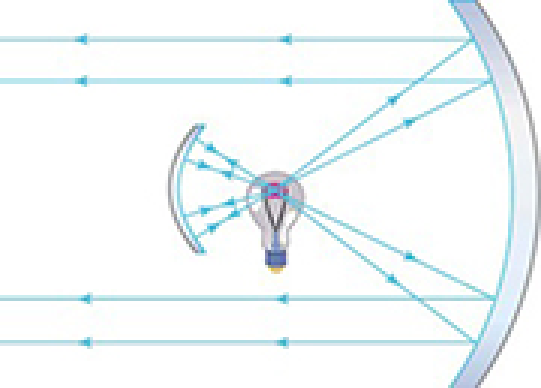
Where is the light source in relation to the focal point or radius of curvature of each mirror? Explain your answer.
英語のヒント
それぞれの鏡の焦点、あるいは曲率半径に対して、光源はどこにあるか。答えを説明せよ。
a. The bulb is at the center of curvature of the small mirror and at the focal point of the large mirror.b. The bulb is at the focal point of the small mirror and at the focal point of the large mirror.c. The bulb is at the center of curvature of the small mirror and at the center of curvature of the large mirror.d. The bulb is at the focal point of the small mirror and at the center of curvature of the large mirror.
a. 電球は小さい鏡の曲率中心にあり、大きい鏡の焦点にある。b. 電球は小さい鏡の焦点にあり、大きい鏡の焦点にある。c. 電球は小さい鏡の曲率中心にあり、大きい鏡の曲率中心にある。d. 電球は小さい鏡の焦点にあり、大きい鏡の曲率中心にある。
44An object is placed in front of a mirror that has a magnification of . What is the radius of curvature of the mirror?
英語のヒント
44倍率の鏡の前のところに物を置く。この鏡の曲率半径はいくらか。
16.2 Refraction 45A scuba diver training in a pool looks at his instructor, as shown in this figure. The angle between the ray in the water and the normal to the water is 25°.
英語のヒント
16.2 屈折 45プールで訓練するダイバーが、この図のように指導者を見ている。水中の光線と水面の法線の間の角度は25°である。
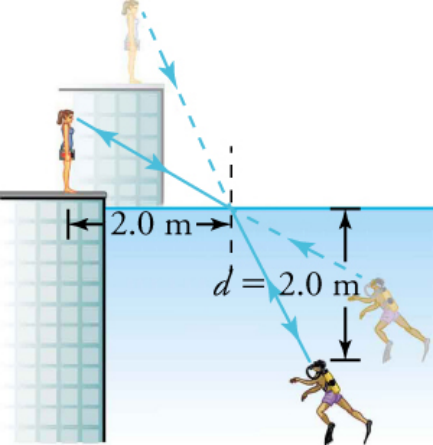
What angle does the ray make from the instructor’s face with the normal to the water () at the point where the ray enters? Assume for air.
指導者の顔から来る光線が水()に入る点で、この光線と水面の法線のなす角は何度か。空気の屈折率はとする。
a. 68°b. 25°c. 19°d. 34°
a. 68°b. 25°c. 19°d. 34°
46Describe total internal reflection. Include a definition of the critical angle and how it is related to total internal reflection. Also, compare the indices of refraction of the interior material and the surrounding material.
英語のヒント
46全反射について述べよ。臨界角の定義と、それが全反射とどう関係するかを含めること。また、内側の材料と周りの材料の屈折率を比べること。
a. When the interior material has a smaller index of refraction than the surrounding material, the incident ray may approach the boundary at an angle (called the critical angle) such that the refraction angle is 90° . The refracted ray cannot leave the interior, so it is reflected back inside and total internal reflection occurs.b. When the interior material has a smaller index of refraction than the surrounding material, the incident ray may approach the boundary at an angle (called the critical angle) such that the refraction angle is less than 90° . The refracted ray cannot leave the interior, so it is reflected back inside and total internal reflection occurs.c. When the interior material has the same index of refraction as the surrounding material, the incident ray approaches the boundary at an angle (called the critical angle) such that the refraction angle is less than 90° . The refracted ray cannot leave the interior, so it is reflected back inside and total internal reflection occurs.d. When the interior material has a greater index of refraction than the surrounding material, the incident ray may approach the boundary at an angle (called the critical angle) such that the refraction angle is 90° . The refracted ray cannot leave the interior, so it is reflected back inside and total internal reflection occurs.
英語のヒント
英語のヒント
a. 内側の材料の屈折率が周りの材料より小さいとき、入射光線が屈折角90°になるような角度(臨界角という)で境目に近づくことがある。屈折光線は内側から出られないので内側へ反射し戻され、全反射が起こる。b. 内側の材料の屈折率が周りの材料より小さいとき、入射光線が屈折角90°未満になるような角度(臨界角という)で境目に近づくことがある。屈折光線は内側から出られないので内側へ反射し戻され、全反射が起こる。c. 内側の材料の屈折率が周りの材料と同じとき、入射光線は屈折角90°未満になるような角度(臨界角という)で境目に近づく。屈折光線は内側から出られないので内側へ反射し戻され、全反射が起こる。d. 内側の材料の屈折率が周りの材料より大きいとき、入射光線が屈折角90°になるような角度(臨界角という)で境目に近づくことがある。屈折光線は内側から出られないので内側へ反射し戻され、全反射が起こる。
16.3 Lenses 47. The muscles that change the shape of the lens in the eyes have become weak, causing vision problems for a person. In particular, the muscles cannot pull hard enough on the edges of the lens to make it less convex.Part A—What condition does inability cause? Part B—Where are images focused with respect to the retina?Part C—Which type of lens corrects this person’s problem? Explain.
英語のヒント
16.3 レンズ 47. 目の水晶体の形を変える筋肉が弱くなり、ある人に視力の問題が起きている。とくに、筋肉が水晶体の縁を引っぱる力が足りず、凸の度合いを弱められない。A部——この不能はどんな状態を起こすか。B部——像は網膜に対してどこに焦点を結ぶか。C部——この人の問題を補正するのはどの種類のレンズか。説明せよ。
a. Part A—This condition causes hyperopia. Part B—Images are focused between the lens and the retina. Part C—A converging lens gathers the rays slightly so they focus onto the retina. b. Part A—This condition causes myopia.
英語のヒント
a. A部——この状態は遠視を起こす。 B部——像は水晶体と網膜の間に焦点を結ぶ。 C部——集束レンズが光線を少し集めて網膜上に焦点を結ばせる。 b. A部——この状態は近視を起こす。
Part B—Images are focused between the lens and the retina. Part C—A converging lens gathers the rays slightly so they focus onto the retina. c. Part A—This condition causes hyperopia.
B部——像は水晶体と網膜の間に焦点を結ぶ。 C部——集束レンズが光線を少し集めて網膜上に焦点を結ばせる。 c. A部——この状態は遠視を起こす。
Part B—Images are focused between the lens and the retina. Part C—A diverging lens spreads the rays slightly so they focus onto the retina. d. Part A—This condition causes myopia.
英語のヒント
B部——像は水晶体と網膜の間に焦点を結ぶ。 C部——発散レンズが光線を少し広げて網膜上に焦点を結ばせる。 d. A部——この状態は近視を起こす。
Part B—Images are focused between the lens and the retina. Part C—A diverging lens spreads the rays slightly so they focus onto the retina.
英語のヒント
B部——像は水晶体と網膜の間に焦点を結ぶ。 C部——発散レンズが光線を少し広げて網膜上に焦点を結ばせる。
48If the lens-to-retina distance is , what is the power of the eye when viewing an object away?a. b.
英語のヒント
48水晶体から網膜までの距離がのとき、離れた物を見ているときの目の度数はいくらか。a. b.