第16章鏡とレンズMirrors and Lenses原書 p.495–540
16.1 Reflection16.1 反射
SECTION LEARNING OBJECTIVES By the end of this section, you will be able to do the following:
この節の学習目標 この節を終えると、次のことができるようになる。
• Explain reflection from mirrors, describe image formation as a consequence of reflection from mirrors, apply ray diagrams to predict and interpret image and object locations, and describe applications of mirrors• Perform calculations based on the law of reflection and the equations for curved mirrors
・鏡による反射を説明し、鏡の反射の結果としての像のでき方を述べ、光線図を使って像と物の位置を予測し解釈し、鏡の応用を述べる・反射の法則と曲面鏡の式にもとづいて計算を行う
Section Key Termsこの節の重要語
angle of incidenceangle of reflectioncentral axisconcave mirrorconvex mirrordiffusedfocal lengthfocal pointgeometric opticslaw of reflectionlaw of refractionrayreal imagespecularvirtual image
入射角反射角中心軸凹面鏡凸面鏡拡散した焦点距離焦点幾何光学反射の法則屈折の法則光線実像正反射の虚像
Characteristics of Mirrors鏡の特徴
There are three ways, as shown in Figure 16.2, in which light can travel from a source to another location. It can come directly from the source through empty space, such as from the Sun to Earth. Light can travel to an object through various media, such as air and glass. Light can also arrive at an object after being reflected, such as by a mirror. In all these cases, light is modeled as traveling in a straight line, called a ray. Light may change direction when it encounters the surface of a different material (such as a mirror) or when it passes from one material to another (such as when passing from air into glass). It then continues in a straight line—that is, as a ray. The word ray comes from mathematics. Here it means a straight line that originates from some point. It is acceptable to visualize light rays as laser rays (or even science fiction depictions of ray guns).
図16.2に示すように、光が源から別の場所へ進むしかたは三つある。太陽から地球へのように、何もない空間を通って源から直接来ることもある。空気やガラスといったさまざまな媒質を通って物まで進むこともある。また、鏡などで反射されてから物に届くこともある。これらのどの場合も、光は直線に沿って進むものとしてモデル化され、それを光線という。光は、違う材料の面(鏡など)に出会うとき、あるいはある材料から別の材料へ入るとき(空気からガラスへ入るときなど)、向きを変えうる。そのあとはまた直線——すなわち光線——として進む。光線(ray)という語は数学から来ている。ここではある点から出る直線を意味する。光線をレーザーの光線(あるいはSFの光線銃の描写でさえ)として思い描いてかまわない。
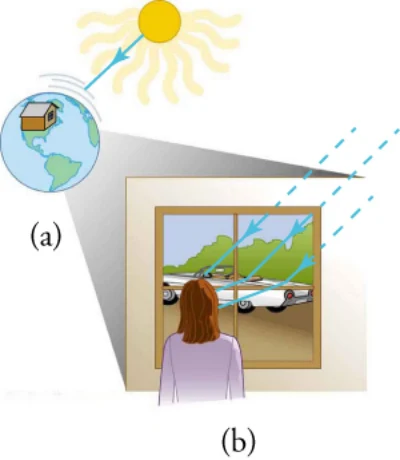
Because light moves in straight lines, that is, as rays, and changes directions when it interacts with matter, it can be described through geometry and trigonometry. This part of optics, described by straight lines and angles, is therefore called geometric optics. There are two laws that govern how light changes direction when it interacts with matter: the law of reflection, for situations in which light bounces off matter; and the law of refraction, for situations in which light passes through matter. In this section, we consider the geometric optics of reflection.
光は直線に沿って、すなわち光線として動き、物質と作用し合うときに向きを変えるので、幾何と三角法で述べられる。直線と角度で述べられるこの部分の光学を、したがって幾何光学という。光が物質と作用し合うときにどう向きを変えるかを支配する法則が二つある。光が物質にあたってはね返る場合の反射の法則と、光が物質を通り抜ける場合の屈折の法則である。この節では反射の幾何光学を考える。
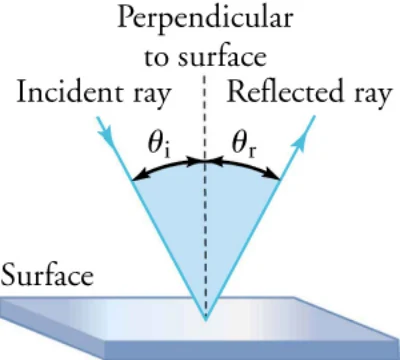
Whenever we look into a mirror or squint at sunlight glinting from a lake, we are seeing a reflection. How does the reflected light travel from the object to your eyes? The law of reflection states: The angle of reflection, , equals the angle of incidence, . This law governs the behavior of all waves when they interact with a smooth surface, and therefore describe the behavior of light waves as well. The reflection of light is simplified when light is treated as a ray. This concept is illustrated in Figure 16.3, which also shows how the angles are measured relative to the line perpendicular to the surface at the point where the light ray strikes it. This perpendicular line is also called the normal line, or just the normal. Light reflected in this way is referred to as specular (from the Latin word for mirror:
鏡をのぞくとき、あるいは湖からきらめく日光に目を細めるとき、私たちは反射を見ている。反射した光は物から目までどう進むのか。反射の法則はこう述べる。反射角は入射角に等しい。この法則は、なめらかな面と作用し合うときのあらゆる波のふるまいを支配し、したがって光の波のふるまいも述べる。光を光線として扱うと、光の反射は単純になる。この考えを図16.3に示す。図はまた、光線が面にあたる点で面に垂直な線を基準にして角度が測られることも示している。この垂直な線は法線とも呼ばれる。このように反射した光は正反射(specular、鏡を意味するラテン語
speculum).
speculumから)と呼ばれる。
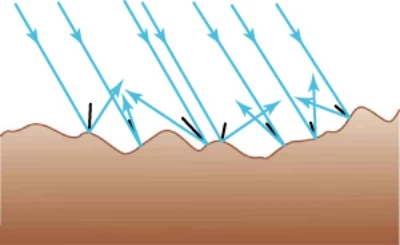
We expect to see reflections from smooth surfaces, but Figure 16.4, illustrates how a rough surface reflects light. Because the light is reflected from different parts of the surface at different angles, the rays go in many different directions, so the reflected light is diffused. Diffused light allows you to read a printed page from almost any angle because some of the rays go in different directions. Many objects, such as people, clothing, leaves, and walls, have rough surfaces and can be seen from many angles. A mirror, on the other hand, has a smooth surface and reflects light at specific angles.
なめらかな面からの反射は当然のものと思っているが、図16.4は粗い面が光をどう反射するかを示す。光は面の違う部分から違う角度で反射されるので、光線は多くの違う向きへ進み、反射した光は拡散する。拡散した光のおかげで、印刷されたページをほとんどどんな角度からでも読める。一部の光線が違う向きへ進むからである。人、衣服、葉、壁など多くの物は粗い面を持ち、多くの角度から見える。これに対して鏡はなめらかな面を持ち、決まった角度に光を反射する。
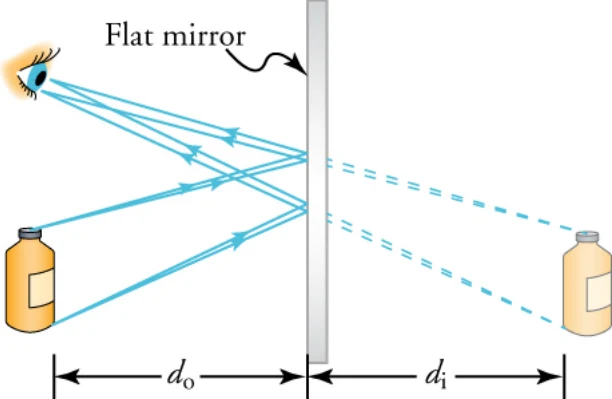
When we see ourselves in a mirror, it appears that our image is actually behind the mirror. We see the light coming from a direction determined by the law of reflection. The angles are such that our image is exactly the same distance behind the mirror, di, as the distance we stand away from the mirror, do. Although these mirror images make objects appear to be where they cannot be (such as behind a solid wall), the images are not figments of our imagination. Mirror images can be photographed and videotaped by instruments and look just as they do to our eyes, which are themselves optical instruments. An image in a mirror is said to be a virtual image, as opposed to a real image. A virtual image is formed when light rays appear to diverge from a point without actually doing so.
鏡に自分を見るとき、像は実際には鏡の後ろにあるように見える。私たちは、反射の法則で決まる向きから来る光を見ている。角度は、像が鏡の後ろにdi、すなわち私たちが鏡から離れて立っている距離doとちょうど同じだけの距離にあるようになっている。こうした鏡像は、物をありえない場所(硬い壁の向こうなど)にあるように見せるが、これらの像は想像の産物ではない。鏡像は器械で写真やビデオに撮ることができ、それ自体が光学器械である私たちの目に見えるのとちょうど同じように見える。鏡の中の像は、実像に対して虚像と呼ばれる。虚像は、光線が実際にはそうしていないのに、ある点から広がっているように見えるときにできる。
Figure 16.5 helps illustrate how a flat mirror forms an image. Two rays are shown emerging from the same point, striking the mirror, and reflecting into the observer’s eye. The rays can diverge slightly, and both still enter the eye. If the rays are extrapolated backward, they seem to originate from a common point behind the mirror, allowing us to locate the image. The paths of the reflected rays into the eye are the same as if they had come directly from that point behind the mirror. Using the law of reflection—the angle of reflection equals the angle of incidence—we can see that the image and object are the same distance from the mirror. This is a virtual image, as defined earlier.
図16.5は、平らな鏡がどう像を作るかを示すのに役立つ。同じ点から出て鏡にあたり、観測者の目へ反射する二本の光線が描かれている。光線は少し広がっていてよく、それでも両方とも目に入る。光線を後ろへ延長すると、鏡の後ろの共通の点から出ているように見え、それによって像の位置を突き止められる。反射して目に入る光線の道筋は、鏡の後ろのその点から直接来た場合とまったく同じである。反射の法則——反射角は入射角に等しい——を使えば、像と物が鏡から同じ距離にあることが分かる。これが、先に定義した虚像である。
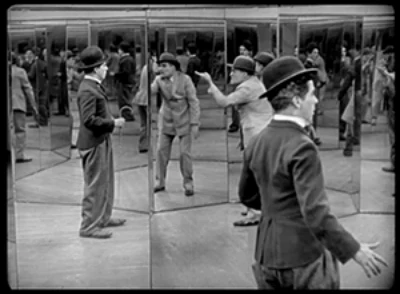
Mirror Mazes Figure 16.6 is a chase scene from an old silent film called The Circus, starring Charlie Chaplin. The chase scene takes place in a mirror maze. You may have seen such a maze at an amusement park or carnival. Finding your way through the maze can be very difficult. Keep in mind that only one image in the picture is real—the others are virtual.
鏡の迷路 図16.6は、チャーリー・チャップリン主演の古い無声映画『サーカス』の追跡場面である。この追跡は鏡の迷路で起こる。遊園地やお祭りでそのような迷路を見たことがあるかもしれない。迷路を抜けるのはとても難しい。この写真で実物は一つだけで、他は虚像であることを覚えておこう。
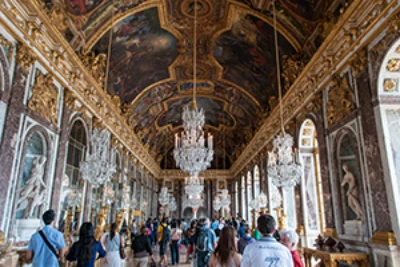
One of the earliest uses of mirrors for creating the illusion of space is seen in the Palace of Versailles, the former home of French royalty. Construction of the Hall of Mirrors (Figure 16.7) began in 1678. It is still one of the most popular tourist attractions at Versailles.
空間の錯覚を作るのに鏡を使った最も早い例の一つが、かつてのフランス王家の住まいであるヴェルサイユ宮殿に見られる。鏡の間(図16.7)の建設は1678年に始まった。今もヴェルサイユで最も人気のある観光の名所の一つである。
GRASP CHECK Only one Charlie in this image (Figure 16.8) is real. The others are all virtual images of him. Can you tell which is real? Hint—His hat is tilted to one side.
理解の確認 この写真(図16.8)でチャーリーは一人だけが本物である。他はすべて彼の虚像である。どれが本物か分かるだろうか。手がかり——彼の帽子は片側に傾いている。
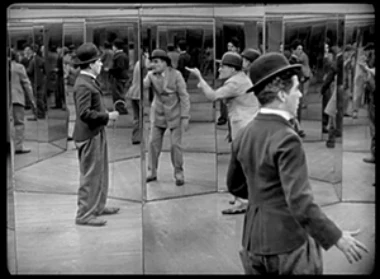
a. The virtual images have their hats tilted to the right.b. The virtual images have their hats tilted to the left.
a. 虚像は帽子が右に傾いている。b. 虚像は帽子が左に傾いている。
c. The real images have their hats tilted to the right.d. The real images have their hats tilted to the left.
c. 実像は帽子が右に傾いている。d. 実像は帽子が左に傾いている。
Virtual Image This video explains the creation of virtual images in a mirror. It shows the location and orientation of the images using ray diagrams, and relates the perception to the human eye.
虚像 この動画は鏡の中に虚像ができることを説明する。光線図を使って像の位置と向きを示し、それを人の目の知覚に結びつける。
Virtual image | Geometric optics | Physics | Khan Academy (https://openstax.org/l/28Virtualimage)
虚像|幾何光学|物理|カーンアカデミー(https://openstax.org/l/28Virtualimage)
Watch Physics: Virtual Image. This video explains the concept of virtual images. Access multimedia content (http://openstax.org/books/physics/pages/16-1-reflection) Compare the distance of an object from a mirror to the apparent distance of its virtual image behind the mirror.a. The distances of the image and the object from the mirror are the same.b. The distances of the image and the object from the mirror are always different.
物理を見る:虚像。この動画は虚像の考えを説明する。マルチメディア教材はこちら(http://openstax.org/books/physics/pages/16-1-reflection) 物の鏡からの距離と、その虚像が鏡の後ろに見える距離を比べよ。a. 像と物の鏡からの距離は同じである。b. 像と物の鏡からの距離はつねに違う。
c. The image is formed at infinity if the object is placed near the mirror.d. The image is formed near the mirror if the object is placed at infinity.
c. 物を鏡の近くに置くと、像は無限遠にできる。d. 物を無限遠に置くと、像は鏡の近くにできる。
Some mirrors are curved instead of flat. A mirror that curves inward is called a concave mirror, whereas one that curves outward is called a convex mirror. Pick up a well-polished metal spoon and you can see an example of each type of curvature. The side of the spoon that holds the food is a concave mirror; the back of the spoon is a convex mirror. Observe your image on both sides of the spoon.
鏡には、平面のものだけでなく曲面のものもある。反射面が内側にくぼんだ鏡を凹面鏡、外側に膨らんだ鏡を凸面鏡という。よく磨かれた金属のスプーンなら、両方を観察できる。食べ物をすくう側は凹面鏡、裏側は凸面鏡になっている。それぞれに自分の顔を映し、像の違いを見てみよう。
TIPS FOR SUCCESS You can remember the difference between concave and convex by thinking, Concave means caved in.
学習のポイント 凹(concave)は「へこんでいる(caved in)」と考えれば、凹と凸の違いを覚えられる。
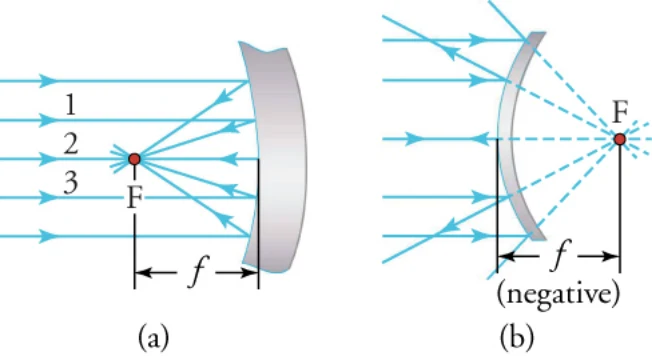
Ray diagrams can be used to find the point where reflected rays converge or appear to converge, or the point from which rays appear to diverge. This is called the focal point, F. The distance from F to the mirror along the central axis (the line perpendicular to the center of the mirror’s surface) is called the focal length, f. Figure 16.9 shows the focal points of concave and convex mirrors.
光線図を使えば、反射した光線が集まる点、あるいは集まるように見える点、また光線が広がって出てくるように見える点を見つけられる。これを焦点Fという。中心軸(鏡の面の中心に垂直な線)に沿ったFから鏡までの距離を焦点距離fという。図16.9に凹面鏡と凸面鏡の焦点を示す。
Images formed by a concave mirror vary, depending on which side of the focal point the object is placed. For any object placed on the far side of the focal point with respect to the mirror, the rays converge in front of the mirror to form a real image, which can be projected onto a surface, such as a screen or sheet of paper However, for an object located inside the focal point with respect to the concave mirror, the image is virtual. For a convex mirror the image is always virtual—that is, it appears to be behind the mirror. The ray diagrams in Figure 16.10 show how to determine the nature of the image formed by concave and convex mirrors.
凹面鏡が作る像は、物が焦点のどちら側に置かれるかによって変わる。鏡から見て焦点より遠い側に置かれた物では、光線は鏡の手前で集まって実像を作り、それはスクリーンや紙のような面に投影できる。しかし、凹面鏡から見て焦点より内側にある物では、像は虚像になる。凸面鏡では像はつねに虚像である——すなわち鏡の後ろにあるように見える。図16.10の光線図は、凹面鏡と凸面鏡が作る像の性質をどう判断するかを示す。
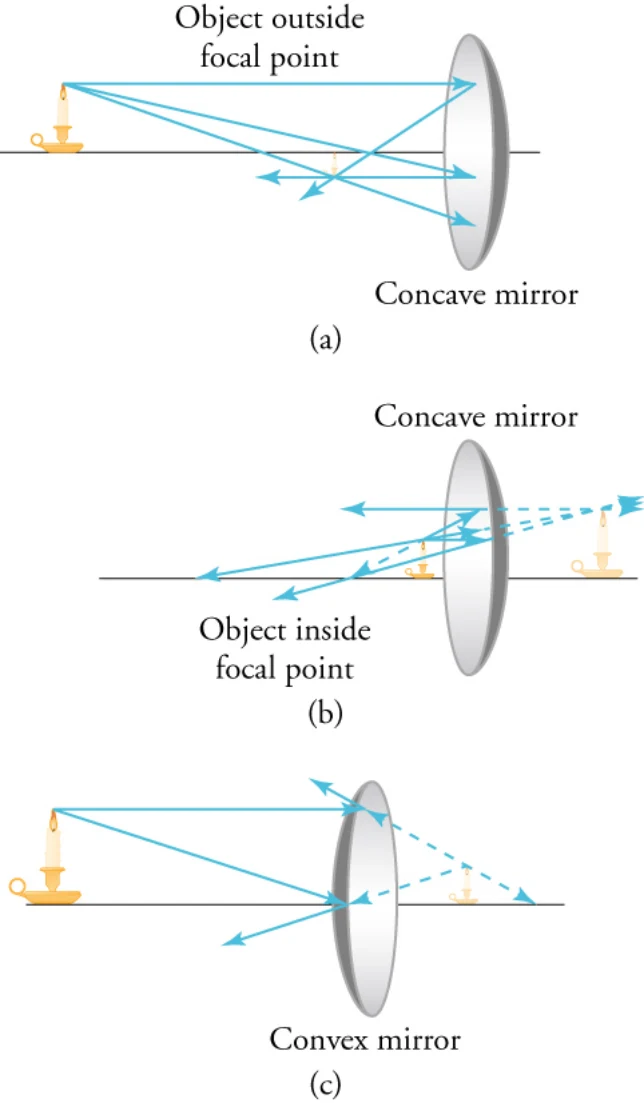
The information in Figure 16.10 is summarized in Table 16.1.
図16.10の情報を表16.1にまとめる。
SNAP LAB身近な実験Concave and Convex Mirrors凹面鏡と凸面鏡
• Silver spoon and silver polish, or a new spoon made of any shiny metal
・銀のスプーンと銀磨き、または光る金属でできた新しいスプーン
Instructions
手引き
Procedure手順
1. Choose any small object with a top and a bottom, such as a short nail or tack, or a coin, such as a quarter. Observe the object’s reflection on the back of the spoon.2. Observe the reflection of the object on the front (bowl side) of the spoon when held away from the spoon at a distance of several inches.3. Observe the image while slowly moving the small object toward the bowl of the spoon. Continue until the object is all the way inside the bowl of the spoon.4. You should see one point where the object disappears and then reappears. This is the focal point.
1. 上下のある小さな物を選ぶ。短い釘や画鋲、あるいは25セント硬貨のような硬貨でよい。その物の映り込みをスプーンの背で観察する。2. スプーンから数インチ離して持ったとき、その物のスプーンの表(くぼんだ側)での映り込みを観察する。3. 小さな物をゆっくりスプーンのくぼみへ近づけながら像を観察する。物がスプーンのくぼみの中に完全に入るまで続ける。4. 物が消えてまた現れる点が一つ見つかるはずである。それが焦点である。
Using a concave mirror, you look at the reflection of a faraway object. The image size changes if you move the object closer to the mirror. Why does the image disappear entirely when the object is at the mirror's focal point?
凹面鏡を使って、遠くの物の映り込みを見る。物を鏡に近づけると像の大きさが変わる。物が鏡の焦点にあるとき、像がまったく消えてしまうのはなぜか。
a. The height of the image became infinite.b. The height of the object became zero.
a. 像の高さが無限大になったから。b. 物の高さが0になったから。
c. The intensity of intersecting light rays became zero.d. The intensity of intersecting light rays increased.
c. 交わる光線の強さが0になったから。d. 交わる光線の強さが増えたから。
Parabolic Mirrors and Real Images This video uses ray diagrams to show the special feature of parabolic mirrors that makes them ideal for either projecting light energy in parallel rays, with the source being at the focal point of the parabola, or for collecting at the focal point light energy from a distant source.
放物面鏡と実像 この動画は光線図を使って、放物面鏡の特別な性質——放物線の焦点に光源を置けば光のエネルギーを平行な光線として投げ出すのに理想的であり、逆に遠くの源からの光のエネルギーを焦点に集めるのにも理想的である——を示す。
Parabolic mirrors and real images | Geometric optics | Physics | Khan Academy (https://www.openstax.org/l/ 28Parabolic)
放物面鏡と実像|幾何光学|物理|カーンアカデミー(https://www.openstax.org/l/28Parabolic)
Watch Physics: Parabolic Mirrors and Real Images. This video explains parabolic mirrors and real images. Access multimedia content (http://openstax.org/books/physics/pages/16-1-reflection) Explain why using a parabolic mirror for a car headlight throws much more light on the highway than a flat mirror.a. The rays do not polarize after reflection.b. The rays are dispersed after reflection.
物理を見る:放物面鏡と実像。この動画は放物面鏡と実像を説明する。マルチメディア教材はこちら(http://openstax.org/books/physics/pages/16-1-reflection)自動車のヘッドライトに放物面鏡を使うと、平らな鏡よりずっと多くの光を道路に投げかけられるのはなぜかを説明せよ。a. 光線は反射のあと偏らないから。b. 光線は反射のあと散らばるから。
c. The rays are polarized after reflection.d. The rays become parallel after reflection.
c. 光線は反射のあと偏るから。d. 光線は反射のあと平行になるから。
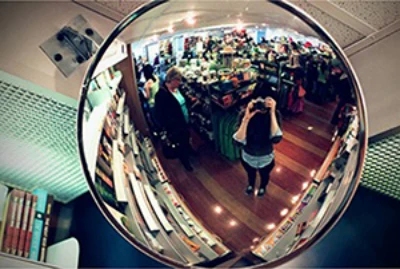
You should be able to notice everyday applications of curved mirrors. One common example is the use of security mirrors in stores, as shown in Figure 16.11.
曲面鏡の日常での応用に気づけるはずである。よくある例が、図16.11に示す店の防犯ミラーである。
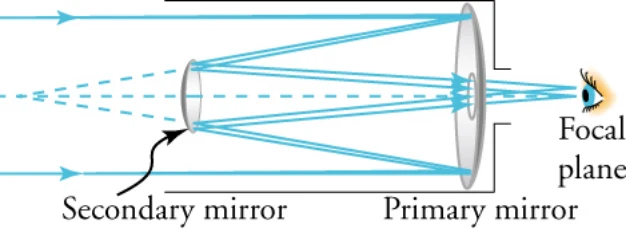
Some telescopes also use curved mirrors and no lenses (except in the eyepieces) both to magnify images and to change the path of light. Figure 16.12 shows a Schmidt-Cassegrain telescope. This design uses a spherical primary concave mirror and a convex secondary mirror. The image is projected onto the focal plane by light passing through the perforated primary mirror. The effective focal length of such a telescope is the focal length of the primary mirror multiplied by the magnification of the secondary mirror. The result is a telescope with a focal length much greater than the length of the telescope itself.
望遠鏡の中には、像を拡大するためにも光の道筋を変えるためにも、(接眼部を除いて)レンズを使わず曲面鏡を使うものもある。図16.12にシュミット・カセグレン望遠鏡を示す。この設計は球面の主凹面鏡と凸面の副鏡を使う。像は、穴のあいた主鏡を通り抜けた光によって焦点面に投影される。この種の望遠鏡の実効焦点距離は、主鏡の焦点距離に副鏡の倍率をかけたものである。その結果、望遠鏡そのものの長さよりずっと大きな焦点距離を持つ望遠鏡になる。
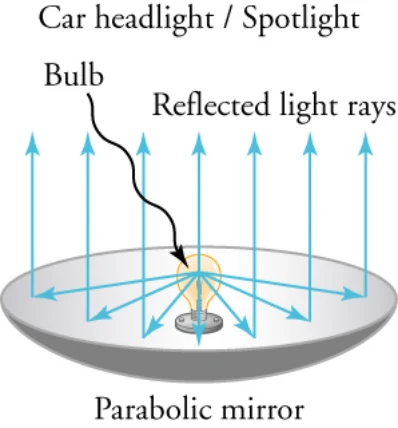
A parabolic concave mirror has the very useful property that all light from a distant source, on reflection by the mirror surface, is directed to the focal point. Likewise, a light source placed at the focal point directs all the light it emits in parallel lines away from the mirror. This case is illustrated by the ray diagram in Figure 16.13. The light source in a car headlight, for example, is located at the focal point of a parabolic mirror.
放物面の凹面鏡は、遠くの源からの光がすべて、鏡の面で反射すると焦点へ向かうという、とても役に立つ性質を持つ。同じように、焦点に置かれた光源は、放つ光をすべて鏡から離れる平行な線に沿って向かわせる。この場合を図16.13の光線図に示す。たとえば自動車のヘッドライトの光源は、放物面鏡の焦点に置かれている。
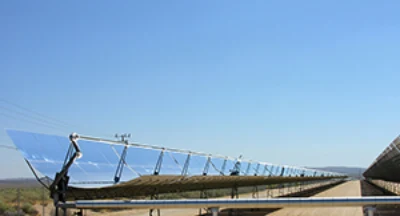
Parabolic mirrors are also used to collect sunlight and direct it to a focal point, where it is transformed into heat, which in turn can be used to generate electricity. This application is shown in Figure 16.14.
放物面鏡は、日光を集めて焦点へ向かわせ、そこで熱に変え、その熱でさらに電気を起こすのにも使われる。この応用を図16.14に示す。
The Application of the Curved Mirror Equations曲面鏡の式の応用
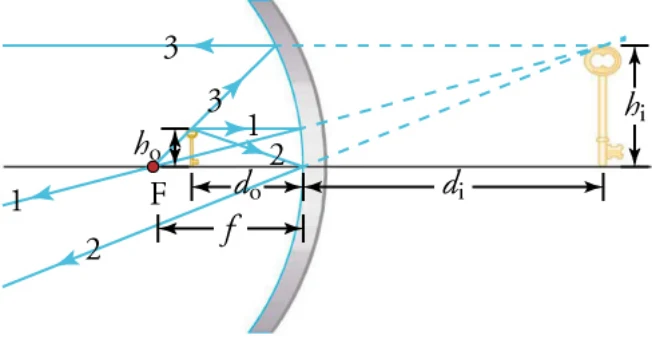
Curved mirrors and the images they create involve a fairly small number of variables: the mirror’s radius of curvature, R; the focal length, f; the distances of the object and image from the mirror, do and di, respectively; and the heights of the object and image, ho and hi, respectively. The signs of these values indicate whether the image is inverted, erect (upright), real, or virtual. We now look at the equations that relate these variables and apply them to everyday problems.
曲面鏡とそれが作る像には、わりあい少ない数の変数が関わる。鏡の曲率半径R、焦点距離f、物と像の鏡からの距離doとdi、そして物と像の高さhoとhiである。これらの値の符号は、像が倒立か正立か、実像か虚像かを示す。これから、これらの変数を結びつける式を見て、日常の問題に応用する。
Figure 16.15 shows the meanings of most of the variables we will use for calculations involving curved mirrors.
図16.15に、曲面鏡の計算に使う変数のほとんどの意味を示す。
The basic equation that describes both lenses and mirrors is the lens/mirror equation
レンズと鏡の両方を述べる基本の式が、レンズ・鏡の式である。
This equation can be rearranged several ways. For example, it may be written to solve for focal length.
この式はいくつかのしかたで変形できる。たとえば焦点距離について解くように書ける。
Magnification, m, is the ratio of the size of the image, hi, to the size of the object, ho. The value of m can be calculated in two ways.
倍率mは、像の大きさhiと物の大きさhoの比である。mの値は二つのしかたで計算できる。
This relationship can be written to solve for any of the variables involved. For example, the height of the image is given by
この関係は、関わるどの変数について解く形にも書ける。たとえば像の高さは次で与えられる。
We saved the simplest equation for last. The radius of curvature of a curved mirror, R, is simply twice the focal length.
最も単純な式を最後にとっておいた。曲面鏡の曲率半径Rは、単に焦点距離の2倍である。
We can learn important information from the algebraic sign of the result of a calculation using the previous equations:
前の式を使った計算の結果の代数的な符号から、重要な情報を読み取れる。
• A negative di indicates a virtual image; a positive value indicates a real image• A negative hi indicates an inverted image; a positive value indicates an erect image
・diが負なら虚像、正なら実像を表す・hiが負なら倒立した像、正なら正立した像を表す
• For concave mirrors, f is positive; for convex mirrors, f is negative
・凹面鏡ではfは正、凸面鏡ではfは負である
Now let’s apply these equations to solve some problems.
では、これらの式を使っていくつか問題を解いてみよう。
Calculating Focal Length A person standing 6.0 m from a convex security mirror forms a virtual image that appears to be 1.0 m behind the mirror. What is the focal length of the mirror? Strategy
焦点距離を計算する 凸面の防犯ミラーから6.0 mのところに立つ人が、鏡の後ろ1.0 mにあるように見える虚像を作る。この鏡の焦点距離はいくらか。 方針
The person is the object, so do = 6.0 m. We know that, for this situation, do is positive. The image is virtual, so the value for the image distance is negative, so di = –1.0 m.
人が物なので、do = 6.0 mである。この場合doが正であることは分かっている。像は虚像なので像までの距離の値は負であり、di = −1.0 mとなる。
Now, use the appropriate version of the lens/mirror equation to solve for focal length by substituting the known values.
あとは、レンズ・鏡の式の適切な形に分かっている値を代入して焦点距離について解けばよい。
Solution解答
Discussion考察
The negative result is expected for a convex mirror. This indicates the focal point is behind the mirror.
凸面鏡では負の結果が期待される。これは焦点が鏡の後ろにあることを示す。
Calculating Object Distance Electric room heaters use a concave mirror to reflect infrared (IR) radiation from hot coils. Note that IR radiation follows the same law of reflection as visible light. Given that the mirror has a radius of curvature of 50.0 cm and produces an image of the coils 3.00 m in front of the mirror, where are the coils with respect to the mirror?Strategy
物までの距離を計算する 電気ストーブは、熱くなったコイルからの赤外線(IR)を反射するのに凹面鏡を使う。赤外線も可視光と同じ反射の法則に従うことに注意しよう。この鏡の曲率半径が50.0 cmで、鏡の手前3.00 mのところにコイルの像を作るとき、コイルは鏡に対してどこにあるか。方針
We are told that the concave mirror projects a real image of the coils at an image distance di = 3.00 m. The coils are the object, and we are asked to find their location—that is, to find the object distance do. We are also given the radius of curvature of the mirror, so that its focal length is f = R/2 = 25.0 cm (a positive value, because the mirror is concave, or converging). We can use the lens/mirror equation to solve this problem.
凹面鏡がコイルの実像を像までの距離di = 3.00 mのところに投影していると言われている。コイルが物であり、その位置——すなわち物までの距離do——を求めよと言われている。鏡の曲率半径も与えられているので、その焦点距離はf = R/2 = 25.0 cm(鏡が凹面、すなわち集める鏡なので正の値)である。この問題はレンズ・鏡の式で解ける。
Solution解答
Because di and f are known, the lens/mirror equation can be used to find do.
diとfが分かっているので、レンズ・鏡の式でdoを求められる。
Rearranging to solve for do, we have
doについて解くように変形すると、
Entering the known quantities gives us
分かっている量を入れると
Discussion考察
505Note that the object (the coil filament) is farther from the mirror than the mirror’s focal length. This is a case 1 image (do > f and f positive), consistent with the fact that a real image is formed. You get the most concentrated thermal energy directly in front of the mirror and 3.00 m away from it. In general, this is not desirable because it could cause burns. Usually, you want the rays to emerge parallel, and this is accomplished by having the filament at the focal point of the mirror.
物(コイルのフィラメント)が鏡の焦点距離より遠くにあることに注意しよう。これは場合1の像(do > fでfは正)であり、実像ができるという事実と辻褄が合う。最も集中した熱のエネルギーは、鏡のちょうど正面、そこから3.00 mのところで得られる。一般にこれは望ましくない。やけどを起こしうるからである。ふつうは光線が平行に出ていくようにしたいので、フィラメントを鏡の焦点に置くことでそれを実現する。
Note that the filament here is not much farther from the mirror than the focal length, and that the image produced is considerably farther away.
ここでのフィラメントは鏡から焦点距離よりさほど遠くなく、それでもできる像はずっと遠くにあることに注意しよう。
Practice Problems練習問題
1A concave mirror has a radius of curvature of . What is the focal length of the mirror?a. b.
1ある凹面鏡の曲率半径がである。この鏡の焦点距離はいくらか。a. b.
2What is the focal length of a makeup mirror that produces a magnification of 1.50 when a person’s face is 12.0 cm away? Construct a ray diagram using paper, a pencil and a ruler to confirm your calculation.a. –36.0 cmb. –7.20 cm
2顔を12.0 cm離したときに1.50の倍率を作る化粧鏡の焦点距離はいくらか。紙と鉛筆と定規で光線図を描いて計算を確かめよ。a. −36.0 cmb. −7.20 cm
c. 7.20 cmd. 36.0 cm
c. 7.20 cmd. 36.0 cm
Check Your Understanding理解の確認
3How does the object distance, do, compare with the focal length, f, for a concave mirror that produces an image that is real and inverted?
3倒立した実像を作る凹面鏡では、物までの距離doは焦点距離fとくらべてどうなっているか。
a. do > f, where do and f are object distance and focal length, respectively.b. do < f, where do and f are object distance and focal length, respectively.
a. do > f。ここでdoとfはそれぞれ物までの距離と焦点距離である。b. do < f。ここでdoとfはそれぞれ物までの距離と焦点距離である。
c. do = f, where do and f are object distance and focal length, respectively.d. do = 0, where do is the object distance.
c. do = f。ここでdoとfはそれぞれ物までの距離と焦点距離である。d. do = 0。ここでdoは物までの距離である。
4Use the law of reflection to explain why it is not a good idea to polish a mirror with coarse sandpaper.
4粗い紙やすりで鏡を磨くのがよくない考えである理由を、反射の法則で説明せよ。
a. The surface becomes smooth. A smooth surface produces a sharp image.b. The surface becomes irregular. An irregular surface produces a sharp image.
a. 面がなめらかになる。なめらかな面は鮮明な像を作る。b. 面が不規則になる。不規則な面は鮮明な像を作る。
c. The surface becomes smooth. A smooth surface transmits but does not reflect light.d. The surface becomes irregular. An irregular surface produces a blurred image.
c. 面がなめらかになる。なめらかな面は光を透過するが反射しない。d. 面が不規則になる。不規則な面はぼやけた像を作る。
5An object is placed in front of a concave mirror at a distance that is greater than the focal length of the mirror. Will the image produced by the mirror be real or virtual? Will it be erect or inverted?
5凹面鏡の前、鏡の焦点距離より遠い距離に物を置く。鏡が作る像は実像か虚像か。正立か倒立か。
a. It is real and erect.b. It is real and inverted.
a. 実像で正立である。b. 実像で倒立である。
c. It is virtual and inverted.d. It is virtual and erect.
c. 虚像で倒立である。d. 虚像で正立である。