第16章鏡とレンズMirrors and Lenses原書 p.495–540
The Law of Refraction屈折の法則
You may have noticed some odd optical phenomena when looking into a fish tank. For example, you may see the same fish appear to be in two different places (Figure 16.16). This is because light coming to you from the fish changes direction when it leaves the tank and, in this case, light rays traveling along two different paths both reach our eyes. The changing of a light ray’s direction (loosely called bending) when it passes a boundary between materials of different composition, or between layers in single material where there are changes in temperature and density, is called refraction. Refraction is responsible for a tremendous range of optical phenomena, from the action of lenses to voice transmission through optical fibers.
水槽をのぞいたとき、奇妙な光学の現象に気づいたことがあるかもしれない。たとえば、同じ魚が二つの違う場所にいるように見えることがある(図16.16)。これは、魚からこちらへ来る光が水槽を出るときに向きを変えるからであり、この場合、二つの違う道筋を進む光線がどちらも私たちの目に届いている。組成の違う材料どうしの境目、あるいは温度と密度が変わる一つの材料の中の層どうしの境目を通り抜けるとき、光線が向きを変えること(ゆるく「曲がる」ともいう)を屈折という。屈折は、レンズの働きから光ファイバーによる音声の伝送まで、途方もない範囲の光学の現象を担っている。
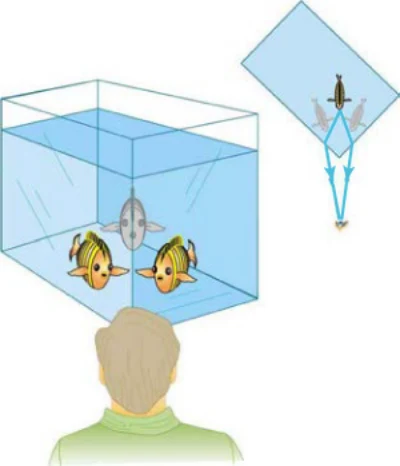
Why does light change direction when passing from one material (medium) to another? It is because light changes speed when going from one material to another. This behavior is typical of all waves and is especially easy to apply to light because light waves have very small wavelengths, and so they can be treated as rays. Before we study the law of refraction, it is useful to discuss the speed of light and how it varies between different media.
光がある材料(媒質)から別のものへ入るとき、なぜ向きを変えるのか。それは、光がある材料から別の材料へ行くとき速さを変えるからである。このふるまいはあらゆる波に共通で、光の波は波長がとても短く光線として扱えるので、光にはとくに当てはめやすい。屈折の法則を学ぶ前に、光の速さと、それが媒質によってどう変わるかを論じておくと役に立つ。
The speed of light is now known to great precision. In fact, the speed of light in a vacuum, c, is so important, and is so precisely known, that it is accepted as one of the basic physical quantities, and has the fixed value
光の速さは今日きわめて精密に知られている。実のところ、真空中の光の速さcはあまりに重要で、あまりに精密に知られているので、基本的な物理量の一つとして受け入れられており、次の決まった値を持つ。
where the approximate value of 3.00 108 m/s is used whenever three-digit precision is sufficient. The speed of light through matter is less than it is in a vacuum, because light interacts with atoms in a material. The speed of light depends strongly on the type of material, given that its interaction with different atoms, crystal lattices, and other substructures varies. We define the index of refraction, n, of a material to be
ここで、3桁の精度で足りるときにはいつでも、近似値3.00 108 m/sが使われる。物質中の光の速さは真空中より小さい。光が材料の中の原子と作用し合うからである。光の速さは材料の種類に大きくよる。原子・結晶格子・その他の微細構造との作用のしかたが違うからである。材料の屈折率nを次のように定義する。
where v is the observed speed of light in the material. Because the speed of light is always less than c in matter and equals c only in a vacuum, the index of refraction (plural: indices of refraction) is always greater than or equal to one.
ここでvはその材料の中で観測される光の速さである。物質中では光の速さがつねにcより小さく、真空中でのみcに等しいので、屈折率はつねに1以上である。
Table 16.2 lists the indices of refraction in various common materials.
表16.2にいろいろな身近な材料の屈折率を挙げる。
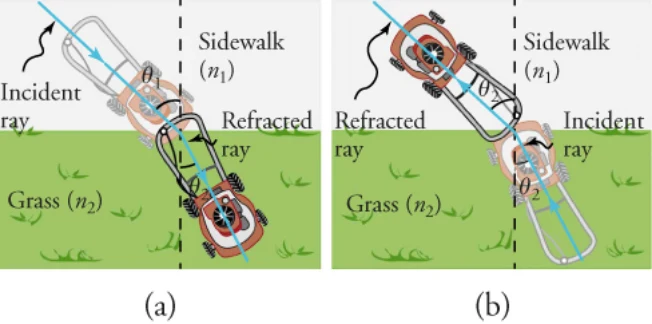
Figure 16.17 provides an analogy for and a description of how a ray of light changes direction when it passes from one medium to another. As in the previous section, the angles are measured relative to a perpendicular to the surface at the point where the light ray crosses it. The change in direction of the light ray depends on how the speed of light changes. The change in the speed of light is related to the indices of refraction of the media involved. In the situations shown in Figure 16.17, medium 2 has a greater index of refraction than medium 1. This difference in index of refraction means that the speed of light is less in medium 2 than in medium 1. Note that, in Figure 16.17(a), the path of the ray moves closer to the perpendicular when the ray slows down. Conversely, in Figure 16.17(b), the path of the ray moves away from the perpendicular when the ray speeds up. The path is exactly reversible. In both cases, you can imagine what happens by thinking about pushing a lawn mower from a footpath onto grass, and vice versa. Going from the footpath to grass, the right front wheel is slowed and pulled to the side as shown. This is the same change in direction for light when it goes from a fast medium to a slow one. When going from the grass to the footpath, the left front wheel moves faster than the others, and the mower changes direction as shown. This, too, is the same change in direction as light going from slow to fast.
図16.17は、光線がある媒質から別の媒質へ入るときにどう向きを変えるかの類比と説明を与える。前の節と同じく、角度は光線が面を横切る点で面に垂直な線を基準に測られる。光線の向きの変化は、光の速さがどう変わるかによる。光の速さの変化は、関わる媒質の屈折率に結びついている。図16.17の場面では、媒質2の屈折率が媒質1より大きい。この屈折率の違いは、媒質2の中の光の速さが媒質1より小さいことを意味する。図16.17(a)では、光線が遅くなるとその道筋が垂線に近づくことに注意しよう。逆に図16.17(b)では、光線が速くなるとその道筋が垂線から遠ざかる。道筋はちょうど逆にたどれる。どちらの場合も、芝刈り機を歩道から芝生へ、またその逆に押していくところを考えれば何が起こるか思い描ける。歩道から芝生へ行くとき、右前の車輪が遅くなり、図のように横へ引っぱられる。これは光が速い媒質から遅い媒質へ行くときの向きの変化と同じである。芝生から歩道へ行くときは、左前の車輪が他より速く動き、芝刈り機は図のように向きを変える。これも、光が遅い媒質から速い媒質へ行くときの向きの変化と同じである。
SNAP LAB身近な実験Bent Pencil曲がった鉛筆
A classic observation of refraction occurs when a pencil is placed in a glass filled halfway with water. Do this and observe the shape of the pencil when you look at it sideways through air, glass, and water.
屈折の古典的な観察が、水を半分入れたコップに鉛筆を入れたときに起こる。これをやって、空気・ガラス・水を通して横から見たときの鉛筆の形を観察しよう。
• A full-length pencil• A glass half full of water
・長さのある鉛筆一本・水を半分入れたコップ
Instructions
手引き
Procedure手順
1. Place the pencil in the glass of water.2. Observe the pencil from the side.3. Explain your observations.
1. 水の入ったコップに鉛筆を入れる。2. 横から鉛筆を観察する。3. 観察したことを説明する。
VIRTUAL PHYSICSシミュレーションBending Light光を曲げる
The Bending Light simulation (https://openstax.org/l/28Bendinglight) allows you to show light refracting as it crosses the boundaries between various media (download animation first to view). It also shows the reflected ray. You can move the protractor to the point where the light meets the boundary and measure the angle of incidence, the angle of refraction, and the angle of reflection. You can also insert a prism into the beam to view the spreading, or dispersion, of white light into colors, as discussed later in this section. Use the ray option at the upper left.
「光を曲げる」シミュレーション(https://openstax.org/l/28Bendinglight)では、光がさまざまな媒質どうしの境目を横切るときに屈折する様子を見られる(見るにはまずアニメーションをダウンロードする)。反射した光線も示される。分度器を光が境目に出会う点まで動かして、入射角・屈折角・反射角を測れる。光束にプリズムを入れて、この節であとで論じる、白い光が色に広がること、すなわち分散を見ることもできる。左上の「光線」の選択肢を使おう。
PhET Explorations: Bending Light. Explore bending of light between two media with different indices of refraction. See how changing from air to water to glass changes the bending angle. Play with prisms of different shapes and make rainbows.Access multimedia content (http://openstax.org/books/physics/pages/16-2-refraction) A light ray moving upward strikes a horizontal boundary at an acute angle relative to the perpendicular and enters the medium above the boundary. What must be true for the light to bend away from the perpendicular?
PhET探究:光を曲げる。屈折率の違う二つの媒質の間で光が曲がる様子を探ろう。空気から水、ガラスへ変えると曲がる角度がどう変わるか見よう。いろいろな形のプリズムで遊んで虹を作ろう。マルチメディア教材はこちら(http://openstax.org/books/physics/pages/16-2-refraction) 上へ進む光線が、水平な境目に垂線から測って鋭角であたり、境目の上の媒質へ入る。光が垂線から遠ざかるように曲がるには、何が成り立っていなければならないか。
a. The medium below the boundary must have a greater index of refraction than the medium above.b. The medium below the boundary must have a lower index of refraction than the medium above.
a. 境目の下の媒質の屈折率が、上の媒質より大きくなければならない。b. 境目の下の媒質の屈折率が、上の媒質より小さくなければならない。
c. The medium below the boundary must have an index of refraction of zero.d. The medium above the boundary must have an infinite index of refraction.
c. 境目の下の媒質の屈折率が0でなければならない。d. 境目の上の媒質の屈折率が無限大でなければならない。
The amount that a light ray changes direction depends both on the incident angle and the amount that the speed changes. For a ray at a given incident angle, a large change in speed causes a large change in direction, and thus a large change in the angle of refraction. The exact mathematical relationship is the law of refraction, or Snell’s law, which is stated in equation form as
光線が向きを変える量は、入射角と速さの変わる量の両方による。決まった入射角の光線では、速さの変化が大きければ向きの変化も大きく、したがって屈折角の変化も大きい。厳密な数学の関係が屈折の法則、すなわちスネルの法則であり、式で書くと次のようになる。
In terms of speeds, Snell’s law becomes
速さの言葉では、スネルの法則は次のようになる。
Here, n1 and n2 are the indices of refraction for media 1 and 2, respectively, and θ1 and θ2 are the angles between the rays and the perpendicular in the respective media 1 and 2, as shown in Figure 16.17. The incoming ray is called the incident ray and the outgoing ray is called the refracted ray. The associated angles are called the angle of incidence and the angle of refraction. Later, we apply Snell’s law to some practical situations.
ここでn1とn2はそれぞれ媒質1と2の屈折率、θ1とθ2は、図16.17に示すとおり、それぞれの媒質1と2の中での光線と垂線の間の角度である。入ってくる光線を入射光線、出ていく光線を屈折光線という。それに対応する角度を入射角、屈折角という。あとでスネルの法則をいくつか実際の場面に応用する。
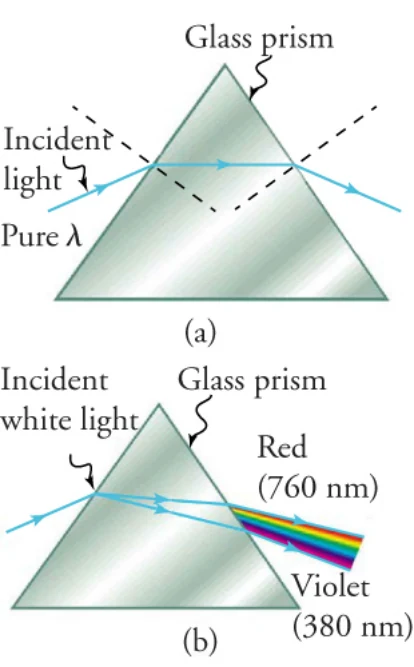
Dispersion is defined as the spreading of white light into the wavelengths of which it is composed. This happens because the index of refraction varies slightly with wavelength. Figure 16.18 shows how a prism disperses white light into the colors of the rainbow.
分散とは、白い光がそれを作っている波長に広がることと定義される。これは屈折率が波長によってわずかに変わるために起こる。図16.18は、プリズムが白い光を虹の色に分散させる様子を示す。
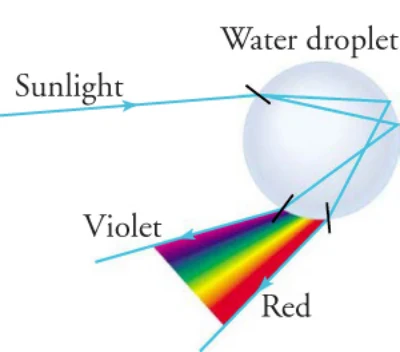
Rainbows are produced by a combination of refraction and reflection. You may have noticed that you see a rainbow only when you turn your back to the Sun. Light enters a drop of water and is reflected from the back of the drop, as shown in Figure 16.19. The light is refracted both as it enters and as it leaves the drop. Because the index of refraction of water varies with wavelength, the light is dispersed and a rainbow is observed.
虹は屈折と反射の組み合わせで生じる。虹は太陽に背を向けたときにしか見えないことに気づいたかもしれない。図16.19に示すとおり、光は水滴に入り、水滴の後ろ側で反射する。光は水滴に入るときにも出るときにも屈折する。水の屈折率は波長によって変わるので、光は分散し、虹が見える。
Dispersion This video explains how refraction disperses white light into its composite colors.
分散 この動画は、屈折がどうやって白い光をそれを作っている色に分けるかを説明する。
Access multimedia content (http://openstax.org/books/physics/pages/16-2-refraction) Watch Physics: Dispersion. This video introduces and explains how prisms split white light into so many colors through a process called dispersion. Access multimedia content (http://openstax.org/books/physics/pages/16-2-refraction) Which colors of the rainbow bend most when refracted?
マルチメディア教材はこちら(http://openstax.org/books/physics/pages/16-2-refraction)物理を見る:分散。この動画は、プリズムが分散という過程を通して白い光をどうしてあれほど多くの色に分けるのかを導き、説明する。マルチメディア教材はこちら(http://openstax.org/books/physics/pages/16-2-refraction)虹のどの色が屈折で最も大きく曲がるか。
a. Colors with a longer wavelength and higher frequency bend most when refracted.b. Colors with a shorter wavelength and higher frequency bend most when refracted.c. Colors with a shorter wavelength and lower frequency bend most when refracted.
a. 波長が長く振動数の高い色が屈折で最も大きく曲がる。b. 波長が短く振動数の高い色が屈折で最も大きく曲がる。c. 波長が短く振動数の低い色が屈折で最も大きく曲がる。
d. Colors with a longer wavelength and a lower frequency bend most when refracted.
d. 波長が長く振動数の低い色が屈折で最も大きく曲がる。
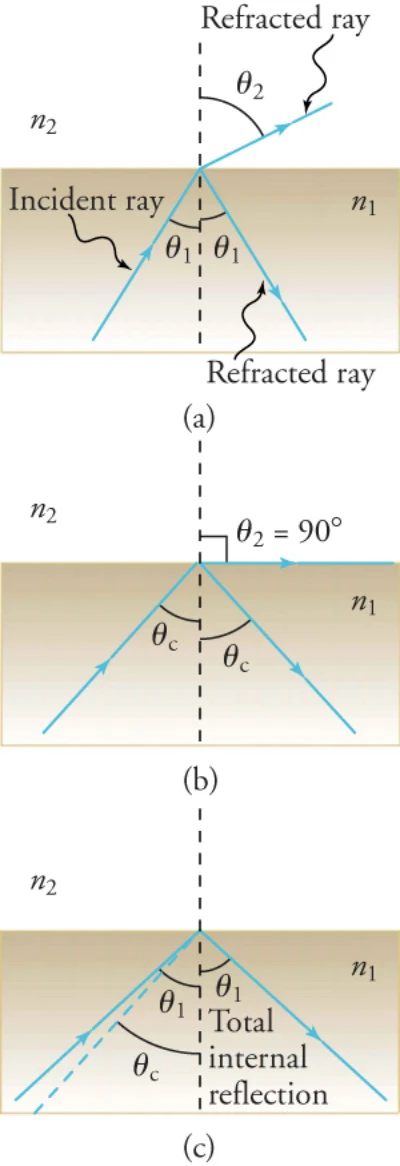
A good-quality mirror reflects more than 90 percent of the light that falls on it; the mirror absorbs the rest. But, it would be useful to have a mirror that reflects all the light that falls on it. Interestingly, we can produce total reflection using an aspect of refraction. Consider what happens when a ray of light strikes the surface between two materials, such as is shown in Figure 16.20(a). Part of the light crosses the boundary and is refracted; the rest is reflected. If, as shown in the figure, the index of refraction for the second medium is less than the first, the ray bends away from the perpendicular. Because n1 > n2, the angle of refraction is greater than the angle of incidence—that is, > . Now, imagine what happens as the incident angle is increased. This causes to increase as well. The largest the angle of refraction, , can be is 90°, as shown in Figure 16.20(b). The critical angle, , for a combination of two materials is defined to be the incident angle, , which produces an angle of refraction of 90°. That is, is the incident angle for which = 90°. If the incident angle, , is greater than the critical angle, as shown in Figure 16.20(c), then all the light is reflected back into medium 1, a condition called total internal reflection.
質のよい鏡は、あたった光の90パーセント以上を反射し、残りを吸収する。しかし、あたった光をすべて反射する鏡があれば役に立つだろう。面白いことに、屈折のある性質を使えば全反射を作れる。図16.20(a)に示すように、光線が二つの材料の間の面にあたるとどうなるかを考えよう。光の一部は境目を越えて屈折し、残りは反射する。図のように、二つ目の媒質の屈折率が一つ目より小さければ、光線は垂線から遠ざかるように曲がる。n1 > n2なので、屈折角は入射角より大きい——すなわち > である。さて、入射角を大きくしていくとどうなるか想像しよう。これはも大きくする。屈折角が取りうる最大は、図16.20(b)に示すとおり90°である。二つの材料の組み合わせに対する臨界角は、屈折角90°を生む入射角と定義される。すなわちは、 = 90°となる入射角である。入射角が臨界角より大きければ、図16.20(c)のように、光はすべて媒質1へ反射し戻される。この状態を全反射という。
Recall that Snell’s law states the relationship between angles and indices of refraction. It is given by
スネルの法則が角度と屈折率の関係を述べていたことを思い出そう。それは次で与えられる。
When the incident angle equals the critical angle ( = ), the angle of refraction is 90° ( = 90°). Noting that sin 90° = 1, Snell’s law in this case becomes
入射角が臨界角に等しい( = )とき、屈折角は90°( = 90°)である。sin 90° = 1に注意すれば、この場合スネルの法則は次のようになる。
The critical angle, , for a given combination of materials is thus
したがって、決まった材料の組み合わせに対する臨界角は
for n1 > n2.
となる。ただしn1 > n2である。
Total internal reflection occurs for any incident angle greater than the critical angle, , and it can only occur when the second medium has an index of refraction less than the first. Note that the previous equation is written for a light ray that travels in medium 1 and reflects from medium 2, as shown in Figure 16.20.
全反射は、臨界角より大きいどんな入射角でも起こり、二つ目の媒質の屈折率が一つ目より小さいときにしか起こりえない。前の式は、図16.20に示すとおり、媒質1の中を進み媒質2から反射する光線について書かれていることに注意しよう。
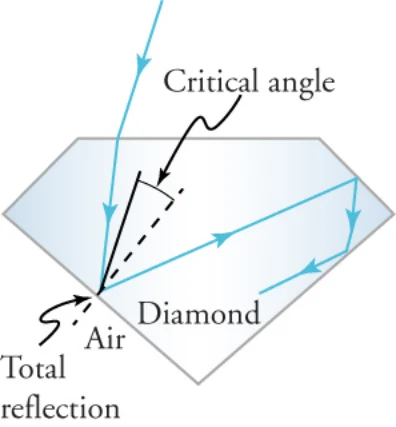
There are several important applications of total internal reflection. Total internal reflection, coupled with a large index of refraction, explains why diamonds sparkle more than other materials. The critical angle for a diamond-to-air surface is only 24.4°; so, when light enters a diamond, it has trouble getting back out (Figure 16.21). Although light freely enters the diamond at different angles, it can exit only if it makes an angle less than 24.4° with the normal to a given surface. Facets on diamonds are specifically intended to make this unlikely, so that the light can exit only in certain places. Diamonds with very few impurities are very clear, so the light makes many internal reflections and is concentrated at the few places it can exit—hence the sparkle.
全反射には重要な応用がいくつもある。全反射は、大きな屈折率と相まって、ダイヤモンドが他の材料よりきらめく理由を説明する。ダイヤモンドと空気の面に対する臨界角はわずか24.4°である。したがって、光はいったんダイヤモンドに入ると、外へ出るのに苦労する(図16.21)。光はいろいろな角度で自由にダイヤモンドに入るが、出られるのはある面の法線と24.4°より小さい角をなす場合だけである。ダイヤモンドのカット面は、これが起こりにくくなるように、そして光がある決まった場所からしか出られないように、わざと作られている。不純物のとても少ないダイヤモンドはとても澄んでいるので、光は何度も内部で反射し、出られる数少ない場所に集中する——これがきらめきである。
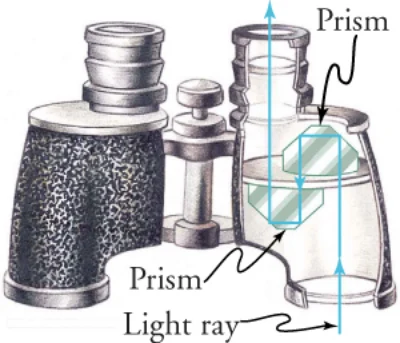
A light ray that strikes an object that consists of two mutually perpendicular reflecting surfaces is reflected back exactly parallel to the direction from which it came. This parallel reflection is true whenever the reflecting surfaces are perpendicular, and it is independent of the angle of incidence. Such an object is called a corner reflector because the light bounces from its inside corner. Many inexpensive reflector buttons on bicycles, cars, and warning signs have corner reflectors designed to return light in the direction from which it originates. Corner reflectors are perfectly efficient when the conditions for total internal reflection are satisfied. With common materials, it is easy to obtain a critical angle that is less than 45°. One use of these perfect mirrors is in binoculars, as shown in Figure 16.22. Another application is for periscopes used in submarines.
互いに垂直な二つの反射面からなる物にあたった光線は、来た向きとちょうど平行に反射し戻される。この平行な反射は、反射面が垂直でありさえすればつねに成り立ち、入射角によらない。光が内側の角ではね返るので、そうした物はコーナーリフレクターと呼ばれる。自転車・自動車・警戒標識にある安価な反射板の多くには、光を来た向きへ返すように作られたコーナーリフレクターが使われている。コーナーリフレクターは、全反射の条件が満たされるとき完全に効率よく働く。よくある材料なら、45°より小さい臨界角を得るのは簡単である。この完全な鏡の使い道の一つが、図16.22に示す双眼鏡である。もう一つの応用が潜水艦の潜望鏡である。
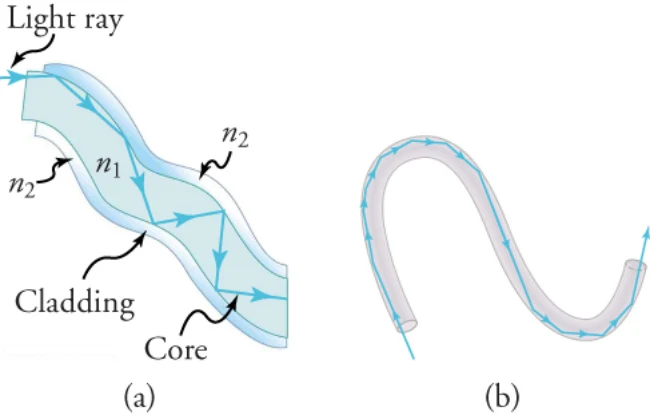
Fiber optics are one common application of total internal reflection. In communications, fiber optics are used to transmit telephone, internet, and cable TV signals, and they use the transmission of light down fibers of plastic or glass. Because the fibers are thin, light entering one is likely to strike the inside surface at an angle greater than the critical angle and, thus, be totally reflected (Figure 16.23). The index of refraction outside the fiber must be smaller than inside, a condition that is satisfied easily by coating the outside of the fiber with a material that has an appropriate refractive index. In fact, most fibers have a varying refractive index to allow more light to be guided along the fiber through total internal reflection. Rays are reflected around corners as shown in the figure, making the fibers into tiny light pipes.
光ファイバーは全反射のよくある応用の一つである。通信では、光ファイバーは電話・インターネット・ケーブルテレビの信号を送るのに使われ、プラスチックやガラスの繊維に沿って光を伝える。繊維が細いので、中に入った光は内側の面に臨界角より大きな角度であたる見込みが高く、したがって全反射される(図16.23)。繊維の外側の屈折率は内側より小さくなければならないが、この条件は、繊維の外側を適切な屈折率を持つ材料で覆えば簡単に満たせる。実のところ、ほとんどの繊維は、全反射によってより多くの光が繊維に沿って導かれるように、屈折率を変化させてある。図に示すように光線は角を曲がって反射され、繊維は小さな光の管になる。
Medicine: Endoscopes A medical device called an endoscope is shown in Figure 16.24.
医学:内視鏡 内視鏡という医療機器を図16.24に示す。
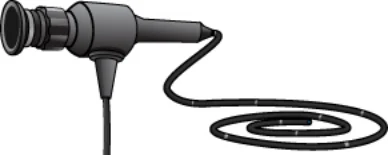
The word endoscope means looking inside. Doctors use endoscopes to look inside hollow organs in the human body and inside body cavities. These devices are used to diagnose internal physical problems. Images may be transmitted to an eyepiece or sent to a video screen. Another channel is sometimes included to allow the use of small surgical instruments. Such surgical procedures include collecting biopsies for later testing, and removing polyps and other growths.
内視鏡(endoscope)という語は「中を見る」という意味である。医師は内視鏡を使って、人体の中空の臓器の内側や体腔の中を見る。これらの機器は体内の身体的な問題の診断に使われる。像は接眼部に送られることもあれば、映像画面に送られることもある。小さな手術器具を使えるように、もう一つの通路が備えられていることもある。そうした手術には、あとで検査するための生検の採取や、ポリープなどの増殖物の除去が含まれる。
Identify the process that allows light and images to travel through a tube that is not straight.a. The process is refraction of light.b. The process is dispersion of light.
まっすぐでない管の中を光と像が通っていける過程を挙げよ。a. 光の屈折という過程。b. 光の分散という過程。
c. The process is total internal reflection of light.d. The process is polarization of light.
c. 光の全反射という過程。d. 光の偏りという過程。