第16章鏡とレンズMirrors and Lenses原書 p.495–540
Chapter Review章のまとめ
Concept Items概念の問題
16.1 Reflection 1PartA. Can you see a virtual image? PartB. Can you photograph one? Explain your answers.
16.1 反射 1A部。虚像は見えるか。B部。それを写真に撮れるか。答えを説明せよ。
a. A. yes; B. No, an image from a flat mirror cannot be photographed.b. A. no; B. Yes, an image from a flat mirror can be photographed.c. A. yes; B. Yes, an image from a flat mirror can be photographed.d. A. no; B. No, an image from a flat mirror cannot be photographed.
a. A. はい。B. いいえ、平らな鏡の像は写真に撮れない。b. A. いいえ。B. はい、平らな鏡の像は写真に撮れる。c. A. はい。B. はい、平らな鏡の像は写真に撮れる。d. A. いいえ。B. いいえ、平らな鏡の像は写真に撮れない。
2State the law of reflection.a. , where is the angle of reflection and is the angle of incidence.b. , where is the angle of reflection and is the angle of incidence.c. , where is the angle of reflection and is the angle of incidence.d. , where is the angle of reflection.
2反射の法則を述べよ。a. 。ここでは反射角、は入射角である。b. 。ここでが反射角とが入射角である。c. 。ここでが反射角とが入射角である。d. 。ここでが反射角である。
16.2 Refraction 3Does light change direction toward or away from the normal when it goes from air to water? Explain.
16.2 屈折 3光が空気から水へ入るとき、法線のほうへ曲がるか、法線から離れるほうへ曲がるか。説明せよ。
a. The light bends away from the normal because the index of refraction of water is greater than that of air.b. The light bends away from the normal because the index of refraction of air is greater than that of water.c. The light bends toward the normal
a. 水の屈折率が空気より大きいので、光は法線から離れるほうへ曲がる。b. 空気の屈折率が水より大きいので、光は法線から離れるほうへ曲がる。c. 水の屈折率が空気より大きいので、光は法線のほうへ
16.3 Lenses16.3 レンズ
power and focal length
度数と焦点距離
mirror/lens (or thin-lens) equation
鏡・レンズ(すなわち薄レンズ)の式
rearranged mirror/lens equation
変形した鏡・レンズの式
magnification equation
倍率の式
because the index of refraction of water is greater than that of air. d. The light bends toward the normal because the index of refraction of air is greater than that of water.
曲がる。 d. 空気の屈折率が水より大きいので、光は法線のほうへ曲がる。
16.3 Lenses 4An object is positioned in front of a lens with its base resting on the principal axis. Describe two rays that could be traced from the top of the object and through the lens that would locate the top of an image.
16.3 レンズ 4物を、その底が主軸の上に乗るようにレンズの前に置く。像の頂上の位置を突き止めるために、物の頂上から出てレンズを通る光線を二本挙げて述べよ。
a. A ray perpendicular to the axis and a ray through the center of the lensb. A ray parallel to the axis and a ray that does not pass through the center of the lensc. A ray parallel to the axis and a ray through the center of the lensd. A ray parallel to the axis and a ray that does not pass through the focal point
a. 軸に垂直な光線と、レンズの中心を通る光線b. 軸に平行な光線と、レンズの中心を通らない光線c. 軸に平行な光線と、レンズの中心を通る光線d. 軸に平行な光線と、焦点を通らない光線
5A person timing the moonrise looks at her watch and then at the rising moon. Describe what happened inside her eyes that allowed her to see her watch clearly one second and then see the moon clearly.
5月の出の時刻を計っている人が、腕時計を見て、それから昇る月を見る。ある瞬間には腕時計をはっきり見て、次には月をはっきり見られたのは、目の中で何が起こったからかを述べよ。
a. The shape of the lens was changed by the sclera, and thus its focal length was also changed, so that each of the images focused on the retina.b. The shape of the lens was changed by the
a. 強膜によって水晶体の形が変わり、したがって焦点距離も変わったので、それぞれの像が網膜に焦点を結んだ。b. 脈絡膜によって
choroid, and thus its focal length was also changed, so that each of the images focused on the retina.c. The shape of the lens was changed by the iris, and thus its focal length was also changed, so that each of the images focused on the retina.d. The shape of the lens was changed by the muscles, and thus its focal length was also changed, so that each of the images focused on the retina.
水晶体の形が変わり、したがって焦点距離も変わったので、それぞれの像が網膜に焦点を結んだ。c. 虹彩によって水晶体の形が変わり、したがって焦点距離も変わったので、それぞれの像が網膜に焦点を結んだ。d. 筋肉によって水晶体の形が変わり、したがって焦点距離も変わったので、それぞれの像が網膜に焦点を結んだ。
6For a concave lens, if the image distance, di, is
6凹レンズで、像までの距離diが
Critical Thinking Items批判的に考える問題
16.1 Reflection 7Why are diverging mirrors often used for rear-view mirrors in vehicles? What is the main disadvantage of using such a mirror compared with a flat one?
16.1 反射 7自動車の後写鏡に発散する鏡がよく使われるのはなぜか。平らな鏡にくらべたときのそうした鏡のおもな欠点は何か。
a. It gives a wide range of view. The image appears to be closer than the actual object.b. It gives a narrow range of view. The image appears to be farther than the actual object.c. It gives a narrow range of view. The image appears to be closer than the actual object.d. It gives a wide range of view. The image appears to be farther than the actual object.
a. 広い範囲が見える。像が実際の物より近くにあるように見える。b. 狭い範囲しか見えない。像が実際の物より遠くにあるように見える。c. 狭い範囲しか見えない。像が実際の物より近くにあるように見える。d. 広い範囲が見える。像が実際の物より遠くにあるように見える。
16.2 Refraction 8A high-quality diamond may be quite clear and colorless, transmitting all visible wavelengths with little absorption. Explain how it can sparkle with flashes of brilliant color when illuminated by white light.
16.2 屈折 8質のよいダイヤモンドはとても澄んで無色で、可視のすべての波長をほとんど吸収せずに通す。それが白い光に照らされたとき、鮮やかな色のきらめきを放ちうる理由を説明せよ。
a. Diamond and air have a small difference in their refractive indices that results in a very small critical angle. The light that enters a diamond may exit at only a few points, and these points sparkle because many rays have been directed toward them.b. Diamond and air have a small difference in their refractive indices that results in a very large critical angle. The light that enters a diamond may exit at only a few points, and these points sparkle because many rays have been directed toward them.
a. ダイヤモンドと空気は屈折率の差が小さく、その結果、臨界角がとても小さくなる。ダイヤモンドに入った光は数少ない点からしか出られず、多くの光線がそこへ向かうので、その点がきらめく。b. ダイヤモンドと空気は屈折率の差が小さく、その結果、臨界角がとても大きくなる。ダイヤモンドに入った光は数少ない点からしか出られず、多くの光線がそこへ向かうので、その点がきらめく。
negative, where does the image appear to be with respect to the object?
負のとき、像は物に対してどこにあるように見えるか。
a. The image always appears on the same side of the lens.b. The image appears on the opposite side of the lens.c. The image appears on the opposite side of the lens only if the object distance is greater than the focal length.d. The image appears on the same side of the lens only if the object distance is less than the focal length.
a. 像はつねにレンズの同じ側に見える。b. 像はレンズの反対側に見える。c. 物までの距離が焦点距離より大きいときだけ、像はレンズの反対側に見える。d. 物までの距離が焦点距離より小さいときだけ、像はレンズの同じ側に見える。
c. Diamond has a high index of refraction with respect to air, which results in a very small critical angle. The light that enters a diamond may exit at only a few points, and these points sparkle because many rays have been directed toward them.d. Diamond has a high index of refraction with respect to air, which results in a very large critical angle. The light that enters a diamond may exit at only a few points, and these points sparkle because many rays have been directed toward them.
c. ダイヤモンドは空気に対して屈折率が大きく、その結果、臨界角がとても小さくなる。ダイヤモンドに入った光は数少ない点からしか出られず、多くの光線がそこへ向かうので、その点がきらめく。d. ダイヤモンドは空気に対して屈折率が大きく、その結果、臨界角がとても大きくなる。ダイヤモンドに入った光は数少ない点からしか出られず、多くの光線がそこへ向かうので、その点がきらめく。
9The most common type of mirage is an illusion in which light from far-away objects is reflected by a pool of water that is not really there. Mirages are generally observed in deserts, where there is a hot layer of air near the ground. Given that the refractive index of air is less for air at higher temperatures, explain how mirages can be formed.
9最もよくある型の蜃気楼は、遠くの物からの光が、実際にはそこにない水たまりに反射されて見える錯覚である。蜃気楼はふつう、地面の近くに熱い空気の層がある砂漠で見られる。空気の屈折率は温度が高いほど小さいことをふまえて、蜃気楼がどうしてできるかを説明せよ。
a. The hot layer of air near the ground is lighter than the cooler air above it, but the difference in refractive index is small, which results in a large critical angle. The light rays coming from the horizon strike the hot air at large angles, so they are reflected as they would be from water.b. The hot layer of air near the ground is lighter than the cooler air above it, and the difference in refractive index is large, which results in a large critical angle. The light rays coming from the horizon strike the hot air at large angles, so they are reflected as they would be from water.c. The hot layer of air near the ground is lighter than the cooler air above it, but the difference in refractive index is small,
a. 地面の近くの熱い空気の層は、その上の冷たい空気より軽いが、屈折率の差は小さく、その結果、臨界角が大きくなる。地平線から来る光線は大きな角度で熱い空気にあたるので、水面から反射するのと同じように反射する。b. 地面の近くの熱い空気の層は、その上の冷たい空気より軽く、屈折率の差は大きく、その結果、臨界角が大きくなる。地平線から来る光線は大きな角度で熱い空気にあたるので、水面から反射するのと同じように反射する。c. 地面の近くの熱い空気の層は、その上の冷たい空気より軽いが、屈折率の差は小さく、
which results in a small critical angle. The light rays coming from the horizon strike the hot air at large angles, so they are reflected as they would be from water. d. The hot layer of air near the ground is lighter than the cooler air above it, and the difference in the refractive index is large, which results in a small critical angle. The light rays coming from the horizontal strike the hot air at large angles, so they are reflected as they would be from water.
その結果、臨界角が小さくなる。地平線から来る光線は大きな角度で熱い空気にあたるので、水面から反射するのと同じように反射する。 d. 地面の近くの熱い空気の層は、その上の冷たい空気より軽く、屈折率の差は大きく、その結果、臨界角が小さくなる。水平から来る光線は大きな角度で熱い空気にあたるので、水面から反射するのと同じように反射する。
16.3 Lenses 10When you focus a camera, you adjust the distance of the lens from the film. If the camera lens acts like a thin lens, why can it not be kept at a fixed distance from the film for both near and distant objects?
16.3 レンズ 10カメラの焦点を合わせるとき、レンズとフィルムの距離を調節する。カメラのレンズが薄レンズとしてはたらくなら、近くの物にも遠くの物にも、フィルムから決まった距離に保ったままではいられないのはなぜか。
a. To focus on a distant object, you need to increase the image distance.b. To focus on a distant object, you need to increase the focal length of the lens.c. To focus on a distant object, you need to decrease the focal length of the lens.d. To focus on a distant object, you may need to increase or decrease the focal length of the lens.
a. 遠くの物に焦点を合わせるには、像までの距離を大きくする必要があるから。b. 遠くの物に焦点を合わせるには、レンズの焦点距離を大きくする必要があるから。c. 遠くの物に焦点を合わせるには、レンズの焦点距離を小さくする必要があるから。d. 遠くの物に焦点を合わせるには、レンズの焦点距離を大きくする必要も小さくする必要もありうるから。
11Part A—How do the refractive indices of the cornea, aqueous humor, and the lens of the eye compare with the refractive index of air?
11A部——角膜、房水、目の水晶体の屈折率は、空気の屈折率とくらべてどうか。
Problems問題
16.1 Reflection 12Some telephoto cameras use a mirror rather than a lens. What radius of curvature is needed for a concave mirror to replace a 0.800 -m focal-length telephoto lens?
16.1 反射 12望遠カメラの中にはレンズでなく鏡を使うものがある。焦点距離0.800 mの望遠レンズを凹面鏡で置き換えるには、どんな曲率半径が必要か。
a. 0.400 mb. 1.60 m
a. 0.400 mb. 1.60 m
c. 4.00 md. 16.0 m
c. 4.00 md. 16.0 m
13What is the focal length of a makeup mirror that produces a magnification of 2.00 when a person’s face is 8.00 cm away?
13顔を8.00 cm離したときに2.00の倍率を作る化粧鏡の焦点距離はいくらか。
a. –16 cmb. –5.3 cmc. 5.3 cmd. 16 cm
a. −16 cmb. −5.3 cmc. 5.3 cmd. 16 cm
16.2 Refraction 14An optical fiber uses flint glass (n = 1.66) clad
16.2 屈折 14ある光ファイバーは、フリントガラス(n = 1.66)を
Part B—How do the comparisons in part A explain how images are focused on the retina?a. (A) The cornea, aqueous humor, and lens of the eye have smaller refractive indices than air. (B) Rays entering the eye are refracted away from the central axis, which causes them to meet at the focal point on the retina.b. (A) The cornea, aqueous humor, and lens of the eye have greater refractive indices than air. (B) Rays entering the eye are refracted away from the central axis, which causes them to meet at the focal point on the retina.c. (A) The cornea, aqueous humor, and lens of the eye have smaller refractive indices than air. (B) Rays entering the eye are refracted toward the central axis, which causes them to meet at the focal point on the retina.d. (A) The cornea, aqueous humor, and lens of the eye have greater refractive indices than air. (B) Rays entering the eye are refracted toward the central axis, which causes them to meet at the focal point on the retina.
B部——A部の比較は、像が網膜に焦点を結ぶことをどう説明するか。a. (A)角膜、房水、目の水晶体は空気より屈折率が小さい。(B)目に入る光線は中心軸から離れるほうへ屈折し、それによって網膜の焦点で交わる。b. (A)角膜、房水、目の水晶体は空気より屈折率が大きい。(B)目に入る光線は中心軸から離れるほうへ屈折し、それによって網膜の焦点で交わる。c. (A)角膜、房水、目の水晶体は空気より屈折率が小さい。(B)目に入る光線は中心軸のほうへ屈折し、それによって網膜の焦点で交わる。d. (A)角膜、房水、目の水晶体は空気より屈折率が大きい。(B)目に入る光線は中心軸のほうへ屈折し、それによって網膜の焦点で交わる。
with crown glass (n = 1.52) . What is the critical angle?
クラウンガラス(n = 1.52)で覆っている。臨界角はいくらか。
a. 33.2°b. 23.7°
a. 33.2°b. 23.7°
c. 0.92 radd. 1.16 rad
c. 0.92 radd. 1.16 rad
15Suppose this figure represents a ray of light going from air (n = 1.0003) through crown glass (n = 1.52) into water, similar to a beam of light going into a fish tank.
15この図が、水槽に入っていく光の束と同じように、空気(n = 1.0003)からクラウンガラス(n = 1.52)を通って水へ進む光線を表しているとする。
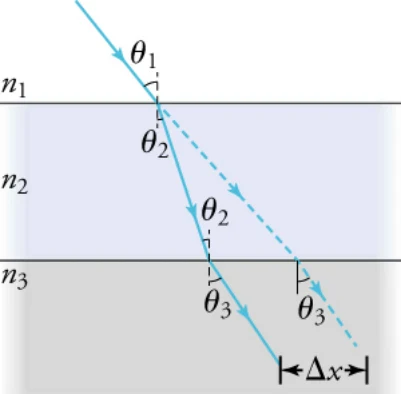
Calculate the amount the ray is displaced by the glass (Δx), given that the incident angle is 40.0° and the glass is 1.00 cm thick.
入射角が40.0°、ガラスの厚さが1.00 cmのとき、光線がガラスによってずらされる量(Δx)を計算せよ。
a. 0.839 cmb. 0.619 cmc. 0.466 cmd. 0.373 cm
a. 0.839 cmb. 0.619 cmc. 0.466 cmd. 0.373 cm
16.3 Lenses 16A camera’s zoom lens has an adjustable focal length ranging from 80.0 to 200 mm . What is its range of powers?
16.3 レンズ 16あるカメラのズームレンズは焦点距離を80.0から200 mmまで調節できる。その度数の範囲はいくらか。
a. The lowest power is 0.05 D and the
a. 最小の度数は0.05 D、
Performance Task実践課題
16.3 Lenses 18In this performance task, you will investigate the lens-like properties of a clear bottle.
16.3 レンズ 18この実践課題では、透明なボトルのレンズのような性質を調べる。
• a water bottle or glass with a round cross-section and smooth, vertical sides• enough water to fill the bottle• a meter stick or tape measure• a bright light source with a small bulb, such as a pen light• a small bright object, such as a silver spoon.
・断面が丸く、側面がなめらかで垂直な水のボトルかグラス・ボトルを満たすだけの水・メートル定規か巻き尺・ペンライトのような、小さな電球のついた明るい光源・銀のスプーンのような、小さくて明るい物
Instructions Procedure
手引き 手順
1Look through a clear glass or plastic bottle
1透明なガラスかプラスチックのボトルを通して見て、