第14章音Sound原書 p.431–472
Test Prep実力テスト
Multiple Choice選択問題
14.1 Speed of Sound, Frequency, and Wavelength 34What properties does a loud, shrill whistle have?a. high amplitude, high frequencyb. high amplitude, low frequency
14.1 音の速さ、振動数、波長 34大きく甲高い笛の音はどんな性質を持つか。a. 大きな振幅、高い振動数b. 大きな振幅、低い振動数
c. low amplitude, high frequencyd. low amplitude, low frequency
c. 小さな振幅、高い振動数d. 小さな振幅、低い振動数
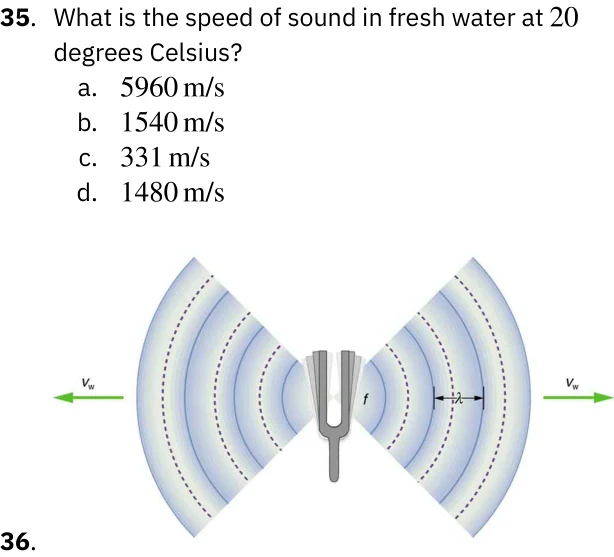
A tuning fork oscillates at a frequency of 512 Hz. If sound is traveling at 345 m/s, how many wave peaks will reach the eardrum of a person sitting near that fork in 2 seconds?
音叉が512 Hzの振動数で振動している。音が345 m/sで進むとき、その音叉の近くに座っている人の鼓膜には、2秒間に何個の波の峰が届くか。
a. About 225.b. About 450.
a. およそ225個b. およそ450個
32An open-pipe resonator has a fundamental frequency of . By how much would its length have to be changed to get a fundamental frequency of ? (Assume the speed of sound is .)a. b.
32ある開管の共鳴体の基本振動数がである。基本振動数をにするには、その長さをどれだけ変えねばならないか。(音の速さはとする。)a. b.
pipe. Calculate the length required for a certain frequency to resonate and then mark the locations where holes should be placed in the pipe to achieve their desired pitches. Use a simple hand drill or ask your wood shop department for help drilling holes. Use tuning forks to test and calibrate your instrument. Demonstrate your pipe for the class.
一本選ぶ。ある振動数が共鳴するのに必要な長さを計算し、望みの音の高さを出すために管のどこに孔をあけるべきかに印をつける。簡単な手回しドリルを使うか、木工室に頼んで孔をあけてもらう。音叉を使って楽器を試し、較正する。作った管をクラスで実演せよ。
c. Slightly over 500.d. Slightly over 1,000.
c. 500個を少し超えるd. 1,000個を少し超える
37Why does the amplitude of a sound wave decrease with distance from its source?
37音波の振幅が源からの距離とともに小さくなるのはなぜか。
a. The amplitude of a sound wave decreases with distance from its source, because the frequency of the sound wave decreases.b. The amplitude of a sound wave decreases with distance from its source, because the speed of the sound wave decreases.c. The amplitude of a sound wave decreases with distance from its source, because the wavelength of the sound wave increases.d. The amplitude of a sound wave decreases with distance from its source, because the energy of the wave is spread over a larger and larger area.
a. 音波の振動数が下がるから、音波の振幅は源からの距離とともに小さくなる。b. 音波の速さが下がるから、音波の振幅は源からの距離とともに小さくなる。c. 音波の波長が長くなるから、音波の振幅は源からの距離とともに小さくなる。d. 波のエネルギーがどんどん広い面積に広がるから、音波の振幅は源からの距離とともに小さくなる。
38Does the elasticity of the medium affect the speed of sound? If so, how?
38媒質の弾性は音の速さに影響するか。するとすればどう影響するか。
a. No, there is no relationship that exists between the speed of sound and elasticity of the medium.b. Yes. When particles are more easily compressed in a medium, sound does not travel as quickly through the medium.c. Yes. When the particles in a medium do not compress much, sound does not travel as quickly through the medium.
a. いいえ。音の速さと媒質の弾性の間に関係はない。b. はい。媒質の中で粒子がより簡単に圧縮されるとき、音はその媒質の中をあまり速く進まない。c. はい。媒質の中で粒子があまり圧縮されないとき、音はその媒質の中をあまり速く進まない。
d. No, the elasticity of a medium affects frequency and wavelength, not wave speed.
d. いいえ。媒質の弾性は振動数と波長に影響するのであって、波の速さには影響しない。
14.2 Sound Intensity and Sound Level 39Which of the following terms is a useful quantity to describe the loudness of a sound?
14.2 音の強さと音の大きさのレベル 39音の大きさを述べるのに役立つ量は次のどれか。
a. intensityb. frequency
a. 強さb. 振動数
c. pitchd. wavelength
c. 音の高さd. 波長
40What is the unit of sound intensity level?a. decibelsb. hertz
40音の強さのレベルの単位は何か。a. デシベルb. ヘルツ
c. watts
c. ワット
41If a particular sound S1 is times more intense than another sound S2, then what is the difference in sound intensity levels in dB for these two sounds?
41ある音S1が別の音S2の倍の強さを持つとき、この二つの音の音の強さのレベルの差はdBでいくらか。
42By what minimum amount should frequencies vary for humans to be able to distinguish two separate sounds?
42人が二つの音を別々に聞き分けられるためには、振動数が最低どれだけ違えばよいか。
43Why is I0 chosen as the reference for sound intensity?
43音の強さの基準にI0が選ばれているのはなぜか。
a. Because, it is the highest intensity of sound a person with normal hearing can perceive at a frequency of 100 Hz.b. Because, it is the lowest intensity of sound a person with normal hearing can perceive at a frequency of 100 Hz.c. Because, it is the highest intensity of sound a person with normal hearing can perceive at a frequency of 1000 Hz.d. Because, it is the lowest intensity of sound a person with normal hearing can perceive at a frequency of 1000 Hz.
a. 正常な聴覚を持つ人が振動数100 Hzで感じ取れる最も大きい音の強さだから。b. 正常な聴覚を持つ人が振動数100 Hzで感じ取れる最も小さい音の強さだから。c. 正常な聴覚を持つ人が振動数1000 Hzで感じ取れる最も大きい音の強さだから。d. 正常な聴覚を持つ人が振動数1000 Hzで感じ取れる最も小さい音の強さだから。
14.3 Doppler Effect and Sonic Booms 44In which of the following situations is the Doppler effect absent?
14.3 ドップラー効果とソニックブーム 44次のうち、ドップラー効果が起こらないのはどの場合か。
a. The source and the observer are moving towards each other.
a. 源と観測者が互いに近づいている。
b. The observer is moving toward the source.c. The source is moving away from the observer.d. Neither the source nor the observer is moving relative to one another.
b. 観測者が源へ向かって動いている。c. 源が観測者から遠ざかっている。d. 源も観測者も互いに対して動いていない。
45What does the occurrence of the sonic boom depend on?
45ソニックブームが起こるかどうかは何によって決まるか。
a. speed of the sourceb. frequency of source
a. 源の速さb. 源の振動数
c. amplitude of sourced. distance of observer from the source
c. 源の振幅d. 観測者と源の距離
46What is the observed frequency when the observer is moving away from the source at
46観測者が源から遠ざかる速さが
? The source frequency is and the speed of sound is .a. b.
のとき、観測される振動数はいくらか。源の振動数は、音の速さはである。a. b.
47How will your perceived frequency change if the source is moving towards you?
47源があなたへ向かって動いているとき、あなたが感じ取る振動数はどう変わるか。
a. The frequency will become lower.b. The frequency will become higher.
a. 振動数は低くなる。b. 振動数は高くなる。
14.4 Sound Interference and Resonance 48Observation of which phenomenon can be considered proof that something is a wave?a. interferenceb. noise
14.4 音の干渉と共鳴 48何かが波であることの証拠とみなせるのは、どの現象の観測か。a. 干渉b. 騒音
c. reflectiond. conduction
c. 反射d. 伝導
49Which of the resonant frequencies has the greatest amplitude?
49共鳴の振動数のうち、振幅が最も大きいのはどれか。
a. The first harmonicb. The second harmonicc. The first overtoned. The second overtone
a. 第一倍音b. 第二倍音c. 第一上音d. 第二上音
50What is the fundamental frequency of an open-pipe resonator?
50開管の共鳴体の基本振動数はどれか。
51What is the beat frequency produced by the superposition of two waves with frequencies and ?
51振動数との二つの波の重ね合わせが生むうなりの振動数はいくらか。
Short Answer記述式
14.1 Speed of Sound, Frequency, and Wavelength 52What component of a longitudinal sound wave is analogous to a trough of a transverse wave?
14.1 音の速さ、振動数、波長 52縦の音波のどの部分が、横波の谷にあたるか。
a. compressionb. rarefaction
a. 密b. 疎
c. noded. antinode
c. 節d. 腹
53What is the frequency of a sound wave as perceived by the human ear?
53人の耳が感じ取る音波の振動数は何か。
a. timbreb. loudnessc. intensityd. pitch
a. 音色b. 音の大きさc. 強さd. 音の高さ
54What properties of a solid determine the speed of sound traveling through it?
54固体のどの性質が、その中を進む音の速さを決めるか。
a. mass and densityb. rigidity and densityc. volume and densityd. shape and rigidity
a. 質量と密度b. 硬さと密度c. 体積と密度d. 形と硬さ
55Does the density of a medium affect the speed of sound?
55媒質の密度は音の速さに影響するか。
a. Nob. Yes
a. いいえb. はい
56Does a bat make use of the properties of sound waves to locate its prey?
56コウモリは獲物の位置を突き止めるのに音波の性質を利用しているか。
a. Nob. Yes
a. いいえb. はい
57Do the properties of a sound wave change when it travels from one medium to another?
57音波がある媒質から別の媒質へ進むとき、その性質は変わるか。
a. Nob. Yes
a. いいえb. はい
14.2 Sound Intensity and Sound Level 58When a passing driver has his stereo turned up, you cannot even hear what the person next to you is saying. Why is this so?
14.2 音の強さと音の大きさのレベル 58通りかかった運転者がステレオの音量を上げていると、隣の人が何を言っているかさえ聞こえない。それはなぜか。
a. The sound from the passing car’s stereo has a higher amplitude and hence higher intensity compared to the intensity of the sound coming from the person next to you. The higher intensity corresponds to greater loudness, so the first sound
a. 通り過ぎる車のステレオからの音は、隣の人から来る音の強さにくらべて振幅が大きく、したがって強さも大きい。強さが大きいほど音は大きく聞こえるので、前者が後者を
dominates the second.b. The sound from the passing car’s stereo has a higher amplitude and hence lower intensity compared to the intensity of the sound coming from the person next to you. The lower intensity corresponds to greater loudness, so the first sound dominates the second.c. The sound from the passing car’s stereo has a higher frequency and hence higher intensity compared to the intensity of the sound coming from the person next to you. The higher frequency corresponds to greater loudness so the first sound dominates the second.d. The sound from the passing car’s stereo has a lower frequency and hence higher intensity compared to the intensity of the sound coming from the person next to you. The lower frequency corresponds to greater loudness, so the first sound dominates the second.
かき消す。b. 通り過ぎる車のステレオからの音は、隣の人から来る音の強さにくらべて振幅が大きく、したがって強さは小さい。強さが小さいほど音は大きく聞こえるので、前者が後者をかき消す。c. 通り過ぎる車のステレオからの音は、隣の人から来る音の強さにくらべて振動数が高く、したがって強さも大きい。振動数が高いほど音は大きく聞こえるので、前者が後者をかき消す。d. 通り過ぎる車のステレオからの音は、隣の人から来る音の強さにくらべて振動数が低く、したがって強さは大きい。振動数が低いほど音は大きく聞こえるので、前者が後者をかき消す。
59For a constant area, what is the relationship between intensity of a sound wave and power?a. The intensity is inversely proportional to the power transmitted by the wave, for a constant area.b. The intensity is inversely proportional to the square of the power transmitted by the wave, for a constant area.
59面積が一定のとき、音波の強さと仕事率の関係はどうなっているか。a. 面積が一定のとき、強さは波が伝える仕事率に反比例する。b. 面積が一定のとき、強さは波が伝える仕事率の2乗に反比例する。
c. The intensity is directly proportional to the square of the power transmitted by the wave, for a constant area. d. The intensity is directly proportional to the power transmitted by the wave, for a constant area.
c. 面積が一定のとき、強さは波が伝える仕事率の2乗に正比例する。d. 面積が一定のとき、強さは波が伝える仕事率に正比例する。
60What does stand for in the equation
60次の式では何を表すか。
a. Yes, is the sound intensity in watts per meter squared in the equation,
a. はい。次の式では平方メートルあたりのワットで表した音の強さである。
b. is the sound illuminance and its unit is lumen per meter squared.c. is the sound intensity and its unit is
b. は音の照度であり、その単位は平方メートルあたりのルーメンである。c. は音の強さであり、その単位は
watts per meter cubed. d. is the sound intensity and its unit is watts per meter squared.
立方メートルあたりのワットである。 d. は音の強さであり、その単位は平方メートルあたりのワットである。
61Why is the reference intensity ?
61基準の強さがこの値なのはなぜか。
a. The upper limit of human hearing is decibels, i.e. . For , .b. The lower threshold of human hearing is decibels, i.e. . For , c. The upper limit of human hearing is decibels, i.e. . For ,
a. 人の聞こえる上限がデシベル、すなわちだから。のとき。b. 人の聞こえる下限がデシベル、すなわちだから。のときc. 人の聞こえる上限がデシベル、すなわちだから。のとき、
d. The lower threshold of human hearing is decibels, i.e., . For ,
d. 人の聞こえる下限がデシベル、すなわちだから。のとき、
62Given that the sound intensity level of a particular wave is , what will be the sound intensity for that wave?
62ある波の音の強さのレベルがであるとき、その波の音の強さはいくらか。
63For a sound wave with intensity , calculate the pressure amplitude given that the sound travels through air at .a. b.
63強さの音波について、音がの空気中を進むとして、圧力振幅を計算せよ。a. b.
64Which nerve carries auditory information to the brain?
64聴覚の情報を脳へ運ぶ神経はどれか。
a. buccal nerveb. peroneal nerve
a. 頬神経b. 腓骨神経
c. cochlear nerved. mandibular nerve
c. 蝸牛神経d. 下顎神経
65Why do some smaller instruments, such as piccolos, produce higher-pitched sounds than larger instruments, such as tubas?
65ピッコロのような小さな楽器が、チューバのような大きな楽器より高い音を出すのはなぜか。
a. Smaller instruments produce sounds with shorter wavelengths, and thus higher frequencies.b. Smaller instruments produce longer wavelength, and thus higher amplitude, sounds.
a. 小さな楽器は波長の短い、したがって振動数の高い音を出すから。b. 小さな楽器は波長の長い、したがって振幅の大きい音を出すから。
c. Smaller instruments produce lower amplitude, and thus longer wavelength sounds.d. Smaller instruments produce higher amplitude, and thus lower frequency, sounds.
c. 小さな楽器は振幅の小さい、したがって波長の長い音を出すから。d. 小さな楽器は振幅の大きい、したがって振動数の低い音を出すから。
14.3 Doppler Effect and Sonic Booms 66How will your perceived frequency change if you move away from a stationary source of sound?
14.3 ドップラー効果とソニックブーム 66止まっている音源から遠ざかるとき、あなたが感じ取る振動数はどう変わるか。
a. The frequency will become lower.b. The frequency will be doubled.
a. 振動数は低くなる。b. 振動数は2倍になる。
c. The frequency will be tripled.d. The frequency will become higher.
c. 振動数は3倍になる。d. 振動数は高くなる。
67True or false—The Doppler effect also occurs with waves other than sound waves.
67正誤問題——ドップラー効果は音波以外の波でも起こる。
a. Falseb. True
a. 誤b. 正
68A source of sound is moving towards you. How will what you hear change if the speed of the source increases?
68音源があなたへ向かって動いている。源の速さが増すと、聞こえ方はどう変わるか。
a. The sound will become more high-pitched.b. The sound will become more low-pitched.c. The pitch of the sound will not change.
a. 音はより高くなる。b. 音はより低くなる。c. 音の高さは変わらない。
69Do sonic booms continue to be created when an object is traveling at supersonic speeds?
69物が超音速で進んでいるあいだ、ソニックブームは作られ続けるか。
a. No, a sonic boom is created only when the source exceeds the speed of sound.b. Yes, sonic booms continue to be created when an object is traveling at supersonic speeds.
a. いいえ。ソニックブームは源が音の速さを超えるときにだけ作られる。b. はい。物が超音速で進んでいるあいだ、ソニックブームは作られ続ける。
70Suppose you are driving at a speed of and you hear the sound of a bell at a frequency of . What is the actual frequency of the bell if the speed of sound is ?a. b.
70速さで車を運転していて、鐘の音が振動数で聞こえるとする。音の速さがのとき、鐘の実際の振動数はいくらか。a. b.
71What is the frequency of a stationary sound source if you hear it at 1200.0 Hz while moving towards it at a speed of 50.0 m/s? (Assume speed of sound to be 331 m/s.)
71止まっている音源へ向かって50.0 m/sの速さで動きながら、その音を1200.0 Hzで聞くとき、その音源の振動数はいくらか。(音の速さは331 m/sとする。)
a. 1410 Hzb. 1380 Hzc. 1020 Hzd. 1042 Hz
a. 1410 Hzb. 1380 Hzc. 1020 Hzd. 1042 Hz
14.4 Sound Interference and Resonance 72What is the actual frequency of the wave produced as a result of superposition of two waves?
14.4 音の干渉と共鳴 72二つの波の重ね合わせでできた波の実際の振動数は何か。
a. It is the average of the frequencies of the two original waves that were superimposed.b. It is the difference between the frequencies of the two original waves that were superimposed.c. It is the product of the frequencies of the two original waves that were superimposed.d. It is the sum of the frequencies of the two original waves that were superimposed.
a. 重ね合わされたもとの二つの波の振動数の平均である。b. 重ね合わされたもとの二つの波の振動数の差である。c. 重ね合わされたもとの二つの波の振動数の積である。d. 重ね合わされたもとの二つの波の振動数の和である。
73Can beats be produced through a phenomenon different from resonance? How?
73共鳴とは違う現象でうなりを作れるか。どうやってか。
a. No, beats can be produced only by resonance.b. Yes, beats can be produced by superimposition of any two waves having slightly different frequencies.
a. いいえ。うなりは共鳴でしか作れない。b. はい。うなりは、振動数がわずかに違うどんな二つの波の重ね合わせでも作れる。
74How is human speech produced?a. Human speech is produced by shaping the cavity formed by the throat and mouth, the vibration of vocal cords, and using the tongue to adjust the fundamental frequency and combination of overtones.b. Human speech is produced by shaping the cavity formed by the throat and mouth into a closed pipe and using tongue to adjust the fundamental frequency and combination of overtones.c. Human speech is produced only by the vibrations of the tongue.d. Human speech is produced by elongating the vocal cords.
74人の話し言葉はどうやって作られるか。a. 人の話し言葉は、のどと口が作る空洞の形、声帯の振動、そして舌で基本振動数と上音の組み合わせを調整することによって作られる。b. 人の話し言葉は、のどと口が作る空洞を閉じた管の形にし、舌で基本振動数と上音の組み合わせを調整することによって作られる。c. 人の話し言葉は舌の振動だけで作られる。d. 人の話し言葉は声帯を伸ばすことで作られる。
75What is the possible number of nodes and antinodes along one full wavelength of a
75定常波の一波長のあいだにありうる節と腹の
Extended Response論述式
14.1 Speed of Sound, Frequency, and Wavelength 80. How is a human able to hear sounds?a. Sound waves cause the eardrum to vibrate. A complicated mechanism converts the vibrations to nerve impulses, which are perceived by the person as sound.
14.1 音の速さ、振動数、波長 80. 人はどうやって音を聞けるのか。a. 音波が鼓膜を振動させる。込み入った仕組みがその振動を神経の信号へ変え、それが音として感じ取られる。
standing wave?
数はいくつか。
a. nodes and antinodes or antinodes and nodes.b. nodes and antinodes or antinodes and nodes.c. nodes and antinodes or antinodes and nodes.d. nodes and antinodes or antinodes and nodes.
a. 個の節と個の腹、あるいは個の腹と個の節。b. 個の節と個の腹、あるいは個の腹と個の節。c. 個の節と個の腹、あるいは個の腹と個の節。d. 個の節と個の腹、あるいは個の腹と個の節。
76In a pipe resonator, which frequency will be the least intense of those given below?
76管の共鳴体で、次のうち最も弱い振動数はどれか。
a. second overtone frequencyb. first overtone frequency
a. 第二上音の振動数b. 第一上音の振動数
c. fundamental frequencyd. third overtone frequency
c. 基本振動数d. 第三上音の振動数
77A flute is an open-pipe resonator. If a flute is long, what is the longest wavelength it can produce?
77フルートは開管の共鳴体である。フルートの長さがのとき、出せる最も長い波長はいくらか。
78What is the frequency of the second overtone of a closed-pipe resonator with a length of ? (Assume the speed of sound is .)a. b.
78長さの閉管の共鳴体の第二上音の振動数はいくらか。(音の速さはとする。)a. b.
79An open-pipe resonator has a fundamental frequency of when the speed of sound is . What will its fundamental frequency be when the speed of sound is ?a. b.
79ある開管の共鳴体は、音の速さがのとき基本振動数がである。音の速さがのとき、その基本振動数はいくらになるか。a. b.
b. Sound waves cause the ear canal to vibrate. A complicated mechanism converts the vibrations to nerve impulses, which are perceived by the person as sound.c. Sound waves transfer electrical impulses to the eardrum. A complicated mechanism converts the electrical impulses to sound.
b. 音波が外耳道を振動させる。込み入った仕組みがその振動を神経の信号へ変え、それが音として感じ取られる。c. 音波が電気の信号を鼓膜へ移す。込み入った仕組みが電気の信号を音へ変える。
d. Sound waves transfer mechanical vibrations to the ear canal, and the eardrum converts them to electrical impulses.
d. 音波が機械的な振動を外耳道へ移し、鼓膜がそれを電気の信号へ変える。
81Why does sound travel faster in iron than in air even though iron is denser than air?
81鉄は空気より密度が大きいのに、音が空気中より鉄の中を速く進むのはなぜか。
a. The density of iron is greater than that of air. However, the rigidity of iron is much greater than that of air. Hence, sound travels faster in it.b. The density of iron is greater than that of air. However, the rigidity of iron is much less than that of air. Hence, sound travels faster in it.c. The density of iron is greater than that of air. However, the rigidity of iron is equal to that of air. Hence, sound travels faster in it.d. The mass of iron is much less than that of air and the rigidity of iron is much greater than that of air. Hence, sound travels faster in it.
a. 鉄の密度は空気より大きい。しかし鉄の硬さは空気よりはるかに大きい。だから音は鉄の中をより速く進む。b. 鉄の密度は空気より大きい。しかし鉄の硬さは空気よりはるかに小さい。だから音は鉄の中をより速く進む。c. 鉄の密度は空気より大きい。しかし鉄の硬さは空気と等しい。だから音は鉄の中をより速く進む。d. 鉄の質量は空気よりはるかに小さく、鉄の硬さは空気よりはるかに大きい。だから音は鉄の中をより速く進む。
82Is the speed of sound dependent on its frequency?
82音の速さはその振動数によるか。
a. Nob. Yes
a. いいえb. はい
14.2 Sound Intensity and Sound Level 83Why is the sound from a tire burst louder than that from a finger snap?
14.2 音の強さと音の大きさのレベル 83タイヤの破裂音が指を鳴らす音より大きいのはなぜか。
a. The sound from the tire burst has higher pressure amplitudes, hence it can exert smaller force on the eardrum.b. The sound from the tire burst has lower pressure amplitudes, hence it can exert smaller force on the eardrum.c. The sound from the tire burst has lower pressure amplitudes, hence it can exert larger force on the ear drum.d. The sound from the tire burst has higher pressure amplitudes, hence it can exert larger force on the eardrum.
a. タイヤの破裂音は圧力振幅が大きく、したがって鼓膜により小さな力を及ぼせるから。b. タイヤの破裂音は圧力振幅が小さく、したがって鼓膜により小さな力を及ぼせるから。c. タイヤの破裂音は圧力振幅が小さく、したがって鼓膜により大きな力を及ぼせるから。d. タイヤの破裂音は圧力振幅が大きく、したがって鼓膜により大きな力を及ぼせるから。
84Sound A is times more intense than Sound B. What will be the difference in decibels in their sound intensity levels?
84音Aは音Bの倍の強さである。両者の音の強さのレベルの差はデシベルでいくらか。
85The ratio of the pressure amplitudes of two sound waves traveling through water at is . What will be the difference in their sound intensity levels in dB?
85二つの音波が水の中を進むとき、その圧力振幅の比は、の水の中でである。両者の音の強さのレベルの差はdBでいくらか。
86Which of the following most closely models how sound is produced by the vocal cords?
86声帯が音を作るしかたに最も近いのは次のどれか。
a. A person plucks a string.b. A person blows over the mouth of a half-filled glass bottle.c. A person strikes a hammer against a hard surface.d. A person blows through a small slit in a wide, stretched rubber band.
a. 人が弦をはじく。b. 人が半分水の入ったガラス瓶の口に息を吹きかける。c. 人が硬い面をハンマーで打つ。d. 人が幅の広い、張った輪ゴムの細いすきまに息を吹き込む。
14.3 Doppler Effect and Sonic Booms 87True or false—The Doppler effect occurs only when the sound source is moving.
14.3 ドップラー効果とソニックブーム 87正誤問題——ドップラー効果は音源が動いているときにだけ起こる。
a. Falseb. True
a. 誤b. 正
88True or false—The observed frequency becomes infinite when the source is moving at the speed of sound.
88正誤問題——源が音の速さで動いているとき、観測される振動数は無限大になる。
a. Falseb. True
a. 誤b. 正
89You are driving alongside a train. You hear its horn at a pitch that is lower than the actual frequency. What should you do to match the speed of the train? Why?
89列車と並んで車を走らせている。その警笛が実際の振動数より低い音で聞こえる。列車と速さを合わせるにはどうすればよいか。それはなぜか。
a. In order to match the speed of the train, one would need to increase or decrease the speed of his/her car because a lower pitch means that either the train (the source) is moving away or that you (the observer) are moving away.b. In order to match the speed of the train, one would need to drive at a constant speed because a lower pitch means that the train and the car are at the same speed.
a. 列車と速さを合わせるには、車の速さを上げるか下げるかしなければならない。音が低いということは、列車(源)が遠ざかっているか、こちら(観測者)が遠ざかっているかのどちらかだから。b. 列車と速さを合わせるには、一定の速さで走ればよい。音が低いということは、列車と車が同じ速さだということだから。
14.4 Sound Interference and Resonance 90How are the beat frequency and the regular frequency of a wave resulting from superposition of two waves different?
14.4 音の干渉と共鳴 90二つの波の重ね合わせでできた波の、うなりの振動数とふつうの振動数はどう違うか。
a. Beat frequency is the sum of two frequencies and regular frequency is the
a. うなりの振動数は二つの振動数の和であり、ふつうの振動数はもとの二つの波の振動数の
difference between frequencies of two original waves.b. Beat frequency is the difference between the constituent frequencies, but the regular frequency is the average of the frequencies of the two original waves.c. Beat frequency is the sum of two frequencies and regular frequency is the average of frequencies of two original waves.d. Beat frequency is the average of frequencies of two original waves and regular frequency is the sum of two original frequencies.
差である。b. うなりの振動数は成分の振動数の差であり、ふつうの振動数はもとの二つの波の振動数の平均である。c. うなりの振動数は二つの振動数の和であり、ふつうの振動数はもとの二つの波の振動数の平均である。d. うなりの振動数はもとの二つの波の振動数の平均であり、ふつうの振動数はもとの二つの振動数の和である。
91In the tuning fork and tube experiment, if resonance is formed for , where is the length of the tube and is the wavelength of the sound wave, can resonance also be formed for a wavelength ? Why?a. The frequency formed is a harmonic and first overtone so resonance will occur.b. The frequency formed is a harmonic and second overtone so resonance will occur.c. The frequency formed is a harmonic and third overtone so resonance will occur.d. The frequency formed is a harmonic and fourth overtone so resonance will occur.
91音叉と管の実験で、のときに共鳴ができるとする。ここでは管の長さ、は音波の波長である。波長でも共鳴はできるか。それはなぜか。a. できる振動数は倍音であり第一上音なので、共鳴が起こる。b. できる振動数は倍音であり第二上音なので、共鳴が起こる。c. できる振動数は倍音であり第三上音なので、共鳴が起こる。d. できる振動数は倍音であり第四上音なので、共鳴が起こる。
92True or false—An open-pipe resonator has more overtones than a closed-pipe resonator.a. Falseb. True
92正誤問題——開管の共鳴体は閉管の共鳴体より上音が多い。a. 誤b. 正
(credit: modification of work by HyperPhysics)
(credit: HyperPhysicsの作品を改変)
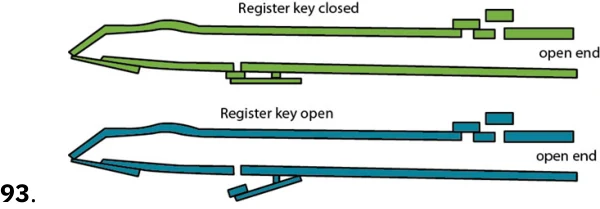
In a clarinet, the mouthpiece is an antinode. This means the clarinet is acoustically a pipe closed at one end.
クラリネットでは、マウスピースが腹になる。これはクラリネットが音響的には一方の端が閉じた管であることを意味する。
The clarinet has a key (the register key) near the mouthpiece. When this this key is pressed, a hole opens at the side. The hole adds a node on the air column.
クラリネットにはマウスピースの近くに鍵(レジスターキー)がある。この鍵を押すと側面に孔が開く。孔は空気の柱に節を一つ加える。
Make a claim about the effect of this key.
この鍵の効果について主張を述べよ。
a. The air column cannot move down this hole.b. The instrument can no longer play its fundemental note.c. All the notes played by the instrument become higher.d. All the notes played by the instrument become lower.
a. 空気の柱はこの孔を下っていけない。b. この楽器はもはや基本音を鳴らせない。c. この楽器が鳴らす音はすべて高くなる。d. この楽器が鳴らす音はすべて低くなる。