第14章音Sound原書 p.431–472
14.2 Sound Intensity and Sound Level14.2 音の強さと音の大きさのレベル
SECTION LEARNING OBJECTIVES By the end of this section, you will be able to do the following:
この節の学習目標 この節を終えると、次のことができるようになる。
• Relate amplitude of a wave to loudness and energy of a sound wave• Describe the decibel scale for measuring sound intensity• Solve problems involving the intensity of a sound wave• Describe how humans produce and hear sounds
・波の振幅を音波の大きさとエネルギーに結びつける・音の強さを測るデシベルの尺度を述べる・音波の強さに関する問題を解く・人がどうやって音を出し、また聞くのかを述べる
Section Key Termsこの節の重要語
amplitudedecibelhearingloudnesspitchsound intensitysound intensity level
振幅デシベル聴覚音の大きさ音の高さ音の強さ音の強さのレベル
Amplitude, Loudness and Energy of a Sound Wave音波の振幅、大きさ、エネルギー

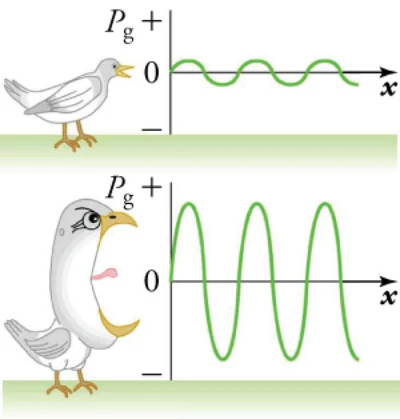
In a quiet forest, you can sometimes hear a single leaf fall to the ground. But in a traffic jam filled with honking cars, you may have to shout just so the person next to you can hear Figure 14.9.The loudness of a sound is related to how energetically its source is vibrating. In cartoons showing a screaming person, the cartoonist often shows an open mouth with a vibrating uvula (the hanging tissue at the back of the mouth) to represent a loud sound coming from the throat. Figure 14.10 shows such a cartoon depiction of a bird loudly expressing its opinion.
静かな森では、葉が一枚地面に落ちる音が聞こえることさえある。しかしクラクションの鳴り響く渋滞の中では、隣の人に聞こえるように叫ばねばならないかもしれない(図14.9)。音の大きさは、その源がどれだけ勢いよく振動しているかに関係する。漫画で叫んでいる人を描くとき、漫画家はよく、のどから大きな音が出ていることを表すために、口を開けて口蓋垂(口の奥に垂れている組織)を震わせて描く。図14.10は、鳥が大声で意見を述べている様子をそのように描いた漫画である。
A useful quantity for describing the loudness of sounds is called sound intensity. In general, the intensity of a wave is the power per unit area carried by the wave. Power is the rate at which energy is transferred by the wave. In equation form, intensity I is
音の大きさを述べるのに役立つ量が、音の強さと呼ばれるものである。一般に、波の強さとは、波が運ぶ単位面積あたりの仕事率である。仕事率とは、波がエネルギーを移す速さである。式で書けば、強さIは
where P is the power through an area A. The SI unit for I is W/m2. The intensity of a sound depends upon its pressure amplitude. The relationship between the intensity of a sound wave and its pressure amplitude (or pressure variation Δp) is
となる。ここでPは面積Aを通る仕事率である。IのSI単位はW/m2である。音の強さはその圧力振幅による。音波の強さとその圧力振幅(すなわち圧力の変化Δp)との関係は
where ρ is the density of the material in which the sound wave travels, in units of kg/m3, and v is the speed of sound in the medium, in units of m/s. Pressure amplitude has units of pascals (Pa) or N/m2. Note that Δp is half the difference between the maximum and minimum pressure in the sound wave.
である。ここでρは音波が伝わる材料の密度で単位はkg/m3、vは媒質の中の音の速さで単位はm/sである。圧力振幅の単位はパスカル(Pa)またはN/m2である。Δpは音波の中の最大の圧力と最小の圧力の差の半分であることに注意しよう。
We can see from the equation that the intensity of a sound is proportional to its amplitude squared. The pressure variation is proportional to the amplitude of the oscillation, and so I varies as (Δp)2. This relationship is consistent with the fact that the sound wave is produced by some vibration; the greater its pressure amplitude, the more the air is compressed during the vibration. Because the power of a sound wave is the rate at which energy is transferred, the energy of a sound wave is also proportional to its amplitude squared.
この式から、音の強さがその振幅の2乗に比例することが分かる。圧力の変化は振動の振幅に比例するので、Iは(Δp)2のように変わる。この関係は、音波が何らかの振動によって作られるという事実と辻褄が合う。圧力振幅が大きいほど、振動のあいだに空気はより強く圧縮される。音波の仕事率はエネルギーが移る速さなので、音波のエネルギーもその振幅の2乗に比例する。
TIPS FOR SUCCESS Pressure is usually denoted by capital P, but we are using a lowercase p for pressure in this case to distinguish it from power P above.
学習のポイント 圧力はふつう大文字のPで表されるが、ここでは上に出てきた仕事率Pと区別するために、圧力に小文字のpを使っている。
The Decibel Scaleデシベルの尺度
You may have noticed that when people talk about the loudness of a sound, they describe it in units of decibels rather than watts per meter squared. While sound intensity (in W/m2) is the SI unit, the sound intensity level in decibels (dB) is more relevant for how humans perceive sounds. The way our ears perceive sound can be more accurately described by the logarithm of the intensity of a sound rather than the intensity of a sound directly. The sound intensity level β is defined to be
音の大きさについて話すとき、人が平方メートルあたりのワットではなくデシベルという単位でそれを述べるのに気づいたかもしれない。音の強さ(W/m2)がSI単位である一方、デシベル(dB)で表した音の強さのレベルのほうが、人が音をどう感じ取るかにはより即している。私たちの耳が音を感じ取るしかたは、音の強さそのものよりも、音の強さの対数によってより正確に述べられる。音の強さのレベルβは次のように定義される。
where I is sound intensity in watts per meter squared, and I0 = 10–12 W/m2 is a reference intensity. I0 is chosen as the reference point because it is the lowest intensity of sound a person with normal hearing can perceive. The decibel level of a sound having an intensity of 10–12 W/m2 is β = 0 dB, because log10 1 = 0. That is, the threshold of human hearing is 0 decibels.
ここでIは平方メートルあたりのワットで表した音の強さ、I0 = 10-12 W/m2は基準の強さである。I0が基準点に選ばれているのは、それが正常な聴覚を持つ人が感じ取れる最も小さい音の強さだからである。強さ10-12 W/m2の音のデシベルのレベルは、log10 1 = 0なのでβ = 0 dBである。すなわち、人の聞こえる限界が0デシベルである。
Each factor of 10 in intensity corresponds to 10 dB. For example, a 90 dB sound compared with a 60 dB sound is 30 dB greater, or three factors of 10 (that is, 103 times) as intense. Another example is that if one sound is 107 as intense as another, it is 70 dB higher.
強さが10倍になるごとに10 dB上がる。たとえば90 dBの音は60 dBの音より30 dB大きく、すなわち10の3乗倍(つまり103倍)強い。もう一つの例として、ある音が別の音の107倍の強さなら、それは70 dB高い。
Since β is defined in terms of a ratio, it is unit-less. The unit called decibel (dB) is used to indicate that this ratio is multiplied by 10. The sound intensity level is not the same as sound intensity—it tells you the level of the sound relative to a reference intensity rather than the actual intensity.
βは比として定義されているので、単位を持たない。デシベル(dB)と呼ばれる単位は、この比が10倍されていることを示すために使われる。音の強さのレベルは音の強さと同じではない。実際の強さではなく、基準の強さに対する音のレベルを教えるものである。
SNAP LAB身近な実験Feeling Sound音を感じる
In this lab, you will play music with a heavy beat to literally feel the vibrations and explore what happens when the volume changes.
この実験では、拍の強い音楽をかけて振動を文字どおり感じ取り、音量を変えると何が起こるかを調べる。
• CD player or portable electronic device connected to speakers• rock or rap music CD or mp3• a lightweight table
・スピーカーにつないだCDプレーヤーか携帯機器・ロックかラップの音楽のCDかmp3・軽い机
Procedure手順
1. Place the speakers on a light table, and start playing the CD or mp3.2. Place your hand gently on the table next to the speakers.3. Increase the volume and note the level when the table just begins to vibrate as the music plays.4. Increase the reading on the volume control until it doubles. What has happened to the vibrations?
1. 軽い机の上にスピーカーを置き、CDかmp3をかけ始める。2. スピーカーの隣の机にそっと手を置く。3. 音量を上げていき、音楽が鳴るときに机がちょうど振動し始めるレベルに注目する。4. 音量つまみの目盛りが2倍になるまで上げる。振動はどうなったか。
Do you think that when you double the volume of a sound wave you are doubling the sound intensity level (in dB)
音波の音量を2倍にするとき、あなたは音の強さのレベル(dB)を2倍にしていると思うか。
or the sound intensity (in )? Why?a. The sound intensity in , because it is a closer measure of how humans perceive sound.b. The sound intensity level in because it is a closer measure of how humans perceive sound.c. The sound intensity in because it is the only unit to express the intensity of sound.d. The sound intensity level in because it is the only unit to express the intensity of sound.
それとも音の強さ(で表した)を2倍にしているのか。それはなぜか。a. で表した音の強さ。人が音をどう感じ取るかにより即した尺度だから。b. で表した音の強さのレベル。人が音をどう感じ取るかにより即した尺度だから。c. で表した音の強さ。音の強さを表す唯一の単位だから。d. で表した音の強さのレベル。音の強さを表す唯一の単位だから。
Solving Sound Wave Intensity Problems音波の強さの問題を解く
Calculating Sound Intensity Levels: Sound Waves Calculate the sound intensity level in decibels for a sound wave traveling in air at 0 ºC and having a pressure amplitude of 0.656 Pa. Strategy
音の強さのレベルを計算する:音波 0 ℃の空気中を進み、圧力振幅0.656 Paの音波について、音の強さのレベルをデシベルで計算せよ。 方針
We are given Δp, so we can calculate I using the equation . Using I , we can calculate β straight from its definition in .
Δpが与えられているので、式を使ってIを計算できる。Iが分かれば、の定義からそのままβを計算できる。
Solution解答
(1) Identify knowns:
(1)分かっているものを見きわめる。
Sound travels at 331 m/s in air at 0 °C.
0 ℃の空気中を音は331 m/sで進む。
Air has a density of 1.29 kg/m3 at atmospheric pressure and 0ºC.
大気圧、0 ℃のもとで空気の密度は1.29 kg/m3である。
(2) Enter these values and the pressure amplitude into .
(2)これらの値と圧力振幅をに入れる。
(3) Enter the value for I and the known value for I0 into . Calculate to find the sound intensity level in decibels.
(3)Iの値と既知のI0の値をに入れる。計算して音の強さのレベルをデシベルで求める。
Discussion考察
This 87.0 dB sound has an intensity five times as great as an 80 dB sound. So a factor of five in intensity corresponds to a difference of 7 dB in sound intensity level. This value is true for any intensities differing by a factor of five.
この87.0 dBの音は、80 dBの音の5倍の強さを持つ。すなわち強さが5倍になると、音の強さのレベルは7 dBの差になる。この値は、強さが5倍違うどんな場合にも当てはまる。
Change Intensity Levels of a Sound: What Happens to the Decibel Level? Show that if one sound is twice as intense as another, it has a sound level about 3 dB higher. Strategy
音の強さのレベルを変える:デシベルの値はどうなるか ある音が別の音の2倍の強さを持つとき、音のレベルはおよそ3 dB高くなることを示せ。 方針
You are given that the ratio of two intensities is 2 to 1, and are then asked to find the difference in their sound levels in decibels. You can solve this problem using of the properties of logarithms.
二つの強さの比が2対1であることが与えられ、そのデシベルでの音のレベルの差を求めよと言われている。この問題は対数の性質を使って解ける。
Solution解答
(1) Identify knowns:
(1)分かっているものを見きわめる。
The ratio of the two intensities is 2 to 1, or:
二つの強さの比は2対1、すなわち
We want to show that the difference in sound levels is about 3 dB. That is, we want to show
音のレベルの差がおよそ3 dBであることを示したい。すなわち次を示したい。
Note that
なお
(2) Use the definition of β to get
(2)βの定義を使って
Discussion考察
This means that the two sound intensity levels differ by 3.01 dB, or about 3 dB, as advertised. Note that because only the ratio I2/I1 is given (and not the actual intensities), this result is true for any intensities that differ by a factor of two. For example, a 56.0 dB sound is twice as intense as a 53.0 dB sound, a 97.0 dB sound is half as intense as a 100 dB sound, and so on.
これは、二つの音の強さのレベルが3.01 dB、すなわちおよそ3 dB違うということであり、宣言したとおりである。(実際の強さではなく)比I2/I1だけが与えられているので、この結果は強さが2倍違うどんな場合にも当てはまることに注意しよう。たとえば56.0 dBの音は53.0 dBの音の2倍の強さであり、97.0 dBの音は100 dBの音の半分の強さである、という具合である。
Practice Problems練習問題
7Calculate the intensity of a wave if the power transferred is 10 W and the area through which the wave is transferred is 5 square meters.a. 200 W / m2b. 50 W / m2c. 0.5 W / m2d. 2 W / m2
7移された仕事率が10 W、波が移される面積が5平方メートルのとき、この波の強さを計算せよ。a. 200 W/m2b. 50 W/m2c. 0.5 W/m2d. 2 W/m2
8Calculate the sound intensity for a sound wave traveling in air at and having a pressure amplitude of . a. b.
8の空気中を進み、圧力振幅がの音波について、音の強さを計算せよ。 a. b.
Hearing and Voice聞くことと声
People create sounds by pushing air up through their lungs and through elastic folds in the throat called vocal cords. These folds open and close rhythmically, creating a pressure buildup. As air travels up and past the vocal cords, it causes them to vibrate. This vibration escapes the mouth along with puffs of air as sound. A voice changes in pitch when the muscles of the larynx relax or tighten, changing the tension on the vocal chords. A voice becomes louder when air flow from the lungs increases, making the amplitude of the sound pressure wave greater.
人は、肺から空気を押し上げ、のどにある声帯と呼ばれる弾力のあるひだを通すことで音を作る。このひだがリズムよく開いたり閉じたりして、圧力の高まりを作る。空気が声帯を通って上っていくとき、声帯を振動させる。この振動が空気のかたまりとともに口から出ていって音になる。喉頭の筋肉がゆるんだり張ったりして声帯の張力が変わると、声の高さが変わる。肺からの空気の流れが増えると音の圧力波の振幅が大きくなり、声は大きくなる。
Hearing is the perception of sound. It can give us plenty of information—such as pitch, loudness, and direction. Humans can normally hear frequencies ranging from approximately 20 to 20,000 Hz. Other animals have hearing ranges different from that of humans. Dogs can hear sounds as high as 45,000 Hz, whereas bats and dolphins can hear up to 110,000 Hz sounds. You may have noticed that dogs respond to the sound of a dog whistle which produces sound out of the range of human hearing.
聴覚とは音を感じ取ることである。音の高さ、大きさ、方向など、多くの情報を与えてくれる。人はふつう、およそ20から20,000 Hzの振動数を聞くことができる。他の動物には人とは違う聞こえる範囲がある。イヌは45,000 Hzもの高い音を聞くことができ、コウモリとイルカは110,000 Hzまでの音を聞ける。人に聞こえない範囲の音を出す犬笛にイヌが反応するのに気づいたことがあるかもしれない。
Sounds below 20 Hz are called infrasound, whereas those above 20,000 Hz are ultrasound. The perception of frequency is called pitch, and the perception of intensity is called loudness.
20 Hzより低い音は超低周波音、20,000 Hzより高い音は超音波と呼ばれる。振動数を感じ取ったものが音の高さ、強さを感じ取ったものが音の大きさである。
The way we hear involves some interesting physics. The sound wave that hits our ear is a pressure wave. The ear converts sound waves into electrical nerve impulses, similar to a microphone.
私たちの聞き方には興味深い物理が関わっている。耳にあたる音波は圧力波である。耳はマイクロフォンと似たしかたで、音波を電気の神経信号へ変える。
Figure 14.11 shows the anatomy of the ear with its division into three parts: the outer ear or ear canal; the middle ear, which runs from the eardrum to the cochlea; and the inner ear, which is the cochlea itself. The body part normally referred to as the ear is technically called the pinna.
図14.11は耳の構造を、三つの部分に分けて示している。外耳すなわち外耳道、鼓膜から蝸牛までの中耳、そして蝸牛そのものである内耳である。ふつう耳と呼ばれている体の部分は、専門的には耳介という。
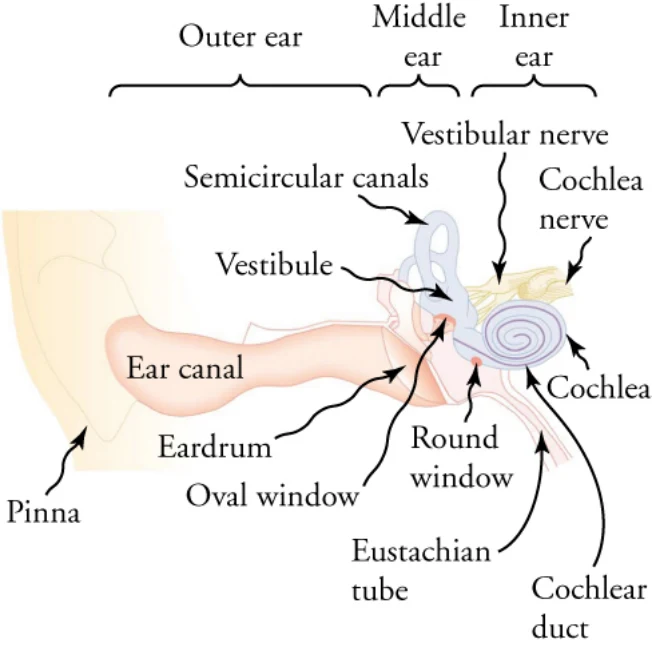
The outer ear, or ear canal, carries sound to the eardrum protected inside of the ear. The middle ear converts sound into mechanical vibrations and applies these vibrations to the cochlea. The lever system of the middle ear takes the force exerted on the eardrum by sound pressure variations, amplifies it and transmits it to the inner ear via the oval window. Two muscles in the middle ear protect the inner ear from very intense sounds. They react to intense sound in a few milliseconds and reduce the force transmitted to the cochlea. This protective reaction can also be triggered by your own voice, so that humming during a fireworks display, for example, can reduce noise damage.
外耳すなわち外耳道は、耳の内側で守られている鼓膜へ音を運ぶ。中耳は音を機械的な振動へ変え、その振動を蝸牛へ加える。中耳のてこの仕組みは、音の圧力の変化によって鼓膜に及ぼされる力を受け取り、それを増幅して、卵円窓を通して内耳へ伝える。中耳にある二つの筋肉が、とても強い音から内耳を守る。それらは強い音に数ミリ秒で反応し、蝸牛へ伝わる力を減らす。この守りの反応は自分の声でも引き起こせるので、たとえば花火の見物中に鼻歌を歌えば、騒音による損傷を減らせる。
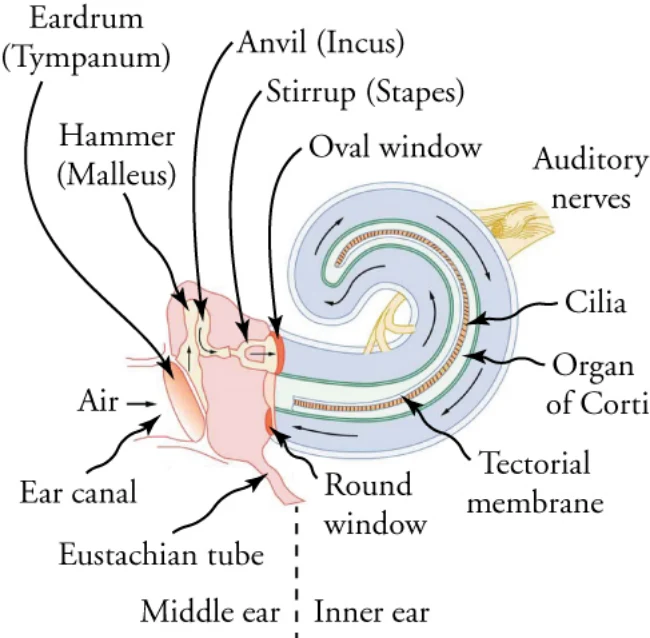
Figure 14.12 shows the middle and inner ear in greater detail. As the middle ear bones vibrate, they vibrate the cochlea, which contains fluid. This creates pressure waves in the fluid that cause the tectorial membrane to vibrate. The motion of the tectorial membrane stimulates tiny cilia on specialized cells called hair cells. These hair cells, and their attached neurons, transform the motion of the tectorial membrane into electrical signals that are sent to the brain.
図14.12は中耳と内耳をより詳しく示す。中耳の骨が振動すると、液体で満たされた蝸牛を振動させる。これが液体の中に圧力の波を作り、それが蓋膜を振動させる。蓋膜の運動が、有毛細胞と呼ばれる特別な細胞の小さな線毛を刺激する。これらの有毛細胞と、それにつながる神経細胞が、蓋膜の運動を脳へ送られる電気信号へ変える。
The tectorial membrane vibrates at different positions based on the frequency of the incoming sound. This allows us to detect the pitch of sound. Additional processing in the brain also allows us to determine which direction the sound is coming from (based on comparison of the sound’s arrival time and intensity between our two ears).
蓋膜は、入ってくる音の振動数に応じて違う位置で振動する。これによって私たちは音の高さを感じ取れる。脳でのさらなる処理によって、音がどの向きから来ているかを(二つの耳の間での音の届く時刻と強さの比較にもとづいて)判断することもできる。
Yet another way that people make sounds is through playing musical instruments (see the previous figure). Recall that the perception of frequency is called pitch. You may have noticed that the pitch range produced by an instrument tends to depend upon its size. Small instruments, such as a piccolo, typically make high-pitch sounds, while larger instruments, such as a tuba, typically make low-pitch sounds. High-pitch means small wavelength, and the size of a musical instrument is directly related to the wavelengths of sound it produces. So a small instrument creates short-wavelength sounds, just as a large instrument creates long-wavelength sounds.
人が音を作るもう一つのやり方が、楽器を演奏することである(前の図を見よ)。振動数を感じ取ったものが音の高さと呼ばれることを思い出そう。楽器が出す音の高さの範囲は、その大きさによる傾向があるのに気づいたかもしれない。ピッコロのような小さな楽器はふつう高い音を出し、チューバのような大きな楽器はふつう低い音を出す。高い音とは波長が短いということであり、楽器の大きさはそれが出す音の波長に直接関係する。だから小さな楽器は波長の短い音を作り、大きな楽器は波長の長い音を作る。
Most of us have excellent relative pitch, which means that we can tell whether one sound has a different frequency from another. We can usually distinguish one sound from another if the frequencies of the two sounds differ by as little as 1 Hz. For example, 500.0 and 501.5 Hz are noticeably different.
私たちの多くは相対音感に優れている。すなわち、ある音の振動数が別の音と違うかどうかを言い当てられる。二つの音の振動数がわずか1 Hzしか違わなくても、ふつう聞き分けられる。たとえば500.0 Hzと501.5 Hzははっきり違う。
Musical notes are particular sounds that can be produced by most instruments, and are the building blocks of a song. In Western music, musical notes have particular names, such as A-sharp, C, or E-flat. Some people can identify musical notes just by listening to them. This rare ability is called perfect, or absolute, pitch.
音符は、たいていの楽器で出せる特定の音であり、曲を組み立てる部品である。西洋の音楽では、音符には嬰イ、ハ、変ホといった特定の名がある。聞くだけで音符を言い当てられる人もいる。この稀な能力を絶対音感という。
When a violin plays middle C, there is no mistaking it for a piano playing the same note. The reason is that each instrument produces a distinctive set of frequencies and intensities. We call our perception of these combinations of frequencies and intensities the timbre of the sound. It is more difficult to quantify timbre than loudness or pitch. Timbre is more subjective. Evocative adjectives such as dull, brilliant, warm, cold, pure, and rich are used to describe the timbre of a sound rather than quantities with units, which makes for a difficult topic to dissect with physics. So the consideration of timbre takes us into the realm of perceptual psychology, where higher-level processes in the brain are dominant. This is also true for other perceptions of sound, such as music and noise. But as a teenager, you are likely already aware that one person’s music may be another person’s noise.
バイオリンが中央ハを弾くとき、それを同じ音を弾くピアノと間違えることはない。それは、楽器ごとに独特の振動数と強さの組を作るからである。この振動数と強さの組み合わせを感じ取ったものを、その音の音色と呼ぶ。音色は大きさや高さより数量にするのが難しい。音色はより主観的である。単位のついた量ではなく、鈍い、輝かしい、暖かい、冷たい、澄んだ、豊かなといった気分を誘う形容詞で音の音色は述べられ、そのため物理で切り分けるのが難しい話題になっている。だから音色を考えることは、脳のより高次の処理が支配する知覚心理学の領域へ私たちを連れていく。これは音楽や騒音といった他の音の感じ取り方についても同じである。しかし十代のあなたなら、ある人の音楽が別の人の騒音でありうることには、もう気づいているだろう。
If you turn up the volume of your stereo, will the pitch change? Why or why not?a. No, because pitch does not depend on intensity.b. Yes, because pitch is directly related to intensity.
ステレオの音量を上げたら、音の高さは変わるか。それはなぜか。a. いいえ。音の高さは強さによらないから。b. はい。音の高さは強さに直接関係するから。
Check Your Understanding理解の確認
9What is sound intensity?a. Intensity is the energy per unit area carried by a wave.b. Intensity is the energy per unit volume carried by a wave.c. Intensity is the power per unit area carried by a wave.d. Intensity is the power per unit volume carried by a wave.
9音の強さとは何か。a. 強さとは、波が運ぶ単位面積あたりのエネルギーである。b. 強さとは、波が運ぶ単位体積あたりのエネルギーである。c. 強さとは、波が運ぶ単位面積あたりの仕事率である。d. 強さとは、波が運ぶ単位体積あたりの仕事率である。
10How is power defined with reference to a sound wave?a. Power is the rate at which energy is transferred by a sound wave.b. Power is the rate at which mass is transferred by a sound wave.
10音波について、仕事率はどう定義されるか。a. 仕事率とは、音波がエネルギーを移す速さである。b. 仕事率とは、音波が質量を移す速さである。
c. Power is the rate at which amplitude of a sound wave changes.d. Power is the rate at which wavelength of a sound wave changes.
c. 仕事率とは、音波の振幅が変わる速さである。d. 仕事率とは、音波の波長が変わる速さである。
11What word or phrase is used to describe the loudness of sound?a. frequency or oscillationb. intensity level or decibel
11音の大きさを述べるのに使われる語や言い回しはどれか。a. 振動数あるいは振動b. 強さのレベルあるいはデシベル
c. timbred. pitch
c. 音色d. 音の高さ
12What is the mathematical expression for sound intensity level ?
12音の強さのレベルを表す数式はどれか。
13What is the range of frequencies that humans are capable of hearing?a. 20 Hz to 200,000 Hzb. 2 Hz to 50,000 Hz
13人が聞くことのできる振動数の範囲はどれか。a. 20 Hzから200,000 Hzb. 2 Hzから50,000 Hz
c. 2 Hz to 2,000 Hzd. 20 Hz to 20,000 Hz
c. 2 Hzから2,000 Hzd. 20 Hzから20,000 Hz
14How do humans change the pitch of their voice?a. Relaxing or tightening their glottisb. Relaxing or tightening their uvula
14人はどうやって声の高さを変えるか。a. 声門をゆるめたり張ったりしてb. 口蓋垂をゆるめたり張ったりして
c. Relaxing or tightening their tongued. Relaxing or tightening their larynx
c. 舌をゆるめたり張ったりしてd. 喉頭をゆるめたり張ったりして
References参考文献
Nave, R. Vocal sound production—HyperPhysics. Retrieved from http://hyperphysics.phy-astr.gsu.edu/hbase/music/ voice.html
Nave, R. Vocal sound production—HyperPhysics. http://hyperphysics.phy-astr.gsu.edu/hbase/music/voice.html より取得