第14章音Sound原書 p.431–472
14.1 Speed of Sound, Frequency, and Wavelength14.1 音の速さ、振動数、波長
SECTION LEARNING OBJECTIVES By the end of this section, you will be able to do the following:
この節の学習目標 この節を終えると、次のことができるようになる。
• Relate the characteristics of waves to properties of sound waves• Describe the speed of sound and how it changes in various media• Relate the speed of sound to frequency and wavelength of a sound wave
・波の特徴を音波の性質に結びつける・音の速さと、それがいろいろな媒質でどう変わるかを述べる・音の速さを音波の振動数と波長に結びつける
Section Key Termsこの節の重要語
rarefactionsound
疎音
Properties of Sound Waves音波の性質
Sound is a wave. More specifically, sound is defined to be a disturbance of matter that is transmitted from its source outward. A disturbance is anything that is moved from its state of equilibrium. Some sound waves can be characterized as periodic waves, which means that the atoms that make up the matter experience simple harmonic motion.
音は波である。より詳しくいえば、媒質が平衡状態からずれ、その変化が音源から周囲へ伝わっていく現象である。音波の中には周期的なものがある。正弦波の音なら、媒質を構成する粒子は平衡位置のまわりで単振動する。
A vibrating string produces a sound wave as illustrated in Figure 14.2, Figure 14.3, and Figure 14.4. As the string oscillates back and forth, part of the string’s energy goes into compressing and expanding the surrounding air. This creates slightly higher and lower pressures. The higher pressure... regions are compressions, and the low pressure regions are rarefactions. The pressure disturbance moves through the air as longitudinal waves with the same frequency as the string. Some of the energy is lost in the form of thermal energy transferred to the air. You may recall from the chapter on waves that areas of compression and rarefaction in longitudinal waves (such as sound) are analogous to crests and troughs in transverse waves.
図14.2、図14.3、図14.4に示すように、振動する弦は音波を作る。弦が行ったり来たり振動するにつれ、弦のエネルギーの一部が周りの空気を圧縮したり広げたりするのに使われる。これによって、わずかに高い圧力とわずかに低い圧力ができる。圧力の高い領域が密、圧力の低い領域が疎である。圧力の乱れは、弦と同じ振動数の縦波として空気の中を進む。エネルギーの一部は、空気へ移る熱エネルギーの形で失われる。波の章で、(音のような)縦波の密と疎の領域が、横波の山と谷にあたるものだったことを思い出すかもしれない。
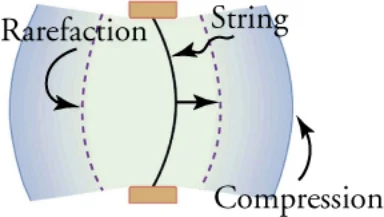
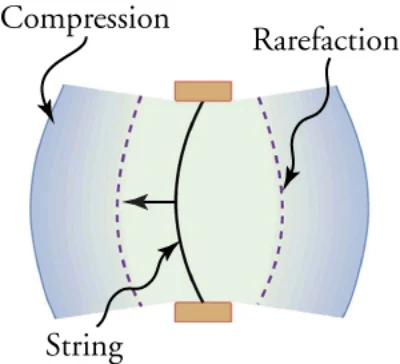
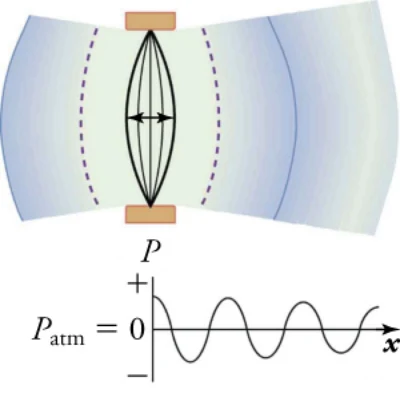
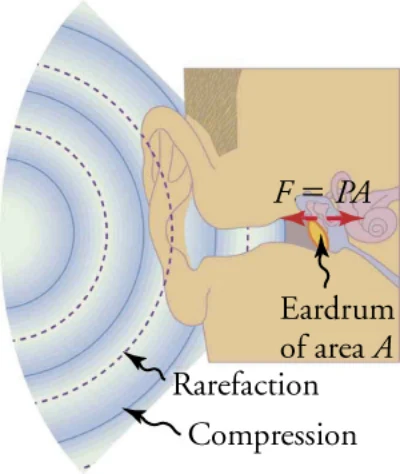
The amplitude of a sound wave decreases with distance from its source, because the energy of the wave is spread over a larger and larger area. But some of the energy is also absorbed by objects, such as the eardrum in Figure 14.5, and some of the energy is converted to thermal energy in the air. Figure 14.4 shows a graph of gauge pressure versus distance from the vibrating string. From this figure, you can see that the compression of a longitudinal wave is analogous to the peak of a transverse wave, and the rarefaction of a longitudinal wave is analogous to the trough of a transverse wave. Just as a transverse wave alternates between peaks and troughs, a longitudinal wave alternates between compression and rarefaction.
音波の振幅は源からの距離とともに小さくなる。波のエネルギーがどんどん広い面積に広がるからである。しかしエネルギーの一部は、図14.5の鼓膜のような物体に吸収されもし、また一部は空気の中で熱エネルギーへ変わる。図14.4は、振動する弦からの距離に対するゲージ圧のグラフを示す。この図から、縦波の密は横波の峰にあたり、縦波の疎は横波の谷にあたることが見て取れる。横波が峰と谷を交互に繰り返すのとちょうど同じように、縦波は密と疎を交互に繰り返す。
The Speed of Sound音の速さ
The speed of sound varies greatly depending upon the medium it is traveling through. The speed of sound in a medium is determined by a combination of the medium’s rigidity (or compressibility in gases) and its density. The more rigid (or less compressible) the medium, the faster the speed of sound. The greater the density of a medium, the slower the speed of sound. The speed of sound in air is low, because air is compressible. Because liquids and solids are relatively rigid and very difficult to compress, the speed of sound in such media is generally greater than in gases. Table 14.1 shows the speed of sound in various media. Since temperature affects density, the speed of sound varies with the temperature of the medium through which it’s traveling to some extent, especially for gases.
音の速さは、伝わっていく媒質によって大きく変わる。媒質の中の音の速さは、媒質の硬さ(気体では圧縮しやすさ)と密度の組み合わせで決まる。媒質が硬い(圧縮しにくい)ほど音の速さは大きい。媒質の密度が大きいほど音の速さは小さい。空気は圧縮しやすいので、空気中の音の速さは小さい。液体と固体は比較的硬く、圧縮するのがとても難しいので、そうした媒質の中の音の速さはふつう気体より大きい。表14.1にさまざまな媒質の中の音の速さを示す。温度は密度に影響するので、音の速さは、とくに気体では、伝わっていく媒質の温度によってある程度変わる。
Gases at 0 °C
0 ℃の気体
Liquids at 20 °C
20 ℃の液体
Solids (longitudinal or bulk)
固体(縦波または体積波)
The Relationship Between the Speed of Sound and the Frequency and Wavelength of a Sound Wave音の速さと、音波の振動数・波長との関係

Sound, like all waves, travels at certain speeds through different media and has the properties of frequency and wavelength. Sound travels much slower than light—you can observe this while watching a fireworks display (see Figure 14.6), since the flash of an explosion is seen before its sound is heard.
音も、あらゆる波と同じく、媒質ごとに決まった速さで進み、振動数と波長という性質を持つ。音は光よりずっと遅く進む。花火を見ていればこれを確かめられる(図14.6を見よ)。炸裂の閃光が、その音が聞こえるより先に見えるからである。
The relationship between the speed of sound, its frequency, and wavelength is the same as for all waves:
音の速さと振動数、波長の関係は、あらゆる波と同じである。
where v is the speed of sound (in units of m/s), f is its frequency (in units of hertz), and is its wavelength (in units of meters). Recall that wavelength is defined as the distance between adjacent identical parts of a wave. The wavelength of a sound, therefore, is the distance between adjacent identical parts of a sound wave. Just as the distance between adjacent crests in a transverse wave is one wavelength, the distance between adjacent compressions in a sound wave is also one wavelength, as shown in Figure 14.7. The frequency of a sound wave is the same as that of the source. For example, a tuning fork vibrating at a given frequency would produce sound waves that oscillate at that same frequency. The frequency of a sound is the number of waves that pass a point per unit time.
ここでvは音の速さ(単位はm/s)、fはその振動数(単位はヘルツ)、はその波長(単位はメートル)である。波長は波の隣り合う同じ部分どうしの距離と定義されたことを思い出そう。したがって音の波長は、音波の隣り合う同じ部分どうしの距離である。横波の隣り合う山どうしの距離が一波長であるのとちょうど同じように、音波の隣り合う密どうしの距離も一波長である。図14.7に示すとおりである。音波の振動数は源の振動数と同じである。たとえば、ある振動数で振動する音叉は、その同じ振動数で振動する音波を作る。音の振動数とは、単位時間にある点を通り過ぎる波の数である。
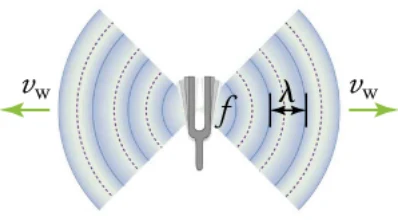
One of the more important properties of sound is that its speed is nearly independent of frequency. If this were not the case, and high-frequency sounds traveled faster, for example, then the farther you were from a band in a football stadium, the more the sound from the low-pitch instruments would lag behind the high-pitch ones. But the music from all instruments arrives in cadence independent of distance, and so all frequencies must travel at nearly the same speed.
音のより重要な性質の一つが、その速さが振動数にほとんどよらないことである。そうでなく、たとえば高い振動数の音のほうが速く進むとしたら、フットボール場で楽団から遠く離れるほど、低い音の楽器の音が高い音の楽器より遅れて届くことになる。しかしすべての楽器の音楽は距離によらず拍が揃って届く。したがってすべての振動数がほぼ同じ速さで進んでいるはずである。
Recall that , and in a given medium under fixed temperature and humidity, v is constant. Therefore, the relationship between f and is inverse: The higher the frequency, the shorter the wavelength of a sound wave.
であり、決まった媒質で温度と湿度が一定なら、vは一定であることを思い出そう。したがってfとの関係は反比例である。振動数が高いほど音波の波長は短い。
The speed of sound can change when sound travels from one medium to another. However, the frequency usually remains the same because it is like a driven oscillation and maintains the frequency of the original source. If v changes and f remains the same, then the wavelength must change. Since , the higher the speed of a sound, the greater its wavelength for a given frequency.
音がある媒質から別の媒質へ進むとき、音の速さは変わりうる。しかし振動数はふつう変わらない。それは強制された振動のようなもので、もとの源の振動数を保つからである。vが変わりfが変わらないなら、波長が変わらねばならない。なので、決まった振動数に対して、音の速さが大きいほど波長は長い。
VIRTUAL PHYSICSシミュレーションSound音
This simulation (https://openstax.org/l/28sound) lets you see sound waves. Adjust the frequency or amplitude (volume) and you can see and hear how the wave changes. Move the listener around and hear what she hears. Switch to the Two Source Interference tab or the Interference by Reflection tab to experiment with interference and reflection.
このシミュレーション(https://openstax.org/l/28sound)では音波を目で見られる。振動数や振幅(音量)を変えれば、波がどう変わるかを見て、また聞くことができる。聞き手を動かして、その人に何が聞こえるかを聞いてみよう。「二つの源の干渉」タブや「反射による干渉」タブに切り替えて、干渉と反射を試してみよう。
TIPS FOR SUCCESS Make sure to have audio enabled and set to Listener rather than Speaker, or else the sound will not vary as you move the listener around.
学習のポイント 音を有効にし、「スピーカー」ではなく「聞き手」に設定しておくこと。そうしないと、聞き手を動かしても音が変わらない。
PhET Explorations: Sound. This simulation lets you see sound waves. Adjust the frequency or volume and you can see and hear how the wave changes. Move the listener around and hear what she hears.Access multimedia content (http://openstax.org/books/physics/pages/14-1-speed-of-sound-frequency-and-wavelength) In the first tab, Listen to a Single Source, move the listener as far away from the speaker as possible, and then change the frequency of the sound wave. You may have noticed that there is a delay between the time when you change the setting and the time when you hear the sound get lower or higher in pitch. Why is this?
PhET探究:音。このシミュレーションでは音波を目で見られる。振動数や音量を変えれば、波がどう変わるかを見て、また聞くことができる。聞き手を動かして、その人に何が聞こえるかを聞いてみよう。マルチメディア教材はこちら(http://openstax.org/books/physics/pages/14-1-speed-of-sound-frequency-and-wavelength)最初のタブ「一つの源を聞く」で、聞き手をスピーカーからできるだけ遠くへ動かし、それから音波の振動数を変えてみよう。設定を変えてから音の高さが低く、あるいは高くなって聞こえるまでに遅れがあるのに気づいたかもしれない。それはなぜか。
a. Because, intensity of the sound wave changes with the frequency.b. Because, the speed of the sound wave changes when the frequency is changed.
a. 音波の強さが振動数とともに変わるから。b. 振動数を変えると音波の速さが変わるから。
c. Because, loudness of the sound wave takes time to adjust after a change in frequency.d. Because it takes time for sound to reach the listener, so the listener perceives the new frequency of sound wave after a delay.
c. 振動数が変わったあと、音波の大きさが調整されるのに時間がかかるから。d. 音が聞き手に届くのに時間がかかるので、聞き手は遅れて新しい振動数の音波を感じ取るから。
Is there a difference in the amount of delay depending on whether you make the frequency higher or lower? Why?
振動数を高くするか低くするかで、遅れの量に違いはあるか。それはなぜか。
a. Yes, the speed of propagation depends only on the frequency of the wave.b. Yes, the speed of propagation depends upon the wavelength of the wave, and wavelength changes as the frequency changes.
a. はい。伝播の速さは波の振動数だけによるから。b. はい。伝播の速さは波の波長により、波長は振動数が変われば変わるから。
c. No, the speed of propagation depends only on the wavelength of the wave.d. No, the speed of propagation is constant in a given medium; only the wavelength changes as the frequency changes.
c. いいえ。伝播の速さは波の波長だけによるから。d. いいえ。伝播の速さは決まった媒質の中では一定で、振動数が変わると波長だけが変わるから。
SNAP LAB身近な実験Voice as a Sound Wave音波としての声
In this lab you will observe the effects of blowing and speaking into a piece of paper in order to compare and contrast different sound waves.
この実験では、いろいろな音波を比べ、対比するために、紙に息を吹きかけたり話しかけたりしたときの効果を観察する。
• sheet of paper• tape• table
・紙一枚・テープ・机
Instructions
手引き
Procedure手順
1. Suspend a sheet of paper so that the top edge of the paper is fixed and the bottom edge is free to move. You could tape the top edge of the paper to the edge of a table, for example.2. Gently blow air near the edge of the bottom of the sheet and note how the sheet moves.3. Speak softly and then louder such that the sounds hit the edge of the bottom of the paper, and note how the sheet moves.4. Interpret the results.
1. 紙の上の縁が固定され、下の縁が自由に動けるように紙を吊るす。たとえば紙の上の縁を机の縁にテープで留めればよい。2. 紙の下の縁の近くにそっと息を吹きかけ、紙がどう動くかに注目する。3. 小さな声で、それから大きな声で、音が紙の下の縁にあたるように話し、紙がどう動くかに注目する。4. 結果を解釈する。
GRASP CHECK Which sound wave property increases when you are speaking more loudly than softly?a. amplitude of the waveb. frequency of the wave
理解の確認 小さな声より大きな声で話すとき、音波のどの性質が増すか。a. 波の振幅b. 波の振動数
c. speed of the waved. wavelength of the wave
c. 波の速さd. 波の波長
What Are the Wavelengths of Audible Sounds? Calculate the wavelengths of sounds at the extremes of the audible range, 20 and 20,000 Hz, in conditions where sound travels at 348.7 m/s. Strategy
聞こえる音の波長はどれだけか 音が348.7 m/sで進む条件のもとで、聞こえる範囲の両端である20 Hzと20,000 Hzの音の波長を計算せよ。 方針
To find wavelength from frequency, we can use .
振動数から波長を求めるにはが使える。
Solution解答
(1) Identify the knowns. The values for v and f are given.
(1)分かっているものを見きわめる。vとfの値が与えられている。
(2) Solve the relationship between speed, frequency and wavelength for .
(2)速さ・振動数・波長の関係をについて解く。
(3) Enter the speed and the minimum frequency to give the maximum wavelength.
(3)速さと最小の振動数を入れて、最大の波長を求める。
(4) Enter the speed and the maximum frequency to give the minimum wavelength.
(4)速さと最大の振動数を入れて、最小の波長を求める。
Discussion考察
Because the product of f multiplied by equals a constant velocity in unchanging conditions, the smaller f is, the larger must be, and vice versa. Note that you can also easily rearrange the same formula to find frequency or velocity.
条件が変わらなければfとの積は一定の速度に等しいので、fが小さいほどは大きくなければならず、その逆も成り立つ。同じ式を簡単に変形して振動数や速度を求めることもできることに注意しよう。
Echolocation is the use of reflected sound waves to locate and identify objects. It is used by animals such as bats, dolphins and whales, and is also imitated by humans in SONAR—Sound Navigation and Ranging—and echolocation technology.
反響定位とは、反射した音波を使って物の位置を突き止め、それが何かを見きわめることである。コウモリ、イルカ、クジラといった動物が使っており、人間もSONAR——音による航法と測距——や反響定位の技術でこれをまねている。
Bats, dolphins and whales use echolocation to navigate and find food in their environment. They locate an object (or obstacle) by emitting a sound and then sensing the reflected sound waves. Since the speed of sound in air is constant, the time it takes for the sound to travel to the object and back gives the animal a sense of the distance between itself and the object. This is called ranging. Figure 14.8 shows a bat using echolocation to sense distances.
コウモリやイルカ、一部のクジラは、反響定位によって周囲の様子を捉え、餌を探す。自分で音を出し、物体や障害物から返ってきた反射音を聞き取るのである。媒質中の音速が分かれば、音が往復する時間から物体までの距離を求められる。これを測距という。図14.8は、反響定位で距離を探るコウモリを示している。
Echolocating animals identify an object by comparing the relative intensity of the sound waves returning to each ear to figure out the angle at which the sound waves were reflected. This gives information about the direction, size and shape of the object. Since there is a slight distance in position between the two ears of an animal, the sound may return to one of the ears with a bit of a delay, which also provides information about the position of the object. For example, if a bear is directly to the right of a bat, the echo will return to the bat’s left ear later than to its right ear. If, however, the bear is directly ahead of the bat, the echo would return to both ears at the same time. For an animal without a sense of sight such as a bat, it is important to know where other animals are as well as what they are; their survival depends on it.
反響定位をする動物は、それぞれの耳に返ってくる音波の強さを比べ、音波が反射された角度を割り出して物を見きわめる。これによって物の向き・大きさ・形についての情報が得られる。動物の二つの耳の位置はわずかに離れているので、音は一方の耳に少し遅れて返ることがあり、これも物の位置についての情報になる。たとえばクマがコウモリのちょうど右にいれば、こだまはコウモリの右耳より左耳に遅れて返る。しかしクマがコウモリのちょうど正面にいれば、こだまは両方の耳に同時に返る。コウモリのように視覚を持たない動物にとって、他の動物がどこにいるか、そしてそれが何かを知ることは大切である。その生存がそれにかかっている。
Principles of echolocation have been used to develop a variety of useful sensing technologies. SONAR, is used by submarines to detect objects underwater and measure water depth. Unlike animal echolocation, which relies on only one transmitter (a mouth) and two receivers (ears), manmade SONAR uses many transmitters and beams to get a more accurate reading of the environment. Radar technologies use the echo of radio waves to locate clouds and storm systems in weather forecasting, and to locate aircraft for air traffic control. Some new cars use echolocation technology to sense obstacles around the car, and warn the driver who may be about to hit something (or even to automatically parallel park). Echolocation technologies and training systems are being developed to help visually impaired people navigate their everyday environments.
反響定位の原理は、さまざまな役に立つ感知技術を作るのに使われてきた。SONARは潜水艦が水中の物を見つけ、水深を測るのに使う。送信器(口)一つと受信器(耳)二つだけに頼る動物の反響定位と違い、人が作ったSONARは多くの送信器とビームを使い、環境をより正確に読み取る。レーダーの技術は、電波のこだまを使って、天気予報で雲や嵐の系を突き止めたり、航空管制で航空機の位置を突き止めたりする。新しい自動車には、反響定位の技術で車のまわりの障害物を感じ取り、何かにぶつかりそうな運転者に警告するもの(さらには自動で縦列駐車するもの)もある。目の不自由な人が日常の環境で進む道を見つけるのを助けるために、反響定位の技術と訓練の仕組みが開発されている。
If a predator is directly to the left of a bat, how will the bat know?a. The echo would return to the left ear first.b. The echo would return to the right ear first.
捕食者がコウモリのちょうど左にいるとき、コウモリはどうやってそれを知るか。a. こだまが左耳に先に返る。b. こだまが右耳に先に返る。
Check Your Understanding理解の確認
3What is a rarefaction?a. Rarefaction is the high-pressure region created in a medium when a longitudinal wave passes through it.b. Rarefaction is the low-pressure region created in a medium when a longitudinal wave passes through it.c. Rarefaction is the highest point of amplitude of a sound wave.d. Rarefaction is the lowest point of amplitude of a sound wave.
3疎とは何か。a. 疎とは、縦波が通り過ぎるときに媒質にできる高い圧力の領域である。b. 疎とは、縦波が通り過ぎるときに媒質にできる低い圧力の領域である。c. 疎とは、音波の振幅の最も高い点である。d. 疎とは、音波の振幅の最も低い点である。
4What sort of motion do the particles of a medium experience when a sound wave passes through it?a. Simple harmonic motionb. Circular motion
4音波が通り過ぎるとき、媒質の粒子はどんな運動をするか。a. 単振動b. 円運動
c. Random motiond. Translational motion
c. でたらめな運動d. 並進運動
5What does the speed of sound depend on?a. The wavelength of the waveb. The size of the medium
5音の速さは何によって決まるか。a. 波の波長b. 媒質の大きさ
c. The frequency of the waved. The properties of the medium
c. 波の振動数d. 媒質の性質
6What property of a gas would affect the speed of sound traveling through it?a. The volume of the gasb. The flammability of the gas
6気体のどの性質が、その中を進む音の速さに影響するか。a. 気体の体積b. 気体の燃えやすさ
c. The mass of the gasd. The compressibility of the gas
c. 気体の質量d. 気体の圧縮しやすさ