第14章音Sound原書 p.431–472
14.3 Doppler Effect and Sonic Booms14.3 ドップラー効果とソニックブーム
SECTION LEARNING OBJECTIVES By the end of this section, you will be able to do the following:
この節の学習目標 この節を終えると、次のことができるようになる。
• Describe the Doppler effect of sound waves• Explain a sonic boom• Calculate the frequency shift of sound from a moving object by the Doppler shift formula, and calculate the speed of an object by the Doppler shift formula
・音波のドップラー効果を述べる・ソニックブームを説明する・ドップラーずれの式で動く物からの音の振動数のずれを計算し、またドップラーずれの式で物の速さを計算する
Section Key Termsこの節の重要語
Doppler effectsonic boom
ドップラー効果ソニックブーム
The Doppler Effect of Sound Waves音波のドップラー効果
The Doppler effect is a change in the observed pitch of a sound, due to relative motion between the source and the observer. An example of the Doppler effect due to the motion of a source occurs when you are standing still, and the sound of a siren coming from an ambulance shifts from high-pitch to low-pitch as it passes by. The closer the ambulance is to you, the more sudden the shift. The faster the ambulance moves, the greater the shift. We also hear this shift in frequency for passing race cars, airplanes, and trains. An example of the Doppler effect with a stationary source and moving observer is if you ride a train past a stationary warning bell, you will hear the bell’s frequency shift from high to low as you pass by.
ドップラー効果とは、源と観測者の間の相対運動によって、観測される音の高さが変わることである。源の運動によるドップラー効果の例は、自分が止まって立っているとき、救急車から来るサイレンの音が、通り過ぎるにつれて高い音から低い音へ移るときに起こる。救急車が自分に近いほど、その移り変わりは急である。救急車が速く動くほど、ずれは大きい。通り過ぎるレーシングカー、飛行機、列車でも、この振動数のずれが聞こえる。源が止まっていて観測者が動く場合のドップラー効果の例は、止まっている警報のベルのそばを列車で通り過ぎるときで、通り過ぎるにつれてベルの振動数が高いほうから低いほうへずれるのが聞こえる。
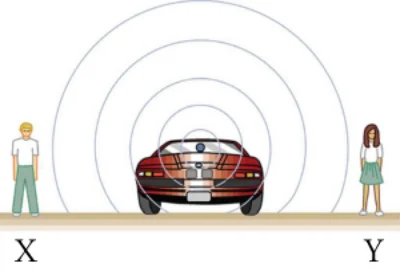
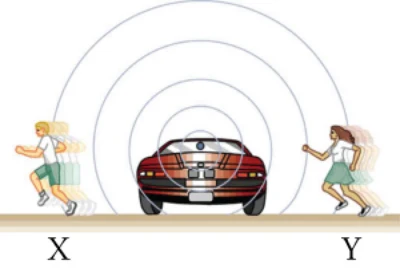
What causes the Doppler effect? Let’s compare three different scenarios: Sound waves emitted by a stationary source (Figure 14.14), sound waves emitted by a moving source (Figure 14.15), and sound waves emitted by a stationary source but heard by moving observers (Figure 14.16). In each case, the sound spreads out from the point where it was emitted.
何がドップラー効果を起こすのか。三つの違う場面を比べてみよう。止まっている源が出す音波(図14.14)、動く源が出す音波(図14.15)、そして止まっている源が出すが動く観測者が聞く音波(図14.16)である。どの場合も、音は出された点から広がっていく。
If the source and observers are stationary, then observers on either side see the same wavelength and frequency as emitted by the source. But if the source is moving and continues to emit sound as it travels, then the air compressions (crests) become closer together in the direction in which it’s traveling and farther apart in the direction it’s traveling away from. Therefore, the wavelength is shorter in the direction the source is moving (on the right in Figure 14.15), and longer in the opposite direction (on the left in Figure 14.15).
源も観測者も止まっているなら、どちら側の観測者も、源が出したのと同じ波長と振動数を見る。しかし源が動いていて、進みながら音を出し続けるなら、空気の密(山)は進む向きでは互いに近づき、遠ざかる向きでは互いに離れる。したがって、源が動いていく向き(図14.15では右)では波長が短く、逆向き(図14.15では左)では長い。
Finally, if the observers move, as in Figure 14.16, the frequency at which they receive the compressions changes. The observer moving toward the source receives them at a higher frequency (and therefore shorter wavelength), and the person moving away from the source receives them at a lower frequency (and therefore longer wavelength).
最後に、図14.16のように観測者が動くなら、彼らが密を受け取る振動数が変わる。源へ向かって動く観測者はより高い振動数(したがってより短い波長)で受け取り、源から遠ざかる人はより低い振動数(したがってより長い波長)で受け取る。
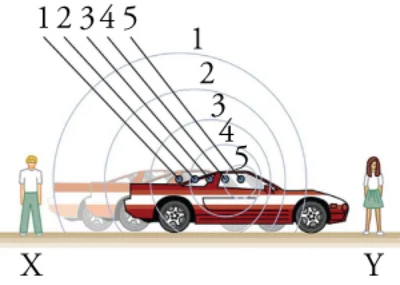
sound. The opposite is true for the observer on the left, where the wavelength is increased and the frequency is reduced.
聞こえる。左の観測者では逆で、波長が長くなり振動数は下がる。
We know that wavelength and frequency are related by where v is the fixed speed of sound. The sound moves in a medium and has the same speed v in that medium whether the source is moving or not. Therefore, f multiplied by is a constant. Because the observer on the right in Figure 14.15 receives a shorter wavelength, the frequency she perceives must be higher. Similarly, the observer on the left receives a longer wavelength and therefore perceives a lower frequency.
波長と振動数はで結びついていることが分かっている。ここでvは決まった音の速さである。音は媒質の中を動き、源が動いていようといまいと、その媒質の中で同じ速さvを持つ。したがってfとの積は一定である。図14.15の右の観測者はより短い波長を受け取るので、彼女が感じ取る振動数はより高いはずである。同じように、左の観測者はより長い波長を受け取るので、より低い振動数を感じ取る。
The same thing happens in Figure 14.16. A higher frequency is perceived by the observer moving toward the source, and a lower frequency is perceived by an observer moving away from the source. In general, then, relative motion of source and observer toward one another increases the perceived frequency. Relative motion apart decreases the perceived frequency. The greater the relative speed is, the greater the effect.
図14.16でも同じことが起こる。源へ向かって動く観測者はより高い振動数を感じ取り、源から遠ざかる観測者はより低い振動数を感じ取る。したがって一般に、源と観測者が互いに近づく相対運動は、感じ取られる振動数を上げる。離れていく相対運動はそれを下げる。相対速度が大きいほど効果は大きい。
Introduction to the Doppler Effect This video explains the Doppler effect visually.
ドップラー効果の導入 この動画はドップラー効果を目で見える形で説明する。
Access multimedia content (http://openstax.org/books/physics/pages/14-3-doppler-effect-and-sonic-booms)
マルチメディア教材はこちら(http://openstax.org/books/physics/pages/14-3-doppler-effect-and-sonic-booms)
GRASP CHECK If you are standing on the sidewalk facing the street and an ambulance drives by with its siren blaring, at what point will the frequency that you observe most closely match the actual frequency of the siren?
理解の確認 通りに面した歩道に立っていて、サイレンを鳴らした救急車が通り過ぎるとき、あなたが観測する振動数が実際のサイレンの振動数に最も近くなるのはどの時点か。
a. when it is coming toward youb. when it is going away from youc. when it is in front of you
a. こちらへ向かってくるときb. 遠ざかっていくときc. 目の前にあるとき
For a stationary observer and a moving source of sound, the frequency (fobs) of sound perceived by the observer is
止まっている観測者と動く音源について、観測者が感じ取る音の振動数(fobs)は
where fs is the frequency of sound from a source, vs is the speed of the source along a line joining the source and observer, and vw is the speed of sound. The minus sign is used for motion toward the observer and the plus sign for motion away from the observer.
となる。ここでfsは源からの音の振動数、vsは源と観測者を結ぶ線に沿った源の速さ、vwは音の速さである。マイナス符号は観測者へ向かう運動に、プラス符号は観測者から遠ざかる運動に使う。
TIPS FOR SUCCESS Rather than just memorizing rules, which are easy to forget, it is better to think about the rules of an equation intuitively. Using a minus sign in will decrease the denominator and increase the observed frequency, which is consistent with the expected outcome of the Doppler effect when the source is moving toward the observer. Using a plus sign will increase the denominator and decrease the observed frequency, consistent with what you would expect for the source moving away from the observer. This may be more helpful to keep in mind rather than memorizing the fact that “the minus sign is used for motion toward the observer and the plus sign for motion away from the observer.”
学習のポイント 忘れやすい規則をただ覚えるより、式の規則を直感的に考えるほうがよい。でマイナス符号を使えば分母が小さくなり、観測される振動数が上がる。これは源が観測者へ向かって動くときにドップラー効果に期待される結果と辻褄が合う。プラス符号を使えば分母が大きくなり、観測される振動数は下がる。これは源が観測者から遠ざかるときに期待されるとおりである。「マイナス符号は観測者へ向かう運動に、プラス符号は観測者から遠ざかる運動に使う」と丸暗記するより、こう考えておくほうが役に立つだろう。
Note that the greater the speed of the source, the greater the Doppler effect. Similarly, for a stationary source and moving observer, the frequency perceived by the observer fobs is given by
源の速さが大きいほどドップラー効果は大きいことに注意しよう。同じように、止まっている源と動く観測者については、観測者が感じ取る振動数fobsは次で与えられる。
where vobs is the speed of the observer along a line joining the source and observer. Here the plus sign is for motion toward the source, and the minus sign is for motion away from the source.
ここでvobsは源と観測者を結ぶ線に沿った観測者の速さである。ここではプラス符号が源へ向かう運動に、マイナス符号が源から遠ざかる運動に対応する。
Sonic Boomsソニックブーム
What happens to the sound produced by a moving source, such as a jet airplane, that approaches or even exceeds the speed of sound? Suppose a jet airplane is coming nearly straight at you, emitting a sound of frequency fs. The greater the plane’s speed, vs, the greater the Doppler shift and the greater the value of fobs. Now, as vs approaches the speed of sound, vw, fobs approaches infinity, because the denominator in approaches zero.
ジェット機のような動く源が音の速さに近づき、さらにはそれを超えるとき、それが出す音はどうなるのか。ジェット機がほぼまっすぐこちらへ向かってきて、振動数fsの音を出しているとしよう。機の速さvsが大きいほどドップラーずれは大きく、fobsの値も大きい。さて、vsが音の速さvwに近づくと、の分母が0に近づくので、fobsは無限大に近づく。
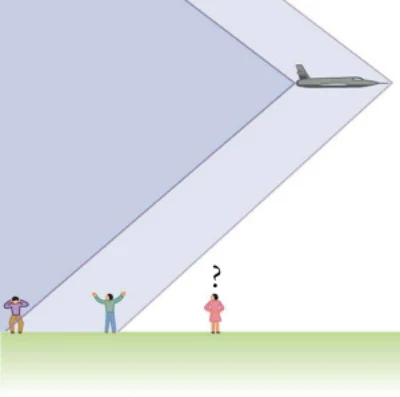
This result means that at the speed of sound, in front of the source, each wave is superimposed on the previous one because the source moves forward at the speed of sound. The observer gets them all at the same instant, and so the frequency is theoretically infinite. If the source exceeds the speed of sound, no sound is received by the observer until the source has passed, so that the sounds from the source when it was approaching are stacked up with those from it when receding, creating a sonic boom. A sonic boom is a constructive interference of sound created by an object moving faster than sound.
この結果が意味するのは、音の速さでは、源の前方で、源が音の速さで前へ進むために、一つひとつの波が前の波の上に重なるということである。観測者はそれらを同じ瞬間に受け取り、したがって振動数は理論上無限大になる。源が音の速さを超えると、源が通り過ぎるまで観測者に音は届かず、近づいてきたときの源からの音と、遠ざかるときの音とが積み重なって、ソニックブームができる。ソニックブームとは、音より速く動く物体が作る音の強め合う干渉である。
An aircraft creates two sonic booms, one from its nose and one from its tail (see Figure 14.17). During television coverage of space shuttle landings, two distinct booms could often be heard. These were separated by exactly the time it would take the shuttle to pass by a point. Observers on the ground often do not observe the aircraft creating the sonic boom, because it has passed by before the shock wave reaches them. If the aircraft flies close by at low altitude, pressures in the sonic boom can be destructive enough to break windows. Because of this, supersonic flights are banned over populated areas of the United States.
航空機は二つのソニックブームを作る。一つは機首から、もう一つは機尾からである(図14.17を見よ)。スペースシャトルの着陸のテレビ中継では、二つのはっきりした轟音がよく聞こえた。それらは、シャトルがある点を通り過ぎるのにかかる時間ちょうどだけ隔たっていた。地上の観測者は、衝撃波が届く前に機が通り過ぎてしまっているので、ソニックブームを作っている航空機を目にしないことが多い。機が低い高度ですぐそばを飛べば、ソニックブームの中の圧力は窓を割るほど破壊的でありうる。このため、アメリカでは人の住む地域の上空での超音速飛行が禁じられている。
Solving Problems Using the Doppler Shift Formulaドップラーずれの式を使って問題を解く
Doppler Effect Formula for Observed Frequency This video explains the Doppler effect formula for cases when the source is moving toward the observer.
観測される振動数のドップラー効果の式 この動画は、源が観測者へ向かって動く場合のドップラー効果の式を説明する。
Doppler effect formula for observed frequency | Physics | Khan Academy (https://www.openstax.org/l/ 28dopplerform)
観測される振動数のドップラー効果の式|物理|カーンアカデミー(https://www.openstax.org/l/28dopplerform)
GRASP CHECK Let’s say that you have a rare phobia where you are afraid of the Doppler effect. If you see an ambulance coming your way, what would be the best Strategy to minimize the Doppler effect and soothe your Doppleraphobia?a. Stop moving and become stationary till it passes by.b. Run toward the ambulance.
理解の確認 ドップラー効果が怖いという珍しい恐怖症を持っているとしよう。救急車がこちらへ向かってくるのが見えたとき、ドップラー効果を最小にしてドップラー恐怖症をなだめる最善の方法は何か。a. 動くのをやめ、通り過ぎるまで止まっている。b. 救急車へ向かって走る。
c. Run alongside the ambulance.
c. 救急車と並んで走る。
Doppler Effect Formula When Source is Moving Away This video explains the Doppler effect formula for cases when the source is moving away from the observer.
源が遠ざかるときのドップラー効果の式 この動画は、源が観測者から遠ざかる場合のドップラー効果の式を説明する。
Access multimedia content (http://openstax.org/books/physics/pages/14-3-doppler-effect-and-sonic-booms) Watch Physics: Doppler Effect Formula when Source is Moving Away. This video explains how the Doppler Effect formula differs when the source is moving away. Access multimedia content (http://openstax.org/books/physics/pages/14-3-doppler-effect-and-sonic-booms) Sal uses two different formulas for the Doppler effect-one for when the source is moving toward the observer and another for when the source is moving away. However, in this textbook we use only one formula. Explain.
マルチメディア教材はこちら(http://openstax.org/books/physics/pages/14-3-doppler-effect-and-sonic-booms)物理を見る:源が遠ざかるときのドップラー効果の式。この動画は、源が遠ざかるときドップラー効果の式がどう違うかを説明する。マルチメディア教材はこちら(http://openstax.org/books/physics/pages/14-3-doppler-effect-and-sonic-booms)サルはドップラー効果に二つの違う式——源が観測者へ向かって動く場合と遠ざかる場合——を使っている。しかしこの教科書では一つの式しか使わない。説明せよ。
a. The combined formula that can be used is, Use ( ) when the source is moving toward the observer and ( ) when the source is moving away from the observer.b. The combined formula that can be used is, . Use ( ) when the source is moving away
a. 使える組み合わせた式は次のとおり。源が観測者へ向かって動くときは()を、源が観測者から遠ざかるときは( )を使う。b. 使える組み合わせた式はである。源が観測者から遠ざかるときは()を、
from the observer and ( ) when the source is moving toward the observer. c. The combined formula that can be used is, . Use ( ) when the source is moving toward the observer and ( ) when the source is moving away from the observer. d. The combined formula that can be used is, . Use ( ) when the source is moving away from the observer and ( ) when the source is moving toward the observer.
源が観測者へ向かって動くときは( )を使う。 c. 使える組み合わせた式はである。源が観測者へ向かって動くときは()を、源が観測者から遠ざかるときは( )を使う。 d. 使える組み合わせた式はである。源が観測者から遠ざかるときは()を、源が観測者へ向かって動くときは( )を使う。
Calculate Doppler Shift: A Train Horn Suppose a train that has a 150 Hz horn is moving at 35 m/s in still air on a day when the speed of sound is 340 m/s. What frequencies are observed by a stationary person at the side of the tracks as the train approaches and after it passes?Strategy
ドップラーずれを計算する:列車の警笛 150 Hzの警笛を持つ列車が、音の速さが340 m/sの日に、静かな空気の中を35 m/sで動いているとする。線路脇に止まって立っている人には、列車が近づくとき、また通り過ぎたあと、どんな振動数が観測されるか。方針
To find the observed frequency, must be used because the source is moving. The minus sign is used for the approaching train, and the plus sign for the receding train.
源が動いているので、観測される振動数を求めるにはを使わねばならない。近づく列車にはマイナス符号を、遠ざかる列車にはプラス符号を使う。
Solution解答
(1) Enter known values into to calculate the frequency observed by a stationary person as the train approaches:
(1)分かっている値をに入れて、列車が近づくときに止まっている人が観測する振動数を計算する。
(2) Use the same equation but with the plus sign to find the frequency heard by a stationary person as the train recedes.
(2)同じ式でプラス符号を使い、列車が遠ざかるときに止まっている人に聞こえる振動数を求める。
Discussion考察
450The numbers calculated are valid when the train is far enough away that the motion is nearly along the line joining the train and the observer. In both cases, the shift is significant and easily noticed. Note that the shift is approximately 20 Hz for motion toward and approximately 10 Hz for motion away. The shifts are not symmetric.
計算された数は、列車が十分遠くにあって、運動がほぼ列車と観測者を結ぶ線に沿っている場合に成り立つ。どちらの場合もずれは大きく、簡単に気づく。近づくときのずれがおよそ20 Hz、遠ざかるときがおよそ10 Hzであることに注意しよう。ずれは対称ではない。
Practice Problems練習問題
15What is the observed frequency when the source having frequency is moving towards the observer at a speed of and the speed of sound is ?a. b.
15振動数の源が速さで観測者へ向かって動き、音の速さがのとき、観測される振動数はいくらか。a. b.
16A train is moving away from you at a speed of . If you are standing still and hear the whistle at a frequency of , what is the actual frequency of the produced whistle? (Assume speed of sound to be .)a. b.
16列車が速さであなたから遠ざかっている。あなたが止まって立っていて、汽笛が振動数で聞こえるとき、実際に出されている汽笛の振動数はいくらか。(音の速さはとする。)a. b.
Check Your Understanding理解の確認
17What is the Doppler effect?a. The Doppler effect is a change in the observed speed of a sound due to the relative motion between the source and the observer.b. The Doppler effect is a change in the observed frequency of a sound due to the relative motion between the source and the observer.c. The Doppler effect is a change in the observed intensity of a sound due to the relative motion between the source and the observer.d. The Doppler effect is a change in the observed timbre of a sound, due to the relative motion between the source and the observer.
17ドップラー効果とは何か。a. ドップラー効果とは、源と観測者の間の相対運動によって、観測される音の速さが変わることである。b. ドップラー効果とは、源と観測者の間の相対運動によって、観測される音の振動数が変わることである。c. ドップラー効果とは、源と観測者の間の相対運動によって、観測される音の強さが変わることである。d. ドップラー効果とは、源と観測者の間の相対運動によって、観測される音の音色が変わることである。
18Give an example of the Doppler effect caused by motion of the source.a. The sound of a vehicle horn shifts from low-pitch to high-pitch as we move towards it.b. The sound of a vehicle horn shifts from low-pitch to high-pitch as we move away from it.c. The sound of a vehicle horn shifts from low-pitch to high-pitch as it passes by.d. The sound of a vehicle horn shifts from high-pitch to low-pitch as it passes by.
18源の運動によるドップラー効果の例を挙げよ。a. こちらが車の警笛へ近づくにつれ、その音が低い音から高い音へずれる。b. こちらが車の警笛から遠ざかるにつれ、その音が低い音から高い音へずれる。c. 車の警笛が通り過ぎるにつれ、その音が低い音から高い音へずれる。d. 車の警笛が通り過ぎるにつれ、その音が高い音から低い音へずれる。
19What is a sonic boom?a. It is a destructive interference of sound created by an object moving faster than sound.b. It is a constructive interference of sound created by an object moving faster than sound.c. It is a destructive interference of sound created by an object moving slower than sound.d. It is a constructive interference of sound created by an object moving slower than sound.
19ソニックブームとは何か。a. 音より速く動く物体が作る音の弱め合う干渉である。b. 音より速く動く物体が作る音の強め合う干渉である。c. 音より遅く動く物体が作る音の弱め合う干渉である。d. 音より遅く動く物体が作る音の強め合う干渉である。
20What is the relation between speed of source and value of observed frequency when the source is moving towards the observer?
20源が観測者へ向かって動くとき、源の速さと観測される振動数の値の関係はどうなっているか。
a. They are independent of each other.b. The greater the speed, the greater the value of observed frequency.
a. 互いに無関係である。b. 速さが大きいほど観測される振動数の値は大きい。
c. The greater the speed, the smaller the value of observed frequency.d. The speed of the sound is directly proportional to the square of the frequency observed.
c. 速さが大きいほど観測される振動数の値は小さい。d. 音の速さは観測される振動数の2乗に正比例する。