第14章音Sound原書 p.431–472
14.4 Sound Interference and Resonance14.4 音の干渉と共鳴
SECTION LEARNING OBJECTIVES By the end of this section, you will be able to do the following:
この節の学習目標 この節を終えると、次のことができるようになる。
• Describe resonance and beats• Define fundamental frequency and harmonic series• Contrast an open-pipe and closed-pipe resonator• Solve problems involving harmonic series and beat frequency
・共鳴とうなりを述べる・基本振動数と倍音列を定義する・開管の共鳴体と閉管の共鳴体を対比する・倍音列とうなりの振動数に関する問題を解く
Section Key Termsこの節の重要語
beatbeat frequencydampingfundamentalharmonicsnatural frequencyovertonesresonanceresonate
うなりうなりの振動数減衰基本音倍音固有振動数上音共鳴共鳴する
Resonance and Beats共鳴とうなり
Sit in front of a piano sometime and sing a loud brief note at it while pushing down on the sustain pedal. It will sing the same note back at you—the strings that have the same frequencies as your voice, are resonating in response to the forces from the sound waves that you sent to them. This is a good example of the fact that objects—in this case, piano strings—can be forced to oscillate but oscillate best at their natural frequency.
いつかピアノの前に座り、ダンパーペダルを踏みながら短く大きな声を出してみるとよい。ピアノは同じ音を返してくる——あなたの声と同じ振動数を持つ弦が、あなたが送った音波からの力に応えて共鳴しているのである。これは、物体——この場合はピアノの弦——が振動させられうるが、その固有振動数で最もよく振動するという事実のよい例である。
A driving force (such as your voice in the example) puts energy into a system at a certain frequency, which is not necessarily the same as the natural frequency of the system. Over time the energy dissipates, and the amplitude gradually reduces to zero-this is called damping. The natural frequency is the frequency at which a system would oscillate if there were no driving and no damping force. The phenomenon of driving a system with a frequency equal to its natural frequency is called resonance, and a system being driven at its natural frequency is said to resonate.
(この例でのあなたの声のような)駆動する力は、ある振動数で系にエネルギーを入れる。その振動数は、系の固有振動数と同じとは限らない。時間がたつにつれてエネルギーは散り、振幅はしだいに0まで減っていく。これを減衰という。固有振動数とは、駆動する力も減衰する力もなければ系が振動するであろう振動数である。系をその固有振動数に等しい振動数で駆動する現象を共鳴といい、固有振動数で駆動されている系は共鳴しているという。
Most of us have played with toys where an object bobs up and down on an elastic band, something like the paddle ball suspended from a finger in Figure 14.18. At first you hold your finger steady, and the ball bounces up and down with a small amount of damping. If you move your finger up and down slowly, the ball will follow along without bouncing much on its own. As you increase the frequency at which you move your finger up and down, the ball will respond by oscillating with increasing amplitude. When you drive the ball at its natural frequency, the ball’s oscillations increase in amplitude with each oscillation for as long as you drive it. As the driving frequency gets progressively higher than the resonant or natural frequency, the amplitude of the oscillations becomes smaller, until the oscillations nearly disappear and your finger simply moves up and down with little effect on the ball.
私たちの多くは、輪ゴムの先で物が上下に跳ねるおもちゃで遊んだことがある。図14.18で指から吊るされたパドルボールのようなものである。はじめは指を止めておき、ボールは少しの減衰をともないながら上下に跳ねる。指をゆっくり上下させれば、ボールはそれについてきて、あまり自分では跳ねない。指を上下させる振動数を上げていくと、ボールはだんだん大きな振幅で振動して応える。ボールをその固有振動数で駆動すると、駆動し続ける限り、振動のたびにボールの振動の振幅は増していく。駆動する振動数が共鳴の振動数、すなわち固有振動数よりどんどん高くなると、振動の振幅は小さくなり、ついには振動がほとんど消え、指はボールにほとんど影響を与えずに上下するだけになる。
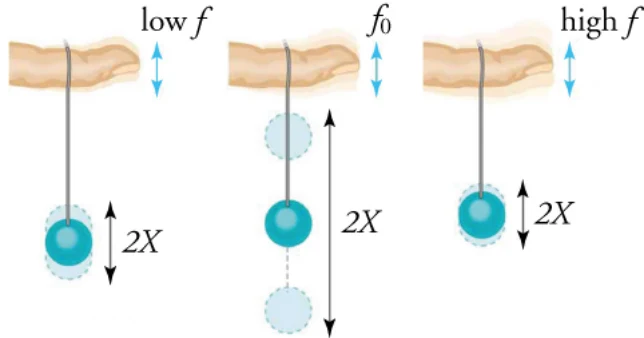
Another example is that when you tune a radio, you adjust its resonant frequency so that it oscillates only at the desired station’s broadcast (driving) frequency. Also, a child on a swing is driven (pushed) by a parent at the swing’s natural frequency to reach the maximum amplitude (height). In all of these cases, the efficiency of energy transfer from the driving force into the oscillator is best at resonance.
もう一つの例が、ラジオの選局をするとき、望みの局の放送(駆動)振動数だけで振動するように共鳴の振動数を合わせることである。また、ぶらんこに乗った子どもは、最大の振幅(高さ)に達するように、ぶらんこの固有振動数で親に駆動される(押される)。これらのどの場合も、駆動する力から振動するものへのエネルギーの移りの効率は、共鳴のときに最もよい。

All sound resonances are due to constructive and destructive interference. Only the resonant frequencies interfere constructively to form standing waves, while others interfere destructively and are absent. From the toot made by blowing over a bottle to the recognizability of a great singer’s voice, resonance and standing waves play a vital role in sound.
音の共鳴はすべて、強め合う干渉と弱め合う干渉によるものである。共鳴の振動数だけが強め合う干渉をして定常波を作り、他の振動数は弱め合う干渉をして消えてしまう。瓶の口に息を吹きかけて出す音から、偉大な歌手の声の聞き分けやすさまで、共鳴と定常波は音で欠かせない役割を果たしている。
Interference happens to all types of waves, including sound waves. In fact, one way to support that something is a wave is to observe interference effects. Figure 14.19 shows a set of headphones that employs a clever use of sound interference to cancel noise. To get destructive interference, a fast electronic analysis is performed, and a second sound is introduced with its maxima and minima exactly reversed from the incoming noise.
干渉は音波を含めあらゆる種類の波に起こる。実のところ、何かが波であることを裏づける一つのやり方が、干渉の効果を観察することである。図14.19は、騒音を打ち消すのに音の干渉を巧みに使ったヘッドホンを示す。弱め合う干渉を得るために、高速の電子的な解析が行われ、入ってくる騒音と最大と最小をちょうど逆にした第二の音が加えられる。
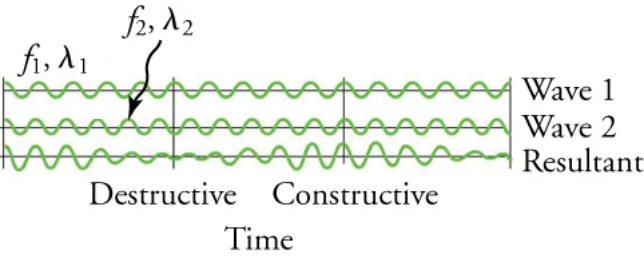
In addition to resonance, superposition of waves can also create beats. Beats are produced by the superposition of two waves with slightly different frequencies but the same amplitude. The waves alternate in time between constructive interference and destructive interference, giving the resultant wave an amplitude that varies over time. (See the resultant wave in Figure 14.20).
共鳴に加えて、波の重ね合わせはうなりも作りうる。うなりは、振動数がわずかに違い振幅は同じ二つの波の重ね合わせで生じる。波は時間とともに強め合う干渉と弱め合う干渉を交互に繰り返し、できあがる波の振幅を時間とともに変化させる。(図14.20のできあがった波を見よ。)
This wave fluctuates in amplitude, or beats, with a frequency called the beat frequency. The equation for beat frequency is
この波は、うなりの振動数と呼ばれる振動数で振幅を揺らす、すなわちうなる。うなりの振動数の式は
where f1 and f2 are the frequencies of the two original waves. If the two frequencies of sound waves are similar, then what we hear is an average frequency that gets louder and softer at the beat frequency.
となる。ここでf1とf2はもとの二つの波の振動数である。二つの音波の振動数が近ければ、聞こえるのは平均の振動数の音が、うなりの振動数で大きくなったり小さくなったりするものである。
TIPS FOR SUCCESS Don’t confuse the beat frequency with the regular frequency of a wave resulting from superposition. While the beat frequency is given by the formula above, and describes the frequency of the beats, the actual frequency of the wave resulting from superposition is the average of the frequencies of the two original waves.
学習のポイント うなりの振動数を、重ね合わせでできた波のふつうの振動数と混同しないこと。うなりの振動数は上の式で与えられ、うなりの振動数を表すが、重ね合わせでできた波の実際の振動数は、もとの二つの波の振動数の平均である。
VIRTUAL PHYSICSシミュレーションWave Interference波の干渉
For this activity (https://openstax.org/l/28interference), switch to the Sound tab. Turn on the Sound option, and experiment with changing the frequency and amplitude, and adding in a second speaker and a barrier.
この活動(https://openstax.org/l/28interference)では「音」タブに切り替える。音の設定を入れ、振動数と振幅を変えたり、スピーカーをもう一つや壁を足したりして試してみよう。
According to the graph, what happens to the amplitude of pressure over time. What is this phenomenon called, and what causes it ?
グラフによれば、圧力の振幅は時間とともにどうなるか。この現象を何と呼び、何がそれを起こすのか。
a. The amplitude decreases over time. This phenomenon is called damping. It is caused by the dissipation of energy.b. The amplitude increases over time. This phenomenon is called feedback. It is caused by the gathering of energy.c. The amplitude oscillates over time. This phenomenon is called echoing. It is caused by fluctuations in energy.
a. 振幅は時間とともに減る。この現象を減衰という。エネルギーが散ることで起こる。b. 振幅は時間とともに増える。この現象をフィードバックという。エネルギーが集まることで起こる。c. 振幅は時間とともに揺れる。この現象をこだまという。エネルギーの揺らぎによって起こる。
Fundamental Frequency and Harmonics基本振動数と倍音
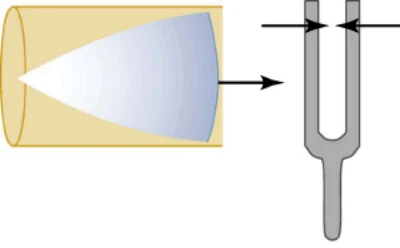
Suppose we hold a tuning fork near the end of a tube that is closed at the other end, as shown in Figure 14.21, Figure 14.22, and Figure 14.23. If the tuning fork has just the right frequency, the air column in the tube resonates loudly, but at most frequencies it vibrates very little. This means that the air column has only certain natural frequencies. The figures show how a resonance at the lowest of these natural frequencies is formed. A disturbance travels down the tube at the speed of sound and bounces off the closed end. If the tube is just the right length, the reflected sound arrives back at the tuning fork exactly half a cycle later, and it interferes constructively with the continuing sound produced by the tuning fork. The incoming and reflected sounds form a standing wave in the tube as shown.
図14.21、図14.22、図14.23に示すように、一方の端が閉じた管のもう一方の端の近くで音叉を鳴らすとしよう。音叉の振動数がちょうどよければ、管の中の空気の柱は大きく共鳴するが、たいていの振動数ではほとんど振動しない。これは、空気の柱がある決まった固有振動数しか持たないということである。図は、これらの固有振動数のうち最も低いもので共鳴がどうできるかを示す。乱れが音の速さで管を下っていき、閉じた端ではね返る。管の長さがちょうどよければ、反射した音はちょうど半周期あとに音叉のところへ戻り、音叉が出し続けている音と強め合う干渉をする。入ってくる音と反射した音は、図のように管の中に定常波を作る。
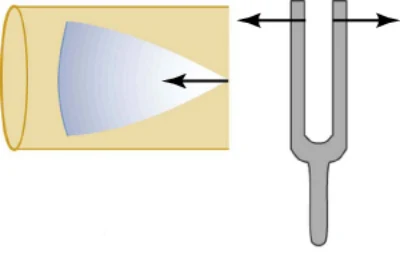
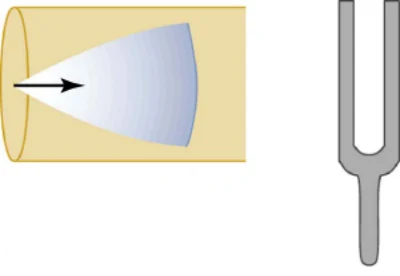
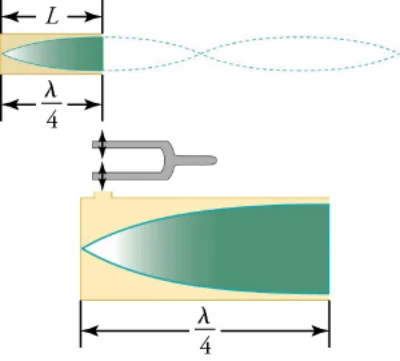
The standing wave formed in the tube has its maximum air displacement (an antinode) at the open end, and no displacement (a node) at the closed end. Recall from the last chapter on waves that motion is unconstrained at the antinode, and halted at the node. The distance from a node to an antinode is one-fourth of a wavelength, and this equals the length of the tube; therefore, . This same resonance can be produced by a vibration introduced at or near the closed end of the tube, as shown in Figure 14.24.
管の中にできる定常波は、開いた端で空気の変位が最大(腹)、閉じた端では変位なし(節)になる。前の波の章から、腹では運動が妨げられず、節では止められることを思い出そう。節から腹までの距離は波長の4分の1で、これが管の長さに等しい。したがってである。この同じ共鳴は、図14.24に示すように、管の閉じた端かその近くに振動を与えても作れる。
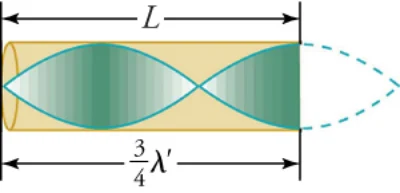
Since maximum air displacements are possible at the open end and none at the closed end, there are other, shorter wavelengths that can resonate in the tube see Figure 14.25). Here the standing wave has three-fourths of its wavelength in the tube, or , so that . There is a whole series of shorter-wavelength and higher-frequency sounds that resonate in the tube.
開いた端で空気の変位が最大になり、閉じた端では変位が0になりうるので、管の中で共鳴できるもっと短い波長が他にもある(図14.25を見よ)。ここでは定常波の波長の4分の3が管の中に収まっている。すなわちなのでである。管の中で共鳴する、より短い波長でより高い振動数の音が、ひと続きに並んでいる。
We use specific terms for the resonances in any system. The lowest resonant frequency is called the fundamental, while all higher resonant frequencies are called overtones. All resonant frequencies are multiples of the fundamental, and are called harmonics. The fundamental is the first harmonic, the first overtone is the second harmonic, and so on. Figure 14.26 shows the fundamental and the first three overtones (the first four harmonics) in a tube closed at one end.
どんな系についても、共鳴には決まった呼び名を使う。最も低い共鳴の振動数を基本音といい、それより高い共鳴の振動数はすべて上音という。共鳴の振動数はすべて基本音の整数倍であり、倍音と呼ばれる。基本音が第一倍音、第一上音が第二倍音、という具合である。図14.26は、一方の端が閉じた管における基本音と最初の三つの上音(最初の四つの倍音)を示す。
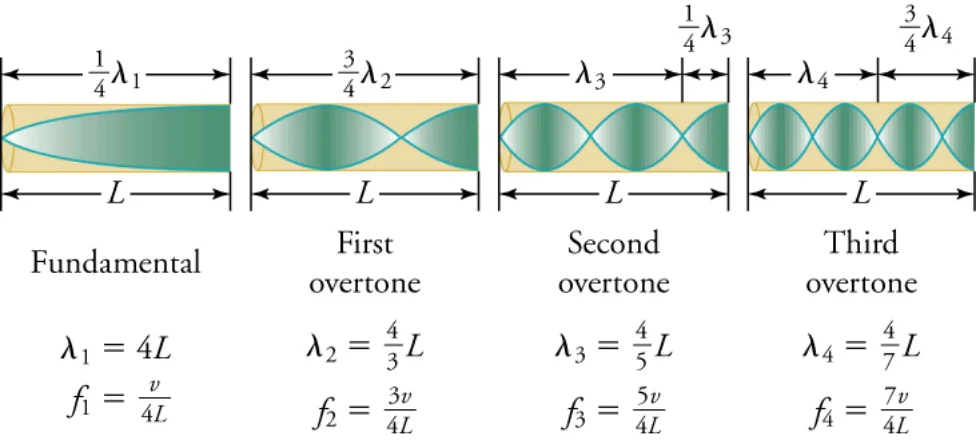
The fundamental and overtones can be present at the same time in a variety of combinations. For example, the note middle C on a trumpet sounds very different from middle C on a clarinet, even though both instruments are basically modified versions of a tube closed at one end. The fundamental frequency is the same (and usually the most intense), but the overtones and their mix of intensities are different. This mix is what gives musical instruments (and human voices) their distinctive characteristics, whether they have air columns, strings, or drumheads. In fact, much of our speech is determined by shaping the cavity formed by the throat and mouth and positioning the tongue to adjust the fundamental and combination of overtones.
基本音と上音は、さまざまな組み合わせで同時に存在しうる。たとえばトランペットの中央ハの音は、クラリネットの中央ハとまるで違って聞こえる。どちらの楽器も、基本的には一方の端が閉じた管を作り替えたものであるのに、である。基本振動数は同じ(そしてたいていは最も強い)だが、上音とその強さの混ざり具合が違う。この混ざり具合こそが、空気の柱を持つものであれ、弦や太鼓の皮を持つものであれ、楽器(そして人の声)に独特の性格を与えている。実のところ、私たちの話し言葉の多くは、のどと口が作る空洞の形と舌の位置によって、基本音と上音の組み合わせを調整することで決まっている。
Open-Pipe and Closed-Pipe Resonators開管の共鳴体と閉管の共鳴体
The resonant frequencies of a tube closed at one end (known as a closed-pipe resonator) are
一方の端が閉じた管(閉管の共鳴体という)の共鳴の振動数は
where f1 is the fundamental, f3 is the first overtone, and so on. Note that the resonant frequencies depend on the speed of sound v and on the length of the tube L.
となる。ここでf1は基本音、f3は第一上音、という具合である。共鳴の振動数は音の速さvと管の長さLによることに注意しよう。
Another type of tube is one that is open at both ends (known as an open-pipe resonator). Examples are some organ pipes, flutes, and oboes. The air columns in tubes open at both ends have maximum air displacements at both ends. (See Figure 14.27). Standing waves form as shown.
もう一つの型の管が、両端が開いたもの(開管の共鳴体という)である。パイプオルガンの管の一部、フルート、オーボエがその例である。両端が開いた管の中の空気の柱は、両端で空気の変位が最大になる。(図14.27を見よ。)図のように定常波ができる。
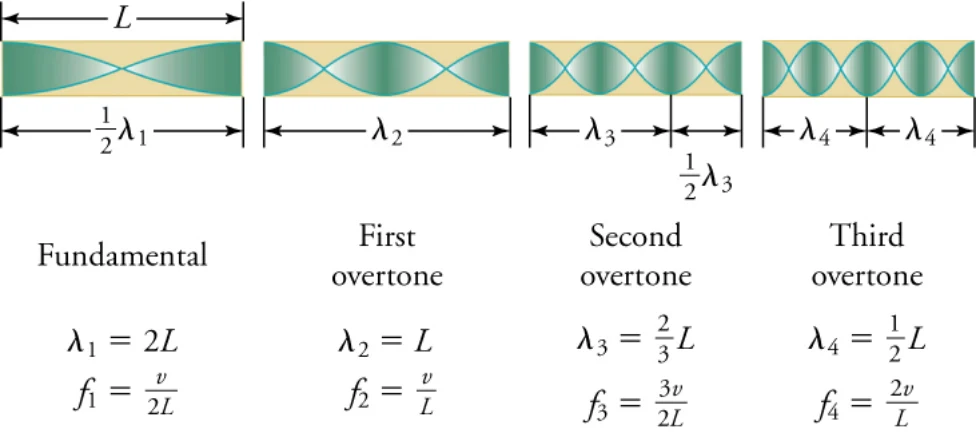
The resonant frequencies of an open-pipe resonator are
開管の共鳴体の共鳴の振動数は
where f1 is the fundamental, f2 is the first overtone, f3 is the second overtone, and so on. Note that a tube open at both ends has a fundamental frequency twice what it would have if closed at one end. It also has a different spectrum of overtones than a tube closed at one end. So if you had two tubes with the same fundamental frequency but one was open at both ends and the other was closed at one end, they would sound different when played because they have different overtones.
となる。ここでf1は基本音、f2は第一上音、f3は第二上音、という具合である。両端が開いた管は、一方の端が閉じている場合の2倍の基本振動数を持つことに注意しよう。上音の並びも、一方の端が閉じた管とは違う。したがって、基本振動数が同じ二つの管があり、一方は両端が開き、もう一方は一方の端が閉じているなら、上音が違うので、鳴らしたときの音は違って聞こえる。
Middle C, for example, would sound richer played on an open tube since it has more overtones. An open-pipe resonator has more overtones than a closed-pipe resonator because it has even multiples of the fundamental as well as odd, whereas a closed tube has only odd multiples.
たとえば中央ハは、上音がより多いので、開いた管で鳴らしたほうが豊かに聞こえるだろう。開管の共鳴体は閉管の共鳴体より上音が多い。基本音の奇数倍だけでなく偶数倍も持つのに対し、閉じた管は奇数倍しか持たないからである。
In this section we have covered resonance and standing waves for wind instruments, but vibrating strings on stringed instruments also resonate and have fundamentals and overtones similar to those for wind instruments.
この節では管楽器の共鳴と定常波を扱ってきたが、弦楽器の振動する弦も共鳴し、管楽器と似た基本音と上音を持つ。
Solving Problems Involving Harmonic Series and Beat Frequency倍音列とうなりの振動数に関する問題を解く
Finding the Length of a Tube for a Closed-Pipe Resonator If sound travels through the air at a speed of 344 m/s, what should be the length of a tube closed at one end to have a fundamental frequency of 128 Hz? Strategy
閉管の共鳴体の管の長さを求める 音が空気中を344 m/sの速さで進むとき、基本振動数を128 Hzにするには、一方の端が閉じた管の長さをどれだけにすべきか。 方針
The length L can be found by rearranging the equation .
長さLは、式を変形すれば求まる。
Solution解答
(1) Identify knowns.
(1)分かっているものを見きわめる。
• The fundamental frequency is 128 Hz.• The speed of sound is 344 m/s. (2) Use to find the fundamental frequency (n = 1).
・基本振動数は128 Hzである。・音の速さは344 m/sである。 (2)を使って基本振動数(n = 1)を求める。
(3) Solve this equation for length.
(3)この式を長さについて解く。
(4) Enter the values of the speed of sound and frequency into the expression for L.
(4)音の速さと振動数の値をLの式に入れる。
Discussion考察
Many wind instruments are modified tubes that have finger holes, valves, and other devices for changing the length of the resonating air column and therefore, the frequency of the note played. Horns producing very low frequencies, such as tubas, require tubes so long that they are coiled into loops.
多くの管楽器は、共鳴する空気の柱の長さ、したがって鳴らされる音の振動数を変えるために、指孔・弁などの仕組みを持つ管を作り替えたものである。チューバのようなとても低い振動数を出す管楽器は、輪に巻かねばならないほど長い管を必要とする。
Finding the Third Overtone in an Open-Pipe Resonator If a tube that’s open at both ends has a fundamental frequency of 120 Hz, what is the frequency of its third overtone? Strategy
開管の共鳴体で第三上音を求める 両端が開いた管の基本振動数が120 Hzのとき、その第三上音の振動数はいくらか。 方針
Since we already know the value of the fundamental frequency (n = 1), we can solve for the third overtone (n = 4) using the equation .
基本振動数(n = 1)の値がすでに分かっているので、式を使って第三上音(n = 4)を求められる。
Solution解答
Since fundamental frequency (n = 1) is
基本振動数(n = 1)が
and
であり、
Discussion考察
To solve this problem, it wasn’t necessary to know the length of the tube or the speed of the air because of the relationship between the fundamental and the third overtone. This example was of an open-pipe resonator; note that for a closed-pipe resonator, the third overtone has a value of n = 7 (not n = 4).
この問題を解くのに、管の長さも空気中の音の速さも知る必要はなかった。基本音と第三上音の関係のおかげである。この例は開管の共鳴体だった。閉管の共鳴体では、第三上音はn = 7(n = 4ではない)の値をとることに注意しよう。
Using Beat Frequency to Tune a Piano Piano tuners use beats routinely in their work. When comparing a note with a tuning fork, they listen for beats and adjust the string until the beats go away (to zero frequency). If a piano tuner hears two beats per second, and the tuning fork has a frequency of 256 Hz, what are the possible frequencies of the piano?Strategy
うなりの振動数を使ってピアノを調律する ピアノの調律師は仕事でいつもうなりを使う。音を音叉と比べるとき、うなりを聞き、うなりが(振動数0に)なくなるまで弦を調節する。調律師が毎秒2回のうなりを聞き、音叉の振動数が256 Hzのとき、ピアノのありうる振動数はいくらか。方針
Since we already know that the beat frequency fB is 2, and one of the frequencies (let’s say f2) is 256 Hz, we can use the equation to solve for the frequency of the piano f1.
うなりの振動数fBが2で、振動数の一方(f2としよう)が256 Hzだとすでに分かっているので、式を使ってピアノの振動数f1を求められる。
Solution解答
Since ,
なので、
we know that either or .
かのどちらかだと分かる。
Solving for f1,
f1について解くと、
Substituting in values,
値を代入すると、
So,
したがって、
Discussion考察
The piano tuner might not initially be able to tell simply by listening whether the frequency of the piano is too high or too low and must tune it by trial and error, making an adjustment and then testing it again. If there are even more beats after the adjustment, then the tuner knows that he went in the wrong direction.
調律師は、ピアノの振動数が高すぎるのか低すぎるのかを、はじめは聞くだけでは判断できないかもしれず、調節してからまた試すという試行錯誤で合わせねばならない。調節したあとうなりがさらに増えたなら、逆の向きへ動かしてしまったと分かる。
Practice Problems練習問題
21Two sound waves have frequencies and . What is the beat frequency produced by their superposition?
21二つの音波の振動数がとである。この二つの重ね合わせが生むうなりの振動数はいくらか。
22What is the length of a pipe closed at one end with fundamental frequency ? (Assume the speed of sound in air is .)a. b.
22基本振動数がの、一方の端が閉じた管の長さはいくらか。(空気中の音の速さはとする。)a. b.
Check Your Understanding理解の確認
23What is damping?a. Over time the energy increases and the amplitude gradually reduces to zero. This is called damping.b. Over time the energy dissipates and the amplitude gradually increases. This is called damping.
23減衰とは何か。a. 時間とともにエネルギーが増え、振幅がしだいに0まで減ること。これを減衰という。b. 時間とともにエネルギーが散り、振幅がしだいに増えること。これを減衰という。
c. Over time the energy increases and the amplitude gradually increases. This is called damping.d. Over time the energy dissipates and the amplitude gradually reduces to zero. This is called damping.
c. 時間とともにエネルギーが増え、振幅がしだいに増えること。これを減衰という。d. 時間とともにエネルギーが散り、振幅がしだいに0まで減ること。これを減衰という。
24What is resonance? When can you say that the system is resonating?
24共鳴とは何か。系が共鳴しているといえるのはどんなときか。
a. The phenomenon of driving a system with a frequency equal to its natural frequency is called resonance, and a system being driven at its natural frequency is said to resonate.b. The phenomenon of driving a system with a frequency higher than its natural frequency is called resonance, and a system being driven at its natural frequency does not resonate.c. The phenomenon of driving a system with a frequency equal to its natural frequency is called resonance, and a system being driven at its natural frequency does not resonate.d. The phenomenon of driving a system with a frequency higher than its natural frequency is called resonance, and a system being driven at its natural frequency is said to resonate.
a. 系をその固有振動数に等しい振動数で駆動する現象を共鳴といい、固有振動数で駆動されている系は共鳴しているという。b. 系をその固有振動数より高い振動数で駆動する現象を共鳴といい、固有振動数で駆動されている系は共鳴していない。c. 系をその固有振動数に等しい振動数で駆動する現象を共鳴といい、固有振動数で駆動されている系は共鳴していない。d. 系をその固有振動数より高い振動数で駆動する現象を共鳴といい、固有振動数で駆動されている系は共鳴しているという。
25In the tuning fork and tube experiment, in case a standing wave is formed, at what point on the tube is the maximum disturbance from the tuning fork observed? Recall that the tube has one open end and one closed end.
25音叉と管の実験で、定常波ができた場合、音叉による乱れが最大になるのは管のどの点か。管は一方の端が開き、もう一方が閉じていることを思い出そう。
a. At the midpoint of the tubeb. Both ends of the tube
a. 管の中央b. 管の両端
c. At the closed end of the tubed. At the open end of the tube
c. 管の閉じた端d. 管の開いた端
26In the tuning fork and tube experiment, when will the air column produce the loudest sound?a. If the tuning fork vibrates at a frequency twice that of the natural frequency of the air column.b. If the tuning fork vibrates at a frequency lower than the natural frequency of the air column.
26音叉と管の実験で、空気の柱が最も大きな音を出すのはどんなときか。a. 音叉が空気の柱の固有振動数の2倍の振動数で振動するとき。b. 音叉が空気の柱の固有振動数より低い振動数で振動するとき。
c. If the tuning fork vibrates at a frequency higher than the natural frequency of the air column.d. If the tuning fork vibrates at a frequency equal to the natural frequency of the air column.
c. 音叉が空気の柱の固有振動数より高い振動数で振動するとき。d. 音叉が空気の柱の固有振動数に等しい振動数で振動するとき。
27What is a closed-pipe resonator?a. A pipe or cylindrical air column closed at both endsb. A pipe with an antinode at the closed end
27閉管の共鳴体とは何か。a. 両端が閉じた管あるいは円筒形の空気の柱b. 閉じた端に腹がある管
c. A pipe with a node at the open endd. A pipe or cylindrical air column closed at one end
c. 開いた端に節がある管d. 一方の端が閉じた管あるいは円筒形の空気の柱
28Give two examples of open-pipe resonators.a. piano, violinb. drum, tabla
28開管の共鳴体の例を二つ挙げよ。a. ピアノ、バイオリンb. 太鼓、タブラ
c. rlectric guitar, acoustic guitard. flute, oboe
c. エレキギター、アコースティックギターd. フルート、オーボエ