第14章音Sound原書 p.431–472
Chapter Review章のまとめ
Concept Items概念の問題
14.1 Speed of Sound, Frequency, and Wavelength 1What is the amplitude of a sound wave perceived by the human ear?
14.1 音の速さ、振動数、波長 1人の耳が感じ取る音波の振幅は何か。
a. loudnessb. pitch
a. 音の大きさb. 音の高さ
c. intensityd. timbre
c. 強さd. 音色
2The compressibility of air and hydrogen is almost the same. Which factor is the reason that sound travels faster in hydrogen than in air?
2空気と水素の圧縮しやすさはほぼ同じである。音が空気より水素の中を速く進むのは、どの要因によるか。
a. Hydrogen is more dense than air.b. Hydrogen is less dense than air.
a. 水素は空気より密度が大きい。b. 水素は空気より密度が小さい。
c. Hydrogen atoms are heavier than air molecules.d. Hydrogen atoms are lighter than air molecules.
c. 水素の原子は空気の分子より重い。d. 水素の原子は空気の分子より軽い。
14.2 Sound Intensity and Sound Level 3What is the mathematical relationship between intensity, power, and area?
14.2 音の強さと音の大きさのレベル 3強さ・仕事率・面積の数式での関係はどれか。
end are , where f1 is the fundamental and L is the length of the tube. • The resonant frequencies of a tube open at both ends are
である。ここでf1は基本音、Lは管の長さである。 ・両端が開いた管の共鳴の振動数はである。
14.3 Doppler Effect and Sonic Booms14.3 ドップラー効果とソニックブーム
Doppler effect observed frequency (moving source)
ドップラー効果で観測される振動数(動く源)
Doppler effect observed frequency (moving observer)
ドップラー効果で観測される振動数(動く観測者)
14.4 Sound Interference and Resonance14.4 音の干渉と共鳴
beat frequency
うなりの振動数
resonant frequencies of a closed-pipe resonator
閉管の共鳴体の共鳴の振動数
resonant frequencies of an open-pipe resonator
開管の共鳴体の共鳴の振動数
4How does the "decibel" get its name?a. The meaning of deci is “hundred” and the number of decibels is one-hundredth of the logarithm to base 10 of the ratio of two sound intensities.b. The meaning of deci is "ten" and the number of decibels is one-tenth of the logarithm to base 10 of the ratio of two sound intensities.c. The meaning of deci is “one-hundredth” and the number of decibels is hundred times the logarithm to base 10 of the ratio of two sound intensities.d. The meaning of deci is “one-tenth” and the number of decibels is ten times the logarithm to base 10 of the ratio of two sound intensities.
4「デシベル」という名はどこから来ているか。a. デシは「百」を意味し、デシベルの数は二つの音の強さの比の常用対数の100分の1である。b. デシは「十」を意味し、デシベルの数は二つの音の強さの比の常用対数の10分の1である。c. デシは「100分の1」を意味し、デシベルの数は二つの音の強さの比の常用対数の100倍である。d. デシは「10分の1」を意味し、デシベルの数は二つの音の強さの比の常用対数の10倍である。
5What is “timbre” of sound? a. Timbre is the quality of the sound that distinguishes it from other sound
5音の「音色」とは何か。 a. 音色とは、その音を他の音と区別する
b. Timbre is the loudness of the sound that distinguishes it from other sound.c. Timbre is the pitch of the sound that distinguishes it from other sound.d. Timbre is the wavelength of the sound that distinguishes it from other sound.
b. 音色とは、その音を他の音と区別する音の大きさである。c. 音色とは、その音を他の音と区別する音の高さである。d. 音色とは、その音を他の音と区別する音の波長である。
14.3 Doppler Effect and Sonic Booms 6Two sources of sound producing the same frequency are moving towards you at different speeds. Which one would sound more high-pitched?
14.3 ドップラー効果とソニックブーム 6同じ振動数を出す二つの音源が、違う速さであなたへ向かって動いている。どちらがより高い音に聞こえるか。
a. the one moving slowerb. the one moving faster
a. 遅いほうb. 速いほう
7When the speed of the source matches the speed of sound, what happens to the amplitude of the sound wave? Why?
7源の速さが音の速さに等しくなると、音波の振幅はどうなるか。それはなぜか。
a. It approaches zero. This is because all wave crests are superimposed on one another through constructive interference.b. It approaches infinity. This is because all wave crests are superimposed on one another through constructive interference.c. It approaches zero, because all wave crests are superimposed on one another through destructive interference.d. It approaches infinity, because all wave crests are superimposed on one another through destructive interference.
a. 0に近づく。強め合う干渉によってすべての波の山が互いに重なるから。b. 無限大に近づく。強め合う干渉によってすべての波の山が互いに重なるから。c. 0に近づく。弱め合う干渉によってすべての波の山が互いに重なるから。d. 無限大に近づく。弱め合う干渉によってすべての波の山が互いに重なるから。
8What is the mathematical expression for the frequency perceived by the observer in the case of a stationary observer and a moving source?
8止まっている観測者と動く源の場合に、観測者が感じ取る振動数を表す数式はどれか。
14.4 Sound Interference and Resonance 9When does a yo-yo travel the farthest from the finger?
14.4 音の干渉と共鳴 9ヨーヨーが指から最も遠くまで行くのはどんなときか。
a. when the amplitude of the finger moving up and down is greater than the amplitude
a. 指を上下させる振幅がヨーヨーの振幅より
Critical Thinking Items批判的に考える問題
14.1 Speed of Sound, Frequency, and Wavelength 13What can be said about the frequency of a monotonous sound?
14.1 音の速さ、振動数、波長 13単調な音の振動数について何が言えるか。
of the yo-yob. when the amplitude of the finger moving up and down is less than the amplitude of the yo-yoc. when the frequency of the finger moving up and down is equal to the resonant frequency of the yo-yod. when the frequency of the finger moving up and down is different from the resonant frequency of the yo-yo
大きいときb. 指を上下させる振幅がヨーヨーの振幅より小さいときc. 指を上下させる振動数がヨーヨーの共鳴の振動数に等しいときd. 指を上下させる振動数がヨーヨーの共鳴の振動数と違うとき
10What is the difference between harmonics and overtones?
10倍音と上音の違いは何か。
a. Harmonics are all multiples of the fundamental frequency. The first overtone is actually the first harmonic.b. Harmonics are all multiples of the fundamental frequency. The first overtone is actually the second harmonic.c. Harmonics are all multiples of the fundamental frequency. The second overtone is actually the first harmonic.d. Harmonics are all multiples of the fundamental frequency. The third overtone is actually the second harmonic.
a. 倍音はすべて基本振動数の整数倍である。第一上音は実は第一倍音である。b. 倍音はすべて基本振動数の整数倍である。第一上音は実は第二倍音である。c. 倍音はすべて基本振動数の整数倍である。第二上音は実は第一倍音である。d. 倍音はすべて基本振動数の整数倍である。第三上音は実は第二倍音である。
11What kind of waves form in pipe resonators?a. damped wavesb. propagating waves
11管の共鳴体の中にできるのはどんな波か。a. 減衰する波b. 伝わっていく波
c. high-frequency wavesd. standing waves
c. 高い振動数の波d. 定常波
12What is the natural frequency of a system?a. The natural frequency is the frequency at which a system oscillates when it undergoes forced vibration.b. The natural frequency is the frequency at which a system oscillates when it undergoes damped oscillation.c. The natural frequency is the frequency at which a system oscillates when it undergoes free vibration without a driving force or damping.d. The natural frequency is the frequency at which a system oscillates when it undergoes forced vibration with damping.
12系の固有振動数とは何か。a. 固有振動数とは、強制振動をするときに系が振動する振動数である。b. 固有振動数とは、減衰振動をするときに系が振動する振動数である。c. 固有振動数とは、駆動する力も減衰もなしに自由振動をするときに系が振動する振動数である。d. 固有振動数とは、減衰をともなう強制振動をするときに系が振動する振動数である。
a. It decreases with time.b. It decreases with distance.c. It increases with distance.d. It remains constant.
a. 時間とともに下がる。b. 距離とともに下がる。c. 距離とともに上がる。d. 変わらない。
14A scientist notices that a sound travels faster through a solid material than through the air. Which of the following can explain this?
14ある科学者が、音が空気中よりも固体の材料の中を速く進むことに気づいた。これを説明できるのは次のどれか。
a. Solid materials are denser than air.b. Solid materials are less dense than air.c. A solid is more rigid than air.d. A solid is easier to compress than air.
a. 固体の材料は空気より密度が大きい。b. 固体の材料は空気より密度が小さい。c. 固体は空気より硬い。d. 固体は空気より圧縮しやすい。
14.2 Sound Intensity and Sound Level 15Which property of the wave is related to its intensity? How?
14.2 音の強さと音の大きさのレベル 15波のどの性質がその強さに関係するか。どう関係するか。
a. The frequency of the wave is related to the intensity of the sound. The larger-frequency oscillations indicate greater pressure maxima and minima, and the pressure is higher in greater-intensity sound.b. The wavelength of the wave is related to the intensity of the sound. The longer-wavelength oscillations indicate greater pressure maxima and minima, and the pressure is higher in greater-intensity sound.c. The amplitude of the wave is related to the intensity of the sound. The larger-amplitude oscillations indicate greater pressure maxima and minima, and the pressure is higher in greater-intensity sound.d. The speed of the wave is related to the intensity of the sound. The higher-speed oscillations indicate greater pressure maxima and minima, and the pressure is higher in greater-intensity sound.
a. 波の振動数が音の強さに関係する。振動数の大きい振動は圧力の最大と最小が大きいことを示し、強さの大きい音では圧力が高い。b. 波の波長が音の強さに関係する。波長の長い振動は圧力の最大と最小が大きいことを示し、強さの大きい音では圧力が高い。c. 波の振幅が音の強さに関係する。振幅の大きい振動は圧力の最大と最小が大きいことを示し、強さの大きい音では圧力が高い。d. 波の速さが音の強さに関係する。速さの大きい振動は圧力の最大と最小が大きいことを示し、強さの大きい音では圧力が高い。
16Why is decibel (dB) used to describe loudness of sound?
16音の大きさを述べるのにデシベル(dB)が使われるのはなぜか。
a. Because, human ears have an inverse response to the amplitude of sound.b. Because, human ears have an inverse response to the intensity of sound.c. Because, the way our ears perceive sound can be more accurately described by the amplitude of a sound rather than the intensity of a sound directly.d. Because, the way our ears perceive sound can be more accurately described by the logarithm of the intensity of a sound rather than the intensity of a sound directly.
a. 人の耳は音の振幅に反比例して応えるから。b. 人の耳は音の強さに反比例して応えるから。c. 私たちの耳が音を感じ取るしかたは、音の強さそのものより音の振幅によってより正確に述べられるから。d. 私たちの耳が音を感じ取るしかたは、音の強さそのものより音の強さの対数によってより正確に述べられるから。
17How can humming while shooting a gun reduce ear damage?
17銃を撃つときに鼻歌を歌うと、耳の損傷を減らせるのはなぜか。
a. Humming can trigger those two muscles in
a. 鼻歌は、撃つときに生じる強い音に反応する外耳の二つの筋肉を
the outer ear that react to intense sound produced while shooting and reduce the force transmitted to the cochlea.b. Humming can trigger those three muscles in the outer ear that react to intense sound produced while shooting and reduce the force transmitted to the cochlea.c. Humming can trigger those two muscles in the middle ear that react to intense sound produced while shooting and reduce the force transmitted to the cochlea.d. Humming can trigger those three muscles in the middle ear that react to intense sound produced while shooting and reduce the force transmitted to the cochlea.
働かせ、蝸牛へ伝わる力を減らせるから。b. 鼻歌は、撃つときに生じる強い音に反応する外耳の三つの筋肉を働かせ、蝸牛へ伝わる力を減らせるから。c. 鼻歌は、撃つときに生じる強い音に反応する中耳の二つの筋肉を働かせ、蝸牛へ伝わる力を減らせるから。d. 鼻歌は、撃つときに生じる強い音に反応する中耳の三つの筋肉を働かせ、蝸牛へ伝わる力を減らせるから。
18A particular sound, S1, has an intensity times that of another sound, S2. What is the difference in sound intensity levels measured in decibels?
18ある音S1が、別の音S2の倍の強さを持つ。デシベルで測った音の強さのレベルの差はいくらか。
14.3 Doppler Effect and Sonic Booms 19When the source of sound is moving through the air, does the speed of sound change with respect to a stationary person standing nearby?
14.3 ドップラー効果とソニックブーム 19音源が空気中を動いているとき、近くに止まって立っている人にとって音の速さは変わるか。
a. Yesb. No
a. はいb. いいえ
20Why is no sound heard by the observer when an object approaches him at a speed faster than that of sound?
20物が音より速い速さで観測者へ近づくとき、観測者に音が聞こえないのはなぜか。
a. If the source exceeds the speed of sound, then destructive interference occurs and no sound is heard by the observer when an object approaches him.b. If the source exceeds the speed of sound, the frequency of sound produced is beyond the audible range of sound.c. If the source exceeds the speed of sound, all the sound waves produced approach minimum intensity and no sound is heard by the observer when an object approaches him.d. If the source exceeds the speed of sound, all the sound waves produced are behind the source. Hence, the observer hears the sound only after the source has passed.
a. 源が音の速さを超えると弱め合う干渉が起こり、物が近づいてくるとき観測者に音は聞こえないから。b. 源が音の速さを超えると、生じる音の振動数が聞こえる範囲を超えるから。c. 源が音の速さを超えると、生じる音波はすべて強さが最小に近づき、物が近づいてくるとき観測者に音は聞こえないから。d. 源が音の速さを超えると、生じる音波はすべて源の後ろにある。したがって観測者は、源が通り過ぎたあとにはじめて音を聞く。
21Does the Doppler effect occur when the source and observer are both moving towards each other? If so, how would this affect the perceived frequency?
21源と観測者が両方とも互いに近づいているとき、ドップラー効果は起こるか。起こるとすれば、感じ取られる振動数にどう影響するか。
a. Yes, the perceived frequency will be even lower in this case than if only one of the two were moving.b. No, the Doppler effect occurs only when an observer is moving towards a source.c. No, the Doppler effect occurs only when a source is moving towards an observer.d. Yes, the perceived frequency will be even higher in this case than if only one of the two were moving.
a. はい。この場合、感じ取られる振動数は、どちらか一方だけが動いている場合よりさらに低くなる。b. いいえ。ドップラー効果は観測者が源へ向かって動くときにだけ起こる。c. いいえ。ドップラー効果は源が観測者へ向かって動くときにだけ起こる。d. はい。この場合、感じ取られる振動数は、どちらか一方だけが動いている場合よりさらに高くなる。
14.4 Sound Interference and Resonance 22When does the amplitude of an oscillating system become maximum?
14.4 音の干渉と共鳴 22振動する系の振幅が最大になるのはどんなときか。
a. When two sound waves interfere destructively.b. When the driving force produces a transverse wave in the system.c. When the driving force of the oscillator to the oscillating system is at a maximum amplitude.d. When the frequency of the oscillator equals the natural frequency of the oscillating system.
a. 二つの音波が弱め合う干渉をするとき。b. 駆動する力が系に横波を作るとき。c. 振動するものから振動する系への駆動する力が最大の振幅になるとき。d. 振動するものの振動数が、振動する系の固有振動数に等しくなるとき。
23How can a standing wave be formed with the help of a tuning fork and a closed-end tube of appropriate length?
23音叉と適切な長さの一端が閉じた管を使って、どうすれば定常波が作れるか。
a. If the tube is just the right length, the reflected sound arrives back at the tuning fork exactly half a cycle later, and it interferes constructively with the continuing sound produced by the tuning fork.b. If the tube is just the right length, the reflected sound arrives back at the tuning fork exactly half a cycle later, and it
a. 管の長さがちょうどよければ、反射した音はちょうど半周期あとに音叉へ戻り、音叉が出し続けている音と強め合う干渉をする。b. 管の長さがちょうどよければ、反射した音はちょうど半周期あとに音叉へ戻り、
Problems問題
14.1 Speed of Sound, Frequency, and Wavelength 25A bat produces a sound at and wavelength . What is the speed of the sound?
14.1 音の速さ、振動数、波長 25コウモリが振動数、波長の音を出す。この音の速さはいくらか。
interferes destructively with the continuing sound produced by the tuning fork.c. If the tube is just the right length, the reflected sound arrives back at the tuning fork exactly one full cycle later, and it interferes constructively with the continuing sound produced by the tuning fork.d. If the tube is just the right length, the reflected sound arrives back at the tuning fork exactly one full cycle later, and it interferes destructively with the continuing sound produced by the tuning fork.
音叉が出し続けている音と弱め合う干渉をする。c. 管の長さがちょうどよければ、反射した音はちょうど一周期あとに音叉へ戻り、音叉が出し続けている音と強め合う干渉をする。d. 管の長さがちょうどよければ、反射した音はちょうど一周期あとに音叉へ戻り、音叉が出し続けている音と弱め合う干渉をする。
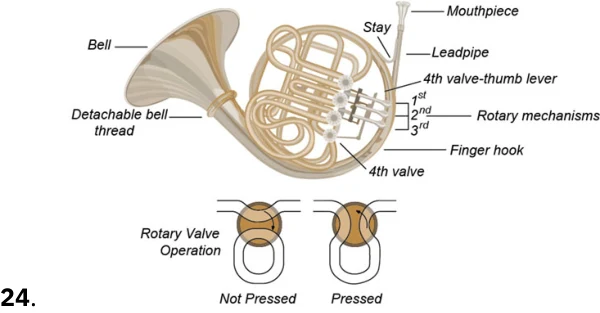
Brass instruments like the horn have rotary valves. See the first image to see where these valves are on a horn and the second image to see how they function when pressed.
ホルンのような金管楽器にはロータリー弁がある。最初の図でホルンのどこにこの弁があるかを、二番目の図で押したときにどう働くかを見よ。
Make a claim about the effect of these valves.
これらの弁の効果について主張を述べよ。
a. They increase the frequency of the sound by making the tube longer.b. They increase the frequency of the sound by making the tube shorter.c. They increase the amplitude of the sound by causing it to remain in the tube for a longer period of time.d. They decrease the amplitude of the sound by causing it to remain in the tube for a longer period of time.
a. 管を長くすることで音の振動数を上げる。b. 管を短くすることで音の振動数を上げる。c. 音を管の中により長くとどめることで音の振幅を大きくする。d. 音を管の中により長くとどめることで音の振幅を小さくする。
Gases at 0 °C
0 ℃の気体
c. It's wavelength decreases by a factor of 4.2.d. It's wavelength decreases by a factor of 18.
c. 波長が4.2分の1になる。d. 波長が18分の1になる。
(credit: modification of work by Radiology Key) An ambulance passes you at a speed of 15.0m/s and its siren has a frequency of 995 Hz. Assuming the speed of sound in air is 331m/s, what is difference in the frequencies you perceive before and after it passes you?
(credit: Radiology Keyの作品を改変) 救急車が15.0 m/sの速さであなたのそばを通り過ぎ、そのサイレンの振動数は995 Hzである。空気中の音の速さを331 m/sとして、通り過ぎる前と後であなたが感じ取る振動数の差はいくらか。
14.2 Sound Intensity and Sound Level 27Calculate the sound intensity for a sound wave traveling through air at 15° C and having a pressure amplitude of 0.80 Pa. (Hint—Speed of sound in air at 15° C is 340 m/s .)a. 9.6×10⁻³ W / m2b. 7.7×10⁻³ W / m2
14.2 音の強さと音の大きさのレベル 2715 ℃の空気中を進み、圧力振幅が0.80 Paの音波について、音の強さを計算せよ。(手がかり——15 ℃の空気中の音の速さは340 m/sである。)a. 9.6×10⁻³ W/m2b. 7.7×10⁻³ W/m2
14.4 Sound Interference and Resonance 31What is the length of an open-pipe resonator with a fundamental frequency of ? (Assume the speed of sound is .)a. b.
14.4 音の干渉と共鳴 31基本振動数がの開管の共鳴体の長さはいくらか。(音の速さはとする。)a. b.
Performance Task実践課題
14.4 Sound Interference and Resonance 33. Design and make an open air resonator capable of playing at least three different pitches (frequencies) of sound using a selection of bamboo of varying widths and lengths, which can be obtained at a local hardware store.Choose a piece of bamboo for creating a musical
14.4 音の干渉と共鳴 33. 近所のホームセンターで手に入る、太さと長さのいろいろな竹を使い、少なくとも三つの違う高さ(振動数)の音を出せる開いた空気の共鳴体を設計し、作れ。楽器にする竹を