第10章特殊相対性理論Special Relativity原書 p.315–338
10.1 Postulates of Special Relativity10.1 特殊相対性理論の前提
SECTION LEARNING OBJECTIVES By the end of this section, you will be able to do the following:
この節の学習目標 この節を終えると、次のことができるようになる。
• Describe the experiments and scientific problems that led Albert Einstein to develop the special theory of relativity• Understand the postulates on which the special theory of relativity was based
・アルベルト・アインシュタインを特殊相対性理論の成立へ導いた実験と科学上の問題を述べる・特殊相対性理論が置いた前提を理解する
Section Key Termsこの節の重要語
etherframe of referenceinertial reference framegeneral relativitypostulaterelativitysimultaneityspecial relativity
エーテル 基準系 慣性基準系一般相対性理論 前提 相対性同時性 特殊相対性理論
Scientific Experiments and Problems科学の実験と問題
Relativity is not new. Way back around the year 1600, Galileo explained that motion is relative. Wherever you happen to be, it seems like you are at a fixed point and that everything moves with respect to you. Everyone else feels the same way. Motion is always measured with respect to a fixed point. This is called establishing a frame of reference. But the choice of the point is arbitrary, and all frames of reference are equally valid. A passenger in a moving car is not moving with respect to the driver, but they are both moving from the point of view of a person on the sidewalk waiting for a bus. They are moving even faster as seen by a person in a car coming toward them. It is all relative.
相対性という考えは新しいものではない。1600年ごろにさかのぼるが、ガリレオはすでに運動が相対的であることを説明していた。どこにいようと、自分は固定した点にいて、他のすべてが自分に対して動いているように見える。ほかの誰もが同じように感じる。運動はつねに、ある固定した点に対して測られる。これを基準系を定めるという。しかしその点の選び方は任意であり、あらゆる基準系が等しく正しい。走る車の乗客は運転手に対して動いていないが、バスを待って歩道に立つ人から見れば二人とも動いている。向かってくる車に乗る人から見れば、二人はもっと速く動いている。すべては相対的なのである。
TIPS FOR SUCCESS A frame of reference is not a complicated concept. It is just something you decide is a fixed point or group of connected points. It is completely up to you. For example, when you look up at celestial objects in the sky, you choose the earth as your frame of reference, and the sun, moon, etc., seem to move across the sky.
学習のポイント 基準系は込み入った概念ではない。あなたが固定した点、あるいはつながった点の集まりだと決めたもの、それだけのことである。決めるのは完全にあなたの自由である。たとえば空の天体を見上げるとき、あなたは地球を基準系に選んでいるので、太陽や月などが空を横切って動くように見えるのである。
Light is involved in the discussion of relativity because theories related to electromagnetism are inconsistent with Galileo’s and Newton’s explanation of relativity. The true nature of light was a hot topic of discussion and controversy in the late 19th century. At the time, it was not generally believed that light could travel across empty space. It was known to travel as waves, and all other types of energy that propagated as waves needed to travel though a material medium. It was believed that space was filled with an invisible medium that light waves traveled through. This imaginary (as it turned out) material was called the ether (also spelled aether). It was thought that everything moved through this mysterious fluid. In other words, ether was the one fixed frame of reference. The Michelson–Morley experiment proved it was not.
相対性の議論に光が関わってくるのは、電磁気に関わる理論が、ガリレオとニュートンの相対性の説明と食い違うからである。光の本性は19世紀後半の熱い議論と論争の的だった。当時、光が何もない空間を進めるとは一般には信じられていなかった。光が波として進むことは知られており、波として伝わる他のあらゆる型のエネルギーは物質的な媒質の中を進む必要があった。空間は、光の波がその中を進む目に見えない媒質で満たされていると信じられていた。この(結局は)想像上の物質はエーテル(aetherとも綴る)と呼ばれた。あらゆるものがこの不思議な流体の中を動いていると考えられていた。言い換えれば、エーテルこそが唯一の固定した基準系だった。マイケルソン・モーリーの実験は、そうではないことを証明した。
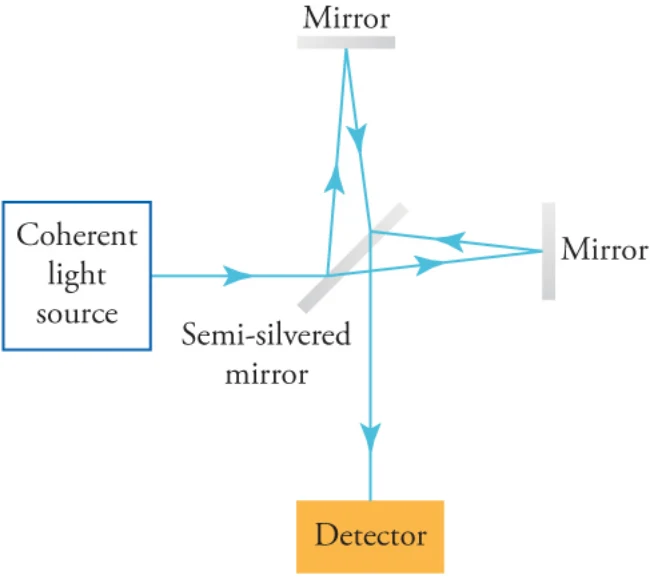
In 1887, Albert Michelson and Edward Morley designed the interferometer shown in Figure 10.2 to measure the speed of Earth through the ether. A light beam is split into two perpendicular paths and then recombined.Recombining the waves produces an inference pattern, with a bright fringe at the locations where the two waves arrive in phase; that is, with the crests of both waves arriving together and the troughs arriving together. A dark fringe appears where the crest of one wave coincides with a trough of the other, so that the two cancel. If Earth is traveling through the ether as it orbits the sun, the peaks in one arm would take longer than in the other to reach the same location. The places where the two waves arrive in phase would change, and the interference pattern would shift. But, using the interferometer, there was no shift seen! This result led to two conclusions: that there is no ether and that the speed of light is the same regardless of the relative motion of source and observer. The Michelson–Morley investigation has been called the most famous failed experiment in history.
1887年、アルバート・マイケルソンとエドワード・モーリーは、エーテルの中を進む地球の速さを測るために、図10.2に示す干渉計を設計した。光の束を互いに垂直な二つの道筋に分け、それからふたたび合わせる。波を合わせると干渉縞ができる。二つの波が同位相で、すなわち両方の波の山どうし、谷どうしが同時に届く場所には明るい縞が現れる。一方の波の山が他方の谷と重なって打ち消し合う場所には暗い縞が現れる。地球が太陽を回りながらエーテルの中を進んでいるなら、一方の腕の山がもう一方より同じ場所に届くのに時間がかかるはずである。二つの波が同位相で届く場所が変わり、干渉縞がずれるはずである。しかし干渉計を使っても、ずれは見られなかった。この結果は二つの結論へ導いた。エーテルは存在しないこと、そして光源と観測者の相対運動によらず光の速さは同じであることである。マイケルソンとモーリーの調査は、歴史上最も有名な失敗した実験と呼ばれてきた。
To see what Michelson and Morley expected to find when they measured the speed of light in two directions, watch this animation (https://openstax.org/l/28MMexperiment). In the video, two people swimming in a lake are represented as an analogy to light beams leaving Earth as it moves through the ether (if there were any ether). The swimmers swim away from and back to a platform that is moving through the water. The swimmers swim in different directions with respect to the motion of the platform. Even though they swim equal distances at the same speed, the motion of the platform causes them to arrive at different times.
マイケルソンとモーリーが二つの向きの光の速さを測ったときに何を見つけると考えていたかは、このアニメーション(https://openstax.org/l/28MMexperiment)で見られる。動画では、湖で泳ぐ二人が、(もしエーテルがあったなら)エーテルの中を動く地球から出る光の束のたとえとして描かれている。泳ぐ二人は、水の中を動いている台から泳ぎ去り、また戻ってくる。二人は台の運動に対して違う向きに泳ぐ。同じ距離を同じ速さで泳いでも、台が動いているせいで到着する時刻は違ってくる。
Einstein’s Postulatesアインシュタインの前提
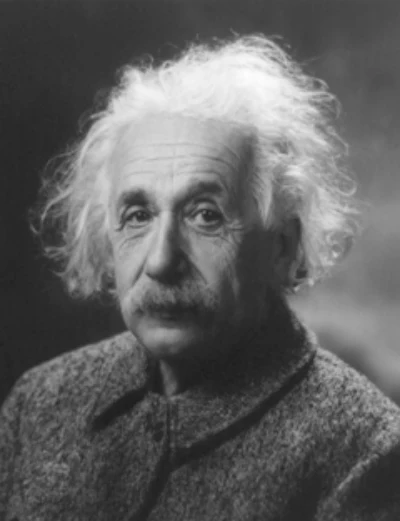
The results described above left physicists with some puzzling and unsettling questions such as, why doesn’t light emitted by a fast-moving object travel faster than light from a street lamp? A radical new theory was needed, and Albert Einstein, shown in Figure 10.3, was about to become everyone’s favorite genius. Einstein began with two simple postulates based on the two things we have discussed so far in this chapter.
上に述べた結果は、物理学者たちを不可解で落ち着かない問いの前に置いた。たとえば、速く動く物体が出す光は、なぜ街灯の光より速く進まないのか。根底から新しい理論が必要だった。そして図10.3に示すアルベルト・アインシュタインが、誰もが愛する天才になろうとしていた。アインシュタインは、この章でこれまでに論じてきた二つのことにもとづく、二つの単純な前提から始めた。
1. The laws of physics are the same in all inertial reference frames.2. The speed of light is the same in all inertial reference frames and is not affected by the speed of its source.
1. 物理法則はすべての慣性基準系で同じである。2. 光の速さはすべての慣性基準系で同じであり、光源の速さに影響されない。
The speed of light is given the symbol c and is equal to exactly 299,792,458 m/s. This is the speed of light in vacuum; that is, in the absence of air. For most purposes, we round this number off to The term inertial reference frame simply refers to a frame of reference where all objects follow Newton’s first law of motion:
光の速さには記号cが与えられ、ちょうど299,792,458 m/sに等しい。これは真空中、すなわち空気のないところでの光の速さである。たいていの用途では、この数をに丸める。慣性基準系という語は、あらゆる物体がニュートンの運動の第一法則に従う基準系を指すにすぎない。
Objects at rest remain at rest, and objects in motion remain in motion at a constant velocity in a straight line, unless acted upon by an external force. The inside of a car moving along a road at constant velocity and the inside of a stationary house are inertial reference frames.
すなわち、静止した物体は静止し続け、動いている物体は、外力を受けない限り一定の速度で一直線に動き続ける。一定の速度で道を走る車の中も、静止した家の中も、慣性基準系である。
The Speed of Light This lecture on light summarizes the most important facts about the speed of light. If you are interested, you can watch the whole video, but the parts relevant to this chapter are found between 3:25 and 5:10, which you find by running your cursor along the bottom of the video.
光の速さ 光についてのこの講義は、光の速さについて最も重要な事実をまとめている。興味があれば全部見てもよいが、この章に関わるのは3:25から5:10の部分で、動画の下端でカーソルを動かせば見つけられる。
Introduction to light | Electronic structure of atoms | Chemistry | Khan Academy (https://www.youtube.com/embed/ rLNM8zI4Q_M)
光の入門|原子の電子構造|化学|カーンアカデミー(https://www.youtube.com/embed/rLNM8zI4Q_M)
GRASP CHECK An airliner traveling at 200 m/s emits light from the front of the plane. Which statement describes the speed of the light?
理解の確認 200 m/sで飛ぶ旅客機が機首から光を出す。その光の速さを述べているのはどれか。
a. It travels at a speed of c + 200 m/s.b. It travels at a speed of c – 200 m/s.
a. c + 200 m/s の速さで進む。b. c - 200 m/s の速さで進む。
c. It travels at a speed c, like all light.d. It travels at a speed slightly less than c.
c. あらゆる光と同じく、速さcで進む。d. cよりわずかに小さい速さで進む。
SNAP LAB身近な実験Measure the Speed of Light光の速さを測る
In this experiment, you will measure the speed of light using a microwave oven and a slice of bread. The waves generated by a microwave oven are not part of the visible spectrum, but they are still electromagnetic radiation, so they travel at the speed of light. If we know the wavelength, λ, and frequency, f, of a wave, we can calculate its speed, v, using the equation v = λf. You can measure the wavelength. You will find the frequency on a label on the back of a microwave oven. The wave in a microwave is a standing wave with areas of high and low intensity. The high intensity sections are one-half wavelength apart.
この実験では、電子レンジと食パン1枚を使って光の速さを測る。電子レンジが生む波は可視光の範囲ではないが、それでも電磁波なので光の速さで進む。波の波長λと振動数fが分かっていれば、式 v = λf でその速さvを計算できる。波長は測れる。振動数は電子レンジの背面のラベルに書いてある。電子レンジの中の波は定在波で、強度の高いところと低いところがある。強度の高い部分どうしは半波長離れている。
High temperature: Very hot temperatures are encountered in this lab. These can cause burns.
高温注意 この実験ではきわめて高い温度になる部分がある。やけどの恐れがある。
• a microwave oven• one slice of plain white bread• a centimeter ruler• a calculator
・電子レンジ・味の付いていない食パン1枚・センチメートルの目盛りの定規・電卓
1. Work with a partner.2. Turn off the revolving feature of the microwave oven or remove the wheels under the microwave dish that make it turn. It is important that the dish does not turn.3. Place the slice of bread on the dish, set the microwave on high, close the door, run the microwave for about 15 seconds.4. A row of brown or black marks should appear on the bread. Stop the microwave as soon as they appear. Measure the distance between two adjacent burn marks and multiply the result by 2. This is the wavelength.5. The frequency of the waves is written on the back of the microwave. Look for something like “2,450 MHz.” Hz is the unit hertz, which means per second. The M represents mega, which stands for million, so multiply the number by 106.6. Express the wavelength in meters and multiply it times the frequency. If you did everything correctly, you will get a number very close to the speed of light. Do not eat the bread. It is a general laboratory safety rule never to eat anything in the lab.
1. 二人一組で行う。2. 電子レンジの回転機能を切るか、皿を回す下の車輪を外す。皿が回らないことが大切である。3. 食パンを皿に置き、電子レンジを強に設定し、扉を閉めて15秒ほど動かす。4. パンに茶色か黒の焦げ目が一列に現れるはずである。現れたらすぐに止める。隣り合う二つの焦げ目の間隔を測り、その結果を2倍する。これが波長である。5. 波の振動数は電子レンジの背面に書いてある。「2,450 MHz」のような表示を探す。Hzはヘルツという単位で、毎秒という意味である。Mはメガ、すなわち100万を表すので、この数に106を掛ける。6. 波長をメートルで表し、振動数と掛け合わせる。すべて正しくできていれば、光の速さにきわめて近い数が得られる。パンは食べないこと。実験室では何も口にしないのが一般の安全規則である。
GRASP CHECK How does your measured value of the speed of light compare to the accepted value (% error)?a. The measured value of speed will be equal to c.b. The measured value of speed will be slightly less than c.
理解の確認 測った光の速さの値は、認められている値とくらべてどうか(誤差は何パーセントか)。a. 測った速さの値はcに等しくなる。b. 測った速さの値はcよりわずかに小さくなる。
c. The measured value of speed will be slightly greater than c.d. The measured value of speed will depend on the frequency of the microwave.
c. 測った速さの値はcよりわずかに大きくなる。d. 測った速さの値は電子レンジの振動数による。
Einstein’s postulates were carefully chosen, and they both seemed very likely to be true. Einstein proceeded despite realizing that these two ideas taken together and applied to extreme conditions led to results that contradict Newtonian mechanics. He just took the ball and ran with it.
アインシュタインの前提は注意深く選ばれており、どちらもきわめてもっともらしく見えた。アインシュタインは、この二つを合わせて極端な条件に当てはめるとニュートン力学に反する結果が出ることに気づきながら、なお進んだ。彼はそのままボールを持って走り出したのである。
In the traditional view, velocities are additive. If you are running at 3 m/s and you throw a ball forward at a speed of 10 m/s, the ball should have a net speed of 13 m/s. However, according to relativity theory, the speed of a moving light source is not added to the speed of the emitted light.
伝統的な見方では、速度は足し合わされる。あなたが3 m/sで走りながら、ボールを前へ10 m/sの速さで投げれば、ボールの正味の速さは13 m/sになるはずである。しかし相対性理論によれば、動いている光源の速さは、出た光の速さに足されない。
In addition, Einstein’s theory shows that if you were moving forward relative to Earth at nearly c (the speed of light) and could throw a ball forward at c, an observer at rest on the earth would not see the ball moving at nearly twice the speed of light. The observer would see it moving at a speed that is still less than c. This result conforms to both of Einstein’s postulates: The speed of light has a fixed maximum and neither reference frame is privileged.
さらにアインシュタインの理論は、あなたが地球に対して光速c近くで前へ動いていて、ボールを前へcで投げられたとしても、地球で静止している観測者にはボールが光速のほぼ2倍で動いているようには見えない、と示す。観測者には、なおcより小さい速さで動いているように見える。この結果は、アインシュタインの二つの前提の両方に合っている。すなわち、光の速さには固定した最大値があり、どちらの基準系も特権を持たない。
Consider how we measure elapsed time. If we use a stopwatch, for example, how do we know when to start and stop the watch? One method is to use the arrival of light from the event, such as observing a light turn green to start a drag race. The timing will be more accurate if some sort of electronic detection is used, avoiding human reaction times and other complications.
経過時間をどう測るかを考えよう。たとえばストップウォッチを使うなら、いつ押して、いつ止めるのかをどう知るのか。一つのやり方は、ドラッグレースの出発で信号が青になるのを見るように、出来事から届く光を使うことである。人間の反応時間などのやっかいごとを避けるために、何らかの電子的な検出を使えば、計時はもっと正確になる。
Now suppose we use this method to measure the time interval between two flashes of light produced by flash lamps on a moving train. (See Figure 10.4)
さて、この方法を使って、走る列車に取り付けたフラッシュランプが出す二つの閃光の時間間隔を測るとしよう(図10.4を見よ)。
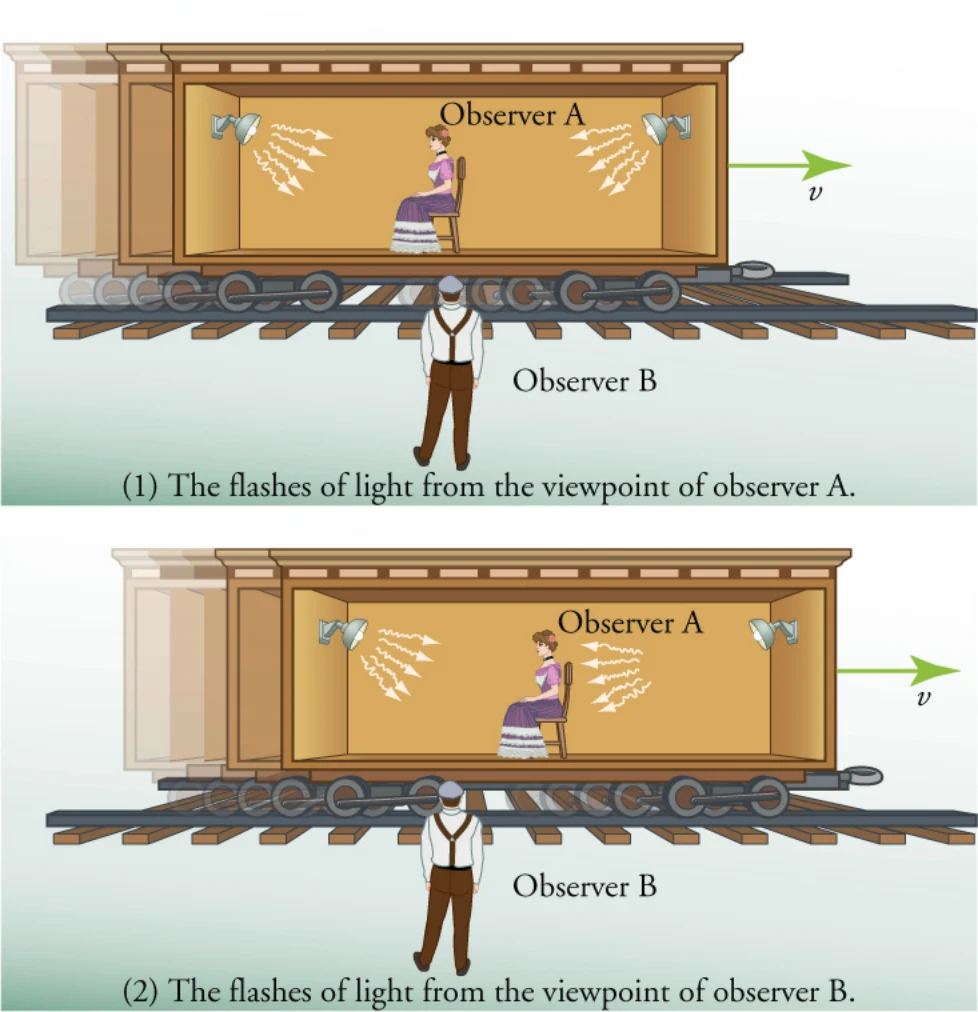
A woman (observer A) is seated in the center of a rail car, with two flash lamps at opposite sides equidistant from her. Multiple light rays that are emitted from the flash lamps move towards observer A, as shown with arrows. A velocity vector arrow for the rail car is shown towards the right. A man (observer B) standing on the platform is facing the woman and also observes the flashes of light.
一人の女性(観測者A)が客車の中央に座っており、彼女から等距離の両側にフラッシュランプが二つある。フラッシュランプから出た複数の光線が観測者Aへ向かって進むようすを矢印で示す。客車の速度ベクトルの矢印は右向きである。ホームに立つ男性(観測者B)は女性のほうを向いており、やはり閃光を観測する。
Observer A moves with the lamps on the rail car as the rail car moves towards the right of observer B. Observer B receives the light flashes simultaneously, and sees the bulbs as both having flashed at the same time. However, he sees observer A receive the flash from the right first. Because the pulse from the right reaches her first, in her frame of reference she sees the bulbs as not having flashed simultaneously. Here, a relative velocity between observers affects whether two events at well-separated locations are observed to be simultaneous. Simultaneity, or whether different events occur at the same instant, depends on the frame of reference of the observer. Remember that velocity equals distance divided by time, so t = d/v. If velocity appears to be different, then duration of time appears to be different.
観測者Aは客車のランプとともに動き、客車は観測者Bの右へ向かって動く。観測者Bは二つの閃光を同時に受け取り、両方の電球が同時に光ったと見る。しかし彼には、観測者Aが右のランプの閃光を先に受け取るのが見える。右からの光の波が先に彼女に届くので、彼女の基準系では、電球は同時には光らなかったことになる。ここでは、観測者どうしの相対速度が、離れた場所での二つの出来事が同時と観測されるかどうかを左右している。同時性、すなわち異なる出来事が同じ瞬間に起こるかどうかは、観測者の基準系による。速度は距離を時間で割ったものなので t = d/v であることを思い出そう。速度が違って見えるなら、時間の長さも違って見える。
This illustrates the power of clear thinking. We might have guessed incorrectly that, if light is emitted simultaneously, then two observers halfway between the sources would see the flashes simultaneously. But careful analysis shows this not to be the case. Einstein was brilliant at this type of thought experiment (in German, Gedankenexperiment). He very carefully considered how an observation is made and disregarded what might seem obvious. The validity of thought experiments, of course, is determined by actual observation. The genius of Einstein is evidenced by the fact that experiments have repeatedly confirmed his theory of relativity. No experiments after that of Michelson and Morley were able to detect any ether medium. We will describe later how experiments also confirmed other predictions of special relativity, such as the distance between two objects and the time interval of two events being different for two observers moving with respect to each other.
これは、はっきり考えることの力を示している。光が同時に出たなら、光源の中間にいる二人の観測者は閃光を同時に見るはずだ、と誤って推測したかもしれない。しかし注意深く分析すれば、そうではないことが分かる。アインシュタインはこの種の思考実験(ドイツ語でGedankenexperiment)の名手だった。彼は、観測がどう行われるかをきわめて注意深く考え、自明に見えるものを退けた。もちろん思考実験の正しさは実際の観測によって決まる。実験が繰り返し彼の相対性理論を裏づけてきたことが、アインシュタインの天才を証している。マイケルソンとモーリーの実験のあと、エーテルの媒質を検出できた実験は一つもない。互いに相対運動する二人の観測者にとって、二つの物体の間の距離や二つの出来事の時間間隔が違ってくるといった特殊相対性理論の他の予測も、実験が裏づけたことをあとで述べる。
In summary: Two events are defined to be simultaneous if an observer measures them as occurring at the same time (such as by receiving light from the events). Two events are not necessarily simultaneous to all observers.
まとめると、二つの出来事は、観測者が(たとえば出来事からの光を受け取って)同じ時刻に起こったと測るとき、同時であると定義される。二つの出来事は、すべての観測者にとって同時とは限らない。
The discrepancies between Newtonian mechanics and relativity theory illustrate an important point about how science advances. Einstein’s theory did not replace Newton’s but rather extended it. It is not unusual that a new theory must be developed to account for new information. In most cases, the new theory is built on the foundation of older theory. It is rare that old theories are completely replaced.
ニュートン力学と相対性理論の食い違いは、科学がどう進むかについての重要な点を示している。アインシュタインの理論はニュートンの理論を置き換えたのではなく、広げたのである。新しい情報を説明するために新しい理論を作らねばならないのは、珍しいことではない。たいていの場合、新しい理論は古い理論の土台の上に建てられる。古い理論がまるごと置き換えられることはまれである。
In this chapter, you will learn about the theory of special relativity, but, as mentioned in the introduction, Einstein developed two relativity theories: special and general. Table 10.1 summarizes the differences between the two theories.
この章では特殊相対性理論を学ぶが、はじめに述べたとおり、アインシュタインは特殊と一般の二つの相対性理論を作った。表10.1に二つの理論の違いをまとめる。
Also note that the theory of general relativity includes the theory of special relativity.
また、一般相対性理論は特殊相対性理論を含んでいることにも注意しよう。
Calculating the Time it Takes Light to Travel a Given Distance The sun is 1.50 × 10⁸ km from Earth. How long does it take light to travel from the sun to Earth in minutes and seconds? Strategy
与えられた距離を光が進むのにかかる時間を計算する 太陽は地球から1.50 × 10⁸ kmのところにある。太陽から地球まで光が進むのに何分何秒かかるか。 方針
Identify knowns.
分かっている量を洗い出す。
Identify unknowns.
分からない量を洗い出す。
Time
時間
Find the equation that relates knowns and unknowns.
分かっている量と分からない量を結ぶ式を見つける。
Be sure to use consistent units.
単位を揃えることを忘れずに。
Solution解答
Discussion考察
The answer is written as 5.00 × 10² rather than 500 in order to show that there are three significant figures. When astronomers witness an event on the sun, such as a sunspot, it actually happened minutes earlier. Compare 8 light minutes to the distance to stars, which are light years away. Any events on other stars happened years ago.
答えを500ではなく5.00 × 10²と書いているのは、有効数字が3桁であることを示すためである。天文学者が黒点のような太陽の出来事を目にするとき、それは実際には数分前に起きたことである。8光分を、何光年も離れた恒星までの距離と比べてみよう。他の恒星での出来事は何年も前に起きたことである。
Practice Problems練習問題
1Light travels through 1.00 m of water in 4.42×10⁻⁹ s. What is the speed of light in water?a. 4.42×10⁻⁹ m/sb. 4.42×10⁹ m/sc. 2.26×10⁸ m/sd. 226×108 m/s
1光は水中の1.00 mを4.42×10⁻⁹秒で進む。水中での光の速さはいくらか。a. 4.42×10⁻⁹ m/sb. 4.42×10⁹ m/sc. 2.26×10⁸ m/sd. 226×108 m/s
2An astronaut on the moon receives a message from mission control on Earth. The signal is sent by a form of electromagnetic radiation and takes 1.28 s to travel the distance between Earth and the moon. What is the distance from Earth to the moon?a. 2.34×10⁵ kmb. 2.34×10⁸ kmc. 3.84×10⁵ kmd. 3.84×10⁸ km
2月面の宇宙飛行士が、地球の管制からのメッセージを受け取る。信号はある形の電磁波で送られ、地球と月の間を進むのに1.28秒かかる。地球から月までの距離はいくらか。a. 2.34×10⁵ kmb. 2.34×10⁸ kmc. 3.84×10⁵ kmd. 3.84×10⁸ km
Check Your Understanding理解の確認
3Explain what is meant by a frame of reference.a. A frame of reference is a graph plotted between distance and time.b. A frame of reference is a graph plotted between speed and time.
3基準系とは何かを説明せよ。a. 基準系とは、距離と時間の間で描かれたグラフである。b. 基準系とは、速さと時間の間で描かれたグラフである。
c. A frame of reference is the velocity of an object through empty space without regard to its surroundings.d. A frame of reference is an arbitrarily fixed point with respect to which motion of other points is measured.
c. 基準系とは、周囲を考えずに測った、何もない空間の中の物体の速度である。d. 基準系とは、他の点の運動を測る基準として任意に固定した点である。
4Two people swim away from a raft that is floating downstream. One swims upstream and returns, and the other swims across the current and back. If this scenario represents the Michelson–Morley experiment, what do (i) the water, (ii) the swimmers, and (iii) the raft represent?
4二人が、川を流れていく筏から泳ぎ出す。一人は上流へ泳いで戻り、もう一人は流れを横切って泳いで戻る。この場面がマイケルソン・モーリーの実験を表しているとすると、(i)水、(ii)泳ぐ人、(iii)筏はそれぞれ何を表すか。
a. the ether rays of light Earthb. rays of light the ether Earthc. the ether Earth rays of lightd. Earth rays of light the ether
a. エーテル、光線、地球b. 光線、エーテル、地球c. エーテル、地球、光線d. 地球、光線、エーテル
5If Michelson and Morley had observed the interference pattern shift in their interferometer, what would that have indicated?
5もしマイケルソンとモーリーが干渉計で干渉縞のずれを観測していたら、それは何を示していたことになるか。
a. The speed of light is the same in all frames of reference.b. The speed of light depends on the motion relative to the ether.c. The speed of light changes upon reflection from a surface.d. The speed of light in vacuum is less than 3.00×10⁸ m/s.
a. 光の速さはすべての基準系で同じである。b. 光の速さはエーテルに対する運動による。c. 光の速さは面で反射すると変わる。 d. 真空中の光の速さは3.00×10⁸ m/sより小さい。
6If you designate a point as being fixed and use that point to measure the motion of surrounding objects, what is the point called?
6ある点を固定したものと定め、その点を基準に周囲の物体の運動を測るとき、その点を何と呼ぶか。
a. An originb. A frame of referencec. A moving framed. A coordinate system
a. 原点b. 基準系c. 動いている系d. 座標系