第10章特殊相対性理論Special Relativity原書 p.315–338
10.2 Consequences of Special Relativity10.2 特殊相対性理論の帰結
SECTION LEARNING OBJECTIVES By the end of this section, you will be able to do the following:
この節の学習目標 この節を終えると、次のことができるようになる。
• Describe the relativistic effects seen in time dilation, length contraction, and conservation of relativistic momentum• Explain and perform calculations involving mass-energy equivalence
・時間の遅れ、長さの収縮、相対論的運動量の保存に見られる相対論的な効果を述べる・質量とエネルギーの等価性を説明し、それに関する計算を行う
Section Key Termsこの節の重要語
binding energylength contractionmass defecttime dilationproper lengthrelativisticrelativistic momentumrelativistic energyrelativistic factorrest mass
結合エネルギー 長さの収縮 質量欠損 時間の遅れ固有長 相対論的 相対論的運動量相対論的エネルギー 相対論的因子 静止質量
Relativistic Effects on Time, Distance, and Momentum時間・距離・運動量に対する相対論的な効果
Consideration of the measurement of elapsed time and simultaneity leads to an important relativistic effect. Time dilation is the phenomenon of time passing more slowly for an observer who is moving relative to another observer.
経過時間の測定と同時性を考えると、重要な相対論的効果が導かれる。時間の遅れとは、ある観測者に対して動いている観測者にとって、時間がよりゆっくり過ぎるという現象である。
For example, suppose an astronaut measures the time it takes for light to travel from the light source, cross her ship, bounce off a mirror, and return. (See Figure 10.5.) How does the elapsed time the astronaut measures compare with the elapsed time measured for the same event by a person on the earth? Asking this question (another thought experiment) produces a profound result. We find that the elapsed time for a process depends on who is measuring it. In this case, the time measured by the astronaut is smaller than the time measured by the earth bound observer. The passage of time is different for the two observers because the distance the light travels in the astronaut’s frame is smaller than in the earth bound frame. Light travels at the same speed in each frame, and so it will take longer to travel the greater distance in the earth bound frame.
たとえば、ある宇宙飛行士が、光源から出た光が船内を横切り、鏡で反射して戻ってくるのにかかる時間を測るとしよう(図10.5を見よ)。この宇宙飛行士が測る経過時間は、同じ出来事について地球にいる人が測る経過時間とくらべてどうなるか。この問い(もう一つの思考実験)は深い結果を生む。ある過程の経過時間は、誰が測るかによって変わることが分かるのである。この場合、宇宙飛行士が測る時間は、地上の観測者が測る時間より小さい。時間の過ぎ方が二人の観測者で違うのは、宇宙飛行士の系で光が進む距離のほうが、地上の系より短いからである。光はどちらの系でも同じ速さで進むので、地上の系のより長い距離を進むには、より長い時間がかかる。
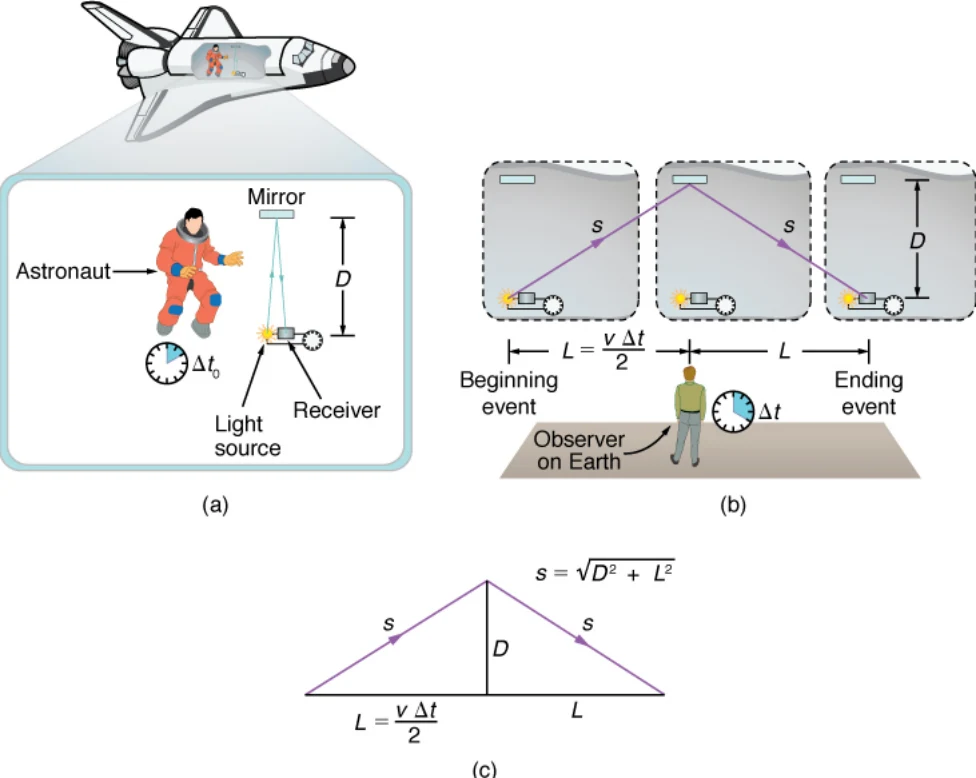
astronaut’s frame. (b) A person on the earth sees the light follow the longer path and take a longer time
(b)地球にいる人には、光がより長い道筋をたどり、より長い時間がかかるように見える。
The relationship between Δt and Δto is given by
ΔtとΔt0の関係は次で与えられる。
where is the relativistic factor given by
ここでは相対論的因子であり、次で与えられる。
and v and c are the speeds of the moving observer and light, respectively.
vとcは、それぞれ動いている観測者の速さと光の速さである。
TIPS FOR SUCCESS Try putting some values for v into the expression for the relativistic factor ( ). Observe at which speeds this factor will make a difference and when is so close to 1 that it can be ignored. Try 225 m/s, the speed of an airliner; 2.98 × 10⁴ m/s, the speed of Earth in its orbit; and 2.990 × 10⁸ m/s, the speed of a particle in an accelerator.
学習のポイント 相対論的因子()の式に、いくつかvの値を入れてみよう。どれくらいの速さでこの因子が効いてくるのか、またが1に近すぎて無視できるのはどんなときかを見てみよう。旅客機の速さ225 m/s、地球の公転の速さ2.98 × 104 m/s、加速器の中の粒子の速さ2.990 × 108 m/sを試すとよい。
Notice that when the velocity v is small compared to the speed of light c, then v/c becomes small, and becomes close to 1. When this happens, time measurements are the same in both frames of reference. Relativistic effects, meaning those that have to do with special relativity, usually become significant when speeds become comparable to the speed of light. This is seen to be the case for time dilation.
速度vが光の速さcに比べて小さいとき、v/cは小さくなり、は1に近づくことに注目しよう。そうなると、どちらの基準系でも時間の測定は同じになる。相対論的な効果、すなわち特殊相対性理論に関わる効果は、ふつう速さが光の速さに近づいたときに効いてくる。時間の遅れについてもそうであることが分かる。
You may have seen science fiction movies in which space travelers return to Earth after a long trip to find that the planet and everyone on it has aged much more than they have. This type of scenario is a based on a thought experiment, known as the twin paradox, which imagines a pair of twins, one of whom goes on a trip into space while the other stays home. When the space traveler returns, she finds her twin has aged much more than she. This happens because the traveling twin has been in two frames of reference, one leaving Earth and one returning.
宇宙旅行者が長い旅から地球へ帰ると、地球と地球の人々が自分よりずっと年をとっていた、というSF映画を見たことがあるかもしれない。この筋書きは双子のパラドックスとして知られる思考実験にもとづく。双子の一方が宇宙へ旅立ち、他方は家に残る。旅から帰ると、旅した側は自分より双子の相手がずっと年をとっていることに気づく。こうなるのは、旅した双子が二つの基準系、すなわち地球を離れる系と戻る系にいたからである。
Time dilation has been confirmed by comparing the time recorded by an atomic clock sent into orbit to the time recorded by a clock that remained on Earth. GPS satellites must also be adjusted to compensate for time dilation in order to give accurate positioning.
時間の遅れは、軌道へ送った原子時計が記録した時間と、地上に残った時計が記録した時間を比べることで確かめられている。GPS衛星も、正確な位置を出すために時間の遅れを補正しなければならない。
Have you ever driven on a road, like that shown in Figure 10.6, that seems like it goes on forever? If you look ahead, you might say you have about 10 km left to go. Another traveler might say the road ahead looks like it is about 15 km long. If you both measured the road, however, you would agree. Traveling at everyday speeds, the distance you both measure would be the same. You will read in this section, however, that this is not true at relativistic speeds. Close to the speed of light, distances measured are not the same when measured by different observers moving with respect to one other.
図10.6のような、どこまでも続くように見える道を走ったことはあるだろうか。前を見て、残りは10 kmくらいだと言うかもしれない。別の旅人は、前の道は15 kmくらいに見えると言うかもしれない。しかし二人とも実際に測れば、値は一致するだろう。日常の速さで動く限り、二人が測る距離は同じである。しかしこの節で読むように、相対論的な速さではそうならない。光の速さに近いところでは、互いに相対運動する観測者が測る距離は同じにならない。

One thing all observers agree upon is their relative speed. When one observer is traveling away from another, they both see the other receding at the same speed, regardless of whose frame of reference is chosen. Remember that speed equals distance divided by time: v = d/t. If the observers experience a difference in elapsed time, they must also observe a difference in distance traversed. This is because the ratio d/t must be the same for both observers.
すべての観測者が一致するものが一つある。互いの相対速度である。一方が他方から遠ざかっているとき、二人はどちらの基準系を選ぼうと、相手が同じ速さで遠ざかっていると見る。速さは距離を時間で割ったもの、すなわち v = d/t であることを思い出そう。二人の観測者の経過時間に違いがあるなら、進んだ距離にも違いを観測せねばならない。比 d/t が両者で同じでなければならないからである。
The shortening of distance experienced by an observer moving with respect to the points whose distance apart is measured is called length contraction. Proper length, L0, is the distance between two points measured in the reference frame where the observer and the points are at rest. The observer in motion with respect to the points measures L. These two lengths are related by the equation
距離を測る対象の二点に対して動いている観測者が経験する距離の縮みを、長さの収縮という。固有長L0とは、観測者とその二点が静止している基準系で測った二点間の距離である。二点に対して動いている観測者はLを測る。この二つの長さは次の式で結ばれる。
Because is the same expression used in the time dilation equation above, the equation becomes
は上の時間の遅れの式で使ったのと同じ式なので、この式は次のようになる。
To see how length contraction is seen by a moving observer, go to this simulation (https://openstax.org/l/ 28simultaneity). Here you can also see that simultaneity, time dilation, and length contraction are interrelated phenomena.
動いている観測者に長さの収縮がどう見えるかは、このシミュレーション(https://openstax.org/l/28simultaneity)で確かめられる。ここでは、同時性・時間の遅れ・長さの収縮が互いに結びついた現象であることも見て取れる。
This link is to a simulation that illustrates the relativity of simultaneous events.
このリンク先は、同時に起こる出来事の相対性を示すシミュレーションである。
In classical physics, momentum is a simple product of mass and velocity. When special relativity is taken into account, objects that have mass have a speed limit. What effect do you think mass and velocity have on the momentum of objects moving at relativistic speeds; i.e., speeds close to the speed of light?
古典物理では、運動量は単に質量と速度の積である。特殊相対性理論を考えに入れると、質量を持つ物体には速さの上限がある。相対論的な速さ、すなわち光の速さに近い速さで動く物体の運動量に、質量と速度はどう効くと思うか。
Momentum is one of the most important concepts in physics. The broadest form of Newton’s second law is stated in terms of momentum. Momentum is conserved in classical mechanics whenever the net external force on a system is zero. This makes momentum conservation a fundamental tool for analyzing collisions. We will see that momentum has the same importance in modern physics. Relativistic momentum is conserved, and much of what we know about subatomic structure comes from the analysis of collisions of accelerator-produced relativistic particles.
運動量は物理で最も重要な概念の一つである。ニュートンの第二法則の最も広い形は運動量で述べられる。古典力学では、系にはたらく外力の合力が0であればいつでも運動量が保存される。このおかげで運動量の保存は衝突を分析する基本的な道具になっている。現代物理でも運動量が同じくらい重要であることを見ていく。相対論的運動量は保存され、素粒子の構造について私たちが知っていることの多くは、加速器で作られた相対論的な粒子の衝突の分析から得られている。
One of the postulates of special relativity states that the laws of physics are the same in all inertial frames. Does the law of conservation of momentum survive this requirement at high velocities? The answer is yes, provided that the momentum is defined as follows.
特殊相対性理論の前提の一つは、物理法則がすべての慣性系で同じだ、というものである。運動量保存の法則は、高速でもこの要請に耐えるだろうか。答えは、次のように運動量を定義するならイエスである。
Relativistic momentum, p, is classical momentum multiplied by the relativistic factor
相対論的運動量pは、古典的な運動量に相対論的因子を掛けたものである。
where is the rest mass of the object (that is, the mass measured at rest, without any factor involved), is its velocity relative to an observer, and as before, is the relativistic factor. We use the mass of the object as measured at rest because we cannot determine its mass while it is moving.
ここでは物体の静止質量(すなわち、の因子を伴わずに静止状態で測った質量)、は観測者に対するその速度、は先と同じく相対論的因子である。動いている間は質量を決められないので、静止状態で測った質量を使う。
Note that we use for velocity here to distinguish it from relative velocity between observers. Only one observer is being considered here. With defined in this way, is conserved whenever the net external force is zero, just as in classical physics. Again we see that the relativistic quantity becomes virtually the same as the classical at low velocities. That is, relativistic momentum becomes the classical at low velocities, because is very nearly equal to 1 at low velocities.
ここで速度にを使うのは、観測者どうしの相対速度と区別するためである。ここで考えている観測者は一人だけである。こう定義したを使えば、古典物理と同じく、外力の合力が0であればいつでもは保存される。ここでもまた、低速では相対論的な量が事実上古典的な量と同じになることが分かる。すなわち、低速ではが1にきわめて近いので、相対論的運動量は古典的なになる。
Relativistic momentum has the same intuitive feel as classical momentum. It is greatest for large masses moving at high velocities. Because of the factor however, relativistic momentum behaves differently from classical momentum by approaching infinity as approaches (See Figure 10.7.) This is another indication that an object with mass cannot reach the speed of light. If it did, its momentum would become infinite, which is an unreasonable value.
相対論的運動量は、古典的な運動量と同じような直感に合う性質を持つ。大きな質量が大きな速度で動くときに最も大きい。しかし因子があるために、相対論的運動量は古典的な運動量とは違う振る舞いをし、がに近づくにつれて無限大に近づく(図10.7を見よ)。これも、質量を持つ物体が光の速さに達しえないことを示す一つの手がかりである。もし達したなら、その運動量は無限大になってしまい、それは筋の通らない値である。
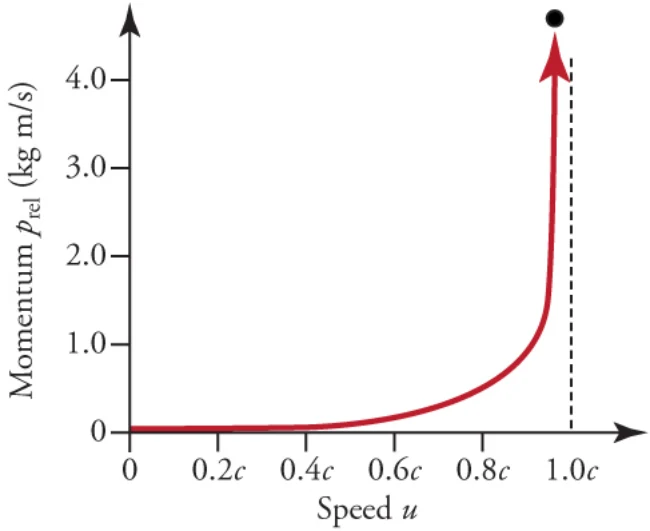
Relativistic momentum is defined in such a way that the conservation of momentum will hold in all inertial frames. Whenever the net external force on a system is zero, relativistic momentum is conserved, just as is the case for classical momentum. This has been verified in numerous experiments.
相対論的運動量は、運動量の保存がすべての慣性系で成り立つように定義されている。系にはたらく外力の合力が0であればいつでも、古典的な運動量と同じく相対論的運動量は保存される。これは数多くの実験で確かめられている。
Mass-Energy Equivalence質量とエネルギーの等価性
Let us summarize the calculation of relativistic effects on objects moving at speeds near the speed of light. In each case we will need to calculate the relativistic factor, given by
光の速さ近くで動く物体についての相対論的な効果の計算をまとめておこう。どの場合でも、次で与えられる相対論的因子を計算する必要がある。
where v and c are as defined earlier. We use u as the velocity of a particle or an object in one frame of reference, and v for the velocity of one frame of reference with respect to another.
ここでvとcは先に定めたとおりである。ある基準系における粒子や物体の速度にはu、ある基準系の別の基準系に対する速度にはvを使う。
Time Dilation Elapsed time on a moving object, as seen by a stationary observer is given by where is the time observed on the moving object when it is taken to be the frame or reference.
時間の遅れ 静止した観測者から見た、動いている物体の経過時間はで与えられる。ここでは、動いている物体自身を基準系としたときにその上で観測される時間である。
Length Contraction Length measured by a person at rest with respect to a moving object, L, is given by
長さの収縮 動いている物体に対して静止している人が測る長さLは、次で与えられる。
where L0 is the length measured on the moving object.
ここでL0は、動いている物体の上で測った長さである。
Relativistic Momentum Momentum, p, of an object of mass, m, traveling at relativistic speeds is given by where u is velocity of a moving object as seen by a stationary observer.
相対論的運動量 相対論的な速さで進む質量mの物体の運動量pはで与えられる。ここでuは静止した観測者から見た、動く物体の速度である。
Relativistic Energy The original source of all the energy we use is the conversion of mass into energy. Most of this energy is generated by nuclear reactions in the sun and radiated to Earth in the form of electromagnetic radiation, where it is then transformed into all the forms with which we are familiar. The remaining energy from nuclear reactions is produced in nuclear power plants and in Earth’s interior. In each of these cases, the source of the energy is the conversion of a small amount of mass into a large amount of energy. These sources are shown in Figure 10.8.
相対論的エネルギー 私たちが使うあらゆるエネルギーのそもそもの源は、質量のエネルギーへの変換である。このエネルギーの大半は太陽の核反応で生み出され、電磁波の形で地球へ放射され、そこで私たちのなじみのあらゆる形へ移り変わる。核反応による残りのエネルギーは、原子力発電所と地球内部で生み出される。どの場合も、エネルギーの源は少量の質量が大量のエネルギーへ変わることである。これらの源を図10.8に示す。
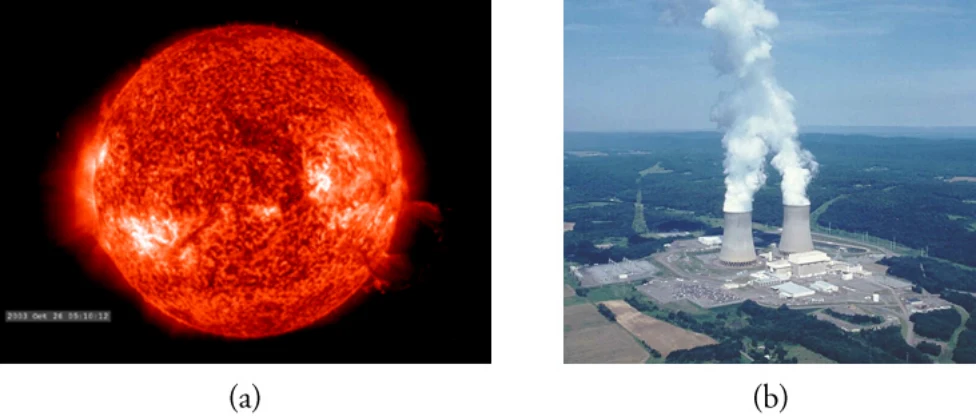
The first postulate of relativity states that the laws of physics are the same in all inertial frames. Einstein showed that the law of conservation of energy is valid relativistically, if we define energy to include a relativistic factor. The result of his analysis is that a particle or object of mass m moving at velocity u has relativistic energy given by
相対性理論の第一の前提は、物理法則がすべての慣性系で同じだ、というものである。アインシュタインは、エネルギーに相対論的因子を含めて定義すれば、エネルギー保存の法則が相対論的にも成り立つことを示した。彼の分析の結果は、速度uで動く質量mの粒子や物体の相対論的エネルギーが次で与えられる、というものである。
This is the expression for the total energy of an object of mass m at any speed u and includes both kinetic and potential energy. Look back at the equation for and you will see that it is equal to 1 when u is 0; that is, when an object is at rest. Then the rest energy, E0, is simply
これは、任意の速さuで動く質量mの物体の全エネルギーの式であり、運動エネルギーと位置エネルギーの両方を含む。の式に戻れば、uが0のとき、すなわち物体が静止しているときにそれが1になることが分かる。そのとき静止エネルギーE0は単に次のようになる。
This is the correct form of Einstein’s famous equation.
これがアインシュタインの有名な式の正しい形である。
This equation is very useful to nuclear physicists because it can be used to calculate the energy released by a nuclear reaction. This is done simply by subtracting the mass of the products of such a reaction from the mass of the reactants. The difference is the m in Here is a simple example:
この式は、核反応で放出されるエネルギーの計算に使えるので、原子核物理学者にとってたいへん役に立つ。それは、反応の生成物の質量を反応物の質量から引くだけでよい。その差がのmである。簡単な例を挙げよう。
A positron is a type of antimatter that is just like an electron, except that it has a positive charge. When a positron and an electron collide, their masses are completely annihilated and converted to energy in the form of gamma rays. Because both particles have a rest mass of 9.11 × 10⁻³¹ kg, we multiply the mc2 term by 2. So the energy of the gamma rays is
陽電子は反物質の一種で、正の電荷を持つ以外は電子とそっくりである。陽電子と電子が衝突すると、両者の質量は完全に消滅し、ガンマ線の形のエネルギーに変わる。どちらの粒子も静止質量が9.11 × 10⁻³¹ kgなので、mc2の項を2倍する。したがってガンマ線のエネルギーは次のようになる。
where we have the expression for the joule (J) in terms of its SI base units of kg, m, and s. In general, the nuclei of stable isotopes have less mass then their constituent subatomic particles. The energy equivalent of this difference is called the binding energy of the nucleus. This energy is released during the formation of the isotope from its constituent particles because the product is more stable than the reactants. Expressed as mass, it is called the mass defect. For example, a helium nucleus is made of two neutrons and two protons and has a mass of 4.0003 atomic mass units (u). The sum of the masses of two protons and two neutrons is 4.0330 u. The mass defect then is 0.0327 u. Converted to kg, the mass defect is 5.0442 × 10⁻³⁰ kg. Multiplying this mass times c2 gives a binding energy of 4.540 × 10⁻¹² J. This does not sound like much because it is only one atom. If you were to make one gram of helium out of neutrons and protons, it would release 683,000,000,000 J. By comparison, burning one gram of coal releases about 24 J.
ここでジュール(J)を、そのSI基本単位であるkg、m、sで表している。一般に、安定な同位体の原子核は、それを構成する核子の質量の和より小さい質量を持つ。この差に相当するエネルギーを、その原子核の結合エネルギーという。生成物のほうが反応物より安定なので、構成粒子から同位体ができるときにこのエネルギーが放出される。質量として表したものを質量欠損という。たとえばヘリウムの原子核は中性子2個と陽子2個からなり、質量は4.0003原子質量単位(u)である。陽子2個と中性子2個の質量の和は4.0330 uである。したがって質量欠損は0.0327 uである。kgに直すと、質量欠損は5.0442 × 10⁻³⁰ kgである。この質量にc2を掛けると、結合エネルギー4.540 × 10⁻¹² Jが得られる。原子1個分なので大した量に聞こえないだろう。しかし中性子と陽子から1グラムのヘリウムを作ったなら、683,000,000,000 Jが放出される。比べてみると、石炭1グラムを燃やして出るのは約24 Jである。
The RHIC Collider Figure 10.9 shows the Brookhaven National Laboratory in Upton, NY. The circular structure houses a particle accelerator called the RHIC, which stands for Relativistic Heavy Ion Collider. The heavy ions in the name are gold nuclei that have been stripped of their electrons. Streams of ions are accelerated in several stages before entering the big ring seen in the figure. Here, they are accelerated to their final speed, which is about 99.7 percent the speed of light. Such high speeds are called relativistic. All the relativistic phenomena we have been discussing in this chapter are very pronounced in this case. At this speed = 12.9, so that relativistic time dilates by a factor of about 13, and relativistic length contracts by the same factor.
RHIC衝突型加速器 図10.9は、ニューヨーク州アプトンにあるブルックヘブン国立研究所である。円形の構造物の中には、RHIC(相対論的重イオン衝突型加速器)と呼ばれる粒子加速器が入っている。名前にある重イオンとは、電子をはぎ取られた金の原子核のことである。イオンの流れは、図に見える大きなリングに入る前に何段階かで加速される。ここで最終的な速さまで加速され、それは光の速さの約99.7パーセントである。このような高速を相対論的という。この章で論じてきた相対論的な現象は、この場合すべてきわめて顕著になる。この速さでは = 12.9 なので、相対論的な時間は約13倍に伸び、相対論的な長さは同じ倍率で縮む。
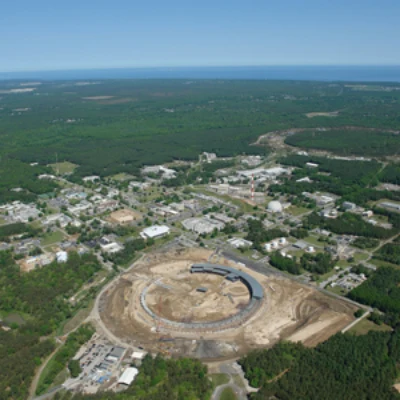
Two ion beams circle the 2.4-mile long track around the big ring in opposite directions. The paths can then be made to cross, thereby causing ions to collide. The collision event is very short-lived but amazingly intense. The temperatures and pressures produced are greater than those in the hottest suns. At 4 trillion degrees Celsius, this is the hottest material ever created in a laboratory
二本のイオンビームが、大きなリングの2.4マイルの走路を互いに逆向きに回る。その道筋を交差させれば、イオンどうしを衝突させられる。衝突は一瞬だが、驚くほど激しい。生じる温度と圧力は、最も熱い恒星の中を上回る。摂氏4兆度というこれは、実験室で作られた最も熱い物質である。
But what is the point of creating such an extreme event? Under these conditions, the neutrons and protons that make up the gold nuclei are smashed apart into their components, which are called quarks and gluons. The goal is to recreate the conditions that theorists believe existed at the very beginning of the universe. It is thought that, at that time, matter was a sort of soup of quarks and gluons. When things cooled down after the initial bang, these particles condensed to form protons and neutrons.
だが、これほど極端な出来事を作り出す意味はどこにあるのか。この条件のもとでは、金の原子核を作っている中性子と陽子が砕けて、クォークとグルーオンと呼ばれる構成要素に分かれる。目的は、理論家が宇宙の始まりに存在したと考える条件を再現することである。当時の物質は、クォークとグルーオンのスープのようなものだったと考えられている。最初の爆発のあと冷えていったとき、これらの粒子が凝縮して陽子と中性子ができた。
Some of the results have been surprising and unexpected. It was thought the quark-gluon soup would resemble a gas or plasma. Instead, it behaves more like a liquid. It has been called a perfect liquid because it has virtually no viscosity, meaning that it has no resistance to flow.
結果のいくつかは意外で予想外のものだった。クォーク・グルーオンのスープは気体かプラズマのようなものだと考えられていた。ところが実際には液体に近い振る舞いをする。粘性が事実上0、すなわち流れへの抵抗がないので、完全流体と呼ばれている。
GRASP CHECK Calculate the relativistic factor γ, for a particle traveling at 99.7 percent of the speed of light.a. 0.08b. 0.71
理解の確認 光の速さの99.7パーセントで進む粒子について、相対論的因子γを計算せよ。a. 0.08b. 0.71
c. 1.41d. 12.9
c. 1.41d. 12.9
The Speed of Light One night you are out looking up at the stars and an extraterrestrial spaceship flashes across the sky. The ship is 50 meters long and is travelling at 95 percent of the speed of light. What would the ship’s length be when measured from your earthbound frame of reference?
光の速さ ある夜、星空を眺めていると、地球外の宇宙船が空を横切った。この船は長さ50メートルで、光の速さの95パーセントで進んでいる。地球上のあなたの基準系から測ると、この船の長さはいくらになるか。
Strategy方針
List the knowns and unknowns.
分かっている量と分からない量を挙げる。
Knowns: proper length of the ship, L0 = 50 m; velocity, v, = 0.95c
分かっている量:船の固有長 L0 = 50 m、速度 v = 0.95c
Unknowns: observed length of the ship accounting for relativistic length contraction, L.
分からない量:相対論的な長さの収縮を考えに入れて観測される船の長さL
Choose the relevant equation.
関係する式を選ぶ。
Solution解答
Discussion考察
Calculations of can usually be simplified in this way when v is expressed as a percentage of c because the c2 terms cancel. Be sure to also square the decimal representing the percentage before subtracting from 1. Note that the aliens will still see the length as L0 because they are moving with the frame of reference that is the ship.
vをcの百分率で表すと、c2の項が約分されるので、の計算はたいていこのように簡単にできる。1から引く前に、百分率を表す小数を2乗するのを忘れないこと。なお、宇宙人には船の長さはL0のままに見える。彼らは船という基準系とともに動いているからである。
Practice Problems練習問題
7Calculate the relativistic factor, γ, for an object traveling at 2.00×10⁸ m/s.a. 0.74b. 0.83
72.00×10⁸ m/sで進む物体について、相対論的因子γを計算せよ。a. 0.74b. 0.83
c. 1.2d. 1.34
c. 1.2d. 1.34
8The distance between two points, called the proper length, L0, is 1.00 km. An observer in motion with respect to the frame of reference of the two points measures 0.800 km, which is L. What is the relative speed of the frame of reference with respect to the observer?a. 1.80×10⁸ m/sb. 2.34×10⁸ m/sc. 3.84×10⁸ m/sd. 5.00×10⁸ m/s
8二点間の距離、すなわち固有長L0は1.00 kmである。この二点の基準系に対して動いている観測者は0.800 kmと測る。これがLである。観測者に対するこの基準系の相対速度はいくらか。a. 1.80×10⁸ m/sb. 2.34×10⁸ m/sc. 3.84×10⁸ m/sd. 5.00×10⁸ m/s
9Consider the nuclear fission reaction . If a neutron has a rest mass of
9核分裂反応を考える。中性子の静止質量が
1009u, has a rest mass of 235.044u, has rest mass of 136.907u, and has a rest mass of
1009 u、の静止質量が235.044 u、一方の生成物の静止質量が136.907 u、の静止質量が
96937u, what is the value of E in joules?a. Jb. Jc. Jd. J
96937 uだとすると、Eの値はジュールでいくらか。a. Jb. Jc. Jd. J
Solution The correct answer is (b). The mass deficit in the reaction is or 0.191u. Converting that mass to kg and applying to find the energy equivalent of the mass deficit gives
解答 正しいのは(b)である。この反応の質量欠損は、すなわち0.191 uである。この質量をkgに直し、質量欠損に相当するエネルギーを求めると次が得られる。
10Consider the nuclear fusion reaction . If has a rest mass of 2.014u, has a rest mass of 3.016u, and has a rest mass of 1.008u, what is the value of E in joules?
10核融合反応を考える。の静止質量が2.014 u、の静止質量が3.016 u、の静止質量が1.008 uだとすると、Eの値はジュールでいくらか。
a. J
a. J
b. Jc. Jd. J
b. Jc. Jd. J
Solution The correct answer is (a). The mass deficit in the reaction is , or 0.004u. Converting that mass to kg and applying to find the energy equivalent of the mass deficit gives
解答 正しいのは(a)である。この反応の質量欠損は、すなわち0.004 uである。この質量をkgに直し、を使って質量欠損に相当するエネルギーを求めると次が得られる。
Check Your Understanding理解の確認
11Describe time dilation and state under what conditions it becomes significant.a. When the speed of one frame of reference past another reaches the speed of light, a time interval between two events at the same location in one frame appears longer when measured from the second frame.b. When the speed of one frame of reference past another becomes comparable to the speed of light, a time interval between two events at the same location in one frame appears longer when measured from the second frame.c. When the speed of one frame of reference past another reaches the speed of light, a time interval between two events at the same location in one frame appears shorter when measured from the second frame.d. When the speed of one frame of reference past another becomes comparable to the speed of light, a time interval between two events at the same location in one frame appears shorter when measured from the second frame.
11時間の遅れを述べ、それが顕著になる条件を答えよ。a. ある基準系が別の基準系のそばを通る速さが光の速さに達すると、一方の系の同じ場所で起こる二つの出来事の時間間隔が、もう一方の系から測ると長く見える。b. ある基準系が別の基準系のそばを通る速さが光の速さに近づくと、一方の系の同じ場所で起こる二つの出来事の時間間隔が、もう一方の系から測ると長く見える。c. ある基準系が別の基準系のそばを通る速さが光の速さに達すると、一方の系の同じ場所で起こる二つの出来事の時間間隔が、もう一方の系から測ると短く見える。d. ある基準系が別の基準系のそばを通る速さが光の速さに近づくと、一方の系の同じ場所で起こる二つの出来事の時間間隔が、もう一方の系から測ると短く見える。
12The equation used to calculate relativistic momentum is p = γ · m · u. Define the terms to the right of the equal sign and state how m and u are measured.
12相対論的運動量を計算する式は p = γ∙m∙u である。等号の右にある項を定義し、mとuがどう測られるかを述べよ。
a. γ is the relativistic factor, m is the rest mass measured when the object is at rest in the frame of reference, and u is the velocity of the frame.b. γ is the relativistic factor, m is the rest mass measured when the object is at rest in the frame of reference, and u is the velocity relative to an observer.
a. γは相対論的因子、mは物体が基準系で静止しているときに測った静止質量、uはその系の速度である。b. γは相対論的因子、mは物体が基準系で静止しているときに測った静止質量、uは観測者に対する速度である。
c. γ is the relativistic factor, m is the relativistic mass measured when the object is moving
c. γは相対論的因子、mは物体が基準系で動いているときに測った相対論的質量
in the frame of reference, and u is the velocity of the frame.
であり、uはその系の速度である。
d. γ is the relativistic factor, m is the relativistic mass measured when the object is moving
d. γは相対論的因子、mは物体が基準系で動いているときに測った相対論的質量
in the frame of reference, and u is the velocity relative to an observer.
であり、uは観測者に対する速度である。
13Describe length contraction and state when it occurs.a. When the speed of an object becomes the speed of light, its length appears to shorten when viewed by a stationary observer.b. When the speed of an object approaches the speed of light, its length appears to shorten when viewed by a stationary observer.c. When the speed of an object becomes the speed of light, its length appears to increase when viewed by a stationary observer.d. When the speed of an object approaches the speed of light, its length appears to increase when viewed by a stationary observer.
13長さの収縮を述べ、それがいつ起こるかを答えよ。a. 物体の速さが光の速さになると、静止した観測者から見てその長さが縮んで見える。b. 物体の速さが光の速さに近づくと、静止した観測者から見てその長さが縮んで見える。c. 物体の速さが光の速さになると、静止した観測者から見てその長さが伸びて見える。d. 物体の速さが光の速さに近づくと、静止した観測者から見てその長さが伸びて見える。