第8章運動量Momentum原書 p.259–286
Chapter Review章のまとめ
Concept Items概念の問題
8.1 Linear Momentum, Force, and Impulse 1What is impulse?a. Change in velocityb. Change in momentum
8.1 運動量、力、力積 1力積とは何か。a. 速度の変化b. 運動量の変化
c. Rate of change of velocityd. Rate of change of momentum
c. 速度の変化する割合d. 運動量の変化する割合
2In which equation of Newton’s second law is mass assumed to be constant?
2ニュートンの第二法則のどの式で、質量は一定だと仮定されているか。
3What is the SI unit of momentum? a. b.
3運動量のSI単位はどれか。 a. b.
4What is the equation for linear momentum? a. b.
4運動量の式はどれか。 a. b.
conservation of momentum along x-axis for 2D collisions
二次元衝突におけるx軸方向の運動量の保存
conservation of momentum along y-axis for 2D collisions
二次元衝突におけるy軸方向の運動量の保存
8.2 Conservation of Momentum 5What is angular momentum?a. The sum of moment of inertia and angular velocityb. The ratio of moment of inertia to angular velocityc. The product of moment of inertia and angular velocityd. Half the product of moment of inertia and square of angular velocity
8.2 運動量の保存 5角運動量とは何か。a. 慣性モーメントと角速度の和b. 慣性モーメントと角速度の比c. 慣性モーメントと角速度の積d. 慣性モーメントと角速度の2乗の積の半分
6What is an isolated system?a. A system in which the net internal force is zerob. A system in which the net external force is zeroc. A system in which the net internal force is a nonzero constantd. A system in which the net external force is a nonzero constant
6孤立系とは何か。a. 正味の内力が0である系b. 外力の合力が0である系c. 正味の内力が0でない定数である系d. 外力の合力が0でない定数である系
8.3 Elastic and Inelastic Collisions 7In the equation p1 + p2 = p'1 + p'2 for the collision of two objects, what is the assumption made regarding the friction acting on the objects?
8.3 弾性衝突と非弾性衝突 7二つの物体の衝突についての式 p1 + p2 = p′1 + p′2 では、物体にはたらく摩擦についてどんな仮定が置かれているか。
a. Friction is zero.
a. 摩擦は0である。
b. Friction is nearly zero.
b. 摩擦はほぼ0である。
c. Friction acts constantly.d. Friction before and after the impact remains the same.
c. 摩擦はたえずはたらいている。d. 衝突の前後で摩擦は変わらない。
8What is an inelastic collision? a. when objects stick together after impact, and their internal energy is not conserved
8非弾性衝突とは何か。 a. 衝突後に物体がくっつき、その内部エネルギーが保存されない場合
Critical Thinking Items批判的に考える問題
8.1 Linear Momentum, Force, and Impulse 9Consider two objects of the same mass. If a force of acts on the first for a duration of and on the other for a duration of , which of the following statements is true?
8.1 運動量、力、力積 9同じ質量の二つの物体を考える。の力が、一つ目にはの間、二つ目にはの間はたらくとき、次のうち正しいのはどれか。
a. The first object will acquire more momentum.b. The second object will acquire more momentum.c. Both objects will acquire the same momentum.d. Neither object will experience a change in momentum.
a. 一つ目の物体のほうが大きな運動量を得る。b. 二つ目の物体のほうが大きな運動量を得る。c. どちらの物体も同じ運動量を得る。d. どちらの物体も運動量の変化を受けない。
10Cars these days have parts that can crumple or collapse in the event of an accident. How does this help protect the passengers?
10今日の車には、事故のときにつぶれたり崩れたりする部品がある。これは乗員をどう守るのか。
a. It reduces injury to the passengers by increasing the time of impact.b. It reduces injury to the passengers by decreasing the time of impact.c. It reduces injury to the passengers by increasing the change in momentum.d. It reduces injury to the passengers by decreasing the change in momentum.
a. 衝撃の時間を長くすることで、乗員のけがを減らす。b. 衝撃の時間を短くすることで、乗員のけがを減らす。c. 運動量の変化を大きくすることで、乗員のけがを減らす。d. 運動量の変化を小さくすることで、乗員のけがを減らす。
11How much force would be needed to cause a 17 kg ⋅ m/s change in the momentum of an object, if the force acted for 5 seconds?
11ある力が5秒間はたらいて物体の運動量を17 kg·m/s変えるには、どれだけの力が必要か。
a. 3.4 Nb. 12 Nc. 22 Nd. 85 N
a. 3.4 Nb. 12 Nc. 22 Nd. 85 N
8.2 Conservation of Momentum 12A billiards ball rolling on the table has momentum p1. It hits another stationary ball, which then starts rolling. Considering friction to be negligible, what will happen to the momentum of the first ball?
8.2 運動量の保存 12台の上を転がるビリヤードの球が運動量p1を持っている。それが静止している別の球に当たり、その球が転がり始める。摩擦が無視できるとして、最初の球の運動量はどうなるか。
a. It will decrease.
a. 減る。
b. when objects stick together after impact, and their internal energy is conservedc. when objects stick together after impact, and always come to rest instantaneously after collisiond. when objects stick together after impact, and their internal energy increases
b. 衝突後に物体がくっつき、その内部エネルギーが保存される場合c. 衝突後に物体がくっつき、衝突直後につねに静止する場合d. 衝突後に物体がくっつき、その内部エネルギーが増える場合
b. It will increase.
b. 増える。
c. It will become zero.d. It will remain the same.
c. 0になる。d. 変わらない。
13A ball rolling on the floor with momentum p1 collides with a stationary ball and sets it in motion. The momentum of the first ball becomes p'1, and that of the second becomes p'2. The directions of p1, p'1, and p'2 are all the same. Compare the magnitudes of p1 and p'2.
13床の上を運動量p1で転がる球が、静止している球に衝突してそれを動かす。最初の球の運動量はp′1に、二つ目の球の運動量はp′2になる。p1、p′1、p′2の向きはすべて同じである。p1とp′2の大きさを比べよ。
a. Momenta p1 and p'2 are the same in magnitude. b. The sum of the magnitudes of p1 and p'2 is zero. c. The magnitude of p1 is greater than that of p'2. d. The magnitude of p'2 is greater than that of p1.
a. 運動量p1とp′2は大きさが等しい。 b. p1とp′2の大きさの和は0である。 c. p1の大きさのほうがp′2より大きい。 d. p′2の大きさのほうがp1より大きい。
14Two cars are moving in the same direction. One car with momentum p1 collides with another, which has momentum p2. Their momenta become p'1 and p'2 respectively. Considering frictional losses, compare (p'1 + p'2 ) with (p1 + p2).
14二台の車が同じ向きに動いている。運動量p1の車が、運動量p2の車に衝突する。衝突後の運動量はそれぞれp′1とp′2になる。摩擦による損失を考えて、(p′1 + p′2)と(p1 + p2)を比べよ。
a. The value of (p'1 + p'2 ) is zero.b. The values of (p1 + p2) and (p'1 + p'2 ) are
a. (p′1 + p′2)の値は0である。b. (p1 + p2)と(p′1 + p′2)の値は
equal. c. The value of (p1 + p2) will be greater than (p'1 + p'2 ). d. The value of (p'1 + p'2 ) will be greater than (p1 + p2).
等しい。 c. (p1 + p2)の値のほうが(p′1 + p′2)より大きい。 d. (p′1 + p′2)の値のほうが(p1 + p2)より大きい。
8.3 Elastic and Inelastic Collisions 15Two people, who have the same mass, throw two different objects at the same velocity. If the first object is heavier than the second, compare the velocities gained by the two people as a result of recoil.
8.3 弾性衝突と非弾性衝突 15質量の等しい二人が、違う二つの物を同じ速度で投げる。一つ目の物のほうが重いとき、反跳によって二人が得る速度を比べよ。
a. The first person will gain more velocity as a result of recoil.b. The second person will gain more velocity
a. 一人目のほうが反跳で大きな速度を得る。b. 二人目のほうが反跳で
as a result of recoil. c. Both people will gain the same velocity as a result of recoil.
大きな速度を得る。 c. 二人とも反跳で同じ速度を得る。
Problems問題
8.1 Linear Momentum, Force, and Impulse8.1 運動量、力、力積
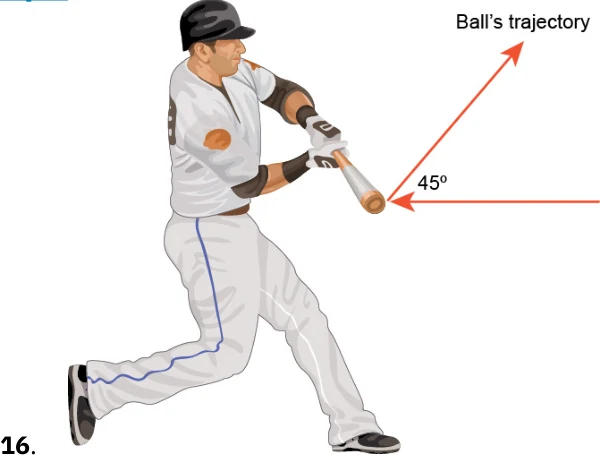
(credit: modification of work from Pinterest)
(Pinterestの図をもとに改変)
A 145-g baseball is incoming at a velocity of 35 m/s. The batter hits the ball as shown in the image. The outgoing baseball has a velocity of 40 m/s at the angle shown.
質量145 gの野球のボールが速度35 m/sで飛んでくる。打者は図のようにボールを打つ。打ち返されたボールは、図に示す角で速度40 m/sを持つ。
What is the magnitude of the x-component of the impulse?
力積のx成分の大きさはいくらか。
a. 0.26 kg⋅m/s.b. 4.09 kg⋅m/s.c. 4.35 kg⋅m/s.d. 8.44 kg⋅m/s.
a. 0.26 kg·m/sb. 4.09 kg·m/sc. 4.35 kg·m/sd. 8.44 kg·m/s
17For how long should a force of 130 N be applied to an object of mass 50 kg to change its speed
17質量50 kgの物体の速さを20 m/sから60 m/sに変えるには、130 Nの力を
Performance Task実践課題
8.3 Elastic and Inelastic Collisions 20You will need the following:• balls of different weights• a ruler or wooden strip• some books• a paper cup
8.3 弾性衝突と非弾性衝突 20次のものを用意する。・重さの違ういくつかの球・定規か木の板・本を数冊・紙コップ1個
Make an inclined plane by resting one end of a ruler on a stack of books. Place a paper cup on the other end. Roll a ball from the top of the ruler so that it hits the paper cup. Measure the
定規の一端を本の山に載せて斜面を作る。もう一端に紙コップを置く。定規の上から球を転がして紙コップに当てる。
d. The velocity of both people will be zero as a result of recoil.
d. 反跳による二人の速度はどちらも0である。
from 20 m/s to 60 m/s?a. 0.031 sb. 0.065 s
どれだけの間加えればよいか。a. 0.031 sb. 0.065 s
c. 15.4 sd. 40 s
c. 15.4 sd. 40 s
8.3 Elastic and Inelastic Collisions 18In an elastic collision, an object with momentum 25 kg⋅m/s (moving to the left) collides with another that has a momentum 35 kg⋅m/s, moving toward it to the right. The first object’s momentum changes to 15 kg⋅m/s, and it is now moving to the right. What is the magnitude of the momentum of the second object after the collision?
8.3 弾性衝突と非弾性衝突 18弾性衝突で、運動量25 kg·m/sで左へ動いている物体が、運動量35 kg·m/sで右へ向かってくる別の物体に衝突する。最初の物体の運動量は15 kg·m/sに変わり、今度は右へ動いている。衝突後の二つ目の物体の運動量の大きさはいくらか。
a. 5 kg⋅m/sb. 10 kg⋅m/sc. 25 kg⋅m/sd. 75 kg⋅m/s
a. 5 kg·m/sb. 10 kg·m/sc. 25 kg·m/sd. 75 kg·m/s
19Find the recoil velocity of a ice hockey goalie who catches a hockey puck slapped at him at a velocity of . Assume that the goalie is at rest before catching the puck, and friction between the ice and the puck-goalie system is negligible.
19質量のアイスホッケーのゴールキーパーが、速度で打ち込まれた質量のパックを受け止めるとき、その反跳の速度を求めよ。ゴールキーパーはパックを受ける前は静止しており、氷とパック・ゴールキーパーの系の間の摩擦は無視できるものとする。
displacement of the paper cup due to the collision. Now use increasingly heavier balls for this activity and see how that affects the displacement of the cup. Plot a graph of mass vs. displacement. Now repeat the same activity, but this time, instead of using different balls, change the incline of the ruler by varying the height of the stack of books. This will give you different velocities of the ball. See how this affects the displacement of the paper cup.
衝突によって紙コップがどれだけ動いたかを測る。次に、だんだん重い球を使って同じことをし、それが紙コップの動きにどう効くかを見る。質量と変位のグラフを描く。今度は同じ活動を、球を変えるかわりに、本の山の高さを変えて定規の傾きを変えて行う。これで球の速度が変わる。それが紙コップの動きにどう効くかを見よ。