第8章運動量Momentum原書 p.259–286
8.1 Linear Momentum, Force, and Impulse8.1 運動量、力、力積
SECTION LEARNING OBJECTIVES By the end of this section, you will be able to do the following:
この節の学習目標 この節を終えると、次のことができるようになる。
• Describe momentum, what can change momentum, impulse, and the impulse-momentum theorem• Describe Newton’s second law in terms of momentum• Solve problems using the impulse-momentum theorem
・運動量、運動量を変えうるもの、力積、そして力積・運動量定理を述べる・ニュートンの第二法則を運動量の言葉で述べる・力積・運動量定理を使って問題を解く
Section Key Termsこの節の重要語
change in momentumimpulseimpulse–momentum theoremlinear momentum
運動量の変化力積力積・運動量定理運動量
Momentum, Impulse, and the Impulse-Momentum Theorem運動量、力積、力積・運動量定理
Linear momentum is the product of a system’s mass and its velocity. In equation form, linear momentum p is
運動量とは、系の質量とその速度の積である。式で書けば、運動量pは次のとおりである。
You can see from the equation that momentum is directly proportional to the object’s mass (m) and velocity (v). Therefore, the greater an object’s mass or the greater its velocity, the greater its momentum. A large, fast-moving object has greater momentum than a smaller, slower object.
式から、運動量が物体の質量(m)と速度(v)に比例することが分かる。したがって物体の質量が大きいほど、また速度が大きいほど、運動量は大きい。大きくて速く動く物体は、小さくて遅い物体より大きな運動量を持つ。
Momentum is a vector and has the same direction as velocity v. Since mass is a scalar, when velocity is in a negative direction (i.e., opposite the direction of motion), the momentum will also be in a negative direction; and when velocity is in a positive direction, momentum will likewise be in a positive direction. The SI unit for momentum is kg m/s.
運動量はベクトルであり、速度vと同じ向きを持つ。質量はスカラーなので、速度が負の向き(すなわち運動の向きと逆)なら運動量も負の向きになり、速度が正の向きなら運動量も正の向きになる。運動量のSI単位はkg·m/sである。
Momentum is so important for understanding motion that it was called the quantity of motion by physicists such as Newton. Force influences momentum, and we can rearrange Newton’s second law of motion to show the relationship between force and momentum.
運動量は運動を理解するうえであまりに重要なので、ニュートンら物理学者はそれを「運動の量」と呼んだ。力は運動量に影響する。ニュートンの運動の第二法則を変形すれば、力と運動量の関係を示せる。
Recall our study of Newton’s second law of motion (Fnet = ma). Newton actually stated his second law of motion in terms of momentum: The net external force equals the change in momentum of a system divided by the time over which it changes. The change in momentum is the difference between the final and initial values of momentum.
ニュートンの運動の第二法則(Fnet = ma)を学んだのを思い出そう。ニュートンは実は、運動の第二法則を運動量の言葉で述べていた。すなわち、外力の合力は、系の運動量の変化を、それが変化した時間で割ったものに等しい。運動量の変化とは、運動量の終わりの値と初めの値の差である。
In equation form, this law is
式で書けば、この法則は次のとおりである。
where Fnet is the net external force, is the change in momentum, and is the change in time.
ここでFnetは外力の合力、は運動量の変化、は時間の変化である。
We can solve for by rearranging the equation
式を変形すればについて解ける。すなわち、
to be
を次のように書き直す。
is known as impulse and this equation is known as the impulse-momentum theorem. From the equation, we see that the impulse equals the average net external force multiplied by the time this force acts. It is equal to the change in momentum. The effect of a force on an object depends on how long it acts, as well as the strength of the force. Impulse is a useful concept because it quantifies the effect of a force. A very large force acting for a short time can have a great effect on the momentum of an object, such as the force of a racket hitting a tennis ball. A small force could cause the same change in momentum, but it would have to act for a much longer time.
は力積として知られ、この式は力積・運動量定理として知られる。この式から、力積は平均の外力の合力に、その力がはたらいた時間を掛けたものに等しいことが分かる。それは運動量の変化に等しい。物体に及ぼす力の効果は、力の強さだけでなく、それがどれだけの間はたらくかにも依存する。力積は力の効果を数量として表すので、便利な概念である。ラケットがテニスボールを打つ力のように、非常に大きな力が短い時間はたらけば、物体の運動量に大きな効果を及ぼしうる。小さな力でも同じ運動量の変化を生みうるが、そのためにはずっと長い時間はたらかねばならない。
Newton’s Second Law in Terms of Momentum運動量で表したニュートンの第二法則
When Newton’s second law is expressed in terms of momentum, it can be used for solving problems where mass varies, since . In the more traditional form of the law that you are used to working with, mass is assumed to be constant. In fact, this traditional form is a special case of the law, where mass is constant. is actually derived from the equation:
ニュートンの第二法則を運動量で表すと、なので、質量が変わる問題にも使える。あなたが使い慣れている、より伝統的な形の法則では、質量は一定だと仮定されている。実のところこの伝統的な形は、質量が一定である特別な場合なのである。は、実は次の式から導かれる。
For the sake of understanding the relationship between Newton’s second law in its two forms, let’s recreate the derivation of from
ニュートンの第二法則の二つの形の関係を理解するために、を次の式から導き直してみよう。
by substituting the definitions of acceleration and momentum.
加速度と運動量の定義を代入する。
The change in momentum is given by
運動量の変化は次で与えられる。
If the mass of the system is constant, then
系の質量が一定なら、
By substituting for , Newton’s second law of motion becomes
にを代入すると、ニュートンの運動の第二法則は
for a constant mass.
質量が一定のとき、次のようになる。
Because
そして、
we can substitute to get the familiar equation
なので、これを代入すれば、系の質量が一定のときの
when the mass of the system is constant.
おなじみの式が得られる。
TIPS FOR SUCCESS We just showed how applies only when the mass of the system is constant. An example of when this formula would not apply would be a moving rocket that burns enough fuel to significantly change the mass of the rocket. In this case, you can use Newton’s second law expressed in terms of momentum to account for the changing mass without having to know anything about the interaction force by the fuel on the rocket.
学習のポイント が系の質量が一定のときにだけ当てはまることを、今しがた示した。この式が当てはまらない例が、燃料を燃やして質量が大きく変わる飛行中のロケットである。この場合、運動量で表したニュートンの第二法則を使えば、燃料がロケットに及ぼす相互作用の力について何も知らなくても、変わっていく質量を扱える。
SNAP LAB身近な実験Hand Movement and Impulse手の動きと力積
In this activity you will experiment with different types of hand motions to gain an intuitive understanding of the relationship between force, time, and impulse.
この活動では、いろいろな手の動かし方を試して、力・時間・力積の関係を直感でつかむ。
• one ball• one tub filled with water
・ボール1個・水を張った桶1つ
Procedure:手順
1. Try catching a ball while giving with the ball, pulling your hands toward your body.2. Next, try catching a ball while keeping your hands still.3. Hit water in a tub with your full palm. Your full palm represents a swimmer doing a belly flop.4. After the water has settled, hit the water again by diving your hand with your fingers first into the water. Your diving hand represents a swimmer doing a dive.5. Explain what happens in each case and why.
1. ボールを受け止めるとき、ボールに合わせて手を体のほうへ引きながら受けてみる。2. 次に、手を動かさずにボールを受けてみる。3. 桶の水を手のひら全体で叩く。手のひら全体は、腹打ちで飛び込む泳者にあたる。4. 水面が静まったら、今度は指先から手を水に突き入れるようにして叩く。突き入れる手は、きれいに飛び込む泳者にあたる。5. それぞれの場合に何が起こったか、そしてなぜかを説明せよ。
What are some other examples of motions that impulse affects?
力積が効いてくる運動の例を、他にどんなものが挙げられるか。
a. a football player colliding with another, or a car moving at a constant velocityb. a car moving at a constant velocity, or an object moving in the projectile motionc. a car moving at a constant velocity, or a racket hitting a balld. a football player colliding with another, or a racket hitting a ball
a. フットボール選手どうしの衝突、または一定の速度で走る車b. 一定の速度で走る車、または放物運動をする物体c. 一定の速度で走る車、またはボールを打つラケットd. フットボール選手どうしの衝突、またはボールを打つラケット
Engineering: Saving Lives Using the Concept of Impulse Cars during the past several decades have gotten much safer. Seat belts play a major role in automobile safety by preventing people from flying into the windshield in the event of a crash. Other safety features, such as airbags, are less visible or obvious, but are also effective at making auto crashes less deadly (see Figure 8.2). Many of these safety features make use of the concept of impulse from physics. Recall that impulse is the net force multiplied by the duration of time of the impact. This was expressed mathematically as .
工学:力積の考えを使って命を救う ここ数十年で、車ははるかに安全になった。シートベルトは、衝突の際に人がフロントガラスへ飛び出すのを防ぐことで、自動車の安全に大きな役割を果たしている。エアバッグなど、目につきにくい安全装備も、事故の致死性を下げるのに効いている(図8.2を見よ)。こうした安全装備の多くは、物理でいう力積の考えを使っている。力積とは合力に衝突の続く時間を掛けたものだったことを思い出そう。数式ではと表された。
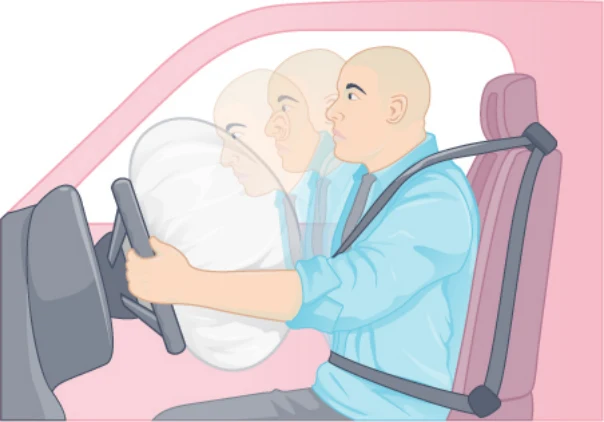
Airbags allow the net force on the occupants in the car to act over a much longer time when there is a sudden stop. The momentum change is the same for an occupant whether an airbag is deployed or not. But the force that brings the occupant to a stop will be much less if it acts over a larger time. By rearranging the equation for impulse to solve for force you can see how increasing while stays the same will decrease Fnet. This is another example of an inverse relationship. Similarly, a padded dashboard increases the time over which the force of impact acts, thereby reducing the force of impact.
エアバッグは、急停止のときに乗員にはたらく合力を、はるかに長い時間にわたってはたらかせる。運動量の変化は、エアバッグが開いても開かなくても同じである。しかし乗員を止める力は、それが長い時間にわたってはたらけばはるかに小さくなる。力積の式を力について解いたを見れば、が同じままを大きくすればFnetが小さくなることが分かる。これも反比例の関係のもう一つの例である。同じように、詰め物をしたダッシュボードは衝撃の力がはたらく時間を長くし、それによって衝撃の力を小さくする。
Cars today have many plastic components. One advantage of plastics is their lighter weight, which results in better gas mileage. Another advantage is that a car will crumple in a collision, especially in the event of a head-on collision. A longer collision time means the force on the occupants of the car will be less. Deaths during car races decreased dramatically when the rigid frames of racing cars were replaced with parts that could crumple or collapse in the event of an accident.
今日の車には多くのプラスチック部品が使われている。プラスチックの利点の一つは軽いことで、燃費がよくなる。もう一つの利点は、衝突のとき、とくに正面衝突のときに車がつぶれることである。衝突の時間が長くなれば、乗員にはたらく力は小さくなる。レーシングカーの剛性の高い車体が、事故のときにつぶれたり崩れたりする部品に置き換えられてから、レース中の死者は劇的に減った。
GRASP CHECK You may have heard the advice to bend your knees when jumping. In this example, a friend dares you to jump off of a park bench onto the ground without bending your knees. You, of course, refuse. Explain to your friend why this would be a foolish thing. Show it using the impulse-momentum theorem.
理解の確認 跳ぶときには膝を曲げよ、という助言を聞いたことがあるだろう。ここで、友人があなたに、膝を曲げずに公園のベンチから地面へ跳び降りてみろと挑発したとする。もちろんあなたは断る。それが愚かなことである理由を友人に説明せよ。力積・運動量定理を使って示せ。
a. Bending your knees increases the time of the impact, thus decreasing the force.b. Bending your knees decreases the time of the impact, thus decreasing the force.c. Bending your knees increases the time of the impact, thus increasing the force.d. Bending your knees decreases the time of the impact, thus increasing the force.
a. 膝を曲げると衝撃の時間が長くなり、力が小さくなる。b. 膝を曲げると衝撃の時間が短くなり、力が小さくなる。c. 膝を曲げると衝撃の時間が長くなり、力が大きくなる。d. 膝を曲げると衝撃の時間が短くなり、力が大きくなる。
Calculating Momentum: A Football Player and a Football (a) Calculate the momentum of a 110 kg football player running at 8 m/s. (b) Compare the player’s momentum with the momentum of a 0.410 kg football thrown hard at a speed of 25 m/s.
運動量を計算する:フットボール選手とボール (a)8 m/sで走る質量110 kgのフットボール選手の運動量を計算せよ。(b)この選手の運動量を、25 m/sの速さで強く投げられた質量0.410 kgのフットボールの運動量と比べよ。
Strategy方針
No information is given about the direction of the football player or the football, so we can calculate only the magnitude of the momentum, p. (A symbol in italics represents magnitude.) In both parts of this example, the magnitude of momentum can be calculated directly from the definition of momentum:
フットボール選手やボールの向きについての情報はないので、運動量の大きさpだけを計算できる。(斜体の記号は大きさを表す。)この例のどちらの問いでも、運動量の大きさは運動量の定義から直接に計算できる。
Solution for (a)(a)の解答
To find the player’s momentum, substitute the known values for the player’s mass and speed into the equation.
選手の運動量を求めるには、選手の質量と速さの既知の値を式に代入する。
Solution for (b)(b)の解答
To find the ball’s momentum, substitute the known values for the ball’s mass and speed into the equation.
ボールの運動量を求めるには、ボールの質量と速さの既知の値を式に代入する。
The ratio of the player’s momentum to the ball’s momentum is
選手の運動量とボールの運動量の比は次のとおりである。
Discussion考察
Although the ball has greater velocity, the player has a much greater mass. Therefore, the momentum of the player is about 86 times greater than the momentum of the football.
ボールのほうが速度は大きいが、選手の質量ははるかに大きい。したがって選手の運動量は、フットボールの運動量のおよそ86倍である。
Calculating Force: Venus Williams’ Racquet During the 2007 French Open, Venus Williams (Figure 8.3) hit the fastest recorded serve in a premier women’s match, reaching a speed of 58 m/s (209 km/h). What was the average force exerted on the 0.057 kg tennis ball by Williams’ racquet? Assume that the ball’s speed just after impact was 58 m/s, the horizontal velocity before impact is negligible, and that the ball remained in contact with the racquet for 5 ms (milliseconds).
力を計算する:ビーナス・ウィリアムズのラケット 2007年の全仏オープンで、ビーナス・ウィリアムズ(図8.3)は女子のプレミア試合における最速のサーブを記録し、58 m/s(時速209 km)に達した。ウィリアムズのラケットが質量0.057 kgのテニスボールに及ぼした平均の力はいくらだったか。衝突直後のボールの速さは58 m/s、衝突前の水平方向の速度は無視でき、ボールがラケットに触れていた時間は5ミリ秒(ms)だったとする。

Strategy方針
Recall that Newton’s second law stated in terms of momentum is
運動量で表したニュートンの第二法則が次のとおりだったことを思い出そう。
As noted above, when mass is constant, the change in momentum is given by
先に述べたとおり、質量が一定のとき、運動量の変化は次で与えられる。
where vf is the final velocity and vi is the initial velocity. In this example, the velocity just after impact and the change in time are given, so after we solve for , we can use to find the force.
ここでvfは終わりの速度、viは初めの速度である。この例では衝突直後の速度と時間の変化が与えられているので、を求めてからを使って力を求められる。
Solution解答
To determine the change in momentum, substitute the values for mass and the initial and final velocities into the equation above.
運動量の変化を求めるために、質量と初めと終わりの速度の値を上の式に代入する。
Now we can find the magnitude of the net external force using
これで、次を使って外力の合力の大きさを求められる。
Discussion考察
This quantity was the average force exerted by Venus Williams’ racquet on the tennis ball during its brief impact. This problem could also be solved by first finding the acceleration and then using Fnet = ma, but we would have had to do one more step. In this case, using momentum was a shortcut.
これが、ごく短い衝突の間にビーナス・ウィリアムズのラケットがテニスボールに及ぼした平均の力である。この問題は、まず加速度を求めてから Fnet = ma を使っても解けるが、その場合は手順が一つ増えていた。この場合、運動量を使うのが近道だった。
Practice Problems練習問題
1A 5 kg bowling ball is rolled with a velocity of 10 m/s. What is its momentum? a. b.
1質量5 kgのボウリングの球を速度10 m/sで転がす。その運動量はいくらか。 a. b.
2 .
2
(credit: modification of work from Pinterest)
(Pinterestの図をもとに改変)
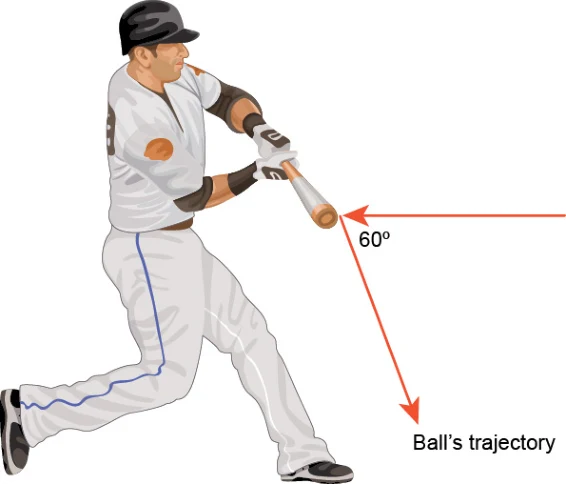
A 155-g baseball is incoming at a velocity of 25 m/s. The batter hits the ball as shown in the image. The outgoing baseball has a velocity of 20 m/s at the angle shown.
質量155 gの野球のボールが速度25 m/sで飛んでくる。打者は図のようにボールを打つ。打ち返されたボールは、図に示す角で速度20 m/sを持つ。
What is the magnitudde of the impulse acting on the ball during the hit?
打撃の間にボールにはたらいた力積の大きさはいくらか。
a. 2.68 kg⋅m/s.b. 5.42 kg⋅m/s.c. 6.05 kg⋅m/s.d. 8.11 kg⋅m/s.
a. 2.68 kg·m/sb. 5.42 kg·m/sc. 6.05 kg·m/sd. 8.11 kg·m/s
Check Your Understanding理解の確認
3What is linear momentum?a. the sum of a system’s mass and its velocityb. the ratio of a system’s mass to its velocity
3運動量とは何か。a. 系の質量とその速度の和b. 系の質量と速度の比
c. the product of a system’s mass and its velocityd. the product of a system’s moment of inertia and its velocity
c. 系の質量とその速度の積d. 系の慣性モーメントとその速度の積
4If an object’s mass is constant, what is its momentum proportional to?a. Its velocityb. Its weight
4物体の質量が一定のとき、その運動量は何に比例するか。a. その速度b. その重さ
c. Its displacementd. Its moment of inertia
c. その変位d. その慣性モーメント
5What is the equation for Newton’s second law of motion, in terms of mass, velocity, and time, when the mass of the system is constant?
5系の質量が一定のとき、質量・速度・時間で表したニュートンの運動の第二法則の式はどれか。
6Give an example of a system whose mass is not constant.a. A spinning topb. A baseball flying through the air
6質量が一定でない系の例を挙げよ。a. 回っているこまb. 空中を飛ぶ野球のボール
c. A rocket launched from Earthd. A block sliding on a frictionless inclined plane
c. 地球から打ち上げられたロケットd. 摩擦のない斜面を滑る物体