第6章円運動と回転運動Circular and Rotational Motion原書 p.205–234
6.3 Rotational Motion6.3 回転運動
SECTION LEARNING OBJECTIVES By the end of this section, you will be able to do the following:
この節の学習目標 この節を終えると、次のことができるようになる。
• Describe rotational kinematic variables and equations and relate them to their linear counterparts• Describe torque and lever arm• Solve problems involving torque and rotational kinematics
・回転の運動学の変数と式を述べ、直線運動での対応物と結びつける・トルクとてこの腕を述べる・トルクと回転の運動学に関する問題を解く
Section Key Termsこの節の重要語
angular accelerationkinematics of rotational motionlever armtangential accelerationtorque
角加速度回転運動の運動学てこの腕接線加速度トルク
Rotational Kinematics回転の運動学
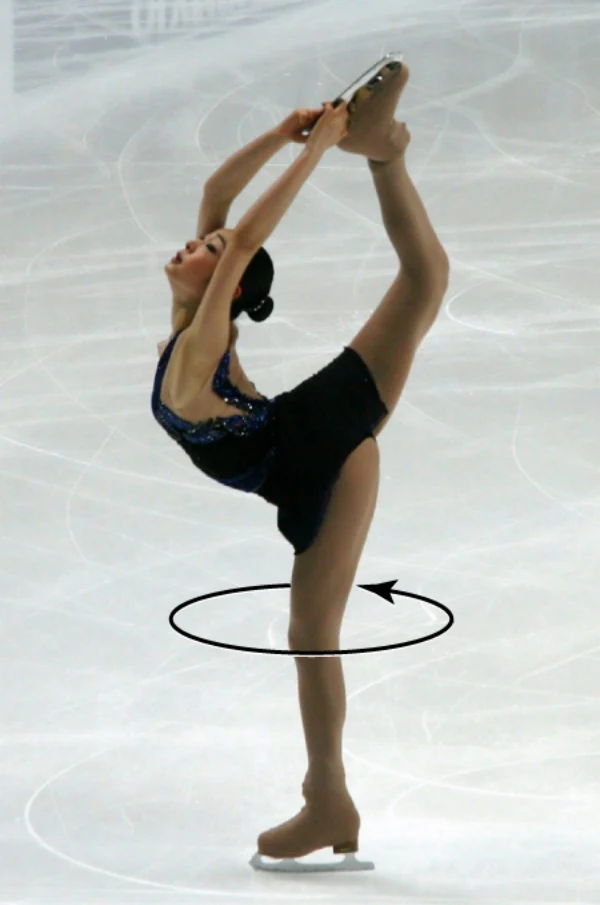
In the section on uniform circular motion, we discussed motion in a circle at constant speed and, therefore, constant angular velocity. However, there are times when angular velocity is not constant—rotational motion can speed up, slow down, or reverse directions. Angular velocity is not constant when a spinning skater pulls in her arms, when a child pushes a merry-go-round to make it rotate, or when a CD slows to a halt when switched off. In all these cases, angular acceleration occurs because the angular velocity changes. The faster the change occurs, the greater is the angular acceleration. Angular acceleration is the rate of change of angular velocity. In equation form, average angular acceleration is
等速円運動の節では、一定の速さ、したがって一定の角速度での円運動を論じた。しかし角速度が一定でないこともある。回転運動は速くなったり遅くなったり、向きを変えたりしうる。回転しているスケーターが腕を縮めるとき、子どもが回転遊具を押して回すとき、電源を切ったCDが止まるまで遅くなるとき、角速度は一定ではない。これらの場合はいずれも、角速度が変わるので角加速度が生じる。変化が速いほど角加速度は大きい。角加速度とは、角速度の変化する割合である。式で書けば、平均の角加速度は次のとおりである。
where is the change in angular velocity and is the change in time. The units of angular acceleration are (rad/ s)/s, or rad/s2. If increases, then is positive. If decreases, then is negative. Keep in mind that, by convention, counterclockwise is the positive direction and clockwise is the negative direction. For example, the skater in Figure 6.9 is rotating counterclockwise as seen from above, so her angular velocity is positive. Acceleration would be negative, for example, when an object that is rotating counterclockwise slows down. It would be positive when an object that is rotating counterclockwise speeds up.
ここでは角速度の変化、は時間の変化である。角加速度の単位は(rad/s)/s、すなわちrad/s2である。が増えればは正、が減ればは負である。慣例として反時計回りが正の向き、時計回りが負の向きであることを心に留めておこう。たとえば図6.9のスケーターは上から見て反時計回りに回っているので、その角速度は正である。たとえば反時計回りに回っている物体が遅くなるとき、加速度は負になる。反時計回りに回っている物体が速くなるときは正になる。
The relationship between the magnitudes of tangential acceleration, a, and angular acceleration,
接線加速度aと角加速度の大きさの関係は次のとおりである。
These equations mean that the magnitudes of tangential acceleration and angular acceleration are directly proportional to each other. The greater the angular acceleration, the larger the change in tangential acceleration, and vice versa. For example, consider riders in their pods on a Ferris wheel at rest. A Ferris wheel with greater angular acceleration will give the riders greater tangential acceleration because, as the Ferris wheel increases its rate of spinning, it also increases its tangential velocity. Note that the radius of the spinning object also matters. For example, for a given angular acceleration , a smaller Ferris wheel leads to a smaller tangential acceleration for the riders.
これらの式は、接線加速度と角加速度の大きさが互いに比例することを意味する。角加速度が大きいほど接線加速度の変化も大きく、その逆も成り立つ。たとえば、止まっている観覧車のゴンドラに乗っている人を考えよう。角加速度の大きい観覧車は、乗客により大きな接線加速度を与える。観覧車が回る速さを増すにつれ、接線速度も増すからである。回っている物の半径も効いてくることに注意しよう。たとえば同じ角加速度でも、観覧車が小さければ乗客の接線加速度は小さくなる。
TIPS FOR SUCCESS Tangential acceleration is sometimes denoted at. It is a linear acceleration in a direction tangent to the circle at the point of interest in circular or rotational motion. Remember that tangential acceleration is parallel to the tangential velocity (either in the same direction or in the opposite direction.) Centripetal acceleration is always perpendicular to the tangential velocity.
学習のポイント 接線加速度はatと書かれることもある。これは、円運動や回転運動で関心のある点における、円の接線方向の直線の加速度である。接線加速度は接線速度に平行である(同じ向きか逆向き)ことを覚えておこう。向心加速度はつねに接線速度に垂直である。
So far, we have defined three rotational variables: , , and . These are the angular versions of the linear variables x, v, and a. The following equations in the table represent the magnitude of the rotational variables and only when the radius is constant and perpendicular to the rotational variable. Table 6.2 shows how they are related.
ここまでに三つの回転の変数、、を定義した。これらは直線運動の変数x、v、aに対応する角の量である。次の表の式は、半径が一定で回転の変数に垂直な場合に限り、回転の変数の大きさを表す。表6.2に、それらがどう関係しているかを示す。
We can now begin to see how rotational quantities like , , and are related to each other. For example, if a motorcycle wheel that starts at rest has a large angular acceleration for a fairly long time, it ends up spinning rapidly and rotates through many revolutions. Putting this in terms of the variables, if the wheel’s angular acceleration is large for a long period of time t, then the final angular velocity and angle of rotation are large. In the case of linear motion, if an object starts at rest and undergoes a large linear acceleration, then it has a large final velocity and will have traveled a large distance.
これで、、といった回転の量が、互いにどう結びついているかが見えはじめる。たとえば、静止から始まったオートバイの車輪が、かなり長い時間にわたって大きな角加速度を受ければ、最後には速く回り、何回転もすることになる。変数の言葉で言えば、車輪の角加速度が長い時間tにわたって大きければ、終わりの角速度と回転角は大きい。直線運動の場合なら、物体が静止から始まって大きな直線の加速度を受ければ、終わりの速度は大きく、長い距離を進んでいることになる。
The kinematics of rotational motion describes the relationships between the angle of rotation, angular velocity, angular acceleration, and time. It only describes motion—it does not include any forces or masses that may affect rotation (these are part of dynamics). Recall the kinematics equation for linear motion: (constant a).
回転運動の運動学は、回転角・角速度・角加速度・時間の間の関係を記述する。それは運動を記述するだけであり、回転に影響しうる力や質量は含まない(それらは動力学の話である)。直線運動の運動学の式(aが一定)を思い出そう。
As in linear kinematics, we assume a is constant, which means that angular acceleration is also a constant, because . The equation for the kinematics relationship between , , and t is
直線の運動学と同じく、ここでもaが一定だとする。なので、これは角加速度も一定だということである。、、tの間の運動学の関係の式は次のとおりである。
where is the initial angular velocity. Notice that the equation is identical to the linear version, except with angular analogs of the linear variables. In fact, all of the linear kinematics equations have rotational analogs, which are given in Table 6.3. These equations can be used to solve rotational or linear kinematics problem in which a and are constant.
ここでは初めの角速度である。この式が、直線の場合の式とまったく同じ形で、変数が角の量に置き換わっただけであることに注目しよう。実際、直線の運動学の式にはすべて回転版があり、表6.3に示す。これらの式は、aとが一定である回転または直線の運動学の問題を解くのに使える。
In these equations, and are initial values, is zero, and the average angular velocity and average velocity are
これらの式で、とは初めの値、は0であり、平均角速度と平均速度は次のとおりである。
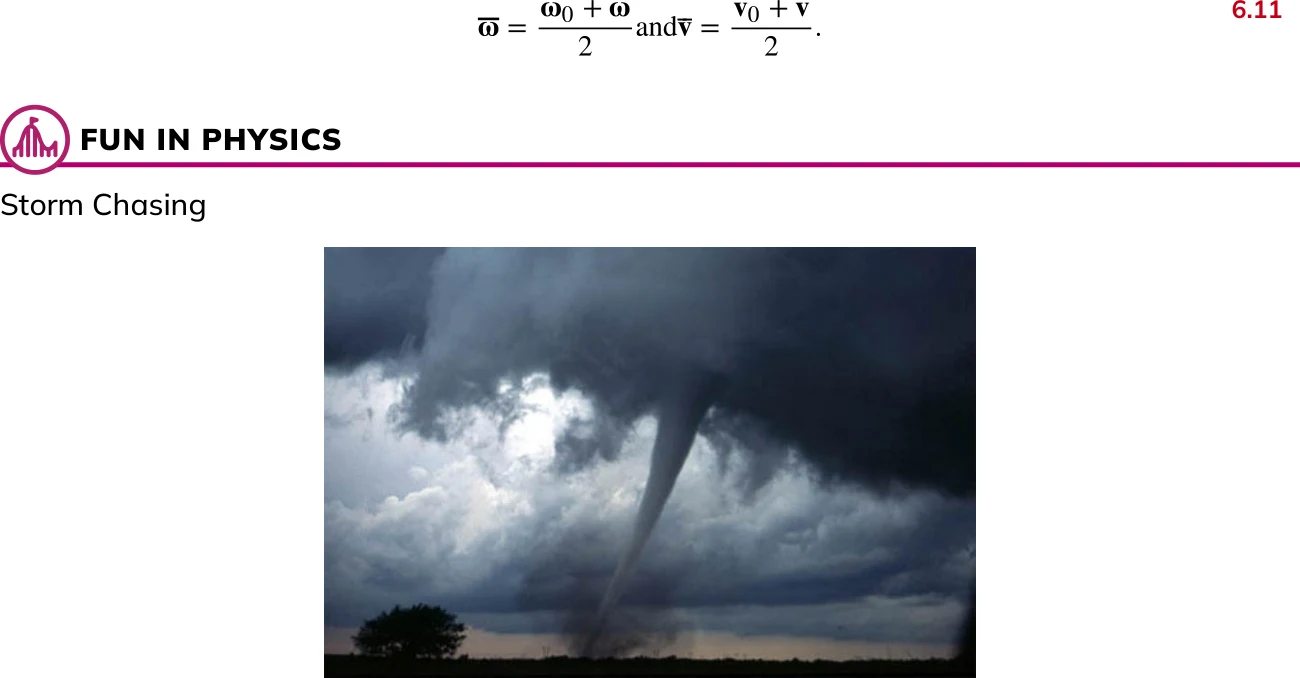
Storm chasers tend to fall into one of four groups: Amateurs chasing tornadoes as a hobby, atmospheric scientists gathering data for research, weather watchers for news media, or scientists having fun under the guise of work. Storm chasing is a dangerous pastime because tornadoes can change course rapidly with little warning. Since storm chasers follow in the wake of the destruction left by tornadoes, changing flat tires due to debris left on the highway is common. The most active part of the world for tornadoes, called tornado alley, is in the central United States, between the Rocky Mountains and Appalachian Mountains.
嵐を追う人々(ストームチェイサー)は、だいたい四つのどれかに分かれる。趣味で竜巻を追うアマチュア、研究のためにデータを集める大気科学者、報道機関のための気象観測者、そして仕事という名目で楽しんでいる科学者である。竜巻はほとんど前触れなく急に進路を変えうるので、嵐を追うのは危険な趣味である。ストームチェイサーは竜巻が残した破壊の跡を追うので、幹線道路に残った破片でタイヤがパンクして交換する羽目になるのはよくあることだ。世界で最も竜巻が活発な地域は「竜巻街道」と呼ばれ、アメリカ中部の、ロッキー山脈とアパラチア山脈の間にある。
Tornadoes are perfect examples of rotational motion in action in nature. They come out of severe thunderstorms called supercells, which have a column of air rotating around a horizontal axis, usually about four miles across. The difference in wind speeds between the strong cold winds higher up in the atmosphere in the jet stream and weaker winds traveling north from the Gulf of Mexico causes the axis of the column of rotating air to shift as the storm travels so that the axis becomes vertical, creating a tornado.
竜巻は、自然の中ではたらく回転運動の完璧な例である。竜巻は、スーパーセルと呼ばれる激しい雷雲から生まれる。スーパーセルの中では、たいてい直径4マイルほどの空気の柱が水平な軸のまわりを回っている。上空のジェット気流の強い冷たい風と、メキシコ湾から北上してくる弱い風との風速の差によって、嵐が進むにつれて回転する空気の柱の軸がずれ、やがて軸が鉛直になって竜巻ができる。
Tornadoes produce wind speeds as high as 500 km/h (approximately 300 miles/h), particularly at the bottom where the funnel is narrowest because the rate of rotation increases as the radius decreases. They blow houses away as if they were made of paper and have been known to pierce tree trunks with pieces of straw.
竜巻は時速500 km(およそ時速300マイル)に達する風速を生む。とくに漏斗がいちばん細くなる下部でそうなる。半径が小さくなるほど回転の割合が増すからである。竜巻は家を紙でできているかのように吹き飛ばし、わらの切れ端で木の幹を貫いたことも知られている。
Torqueトルク
223If you have ever spun a bike wheel or pushed a merry-go-round, you know that force is needed to change angular velocity. The farther the force is applied from the pivot point (or fulcrum), the greater the angular acceleration. For example, a door opens slowly if you push too close to its hinge, but opens easily if you push far from the hinges. Furthermore, we know that the more massive the door is, the more slowly it opens; this is because angular acceleration is inversely proportional to mass. These relationships are very similar to the relationships between force, mass, and acceleration from Newton’s second law of motion. Since we have already covered the angular versions of distance, velocity and time, you may wonder what the angular version of force is, and how it relates to linear force.
自転車の車輪を回したり回転遊具を押したりしたことがあるなら、角速度を変えるには力が要ることを知っているだろう。力を回転の中心(支点)から遠いところに加えるほど、角加速度は大きくなる。たとえばドアは、蝶番に近すぎるところを押すとゆっくりしか開かないが、蝶番から遠いところを押せば楽に開く。さらに、ドアが重いほどゆっくりしか開かないことも分かっている。これは、角加速度が質量に反比例するからである。これらの関係は、ニュートンの運動の第二法則における力・質量・加速度の関係とよく似ている。距離・速度・時間の角版はすでに扱ったので、力の角版とは何で、それが直線の力とどう関係するのかが気になるだろう。
The angular version of force is torque , which is the turning effectiveness of a force. See Figure 6.11. The equation for the magnitude of torque is
力の角版がトルクであり、これは力の回す効きめである。図6.11を見よ。トルクの大きさの式は次のとおりである。
where r is the distance from the pivot point to the point where the force is applied, F is the magnitude of the linear force, and is the angle between the lever arm and the force. The lever arm is the vector from the point of rotation (pivot point or fulcrum) to the location where force is applied. Since the magnitude of the lever arm is a distance, its units are in meters, and torque has units of N⋅m. Torque is a vector quantity and has the same direction as the angular acceleration that it produces.
ここでrは回転の中心から力を加える点までの距離、Fは直線の力の大きさ、はてこの腕と力のなす角である。てこの腕とは、回転の点(支点)から力を加える場所へ向かうベクトルである。てこの腕の大きさは距離なので単位はメートルであり、トルクの単位はN・mになる。トルクはベクトル量であり、それが生む角加速度と同じ向きを持つ。
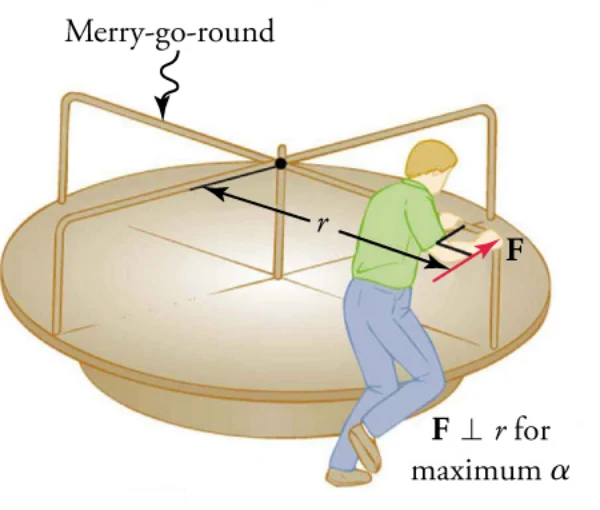
Applying a stronger torque will produce a greater angular acceleration. For example, the harder the man pushes the merry-go-round in Figure 6.11, the faster it accelerates. Furthermore, the more massive the merry-go-round is, the slower it accelerates for the same torque. If the man wants to maximize the effect of his force on the merry-go-round, he should push as far from the center as possible to get the largest lever arm and, therefore, the greatest torque and angular acceleration. Torque is also maximized when the force is applied perpendicular to the lever arm.
大きなトルクを加えれば大きな角加速度が生じる。たとえば図6.11の男が強く押すほど、回転遊具は速く加速する。さらに、回転遊具が重いほど、同じトルクに対する加速は遅くなる。回転遊具に及ぼす力の効きめを最大にしたければ、男はできるだけ中心から遠いところを押して、てこの腕をいちばん長くし、したがってトルクと角加速度を最大にすべきである。トルクは、力をてこの腕に垂直に加えたときにも最大になる。
Solving Rotational Kinematics and Torque Problems回転の運動学とトルクの問題を解く
Just as linear forces can balance to produce zero net force and no linear acceleration, the same is true of rotational motion. When two torques of equal magnitude act in opposing directions, there is no net torque and no angular acceleration, as you can see in the following video. If zero net torque acts on a system spinning at a constant angular velocity, the system will continue to spin at the same angular velocity.
直線の力がつり合って合力が0、直線の加速度が0になりうるのと同じことが、回転運動でも成り立つ。大きさの等しい二つのトルクが逆向きにはたらくとき、正味のトルクは0で角加速度も0になる。次の動画で見られるとおりである。一定の角速度で回っている系にはたらく正味のトルクが0なら、その系は同じ角速度で回り続ける。
Introduction to Torque This video (https://openstax.org/l/28torque) defines torque in terms of moment arm (which is the same as lever arm). It also covers a problem with forces acting in opposing directions about a pivot point. (At this stage, you can ignore Sal’s references to work and mechanical advantage.)
トルクの入門 この動画(https://openstax.org/l/28torque)は、モーメントの腕(てこの腕と同じもの)を使ってトルクを定義する。支点のまわりで逆向きにはたらく力の問題も扱う。(この段階では、サルが仕事や機械的利得に触れているところは気にしなくてよい。)
Access multimedia content (http://openstax.org/books/physics/pages/6-3-rotational-motion) If the net torque acting on the ruler from the example was positive instead of zero, what would this say about the angular acceleration? What would happen to the ruler over time?
マルチメディア教材はこちら(http://openstax.org/books/physics/pages/6-3-rotational-motion) 例に出てきた定規にはたらく正味のトルクが0ではなく正だったとしたら、角加速度について何が言えるか。時間がたつと定規はどうなるか。
a. The ruler is in a state of rotational equilibrium so it will not rotate about its center of mass. Thus, the angular acceleration will be zero.b. The ruler is not in a state of rotational equilibrium so it will not rotate about its center of mass. Thus, the angular acceleration will be zero.c. The ruler is not in a state of rotational equilibrium so it will rotate about its center of mass. Thus, the angular acceleration will be non-zero.d. The ruler is in a state of rotational equilibrium so it will rotate about its center of mass. Thus, the angular acceleration will be non-zero.
a. 定規は回転のつり合いの状態にあるので、重心のまわりを回らない。したがって角加速度は0である。b. 定規は回転のつり合いの状態にないので、重心のまわりを回らない。したがって角加速度は0である。c. 定規は回転のつり合いの状態にないので、重心のまわりを回る。したがって角加速度は0ではない。d. 定規は回転のつり合いの状態にあるので、重心のまわりを回る。したがって角加速度は0ではない。
Now let’s look at examples applying rotational kinematics to a fishing reel and the concept of torque to a merry-go-round.
では、回転の運動学を釣りのリールに、トルクの考えを回転遊具に当てはめる例を見よう。
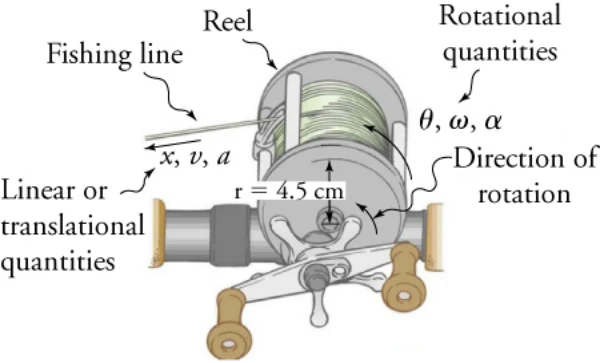
Calculating the Time for a Fishing Reel to Stop Spinning A deep-sea fisherman uses a fishing rod with a reel of radius 4.50 cm. A big fish takes the bait and swims away from the boat, pulling the fishing line from his fishing reel. As the fishing line unwinds from the reel, the reel spins at an angular velocity of 220 rad/s. The fisherman applies a brake to the spinning reel, creating an angular acceleration of −300 rad/s2. How long does it take the reel to come to a stop?
釣りのリールが止まるまでの時間を計算する 深海釣りをする人が、半径4.50 cmのリールが付いた釣り竿を使っている。大きな魚が餌に食いつき、船から泳ぎ去りながらリールから釣り糸を引き出す。釣り糸がリールからほどけていくとき、リールは角速度220 rad/sで回っている。釣り人が回るリールにブレーキをかけ、−300 rad/s2の角加速度を生じさせる。リールが止まるまでに何秒かかるか。
Strategy方針
We are asked to find the time t for the reel to come to a stop. The magnitude of the initial angular velocity is rad/s, and the magnitude of the final angular velocity . The signed magnitude of the angular acceleration is rad/s2, where the minus sign indicates that it acts in the direction opposite to the angular velocity. Looking at the rotational kinematic equations, we see all quantities but t are known in the equation , making it the easiest equation to use for this problem.
リールが止まるまでの時間tを求めよと言われている。初めの角速度の大きさは rad/s、終わりの角速度の大きさはである。角加速度の符号付きの大きさは rad/s2で、マイナスの符号は角速度と逆向きにはたらくことを示す。回転の運動学の式を見ると、式ではt以外のすべての量が分かっているので、この問題にはこの式を使うのがいちばん簡単である。
Solution解答
The equation to use is .
使う式はである。
We solve the equation algebraically for t, and then insert the known values.
この式をtについて代数的に解き、そのうえで分かっている値を入れる。
Discussion考察
The time to stop the reel is fairly small because the acceleration is fairly large. Fishing lines sometimes snap because of the forces involved, and fishermen often let the fish swim for a while before applying brakes on the reel. A tired fish will be slower, requiring a smaller acceleration and therefore a smaller force.
加速度がかなり大きいので、リールが止まるまでの時間はかなり短い。関わる力のせいで釣り糸が切れることもあるので、釣り人はしばしば、リールにブレーキをかける前に魚をしばらく泳がせておく。疲れた魚は遅くなるので、必要な加速度は小さくてすみ、したがって力も小さくてすむ。
Calculating the Torque on a Merry-Go-Round Consider the man pushing the playground merry-go-round in Figure 6.11. He exerts a force of 250 N at the edge of the merry-go-round and perpendicular to the radius, which is 1.50 m. How much torque does he produce? Assume that friction acting on the merry-go-round is negligible.Strategy
回転遊具にはたらくトルクを計算する 図6.11で回転遊具を押している男を考えよう。彼は回転遊具の縁で、半径1.50 mに垂直に250 Nの力を及ぼす。彼が生むトルクはいくらか。回転遊具にはたらく摩擦は無視できるとする。方針
To find the torque, note that the applied force is perpendicular to the radius and that friction is negligible.
トルクを求めるには、加えられた力が半径に垂直であり、摩擦が無視できることに注意する。
Solution解答
Discussion考察
The man maximizes the torque by applying force perpendicular to the lever arm, so that and . The man also maximizes his torque by pushing at the outer edge of the merry-go-round, so that he gets the largest-possible lever arm.
男は力をてこの腕に垂直に加えることでトルクを最大にしている。すなわちでありである。男はまた、回転遊具の外縁を押すことでてこの腕をできるだけ長くし、トルクを最大にしている。
Practice Problems練習問題
15How much torque does a person produce if he applies a force away from the pivot point, perpendicularly to the lever arm?
15ある人が、回転の中心から離れたところに、てこの腕に垂直にの力を加えるとき、生じるトルクはいくらか。
16An object’s angular velocity changes from 3 rad/s clockwise to 8 rad/s clockwise in 5 s. What is its angular acceleration?a. 0.6 rad/s2b. 1.6 rad/s2c. 1 rad/s2d. 5 rad/s2
16ある物体の角速度が、5秒の間に時計回りに3 rad/sから時計回りに8 rad/sへ変わった。その角加速度はいくらか。a. 0.6 rad/s2b. 1.6 rad/s2c. 1 rad/s2d. 5 rad/s2
Check Your Understanding理解の確認
17What is angular acceleration?a. Angular acceleration is the rate of change of the angular displacement.b. Angular acceleration is the rate of change of the angular velocity.
17角加速度とは何か。a. 角加速度とは、角変位の変化する割合である。b. 角加速度とは、角速度の変化する割合である。
c. Angular acceleration is the rate of change of the linear displacement.d. Angular acceleration is the rate of change of the linear velocity.
c. 角加速度とは、直線の変位の変化する割合である。d. 角加速度とは、直線の速度の変化する割合である。
18What is the equation for angular acceleration, α? Assume θ is the angle, ω is the angular velocity, and t is time.
18角加速度αの式はどれか。θを角、ωを角速度、tを時間とする。
19Which of the following best describes torque?
19トルクを最もよく言い表しているのはどれか。
a. It is the rotational equivalent of a force.b. It is the force that affects linear motion.
a. 力の回転版である。b. 直線運動に効く力である。
c. It is the rotational equivalent of acceleration.d. It is the acceleration that affects linear motion.
c. 加速度の回転版である。d. 直線運動に効く加速度である。
20What is the equation for torque? a.
20トルクの式はどれか。 a.