第6章円運動と回転運動Circular and Rotational Motion原書 p.205–234
6.2 Uniform Circular Motion6.2 等速円運動
SECTION LEARNING OBJECTIVES By the end of this section, you will be able to do the following:
この節の学習目標 この節を終えると、次のことができるようになる。
• Describe centripetal acceleration and relate it to linear acceleration• Describe centripetal force and relate it to linear force• Solve problems involving centripetal acceleration and centripetal force
・向心加速度を述べ、直線運動の加速度と結びつける・向心力を述べ、直線運動の力と結びつける・向心加速度と向心力に関する問題を解く
Section Key Termsこの節の重要語
centrifugal forcecentripetal accelerationcentripetal forceuniform circular motion
遠心力向心加速度向心力等速円運動
Centripetal Acceleration向心加速度
In the previous section, we defined circular motion. The simplest case of circular motion is uniform circular motion, where an object travels a circular path at a constant speed. Note that, unlike speed, the linear velocity of an object in circular motion is constantly changing because it is always changing direction. We know from kinematics that acceleration is a change in velocity, either in magnitude or in direction or both. Therefore, an object undergoing uniform circular motion is always accelerating, even though the magnitude of its velocity is constant.
前の節で円運動を定義した。円運動の最も単純な場合が等速円運動で、物体が一定の速さで円の道筋を進むものである。速さと違って、円運動する物体の直線速度は、つねに向きが変わっているのでたえず変化していることに注意しよう。運動学から、加速度とは速度の変化、すなわち大きさか向き、あるいは両方の変化であることが分かっている。したがって等速円運動をする物体は、速度の大きさが一定であっても、つねに加速している。
You experience this acceleration yourself every time you ride in a car while it turns a corner. If you hold the steering wheel steady during the turn and move at a constant speed, you are executing uniform circular motion. What you notice is a feeling of sliding (or being flung, depending on the speed) away from the center of the turn. This isn’t an actual force that is acting on you—it only happens because your body wants to continue moving in a straight line (as per Newton’s first law) whereas the car is turning off this straight-line path. Inside the car it appears as if you are forced away from the center of the turn. This fictitious force is known as the centrifugal force. The sharper the curve and the greater your speed, the more noticeable this effect becomes.
車に乗って角を曲がるたびに、あなた自身がこの加速を体験している。曲がる間ハンドルを一定に保ち、一定の速さで動いていれば、それは等速円運動をしていることになる。あなたが感じるのは、カーブの中心から外へ滑らされる(速さによっては放り出される)ような感覚である。これはあなたにはたらく実在の力ではない。それが起こるのは、あなたの体が(ニュートンの第一法則どおり)直線に沿って動き続けようとするのに対し、車がその直線の道筋から曲がっていくからにすぎない。車の中では、あたかもカーブの中心から外へ押しやられているように見える。この見かけの力を遠心力という。カーブが急なほど、また速さが大きいほど、この効果ははっきり感じられるようになる。
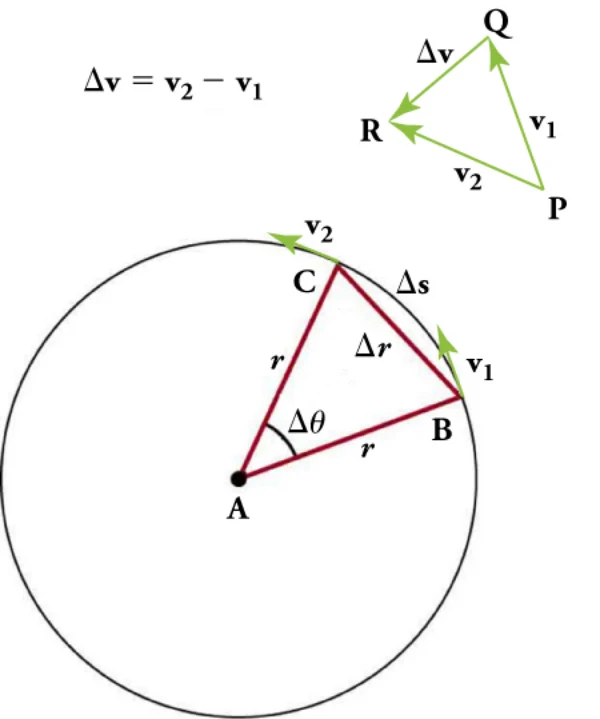
Figure 6.7 shows an object moving in a circular path at constant speed. The direction of the instantaneous tangential velocity is shown at two points along the path. Acceleration is in the direction of the change in velocity; in this case it points roughly toward the center of rotation. (The center of rotation is at the center of the circular path). If we imagine becoming smaller and smaller, then the acceleration would point exactly toward the center of rotation, but this case is hard to draw. We call the acceleration of an object moving in uniform circular motion the centripetal acceleration ac because centripetal means center seeking.
図6.7は、一定の速さで円の道筋を動く物体を示している。瞬間の接線速度の向きが、道筋の2点で示されている。加速度は速度の変化の向きを向く。この場合それはおおよそ回転の中心を指す。(回転の中心は円の道筋の中心にある。)をどんどん小さくしていけば、加速度はちょうど回転の中心を指すことになるが、この場合は図に描きにくい。等速円運動をする物体の加速度を向心加速度acと呼ぶ。「向心」とは中心を求める、という意味である。
Now that we know that the direction of centripetal acceleration is toward the center of rotation, let’s discuss the magnitude of centripetal acceleration. For an object traveling at speed v in a circular path with radius r, the magnitude of centripetal acceleration is
向心加速度の向きが回転の中心を向くと分かったので、次にその大きさを論じよう。半径rの円の道筋を速さvで進む物体について、向心加速度の大きさは次のとおりである。
Centripetal acceleration is greater at high speeds and in sharp curves (smaller radius), as you may have noticed when driving a car, because the car actually pushes you toward the center of the turn. But it is a bit surprising that ac is proportional to the speed squared. This means, for example, that the acceleration is four times greater when you take a curve at 100 km/h than at 50 km/h.
向心加速度は、速さが大きいときと急なカーブ(半径が小さい)で大きくなる。車を運転していて気づくかもしれないが、これは車が実際にあなたをカーブの中心へ押しているからである。ただ、acが速さの2乗に比例するのは少し意外だろう。これはたとえば、時速100 kmでカーブを曲がるときの加速度が、時速50 kmのときの4倍になるということである。
We can also express ac in terms of the magnitude of angular velocity. Substituting into the equation above,
acは角速度の大きさでも表せる。上の式にを代入すると、
we get . Therefore, the magnitude of centripetal acceleration in terms of the magnitude of angular velocity is
が得られる。したがって、角速度の大きさで表した向心加速度の大きさは次のとおりである。
TIPS FOR SUCCESS The equation expressed in the form ac = rω2 is useful for solving problems where you know the angular velocity rather than the tangential velocity.
学習のポイント ac = rω2 の形の式は、接線速度ではなく角速度が分かっている問題を解くのに役立つ。
VIRTUAL PHYSICSシミュレーションLadybug Motion in 2D二次元のてんとう虫の運動
In this simulation (https://openstax.org/l/28ladybugmotion), you experiment with the position, velocity, and acceleration of a ladybug in circular and elliptical motion. Switch the type of motion from linear to circular and observe the velocity and acceleration vectors. Next, try elliptical motion and notice how the velocity and acceleration vectors differ from those in circular motion.
このシミュレーション(https://openstax.org/l/28ladybugmotion)では、円運動や楕円運動をするてんとう虫の位置・速度・加速度を試せる。運動の型を直線から円に切り替えて、速度と加速度のベクトルを観察しよう。次に楕円運動を試し、速度と加速度のベクトルが円運動のときとどう違うかに注目しよう。
GRASP CHECK In uniform circular motion, what is the angle between the acceleration and the velocity? What type of acceleration does a body experience in the uniform circular motion?
理解の確認 等速円運動において、加速度と速度のなす角はいくらか。等速円運動で物体が受ける加速度はどんな種類か。
a. The angle between acceleration and velocity is 0°, and the body experiences linear acceleration.b. The angle between acceleration and velocity is 0°, and the body experiences centripetal acceleration.
a. 加速度と速度のなす角は0°で、物体は直線の加速度を受ける。b. 加速度と速度のなす角は0°で、物体は向心加速度を受ける。
c. The angle between acceleration and velocity is 90°, and the body experiences linear acceleration.d. The angle between acceleration and velocity is 90°, and the body experiences centripetal acceleration.
c. 加速度と速度のなす角は90°で、物体は直線の加速度を受ける。d. 加速度と速度のなす角は90°で、物体は向心加速度を受ける。
Centripetal Force向心力
Because an object in uniform circular motion undergoes acceleration (by changing the direction of motion but not the speed), we know from Newton’s second law of motion that there must be a net external force acting on the object. Since the magnitude of the acceleration is constant, so is the magnitude of the net force, and since the acceleration points toward the center of the rotation, so does the net force.
等速円運動する物体は(速さは変えずに運動の向きを変えることで)加速しているので、ニュートンの運動の第二法則から、その物体には外力の合力がはたらいているはずだと分かる。加速度の大きさが一定なので合力の大きさも一定であり、加速度が回転の中心を向くので合力も中心を向く。
Any force or combination of forces can cause a centripetal acceleration. Just a few examples are the tension in the rope on a tether ball, the force of Earth’s gravity on the Moon, the friction between a road and the tires of a car as it goes around a curve, or the normal force of a roller coaster track on the cart during a loop-the-loop.
どんな力、あるいは力の組み合わせでも向心加速度を生みうる。ほんの数例を挙げれば、テザーボールの綱の張力、月にはたらく地球の重力、カーブを曲がる車のタイヤと路面の間の摩擦、宙返り中のジェットコースターの台車にはたらくレールからの垂直抗力などである。
The component of any net force that causes circular motion is called a centripetal force. When the net force is equal to the centripetal force, and its magnitude is constant, uniform circular motion results. The direction of a centripetal force is toward the center of rotation, the same as for centripetal acceleration. According to Newton’s second law of motion, a net force causes the acceleration of mass according to Fnet = ma. For uniform circular motion, the acceleration is centripetal acceleration: a = ac. Therefore, the magnitude of centripetal force, Fc, is
円運動を生む合力の成分を向心力という。合力が向心力に等しく、その大きさが一定であるとき、等速円運動になる。向心力の向きは、向心加速度と同じく回転の中心を向く。ニュートンの運動の第二法則によれば、合力は Fnet = ma に従って質量を加速させる。等速円運動では加速度は向心加速度、すなわち a = ac である。したがって向心力の大きさFcは次のとおりである。
By using the two different forms of the equation for the magnitude of centripetal acceleration, and , we get two expressions involving the magnitude of the centripetal force . The first expression is in terms of tangential speed, the second is in terms of angular speed: and .
向心加速度の大きさの二つの表し方とを使うと、向心力の大きさについての二つの式が得られる。一つ目は接線速さによる表し方、二つ目は角速さによる表し方である。すなわちとである。
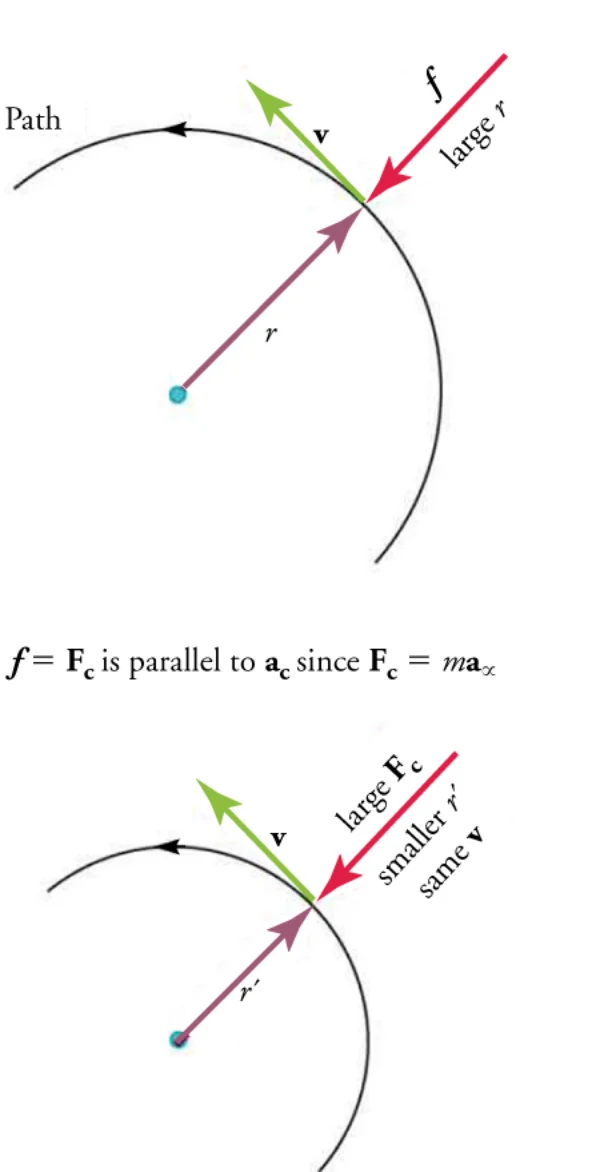
Both forms of the equation depend on mass, velocity, and the radius of the circular path. You may use whichever expression for centripetal force is more convenient. Newton’s second law also states that the object will accelerate in the same direction as the net force. By definition, the centripetal force is directed towards the center of rotation, so the object will also accelerate towards the center. A straight line drawn from the circular path to the center of the circle will always be perpendicular to the tangential velocity. Note that, if you solve the first expression for r, you get
どちらの形の式も、質量・速度・円の道筋の半径による。どちらの向心力の式でも、都合のよいほうを使えばよい。ニュートンの第二法則はまた、物体が合力と同じ向きに加速すると述べる。定義により向心力は回転の中心を向くので、物体も中心へ向かって加速する。円の道筋から円の中心へ引いた直線は、つねに接線速度に垂直である。一つ目の式をrについて解けば、次が得られることにも注意しよう。
From this expression, we see that, for a given mass and velocity, a large centripetal force causes a small radius of curvature—that is, a tight curve.
この式から、質量と速度が与えられているとき、向心力が大きいと曲率半径が小さくなる、すなわちカーブがきつくなることが分かる。
Centripetal Force and Acceleration Intuition This video explains why centripetal force, when it is equal to the net force and has constant magnitude, creates centripetal acceleration and uniform circular motion.
向心力と加速度を直感でつかむ この動画は、向心力が合力に等しく大きさが一定であるとき、なぜそれが向心加速度と等速円運動を生むのかを説明する。
Access multimedia content (http://openstax.org/books/physics/pages/6-2-uniform-circular-motion) Imagine that you are swinging a yoyo in a vertical clockwise circle in front of you, perpendicular to the direction you are facing. If the string breaks just as the yoyo reaches its bottommost position, nearest the floor. What will happen to the yoyo after the string breaks?
マルチメディア教材はこちら(http://openstax.org/books/physics/pages/6-2-uniform-circular-motion)自分の正面で、向いている方向に垂直な鉛直面内を、ヨーヨーを時計回りに振り回しているところを想像してほしい。ヨーヨーが床にいちばん近い最下点に来たちょうどそのとき糸が切れたら、そのあとヨーヨーはどうなるか。
a. The yoyo will fly inward in the direction of the centripetal force.b. The yoyo will fly outward in the direction of the centripetal force.
a. ヨーヨーは向心力の向きに内側へ飛ぶ。b. ヨーヨーは向心力の向きに外側へ飛ぶ。
c. The yoyo will fly to the left in the direction of the tangential velocity.d. The yoyo will fly to the right in the direction of the tangential velocity.
c. ヨーヨーは接線速度の向きに左へ飛ぶ。d. ヨーヨーは接線速度の向きに右へ飛ぶ。
Solving Centripetal Acceleration and Centripetal Force Problems向心加速度と向心力の問題を解く
To get a feel for the typical magnitudes of centripetal acceleration, we’ll do a lab estimating the centripetal acceleration of a tennis racket and then, in our first Worked Example, compare the centripetal acceleration of a car rounding a curve to gravitational acceleration. For the second Worked Example, we’ll calculate the force required to make a car round a curve.
向心加速度の典型的な大きさを実感するために、まずテニスラケットの向心加速度を見積もる実験をし、次に最初の計算例で、カーブを曲がる車の向心加速度を重力加速度と比べる。二つ目の計算例では、車にカーブを曲がらせるのに必要な力を計算する。
SNAP LAB身近な実験Estimating Centripetal Acceleration向心加速度を見積もる
In this activity, you will measure the swing of a golf club or tennis racket to estimate the centripetal acceleration of the end of the club or racket. You may choose to do this in slow motion. Recall that the equation for centripetal acceleration is or .
この活動では、ゴルフクラブかテニスラケットの振りを測って、クラブやラケットの先端の向心加速度を見積もる。ゆっくり振ってやってもよい。向心加速度の式はまたはであったことを思い出そう。
• One tennis racket or golf club• One timer• One ruler or tape measure
・テニスラケットかゴルフクラブ1本・タイマー1個・定規か巻き尺1本
Procedure手順
1. Work with a partner. Stand a safe distance away from your partner as he or she swings the golf club or tennis racket.2. Describe the motion of the swing—is this uniform circular motion? Why or why not?3. Try to get the swing as close to uniform circular motion as possible. What adjustments did your partner need to make?4. Measure the radius of curvature. What did you physically measure?5. By using the timer, find either the linear or angular velocity, depending on which equation you decide to use.6. What is the approximate centripetal acceleration based on these measurements? How accurate do you think they are? Why? How might you and your partner make these measurements more accurate?
1. 二人一組で行う。相手がゴルフクラブやテニスラケットを振る間、安全な距離をとって立つこと。2. 振りの運動を述べよ。これは等速円運動か。そうである、あるいはそうでない理由は何か。3. できるだけ等速円運動に近づけてみよう。相手はどんな調整をする必要があったか。4. 曲率半径を測れ。実際に測ったのは何か。5. どちらの式を使うかに応じて、タイマーで直線の速度か角速度を求めよ。6. これらの測定にもとづく、およその向心加速度はいくらか。どれくらい正確だと思うか。それはなぜか。二人でどうすればもっと正確に測れるか。
GRASP CHECK理解の確認
Was it more useful to use the equation or in this activity? Why?
この活動では、式とのどちらを使うほうが役に立ったか。それはなぜか。
a. It should be simpler to use because measuring angular velocity through observation would be easier.
a. のほうが簡単なはずである。観察によって角速度を測るほうが楽だから。
b. It should be simpler to use because measuring tangential velocity through observation would be easier.
b. のほうが簡単なはずである。観察によって接線速度を測るほうが楽だから。
c. It should be simpler to use because measuring angular velocity through observation would be difficult.
c. のほうが簡単なはずである。観察によって角速度を測るのは難しいから。
d. It should be simpler to use because measuring tangential velocity through observation would be difficult.
d. のほうが簡単なはずである。観察によって接線速度を測るのは難しいから。
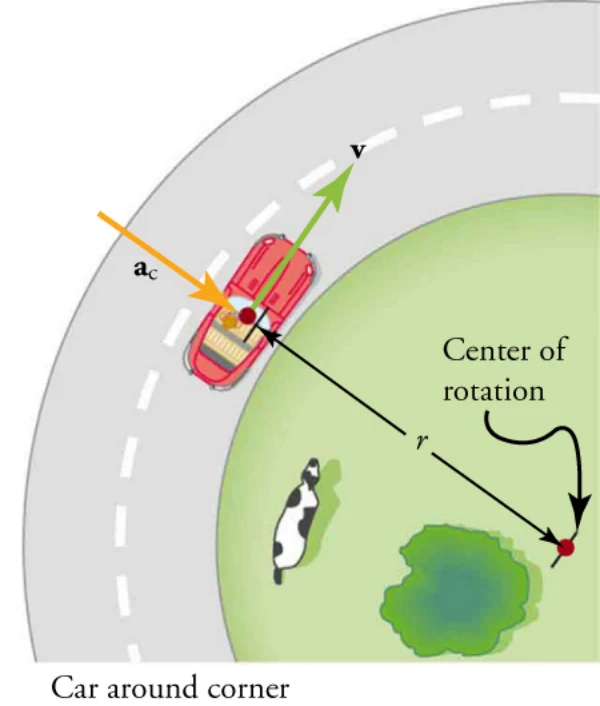
Comparing Centripetal Acceleration of a Car Rounding a Curve with Acceleration Due to Gravity A car follows a curve of radius 500 m at a speed of 25.0 m/s (about 90 km/h). What is the magnitude of the car’s centripetal acceleration? Compare the centripetal acceleration for this fairly gentle curve taken at highway speed with acceleration due to gravity (g).
カーブを曲がる車の向心加速度を重力加速度と比べる ある車が、半径500 mのカーブを25.0 m/s(時速約90 km)で曲がる。この車の向心加速度の大きさはいくらか。高速道路の速さで曲がるこのかなりゆるやかなカーブでの向心加速度を、重力加速度(g)と比べよ。
Strategy方針
Because linear rather than angular speed is given, it is most convenient to use the expression to find the magnitude of the centripetal acceleration.
角速さではなく直線の速さが与えられているので、式を使って向心加速度の大きさを求めるのが最も都合よい。
Solution解答
Entering the given values of v = 25.0 m/s and r = 500 m into the expression for ac gives
与えられた値 v = 25.0 m/s と r = 500 m を ac の式に入れると、次が得られる。
Discussion考察
To compare this with the acceleration due to gravity (g = 9.80 m/s2), we take the ratio
これを重力加速度(g = 9.80 m/s2)と比べるために、比をとる。
. Therefore, , which means that the centripetal acceleration is about one tenth the acceleration due to gravity.
である。したがってであり、向心加速度は重力加速度のおよそ10分の1だということになる。
Frictional Force on Car Tires Rounding a Curveカーブを曲がる車のタイヤにはたらく摩擦力
a. Calculate the centripetal force exerted on a 900 kg car that rounds a 600-m-radius curve on horizontal ground at 25.0 m/s.
a. 質量900 kgの車が、水平な地面の上で半径600 mのカーブを25.0 m/sで曲がるとき、車にはたらく向心力を計算せよ。
b. Static friction prevents the car from slipping. Find the magnitude of the frictional force between the tires and the road that allows the car to round the curve without sliding off in a straight line.c. If the car would slip if it were to be traveling any faster, what is the coefficient of static friction between the tires and the road? Could we conclude anything about the coefficient of static friction if we did not know whether the car could round the curve any faster without slipping?
b. 静止摩擦が車の滑りを防いでいる。車が直線方向へ滑り出さずにカーブを曲がれるようにしている、タイヤと路面の間の摩擦力の大きさを求めよ。c. これ以上速く走ったら車が滑るとすると、タイヤと路面の間の静止摩擦係数はいくらか。もし、この車がこれ以上速く滑らずにカーブを曲がれるかどうかが分からなかったとしたら、静止摩擦係数について何か結論できるだろうか。
Strategy and Solution for (a)(a)の方針と解答
We know that . Therefore,
であることが分かっている。したがって、
Strategy and Solution for (b)(b)の方針と解答
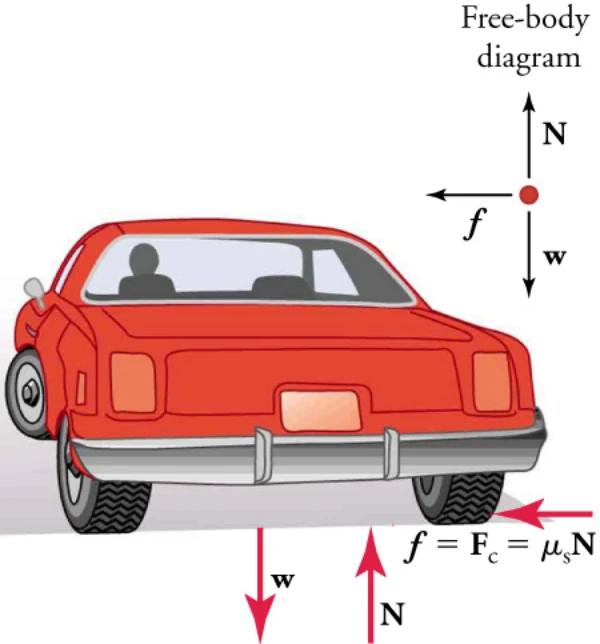
The image above shows the forces acting on the car while rounding the curve. In this diagram, the car is traveling into the page as shown and is turning to the left. Friction acts toward the left, accelerating the car toward the center of the curve. Because friction is the only horizontal force acting on the car, it provides all of the centripetal force in this case. Therefore, the force of friction is the centripetal force in this situation and points toward the center of the curve.
上の図は、カーブを曲がる間に車にはたらく力を示している。この図では、車は図のとおり紙面の奥へ進みながら左へ曲がっている。摩擦は左向きにはたらき、車をカーブの中心へ向かって加速させる。摩擦は車にはたらく唯一の水平方向の力なので、この場合はそれが向心力のすべてを与えている。したがってこの状況では摩擦力が向心力であり、カーブの中心を向く。
Strategy and Solution for (c)(c)の方針と解答
If the car is about to slip, the static friction is at its maximum value and . Solving for , we get
車が滑りかけているなら、静止摩擦は最大値にあり、である。について解くと、次が得られる。
. Regardless of whether we know the maximum allowable speed for rounding the curve, we can conclude this is a minimum value for the coefficient.
カーブを曲がれる最大の速さが分かっているかどうかにかかわらず、これが係数の最小値だと結論できる。
Discussion考察
Since we found the force of friction in part (b), we could also solve for the coefficient of friction, since
(b)で摩擦力を求めたので、
. The static friction is only equal to when it is at the maximum possible value. If the car could go faster, the friction at the given speed would still be the same as we calculated, but the coefficient of static friction would be larger.
から摩擦係数についても解ける。静止摩擦がに等しくなるのは、それが取りうる最大値にあるときだけである。もし車がもっと速く走れるのなら、与えられた速さでの摩擦は計算したとおりのままだが、静止摩擦係数はもっと大きいことになる。
Practice Problems練習問題
9What is the centripetal acceleration felt by the passengers of a car moving at 12 m/s along a curve with radius 2.0 m?a. 3 m/s2b. 6 m/s2c. 36 m/s2d. 72 m/s2
9半径2.0 mのカーブを12 m/sで走る車の乗客が受ける向心加速度はいくらか。a. 3 m/s2b. 6 m/s2c. 36 m/s2d. 72 m/s2
10Calculate the centripetal acceleration of an object following a path with a radius of a curvature of 0.2 m and at an angular velocity of 5 rad/s.
10曲率半径0.2 mの道筋を角速度5 rad/sでたどる物体の向心加速度を計算せよ。
a. 1 m/sb. 5 m/sc. 1 m/s2d. 5 m/s2
a. 1 m/sb. 5 m/sc. 1 m/s2d. 5 m/s2
Check Your Understanding理解の確認
11What is uniform circular motion?a. Uniform circular motion is when an object accelerates on a circular path at a constantly increasing velocity.b. Uniform circular motion is when an object travels on a circular path at a variable acceleration.
11等速円運動とは何か。a. 等速円運動とは、物体が円の道筋を、たえず増していく速度で加速することである。b. 等速円運動とは、物体が円の道筋を、変化する加速度で進むことである。
c. Uniform circular motion is when an object travels on a circular path at a constant speed.d. Uniform circular motion is when an object travels on a circular path at a variable speed.
c. 等速円運動とは、物体が円の道筋を一定の速さで進むことである。d. 等速円運動とは、物体が円の道筋を変化する速さで進むことである。
12Which of the following is centripetal acceleration?a. The acceleration of an object moving in a circular path and directed radially toward the center of the circular orbitb. The acceleration of an object moving in a circular path and directed tangentially along the circular pathc. The acceleration of an object moving in a linear path and directed in the direction of motion of the objectd. The acceleration of an object moving in a linear path and directed in the direction opposite to the motion of the object
12向心加速度はどれか。a. 円の道筋を動く物体の加速度で、円軌道の中心へ向かって半径方向を向くものb. 円の道筋を動く物体の加速度で、円の道筋に沿って接線方向を向くものc. 直線の道筋を動く物体の加速度で、物体の運動の向きを向くものd. 直線の道筋を動く物体の加速度で、物体の運動と逆の向きを向くもの
13Is there a net force acting on an object in uniform circular motion?a. Yes, the object is accelerating, so a net force must be acting on it.b. Yes, because there is no acceleration.
13等速円運動をする物体には合力がはたらいているか。a. はたらいている。物体は加速しているので、合力がはたらいているはずである。b. はたらいている。加速度がないから。
c. No, because there is acceleration.d. No, because there is no acceleration.
c. はたらいていない。加速度があるから。d. はたらいていない。加速度がないから。
14Identify two examples of forces that can cause centripetal acceleration.a. The force of Earth’s gravity on the moon and the normal forceb. The force of Earth’s gravity on the moon and the tension in the rope on an orbiting tetherballc. The normal force and the force of friction acting on a moving card. The normal force and the tension in the rope on a tetherball
14向心加速度を生みうる力の例を二つ挙げよ。a. 月にはたらく地球の重力と、垂直抗力b. 月にはたらく地球の重力と、回っているテザーボールの綱の張力c. 垂直抗力と、走っている車にはたらく摩擦力d. 垂直抗力と、テザーボールの綱の張力