第1章物理学とは何かWhat is Physics?原書 p.5–54
Using Scientific Notation with Physical Measurements科学的記数法を物理量に使う
Scientific notation is a way of writing numbers that are too large or small to be conveniently written as a decimal. For example, consider the number 840,000,000,000,000. It’s a rather large number to write out. The scientific notation for this number is 8.40 1014. Scientific notation follows this general format
科学的記数法とは、小数として書くには大きすぎたり小さすぎたりする数を書き表す方法である。たとえば840,000,000,000,000という数を考えよう。書き下すにはかなり大きな数である。この数の科学的記数法による表記は8.401014である。科学的記数法は次の一般形に従う。
In this format x is the value of the measurement with all placeholder zeros removed. In the example above, x is 8.4. The x is multiplied by a factor, 10y, which indicates the number of placeholder zeros in the measurement. Placeholder zeros are those at the end of a number that is 10 or greater, and at the beginning of a decimal number that is less than 1. In the example above, the factor is 1014. This tells you that you should move the decimal point 14 positions to the right, filling in placeholder zeros as you go. In this case, moving the decimal point 14 places creates only 13 placeholder zeros, indicating that the actual measurement value is 840,000,000,000,000.
この形において、xは測定値から位取りのゼロをすべて取り除いた値である。上の例ではxは8.4である。xには因子10ʸが掛かり、これが測定値に含まれる位取りのゼロの個数を示す。位取りのゼロとは、10以上の数の末尾にあるゼロと、小数の先頭にあるゼロのことである。1より小さい数の先頭にあるゼロもそうである。上の例では因子は1014だった。これは小数点を右へ14桁動かし、動かしながら位取りのゼロを埋めよ、という意味である。この場合、小数点を14桁動かすと位取りのゼロは13個しかできず、実際の測定値が840,000,000,000,000であることがわかる。
Numbers that are fractions can be indicated by scientific notation as well. Consider the number 0.0000045. Its scientific notation is 4.5 10–6. Its scientific notation has the same format
1より小さい数も科学的記数法で表せる。0.0000045という数を考えよう。科学的記数法では4.510-6となる。その形は先ほどと同じである。
Here, x is 4.5. However, the value of y in the 10y factor is negative, which indicates that the measurement is a fraction of 1. Therefore, we move the decimal place to the left, for a negative y. In our example of 4.5 10–6, the decimal point would be moved to the left six times to yield the original number, which would be 0.0000045.
ここでxは4.5である。ただし因子10ʸのyの値は負で、これは測定値が1より小さいことを示す。したがってyが負のときは小数点を左へ動かす。4.510-6という例では、小数点を左へ6回動かすともとの数0.0000045に戻る。
The term order of magnitude refers to the power of 10 when numbers are expressed in scientific notation.Quantities that have the same power of 10 when expressed in scientific notation, or come close to it, are said to be of the same order of magnitude. For example, the number 800 can be written as 8 102, and the number 450 can be written as 4.5 102. Both numbers have the same value for y. Therefore, 800 and 450 are of the same order of magnitude. Similarly, 101 and 99 would be regarded as the same order of magnitude, 102. Order of magnitude can be thought of as a ballpark estimate for the scale of a value. The diameter of an atom is on the order of 10−9 m, while the diameter of the sun is on the order of 109 m. These two values are 18 orders of magnitude apart.
桁(オーダー)という語は、数を科学的記数法で表したときの10の累乗を指す。科学的記数法で表したとき10の累乗が同じ、あるいはそれに近い量どうしは、同じ桁であるという。たとえば800は8102と書け、450は4.5102と書ける。どちらもyの値は同じである。したがって800と450は同じ桁である。同様に101と99も同じ桁、すなわち102とみなされる。桁とは、値の大きさについてのおおよその見積もりだと考えればよい。原子の直径は10-9 mの桁であり、太陽の直径は109 mの桁である。この二つの値は18桁離れている。
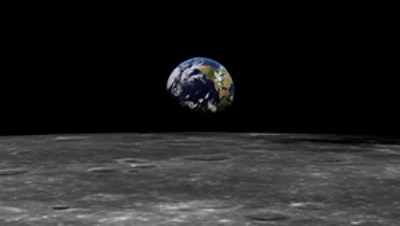
Scientists make frequent use of scientific notation because of the vast range of physical measurements possible in the universe, such as the distance from Earth to the moon (Figure 1.18), or to the nearest star.
科学者が科学的記数法を頻繁に使うのは、宇宙で測定しうる物理量の幅がとてつもなく広いからである。地球から月までの距離(図1.18)や、最も近い恒星までの距離を思えばよい。
Unit Conversion and Dimensional Analysis It is often necessary to convert from one type of unit to another. For example, if you are reading a European cookbook in the United States, some quantities may be expressed in liters and you need to convert them to cups. A Canadian tourist driving through the United States might want to convert miles to kilometers, to have a sense of how far away his next destination is. A doctor in the United States might convert a patient’s weight in pounds to kilograms.
単位の換算と次元解析 ある種類の単位を別の単位に換算しなければならないことは多い。たとえばアメリカでヨーロッパの料理本を読んでいると、量がリットルで書かれていて、カップに直す必要があるかもしれない。アメリカを車で旅するカナダ人観光客は、次の目的地までどれくらい遠いのかをつかむために、マイルをキロメートルに直したいと思うかもしれない。アメリカの医師は、患者の体重をポンドからキログラムに直すかもしれない。
Let’s consider a simple example of how to convert units within the metric system. How can we convert 1 hour to seconds?
メートル法の中で単位を換算する簡単な例を考えよう。1時間を秒に直すにはどうすればよいか。
First, we need to determine a conversion factor. A conversion factor is a ratio expressing how many of one unit are equal to another unit. A conversion factor is simply a fraction which equals 1. You can multiply any number by 1 and get the same value. When you multiply a number by a conversion factor, you are simply multiplying it by one. For example, the following are conversion factors: (1 foot)/(12 inches) = 1 to convert inches to feet, (1 meter)/(100 centimeters) = 1 to convert centimeters to meters, (1 minute)/(60 seconds) = 1 to convert seconds to minutes.
まず換算係数を決める必要がある。換算係数とは、一方の単位のいくつが他方の単位に等しいかを表す比である。換算係数は要するに、値が1に等しい分数である。どんな数に1を掛けても値は変わらない。ある数に換算係数を掛けるとき、あなたは単にその数に1を掛けているにすぎない。たとえば次のようなものが換算係数である。インチをフィートに直すには(1フィート)/(12インチ)=1、センチメートルをメートルに直すには(1メートル)/(100センチメートル)=1、秒を分に直すには(1分)/(60秒)=1。
Now we can set up our unit conversion. We will write the units that we have and then multiply them by the conversion factors (60 min/1 h) = 1 and (60 s/1 min) = 1, so we are simply multiplying 1 hour by 1:
これで単位換算の式を組み立てられる。手元にある単位を書き、それに換算係数(60分/1時間)=1と(60秒/1分)=1を掛ける。つまり1時間に1を掛けているだけである。
When there is a unit in the original number, and a unit in the denominator (bottom) of the conversion factor, the units cancel. In this case, hours and minutes cancel and the value in seconds remains.
もとの数に付いた単位と、換算係数の分母(下)にある単位とが同じなら、その単位は打ち消し合う。この場合は時間と分が消えて、秒で表した値が残る。
You can use this method to convert between any types of unit, including between the U.S. customary system and metric system. Notice also that, although you can multiply and divide units algebraically, you cannot add or subtract different units. An expression like 10 km + 5 kg makes no sense. Even adding two lengths in different units, such as 10 km + 20 m does not make sense. You express both lengths in the same unit. See Reference Tables for a more complete list of conversion factors.
この方法を使えば、ヤード・ポンド法とメートル法の間を含め、どんな種類の単位の間でも換算できる。なお、単位は代数的に掛けたり割ったりできるが、異なる単位を足したり引いたりはできないことにも注意しよう。10 km + 5 kgのような式は意味をなさない。10 km + 20 mのように、単位の違う二つの長さを足すことさえ意味をなさない。両方の長さを同じ単位で表さねばならない。換算係数のより完全な一覧は巻末の参照表を見よ。
Unit Conversions: A Short Drive Home Suppose that you drive the 10.0 km from your university to home in 20.0 min. Calculate your average speed (a) in kilometers per hour (km/h) and (b) in meters per second (m/s). (Note—Average speed is distance traveled divided by time of travel.) Strategy
単位換算:家までの短いドライブ 大学から家まで10.0 kmを20.0分で走ったとする。平均の速さを(a)キロメートル毎時(km/h)、(b)秒速メートル(m/s)で求めよ。(注——平均の速さは、進んだ距離を進むのにかかった時間で割ったものである。) 方針
First we calculate the average speed using the given units. Then we can get the average speed into the desired units by picking the correct conversion factor and multiplying by it. The correct conversion factor is the one that cancels the unwanted unit and leaves the desired unit in its place.
まず与えられた単位のまま平均の速さを計算する。次に、正しい換算係数を選んで掛けることで、望みの単位に直す。正しい換算係数とは、いらない単位を打ち消し、その場所に望みの単位を残すものである。
Solution for (a)(a)の解答
1. Calculate average speed. Average speed is distance traveled divided by time of travel. (Take this definition as a given for now—average speed and other motion concepts will be covered in a later module.) In equation form,
1. 平均の速さを計算する。平均の速さは、進んだ距離を進むのにかかった時間で割ったものである(今のところこの定義を与えられたものとして使う。平均の速さなど運動の概念は後の章で扱う)。式で書くと次のようになる。
2. Substitute the given values for distance and time.
2. 距離と時間に与えられた値を代入する。
3. Convert km/min to km/h: multiply by the conversion factor that will cancel minutes and leave hours. That conversion factor is . Thus,
3. km/minをkm/hに直す。分を打ち消して時間を残す換算係数を掛ければよい。その換算係数はである。したがって、
Discussion for (a)(a)の考察
To check your answer, consider the following:
答えを確かめるには、次のことを考えるとよい。
1. Be sure that you have properly cancelled the units in the unit conversion. If you have written the unit conversion factor upside down, the units will not cancel properly in the equation. If you accidentally get the ratio upside down, then the units will not cancel; rather, they will give you the wrong units as follows
1. 単位換算で単位がきちんと打ち消し合っているかを確かめる。換算係数を逆さに書いてしまうと、式の中で単位はうまく消えない。うっかり比を逆さにすると単位は消えず、次のように誤った単位を与える。
which are obviously not the desired units of km/h.
これは明らかに、求めたいkm/hという単位ではない。
2. Check that the units of the final answer are the desired units. The problem asked us to solve for average speed in units of km/h and we have indeed obtained these units.3. Check the significant figures. Because each of the values given in the problem has three significant figures, the answer should also have three significant figures. The answer 30.0 km/h does indeed have three significant figures, so this is appropriate. Note that the significant figures in the conversion factor are not relevant because an hour is defined to be 60 min, so the precision of the conversion factor is perfect.4. Next, check whether the answer is reasonable. Let us consider some information from the problem—if you travel 10 km in a third of an hour (20 min), you would travel three times that far in an hour. The answer does seem reasonable.
2. 最終的な答えの単位が求めたい単位になっているかを確かめる。問題は平均の速さをkm/hの単位で求めよと言っており、実際その単位が得られている。3. 有効数字を確かめる。問題で与えられた値はどれも有効数字3桁なので、答えも有効数字3桁であるべきである。答えの30.0 km/hはたしかに3桁なので、これでよい。なお換算係数の有効数字は関係ない。1時間は60分と定義されているので、換算係数の精度は完全だからである。4. 次に、答えが妥当かどうかを確かめる。問題の情報から考えよう。1時間の3分の1(20分)で10 km進むなら、1時間ではその3倍進むはずである。答えはたしかに妥当に見える。
Solution (b)(b)の解答
There are several ways to convert the average speed into meters per second.
平均の速さを秒速メートルに直すやり方はいくつかある。
1. Start with the answer to (a) and convert km/h to m/s. Two conversion factors are needed—one to convert hours to seconds, and another to convert kilometers to meters.2. Multiplying by these yields
1. (a)の答えから出発し、km/hをm/sに直す。換算係数は二つ必要である。一つは時間を秒に直すもの、もう一つはキロメートルをメートルに直すものである。2. これらを掛けると次が得られる。
Discussion for (b)(b)の考察
If we had started with 0.500 km/min, we would have needed different conversion factors, but the answer would have been the same: 8.33 m/s.
0.500 km/minから出発していたら、必要な換算係数は違っていたが、答えは同じ8.33 m/sになっただろう。
You may have noted that the answers in the worked example just covered were given to three digits. Why? When do you need to be concerned about the number of digits in something you calculate? Why not write down all the digits your calculator produces?
今の計算例では、答えがどれも3桁で与えられていることに気づいたかもしれない。なぜだろうか。計算した値の桁数を気にしなければならないのはどんなときか。なぜ電卓が出す桁をすべて書き写してはいけないのか。
Using Physics to Evaluate Promotional Materials A commemorative coin that is 2″ in diameter is advertised to be plated with 15 mg of gold. If the density of gold is 19.3 g/cc, and the amount of gold around the edge of the coin can be ignored, what is the thickness of the gold on the top and bottom faces of the coin?
物理を使って宣伝文句を吟味する 直径2インチの記念コインが、15 mgの金でめっきしてあると宣伝されている。金の密度を19.3 g/cm3とし、コインの縁にまわった金は無視できるとすると、コインの表と裏の面についた金の厚さはどれだけか。
Strategy方針
To solve this problem, the volume of the gold needs to be determined using the gold’s mass and density. Half of that volume is distributed on each face of the coin, and, for each face, the gold can be represented as a cylinder that is 2″ in diameter with a height equal to the thickness. Use the volume formula for a cylinder to determine the thickness.
この問題を解くには、金の質量と密度から金の体積を求める必要がある。その体積の半分がコインの各面に分かれてついており、各面の金は、直径2インチで高さが厚さに等しい円柱とみなせる。円柱の体積の式を使って厚さを求める。
Solution解答
The mass of the gold is given by the formula where and V is the volume.
金の質量はで与えられる。ここで、Vは体積である。
If t is the thickness, the volume corresponding to half the gold is where the 1″
厚さをtとすると、金の半分に対応する体積はである。ここで半径1インチは
radius has been converted to cm. Solving for the thickness gives
センチメートルに直してある。これを厚さについて解くと次が得られる。
Discussion考察
The amount of gold used is stated to be 15 mg, which is equivalent to a thickness of about 0.00019 mm. The mass figure may make the amount of gold sound larger, both because the number is much bigger (15 versus 0.00019), and because people may have a more intuitive feel for how much a millimeter is than for how much a milligram is. A simple analysis of this sort can clarify the significance of claims made by advertisers.
使われている金の量は15 mgとされているが、これは厚さにすると約0.00019 mmにあたる。質量で示すと金の量が多く聞こえる。数そのものがはるかに大きい(0.00019に対して15)からでもあり、ミリグラムがどれくらいかより、ミリメートルがどれくらいかのほうが直感的につかみやすいからでもある。この程度の単純な分析でも、広告の主張が実際どれほどのものかをはっきりさせられる。