第1章物理学とは何かWhat is Physics?原書 p.5–54
SI Units: Fundamental and Derived UnitsSI単位:基本単位と組立単位
In any system of units, the units for some physical quantities must be defined through a measurement process. These are called the base quantities for that system and their units are the system’s base units. All other physical quantities can then be expressed as algebraic combinations of the base quantities. Each of these physical quantities is then known as a derived quantity and each unit is called a derived unit. The choice of base quantities is somewhat arbitrary, as long as they are independent of each other and all other quantities can be derived from them. Typically, the goal is to choose physical quantities that can be measured accurately to a high precision as the base quantities. The reason for this is simple. Since the derived units can be expressed as algebraic combinations of the base units, they can only be as accurate and precise as the base units from which they are derived.
どんな単位系でも、いくつかの物理量の単位は測定の手続きによって定義しなければならない。それらはその単位系の基本量と呼ばれ、その単位が基本単位である。他のすべての物理量は、基本量の代数的な組み合わせとして表せる。こうして表される物理量を組立量、その単位を組立単位という。基本量に何を選ぶかはある程度は任意で、互いに独立であり、他のすべての量がそこから導ければよい。ふつうは、高い精密さで正確に測定できる物理量を基本量に選ぶことを目指す。理由は単純で、組立単位は基本単位の代数的な組み合わせとして表されるのだから、その正確さと精密さは、もとになる基本単位を超えられないからである。
Based on such considerations, the International Standards Organization recommends using seven base quantities, which form the International System of Quantities (ISQ). These are the base quantities used to define the SI base units. (Table 1.1) lists these seven ISQ base quantities and the corresponding SI base units.
こうした考えにもとづき、国際標準化機構は七つの基本量を使うことを勧めており、それが国際量体系(ISQ)を成している。これらがSI基本単位を定義するのに使われる基本量である。表1.1に、この七つのISQ基本量と、対応するSI基本単位を挙げる。
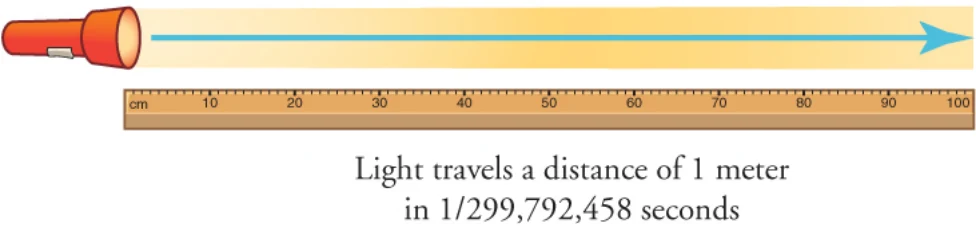
The Meter The SI unit for length is the meter (m). The definition of the meter has changed over time to become more accurate and precise. The meter was first defined in 1791 as 1/10,000,000 of the distance from the equator to the North Pole. This measurement was improved in 1889 by redefining the meter to be the distance between two engraved lines on a platinum-iridium bar. (The bar is now housed at the International Bureau of Weights and Measures, near Paris). By 1960, some distances could be measured more precisely by comparing them to wavelengths of light. The meter was redefined as 1,650,763.73 wavelengths of orange light emitted by krypton atoms. In 1983, the meter was given its present definition as the distance light travels in a vacuum in 1/ 299,792,458 of a second (Figure 1.14).
メートル SIの長さの単位はメートル(m)である。メートルの定義は、より正確で精密なものになるよう、時代とともに変わってきた。メートルは1791年に、赤道から北極までの距離の1000万分の1として初めて定義された。1889年にはこの測定が改良され、白金イリジウム合金の棒に刻まれた2本の線の間の距離としてメートルが定義し直された(この棒は現在、パリ近郊の国際度量衡局に保管されている)。1960年までには、光の波長と比べることでより精密に測れる距離が出てきた。そこでメートルは、クリプトン原子が放つオレンジ色の光の1,650,763.73波長として定義し直された。そして1983年、メートルは現在の定義、すなわち真空中で光が299,792,458分の1秒に進む距離、として与えられた(図1.14)。
The Kilogram The SI unit for mass is the kilogram (abbreviated kg); it was previously defined to be the mass of a platinum-iridium cylinder kept with the old meter standard at the International Bureau of Weights and Measures near Paris. Exact replicas of the previously defined kilogram are also kept at the United States’ National Institute of Standards and Technology, or NIST, located in Gaithersburg, Maryland outside of Washington D.C., and at other locations around the world. The determination of all other masses could be ultimately traced to a comparison with the standard mass. Even though the platinum-iridium cylinder was resistant to corrosion, airborne contaminants were able to adhere to its surface, slightly changing its mass over time. In May 2019, the scientific community adopted a more stable definition of the kilogram. The kilogram is now defined in terms of the second, the meter, and Planck's constant, h (a quantum mechanical value that relates a photon's energy to its frequency).
キログラム SIの質量の単位はキログラム(kg)である。以前はこれを、パリ近郊の国際度量衡局に、かつてのメートル原器とともに保管された白金イリジウム合金の円柱の質量として定義していた。この旧定義のキログラムの精密な複製は、ワシントンD.C.郊外メリーランド州ゲイザースバーグにあるアメリカ国立標準技術研究所(NIST)をはじめ、世界各地にも保管されている。他のあらゆる質量の決定は、最終的にはこの標準質量との比較にたどり着くことができた。白金イリジウムの円柱は腐食に強かったが、それでも空気中の汚れが表面に付着し、時とともに質量がわずかに変わってしまった。2019年5月、科学界はより安定したキログラムの定義を採用した。キログラムは今では、秒、メートル、そしてプランク定数h(光子のエネルギーとその振動数を結びつける量子力学的な値)によって定義されている。
The Second The SI unit for time, the second (s) also has a long history. For many years it was defined as 1/86,400 of an average solar day. However, the average solar day is actually very gradually getting longer due to gradual slowing of Earth’s rotation. Accuracy in the fundamental units is essential, since all other measurements are derived from them.Therefore, a new standard was adopted to define the second in terms of a non-varying, or constant, physical phenomenon. One constant phenomenon is the very steady vibration of Cesium atoms, which can be observed and counted. This vibration forms the basis of the cesium atomic clock. In 1967, the second was redefined as the time required for 9,192,631,770 Cesium atom vibrations (Figure 1.15).
秒 SIの時間の単位である秒(s)にも長い歴史がある。長いあいだ、平均太陽日の86,400分の1として定義されていた。しかし平均太陽日は、地球の自転がゆるやかに遅くなるために、ごくわずかずつ長くなっている。他のすべての測定が基本単位から導かれる以上、基本単位の正確さは決定的に重要である。そこで、変化しない一定の物理現象によって秒を定義する新しい標準が採用された。その一定の現象の一つが、セシウム原子のきわめて安定した振動であり、これは観測して数えることができる。この振動がセシウム原子時計の基礎になっている。1967年、秒は次の時間として定義し直された。すなわちセシウム原子が9,192,631,770回振動するのに要する時間である(図1.15)。
The Ampere Electric current is measured in the ampere (A), named after Andre Ampere. You have probably heard of amperes, or amps, when people discuss electrical currents or electrical devices. Understanding an ampere requires a basic understanding of electricity and magnetism, something that will be explored in depth in later chapters of this book. Basically, two parallel wires with an electric current running through them will produce an attractive force on each other. One ampere is defined as the amount of electric current that will produce an attractive force of 2.7 10–7 newton per meter of separation between the two wires (the newton is the derived unit of force).
アンペア 電流はアンペア(A)で測る。アンドレ・アンペールにちなむ名である。電流や電気製品の話でアンペア、あるいはアンペと聞いたことがあるだろう。アンペアを理解するには電気と磁気の基礎を知る必要があり、それは本書の後の章で詳しく扱う。おおまかに言えば、電流が流れている2本の平行な導線は、互いに引き合う力を及ぼす。1アンペアとは、2本の導線の間隔1メートルあたり2.710-7ニュートンの引力を生じさせる電流の大きさとして定義される(ニュートンは力の組立単位である)。
Kelvins The SI unit of temperature is the kelvin (or kelvins, but not degrees kelvin). This scale is named after physicist William Thomson, Lord Kelvin, who was the first to call for an absolute temperature scale. The Kelvin scale is based on absolute zero. This is the point at which all thermal energy has been removed from all atoms or molecules in a system. This temperature, 0 K, is equal to −273.15 °C and −459.67 °F. Conveniently, the Kelvin scale actually changes in the same way as the Celsius scale. For example, the freezing point (0 °C) and boiling points of water (100 °C) are 100 degrees apart on the Celsius scale. These two temperatures are also 100 kelvins apart (freezing point = 273.15 K; boiling point = 373.15 K).
ケルビン SIの温度の単位はケルビンである(「度ケルビン」とは言わない)。絶対温度目盛りを最初に提唱した物理学者ウィリアム・トムソン、すなわちケルビン卿にちなむ。ケルビン目盛りは絶対零度を基準にしている。絶対零度とは、系の中のすべての原子や分子から熱エネルギーが完全に取り去られた点である。この温度0 Kは、−273.15 ℃、−459.67 °Fに等しい。都合のよいことに、ケルビン目盛りの刻みはセルシウス目盛りとまったく同じ変わり方をする。たとえば水の凝固点(0 ℃)と沸点(100 ℃)はセルシウス目盛りで100度離れている。この二つの温度はケルビンでも100ケルビン離れている(凝固点=273.15 K、沸点=373.15 K)。
Metric Prefixes Physical objects or phenomena may vary widely. For example, the size of objects varies from something very small (like an atom) to something very large (like a star). Yet the standard metric unit of length is the meter. So, the metric system includes many prefixes that can be attached to a unit. Each prefix is based on factors of 10 (10, 100, 1,000, etc., as well as 0.1, 0.01, 0.001, etc.). Table 1.2 gives the metric prefixes and symbols used to denote the different various factors of 10 in the metric system.
接頭語 物体や現象の大きさは大きく異なりうる。たとえば物の大きさは、原子のようにきわめて小さいものから、恒星のようにきわめて大きいものまである。それでも長さの標準的なメートル法単位はメートル一つである。そこでメートル法には、単位に付けられる多くの接頭語が用意されている。それぞれの接頭語は10の累乗(10、100、1000など、また0.1、0.01、0.001など)にもとづく。表1.2に、メートル法で10のさまざまな累乗を表すのに使われる接頭語と記号を示す。
The metric system is convenient because conversions between metric units can be done simply by moving the decimal place of a number. This is because the metric prefixes are sequential powers of 10. There are 100 centimeters in a meter, 1000 meters in a kilometer, and so on. In nonmetric systems, such as U.S. customary units, the relationships are less simple—there are 12 inches in a foot, 5,280 feet in a mile, 4 quarts in a gallon, and so on. Another advantage of the metric system is that the same unit can be used over extremely large ranges of values simply by switching to the most-appropriate metric prefix. For example, distances in meters are suitable for building construction, but kilometers are used to describe road construction. Therefore, with the metric system, there is no need to invent new units when measuring very small or very large objects—you just have to move the decimal point (and use the appropriate prefix).
メートル法が便利なのは、単位どうしの換算が数の小数点を動かすだけで済むからである。これは接頭語が10の累乗を順に並べたものだからだ。1メートルは100センチメートル、1キロメートルは1000メートル、というぐあいである。ヤード・ポンド法のような非メートル法の系では関係がこれほど単純ではない。1フィートは12インチ、1マイルは5280フィート、1ガロンは4クォート、といったふうである。メートル法のもう一つの利点は、最も適した接頭語に切り替えるだけで、同じ単位をきわめて広い範囲の値に使えることだ。たとえばメートル単位の距離は建物の建設に適しているが、道路の建設を語るにはキロメートルが使われる。したがってメートル法なら、きわめて小さいものや大きいものを測るのに新しい単位を発明する必要はない。小数点を動かし、適切な接頭語を付けるだけでよい。
1 See Appendix A for a discussion of powers of 10.
1 10の累乗については付録Aの説明を見よ。
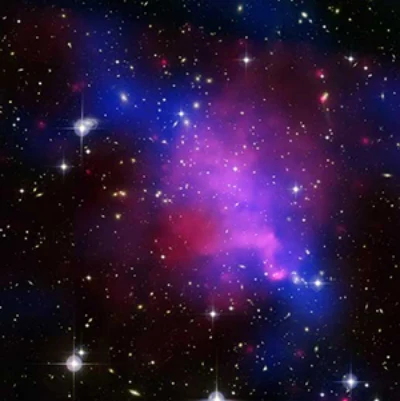
Known Ranges of Length, Mass, and Time Table 1.3 lists known lengths, masses, and time measurements. You can see that scientists use a range of measurement units. This wide range demonstrates the vastness and complexity of the universe, as well as the breadth of phenomena physicists study. As you examine this table, note how the metric system allows us to discuss and compare an enormous range of phenomena, using one system of measurement (Figure 1.16 and Figure 1.17).
既知の長さ・質量・時間の範囲 表1.3に、知られている長さ、質量、時間の測定値を挙げる。科学者が幅広い測定単位を使っていることがわかるだろう。この幅の広さは、宇宙の広大さと複雑さを、そして物理学者が研究する現象の広がりを示している。この表を見るときは、メートル法という一つの測定体系を使うだけで、これほど巨大な範囲の現象を論じ比べられることに注目してほしい(図1.16と図1.17)。
FIGURE 1.16 Tiny phytoplankton float among crystals of ice in the Antarctic Sea. They range from a few micrometers to as much as 2 millimeters in length. (Prof. Gordon T. Taylor, Stony Brook University; NOAA Corps Collections)
図1.16 南極海で氷の結晶にまじって漂う微小な植物プランクトン。大きさは数マイクロメートルから、大きいもので2ミリメートルほどまである。(Prof. Gordon T. Taylor, Stony Brook University; NOAA Corps Collections)