第17章電気化学
17.7 Electrolysis17.7 電気分解
Learning Objectives学習目標
By the end of this section, you will be able to:
この節を学び終えると、次のことができるようになる。
- Describe the process of electrolysis電気分解の過程を説明する。
- Compare the operation of electrolytic cells with that of galvanic cells電解セルの動作をガルバニ電池の動作と比較する。
- Perform stoichiometric calculations for electrolytic processes電解過程について化学量論計算を行う。
Electrochemical cells in which spontaneous redox reactions take place (galvanic cells) have been the topic of discussion so far in this chapter. In these cells, electrical work is done by a redox system on its surroundings as electrons produced by the redox reaction are transferred through an external circuit. This final section of the chapter will address an alternative scenario in which an external circuit does work on a redox system by imposing a voltage sufficient to drive an otherwise nonspontaneous reaction, a process known as electrolysis. A familiar example of electrolysis is recharging a battery, which involves use of an external power source to drive the spontaneous (discharge) cell reaction in the reverse direction, restoring to some extent the composition of the half-cells and the voltage of the battery. Perhaps less familiar is the use of electrolysis in the refinement of metallic ores, the manufacture of commodity chemicals, and the electroplating of metallic coatings on various products (e.g., jewelry, utensils, auto parts). To illustrate the essential concepts of electrolysis, a few specific processes will be considered.
英語のヒント
本章ではここまで、自発的な酸化還元反応が起こる電気化学セル(ガルバニ電池)を扱ってきた。これらのセルでは、酸化還元反応で生じた電子が外部回路を通じて移動し、酸化還元系が周囲に対して電気的な仕事を行う。本章の最後の節では、外部回路が酸化還元系に仕事をする別の状況を扱う。外部回路が、そうしなければ非自発的な反応を進めるのに十分な電圧を加えるもので、電気分解と呼ばれる過程である。電気分解の身近な例は、電池の充電である。外部電源を使って、自発的な(放電時の)電池反応を逆方向に進め、半電池の組成と電池の電圧を、ある程度回復させる。金属鉱石の精錬、汎用化学品の製造、およびさまざまな製品(たとえば宝飾品、食器、自動車部品)への金属被膜の電気めっきに電気分解が使われることは、あまりなじみがないかもしれない。電気分解の本質的な概念を示すため、いくつかの具体的な過程を考えよう。
The Electrolysis of Molten Sodium Chloride溶融塩化ナトリウムの電気分解
Metallic sodium, Na, and chlorine gas, Cl2, are used in numerous applications, and their industrial production relies on the large-scale electrolysis of molten sodium chloride, NaCl(l). The industrial process typically uses a Downs cell similar to the simplified illustration shown in Figure 17.18. The reactions associated with this process are:
英語のヒント
金属ナトリウムNaと塩素ガスCl2は多くの用途で使われ、その工業的製造は、溶融塩化ナトリウムNaCl(l)の大規模な電気分解に依存している。工業的な工程では通常、図17.18の簡略図に似たダウンズ電解槽を使う。この過程に関係する反応は、次のとおりである。
The cell potential for the above process is negative, indicating the reaction as written (decomposition of liquid NaCl) is not spontaneous. To force this reaction, a positive potential of magnitude greater than the negative cell potential must be applied to the cell.
英語のヒント
上記の過程の電池電位は負であり、記された方向の反応(液体NaClの分解)が自発的ではないことを示す。この反応を強制的に起こすには、負の電池電位の絶対値を超える大きさの正の電位を、セルに加えなければならない。
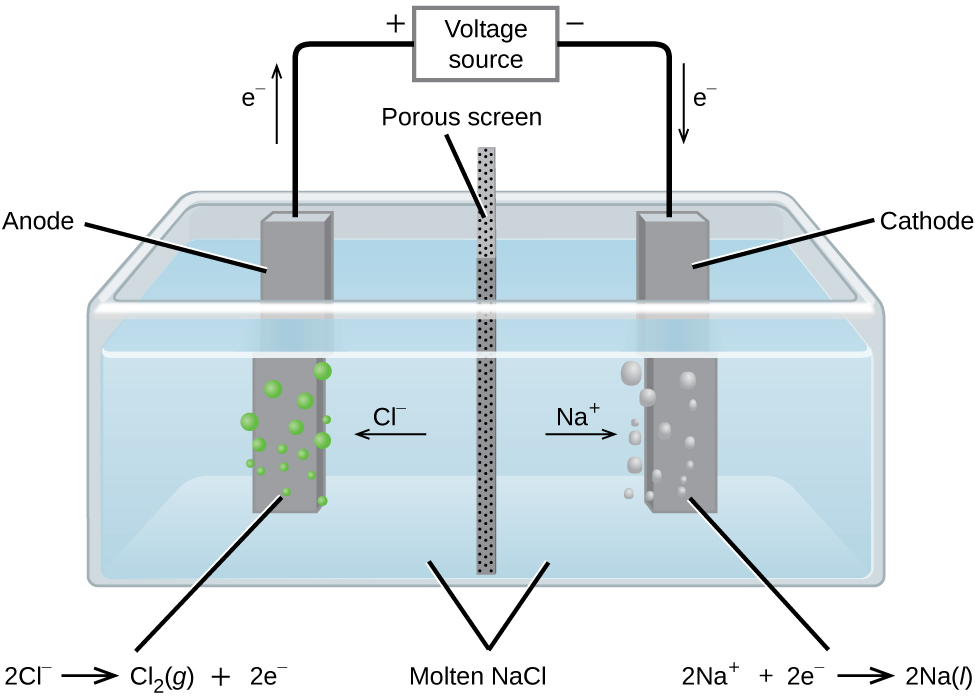
Figure 17.18図 17.18
Cells of this sort (a cell for the electrolysis of molten sodium chloride) are used in the Downs process for production of sodium and chlorine, and they typically use iron cathodes and carbon anodes.
この種のセル(溶融塩化ナトリウムの電気分解用セル)は、ナトリウムと塩素を製造するダウンズ法に用いられ、通常は鉄のカソードと炭素のアノードを使う。
The Electrolysis of Water水の電気分解
Water may be electrolytically decomposed in a cell similar to the one illustrated in Figure 17.19. To improve electrical conductivity without introducing a different redox species, the hydrogen ion concentration of the water is typically increased by addition of a strong acid. The redox processes associated with this cell are
水は、図17.19に示すようなセルで電気分解できる。異なる酸化還元化学種を導入せずに電気伝導性を高めるため、通常は強酸を加え、水の水素イオン濃度を高くする。このセルに関係する酸化還元過程は、次のとおりである。
Again, the cell potential as written is negative, indicating a nonspontaneous cell reaction that must be driven by imposing a cell voltage greater than +1.229 V. Keep in mind that standard electrode potentials are used to inform thermodynamic predictions here, though the cell is not operating under standard state conditions. Therefore, at best, calculated cell potentials should be considered ballpark estimates.
英語のヒント
ここでも、記された方向の電池電位は負であり、+1.229 Vを超える電池電圧を加えて進める必要のある、非自発的な電池反応であることを示している。セルは標準状態の条件で動作していないが、ここでは標準電極電位を熱力学的な予測の参考として使っていることを忘れないようにしよう。したがって、計算した電池電位は、よくても概算値として考えるべきである。
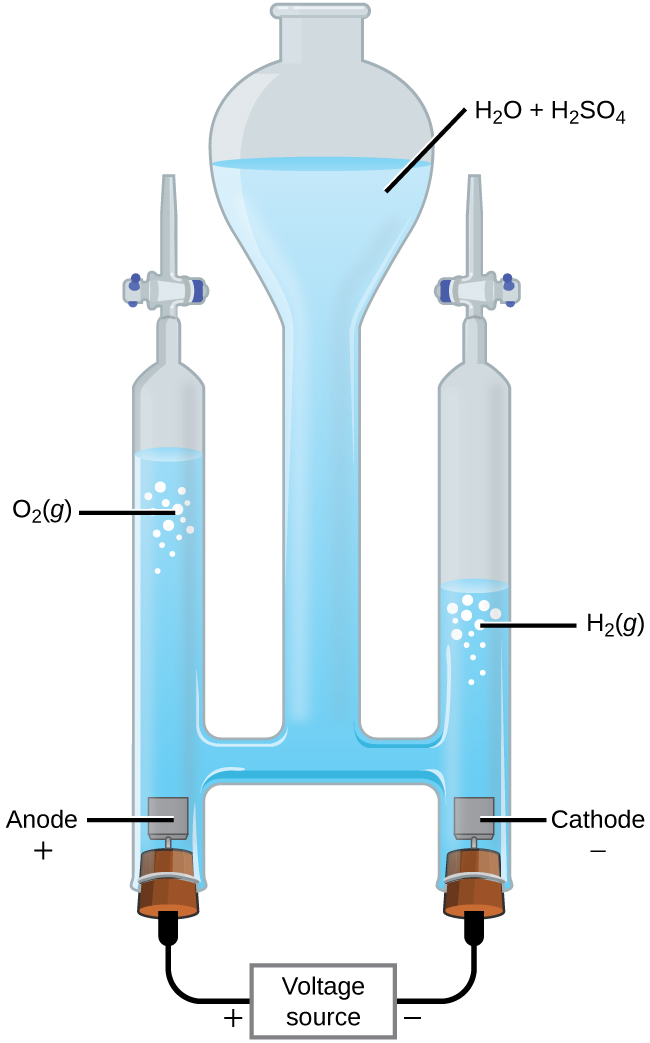


Figure 17.19図 17.19
The electrolysis of water produces stoichiometric amounts of oxygen gas at the anode and hydrogen at the cathode.
水の電気分解では、アノードに酸素、カソードに水素が、化学量論的な量比で発生する。
The Electrolysis of Aqueous Sodium Chloride塩化ナトリウム水溶液の電気分解
When aqueous solutions of ionic compounds are electrolyzed, the anode and cathode half-reactions may involve the electrolysis of either water species (H2O, H+, OH-) or solute species (the cations and anions of the compound). As an example, the electrolysis of aqueous sodium chloride could involve either of these two anode reactions:
イオン化合物の水溶液を電気分解すると、アノードとカソードの半反応には、水の化学種(H2O、H+、OH-)または溶質の化学種(化合物の陽イオンと陰イオン)のどちらかの電気分解が関与することがある。たとえば、塩化ナトリウム水溶液の電気分解では、次の二つのアノード反応のどちらかが起こりうる。
The standard electrode (reduction) potentials of these two half-reactions indicate water may be oxidized at a less negative/more positive potential (–1.229 V) than chloride ion (–1.358 V). Thermodynamics thus predicts that water would be more readily oxidized, though in practice it is observed that both water and chloride ion are oxidized under typical conditions, producing a mixture of oxygen and chlorine gas.
この二つの半反応の標準電極(還元)電位は、水が塩化物イオン(–1.358 V)より負の程度が小さい、すなわちより正の電位(–1.229 V)で酸化されうることを示している。したがって熱力学では水のほうが酸化されやすいと予測されるが、実際には典型的な条件で水と塩化物イオンの両方が酸化され、酸素ガスと塩素ガスの混合物を生じることが観察される。
Turning attention to the cathode, the possibilities for reduction are:
カソードに目を向けると、還元の可能性は次のとおりである。
Comparison of these standard half-reaction potentials suggests the reduction of hydrogen ion is thermodynamically favored. However, in a neutral aqueous sodium chloride solution, the concentration of hydrogen ion is far below the standard state value of 1 M (approximately 10-7 M), and so the observed cathode reaction is actually reduction of water. The net cell reaction in this case is then
英語のヒント
これらの標準半反応電位を比較すると、熱力学的には水素イオンの還元が有利であることが示唆される。しかし、中性の塩化ナトリウム水溶液では水素イオン濃度は標準状態の1 Mよりはるかに低い(約10-7 M)ため、実際に観察されるカソード反応は水の還元である。したがって、この場合の正味の電池反応は次のようになる。
This electrolysis reaction is part of the chlor-alkali process used by industry to produce chlorine and sodium hydroxide (lye).
英語のヒント
この電気分解反応は、塩素と水酸化ナトリウム(苛性ソーダ)を工業的に製造するクロルアルカリ法の一部である。