第17章電気化学
17.2 Galvanic Cells17.2 ガルバニ電池
Learning Objectives学習目標
By the end of this section, you will be able to:
この節を学び終えると、次のことができるようになる。
- Describe the function of a galvanic cell and its componentsガルバニ電池とその構成要素の機能を説明する。
- Use cell notation to symbolize the composition and construction of galvanic cells電池表記を用いて、ガルバニ電池の組成と構造を記号で表す。
As demonstration of spontaneous chemical change, Figure 17.2 shows the result of immersing a coiled wire of copper into an aqueous solution of silver nitrate. A gradual but visually impressive change spontaneously occurs as the initially colorless solution becomes increasingly blue, and the initially smooth copper wire becomes covered with a porous gray solid.
英語のヒント
図17.2は、自発的な化学変化の実演として、らせん状に巻いた銅線を硝酸銀水溶液に浸した結果を示している。初めは無色だった溶液が次第に青くなり、初めは滑らかだった銅線が多孔質の灰色固体に覆われるという、ゆっくりだが見た目に印象的な変化が自発的に起こる。

Figure 17.2図 17.2
A copper wire and an aqueous solution of silver nitrate (left) are brought into contact (center) and a spontaneous transfer of electrons occurs, creating blue Cu2+(aq) and gray Ag(s) (right).
銅線と硝酸銀水溶液(左)を接触させると(中央)、自発的な電子移動が起こり、青色のCu2+(aq)と灰色のAg(s)が生じる(右)。
These observations are consistent with (i) the oxidation of elemental copper to yield copper(II) ions, Cu2+(aq), which impart a blue color to the solution, and (ii) the reduction of silver(I) ions to yield elemental silver, which deposits as a fluffy solid on the copper wire surface. And so, the direct transfer of electrons from the copper wire to the aqueous silver ions is spontaneous under the employed conditions. A summary of this redox system is provided by these equations:
英語のヒント
これらの観察結果は、(i)単体の銅が酸化されて銅(II)イオンCu2+(aq)を生じ、それが溶液を青色にすること、および(ii)銀(I)イオンが還元されて単体の銀を生じ、それが銅線表面にふわふわした固体として析出することと一致する。したがって、使用した条件では、銅線から水溶液中の銀イオンへの直接的な電子移動は自発的である。この酸化還元系は、次の式にまとめられる。
Consider the construction of a device that contains all the reactants and products of a redox system like the one here, but prevents physical contact between the reactants. Direct transfer of electrons is, therefore, prevented; transfer, instead, takes place indirectly through an external circuit that contacts the separated reactants. Devices of this sort are generally referred to as electrochemical cells, and those in which a spontaneous redox reaction takes place are called galvanic cells (or voltaic cells).
英語のヒント
ここで示したような酸化還元系の反応物と生成物をすべて含みながら、反応物どうしの物理的な接触を防ぐ装置を作ることを考えよう。これによって電子の直接的な移動は防がれ、代わりに、離した反応物に接続する外部回路を通じて間接的に移動する。この種の装置は一般に電気化学セルと呼ばれ、そのうち自発的な酸化還元反応が起こるものは、ガルバニ電池(またはボルタ電池)と呼ばれる。
A galvanic cell based on the spontaneous reaction between copper and silver(I) is depicted in Figure 17.3. The cell is comprised of two half-cells, each containing the redox conjugate pair (“couple”) of a single reactant. The half-cell shown at the left contains the Cu(0)/Cu(II) couple in the form of a solid copper foil and an aqueous solution of copper nitrate. The right half-cell contains the Ag(I)/Ag(0) couple as solid silver foil and an aqueous silver nitrate solution. An external circuit is connected to each half-cell at its solid foil, meaning the Cu and Ag foil each function as an electrode. By definition, the anode of an electrochemical cell is the electrode at which oxidation occurs (in this case, the Cu foil) and the cathode is the electrode where reduction occurs (the Ag foil). The redox reactions in a galvanic cell occur only at the interface between each half-cell’s reaction mixture and its electrode. To keep the reactants separate while maintaining charge-balance, the two half-cell solutions are connected by a tube filled with inert electrolyte solution called a salt bridge. The spontaneous reaction in this cell produces Cu2+ cations in the anode half-cell and consumes Ag+ ions in the cathode half-cell, resulting in a compensatory flow of inert ions from the salt bridge that maintains charge balance. Increasing concentrations of Cu2+ in the anode half-cell are balanced by an influx of NO3− from the salt bridge, while a flow of Na+ into the cathode half-cell compensates for the decreasing Ag+ concentration.
英語のヒント
銅と銀(I)の自発的な反応を利用するガルバニ電池を、図17.3に示す。この電池は二つの半電池から成り、それぞれが一つの反応物の酸化還元共役対(「酸化還元対」)を含む。左側の半電池は、固体の銅箔と硝酸銅水溶液という形で、Cu(0)/Cu(II)対を含む。右側の半電池は、固体の銀箔と硝酸銀水溶液として、Ag(I)/Ag(0)対を含む。外部回路は各半電池の固体の箔に接続されており、Cu箔とAg箔がそれぞれ電極として働く。定義上、電気化学セルのアノードは酸化が起こる電極(この場合はCu箔)であり、カソードは還元が起こる電極(Ag箔)である。ガルバニ電池の酸化還元反応は、各半電池の反応混合物と電極の界面だけで起こる。電荷のつり合いを保ちながら反応物を分離しておくため、二つの半電池の溶液は、不活性な電解質溶液で満たした塩橋という管でつながれている。この電池の自発的な反応は、アノード側の半電池でCu2+陽イオンを生成し、カソード側の半電池でAg+イオンを消費する。それに伴い、塩橋から不活性イオンが補償のために流れ、電荷のつり合いを保つ。アノード側の半電池でCu2+濃度が増加することは、塩橋からのNO3−の流入によって補償される。一方、カソード側の半電池へのNa+の流入は、Ag+濃度の減少を補償する。
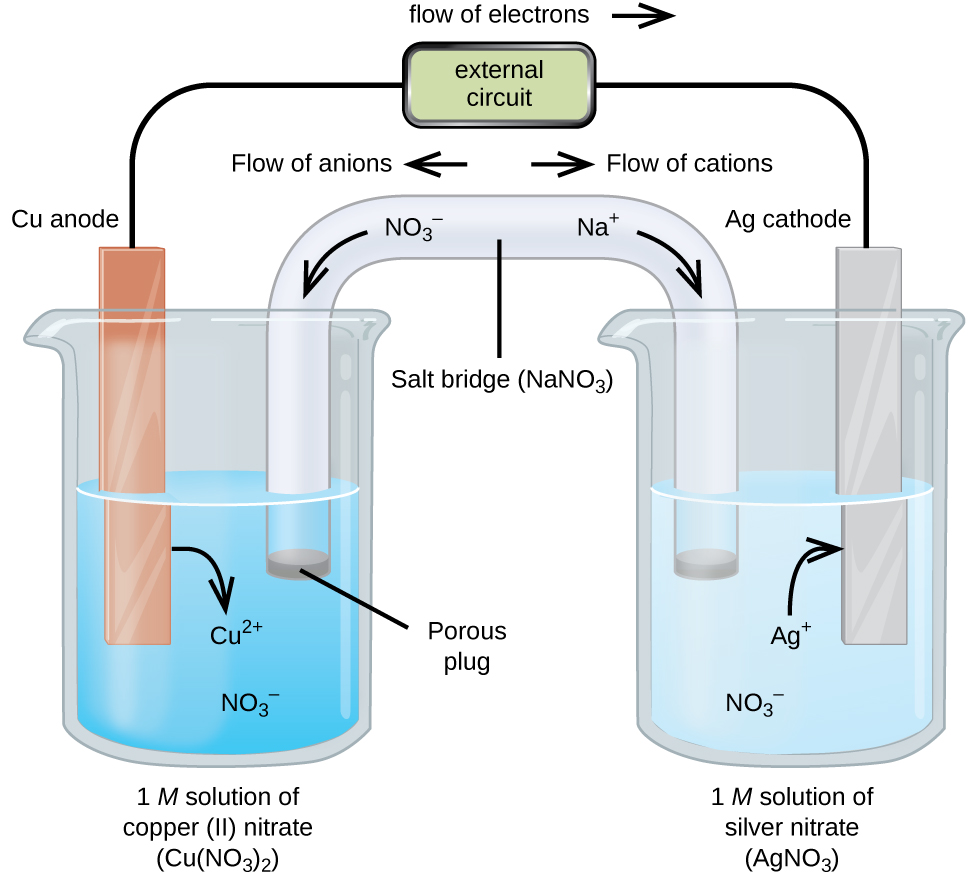
Figure 17.3図 17.3
A galvanic cell based on the spontaneous reaction between copper and silver(I) ions.
銅と銀(I)イオンの自発的な反応を利用するガルバニ電池。
Cell Notation電池の表記
Abbreviated symbolism is commonly used to represent a galvanic cell by providing essential information on its composition and structure. These symbolic representations are called cell notations or cell schematics, and they are written following a few guidelines:
英語のヒント
ガルバニ電池を表すには、その組成と構造に関する本質的な情報を示す簡略な記号表現がよく使われる。この記号表現は電池表記、または電池の模式表記と呼ばれ、いくつかの指針に従って書く。
- The relevant components of each half-cell are represented by their chemical formulas or element symbols各半電池の関係する成分を、化学式または元素記号で表す。
- All interfaces between component phases are represented by vertical parallel lines; if two or more components are present in the same phase, their formulas are separated by commas成分の相の間のすべての界面を、縦の平行線で表す。同じ相に二つ以上の成分が存在するときは、それらの化学式をコンマで区切る。
- By convention, the schematic begins with the anode and proceeds left-to-right identifying phases and interfaces encountered within the cell, ending with the cathode
英語のヒント
慣例により、模式表記はアノードから始め、電池内の相と界面を順に示しながら左から右へ進み、カソードで終える。
A verbal description of the cell as viewed from anode-to-cathode is often a useful first-step in writing its schematic. For example, the galvanic cell shown in Figure 17.3 consists of a solid copper anode immersed in an aqueous solution of copper(II) nitrate that is connected via a salt bridge to an aqueous silver(I) nitrate solution, immersed in which is a solid silver cathode. Converting this statement to symbolism following the above guidelines results in the cell schematic:
英語のヒント
電池をアノードからカソードへ見たときの様子を言葉で説明することは、模式表記を書くための有用な第一歩となることが多い。たとえば、図17.3に示したガルバニ電池は、硝酸銅(II)水溶液に浸した固体の銅アノードから成り、その溶液は塩橋を介して硝酸銀(I)水溶液につながり、その中に固体の銀カソードが浸されている。この記述を上記の指針に従って記号に変換すると、次の電池の模式表記が得られる。
Consider a different galvanic cell (see Figure 17.4) based on the spontaneous reaction between solid magnesium and aqueous iron(III) ions:
固体のマグネシウムと水溶液中の鉄(III)イオンの自発的な反応を利用する、別のガルバニ電池を考えよう(図17.4を参照)。
In this cell, a solid magnesium anode is immersed in an aqueous solution of magnesium chloride that is connected via a salt bridge to an aqueous solution containing a mixture of iron(III) chloride and iron(II) chloride, immersed in which is a platinum cathode. The cell schematic is then written as
この電池では、固体のマグネシウムアノードを塩化マグネシウム水溶液に浸し、その溶液を、塩化鉄(III)と塩化鉄(II)の混合物を含む水溶液に塩橋でつなぎ、後者の溶液には白金カソードを浸す。この電池の模式表記は、次のようになる。
Notice the cathode half-cell is different from the others considered thus far in that its electrode is comprised of a substance (Pt) that is neither a reactant nor a product of the cell reaction. This is required when neither member of the half-cell’s redox couple can reasonably function as an electrode, which must be electrically conductive and in a phase separate from the half-cell solution. In this case, both members of the redox couple are solute species, and so Pt is used as an inert electrode that can simply provide or accept electrons to redox species in solution. Electrodes constructed from a member of the redox couple, such as the Mg anode in this cell, are called active electrodes.
英語のヒント
カソード側の半電池は、電極が電池反応の反応物でも生成物でもない物質(Pt)から成る点で、これまで考えたものと異なることに注意しよう。これは、半電池の酸化還元対のどちらの成分も、適切に電極として働けない場合に必要となる。電極は電気を伝導し、半電池の溶液とは別の相にある必要がある。この場合、酸化還元対の両成分は溶質の化学種であるため、溶液中の酸化還元化学種へ電子を供給したり、そこから電子を受け取ったりするだけの不活性電極としてPtを使う。この電池のMgアノードのように、酸化還元対の一成分で作った電極は、活性電極と呼ばれる。
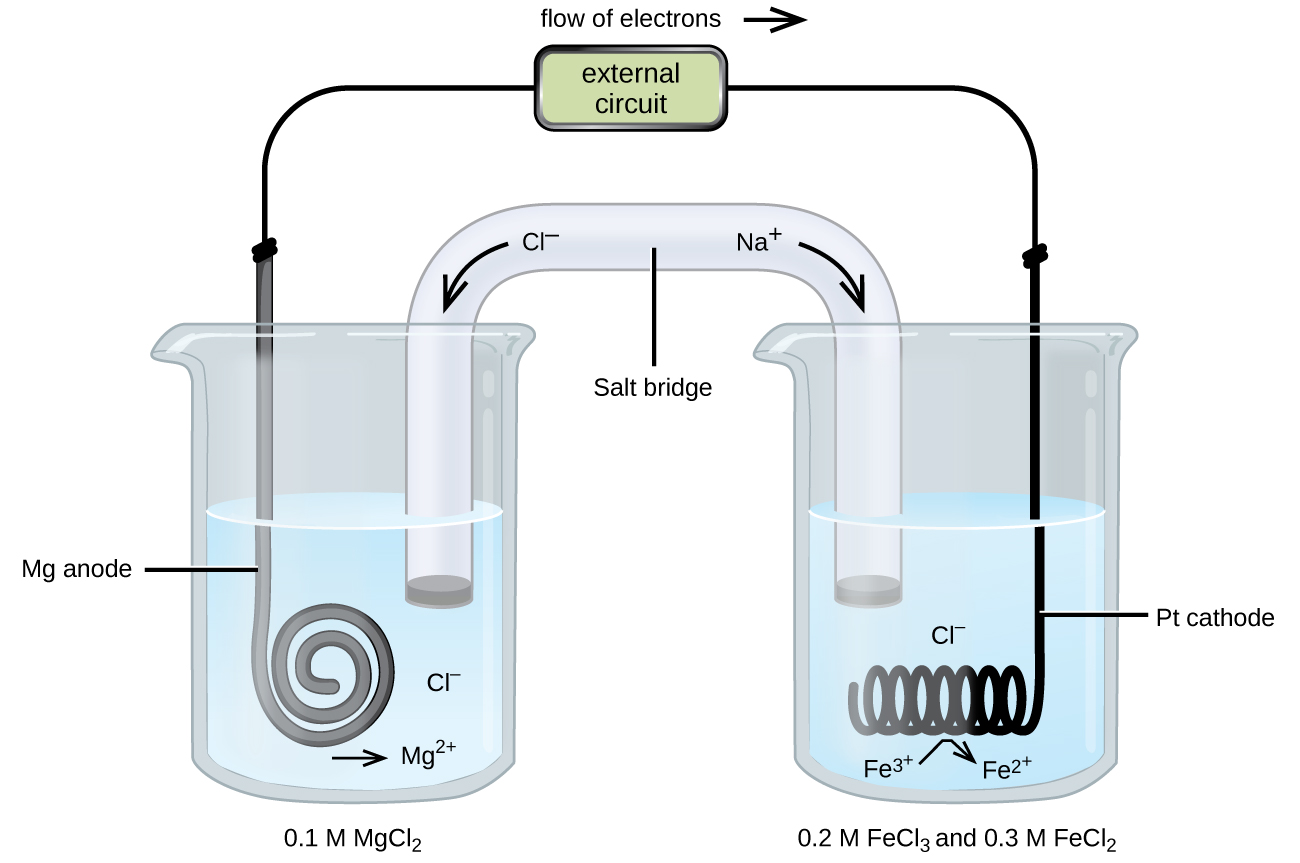


Figure 17.4図 17.4
A galvanic cell based on the spontaneous reaction between magnesium and iron(III) ions.
マグネシウムと鉄(III)イオンの自発的な反応を利用するガルバニ電池。
Example 17.3例題 17.3
Writing Galvanic Cell Schematicsガルバニ電池の模式表記を書く
A galvanic cell is fabricated by connecting two half-cells with a salt bridge, one in which a chromium wire is immersed in a 1 M CrCl3 solution and another in which a copper wire is immersed in 1 M CuCl2. Assuming the chromium wire functions as an anode, write the schematic for this cell along with equations for the anode half-reaction, the cathode half-reaction, and the overall cell reaction.
英語のヒント
クロム線を1 MのCrCl3溶液に浸した半電池と、銅線を1 MのCuCl2に浸した半電池を塩橋でつなぎ、ガルバニ電池を作る。クロム線がアノードとして働くと仮定し、この電池の模式表記を、アノードの半反応式、カソードの半反応式、および電池全体の反応式とともに書きなさい。
Solution解き方
Since the chromium wire is stipulated to be the anode, the schematic begins with it and proceeds left-to-right, symbolizing the other cell components until ending with the copper wire cathode:
クロム線がアノードと指定されているので、模式表記はそれから始まり、他の電池成分を記号で表しながら左から右へ進み、銅線のカソードで終わる。
The half-reactions for this cell are
この電池の半反応は次のとおりである。
Multiplying to make the number of electrons lost by Cr and gained by Cu2+ equal yields
Crが失う電子数とCu2+が受け取る電子数を等しくするように倍数倍すると、次の式が得られる。
Adding the half-reaction equations and simplifying yields an equation for the cell reaction:
半反応式を加えて整理すると、電池反応の式が得られる。
Check Your Learning理解度の確認
Omitting solute concentrations and spectator ion identities, write the schematic for a galvanic cell whose net cell reaction is shown below.
英語のヒント
溶質の濃度と傍観イオンの種類を省略し、以下に示す正味の電池反応を行うガルバニ電池の模式表記を書きなさい。