第17章電気化学
Fuel Cells燃料電池
A fuel cell is a galvanic cell that uses traditional combustive fuels, most often hydrogen or methane, that are continuously fed into the cell along with an oxidant. (An alternative, but not very popular, name for a fuel cell is a flow battery.) Within the cell, fuel and oxidant undergo the same redox chemistry as when they are combusted, but via a catalyzed electrochemical that is significantly more efficient. For example, a typical hydrogen fuel cell uses graphite electrodes embedded with platinum-based catalysts to accelerate the two half-cell reactions:
英語のヒント
燃料電池は、通常の燃焼用燃料、最も一般的には水素やメタンを、酸化剤とともに連続的にセルへ供給して使うガルバニ電池である。(あまり一般的ではないが、燃料電池の別名としてフロー電池という呼び方がある。)セル内では、燃料と酸化剤は、燃焼させたときと同じ酸化還元の化学変化を、はるかに効率のよい、触媒を用いた電気化学的な過程を通じて受ける。たとえば、典型的な水素燃料電池は、白金を主成分とする触媒を埋め込んだ黒鉛電極を用い、次の二つの半電池反応を速める。
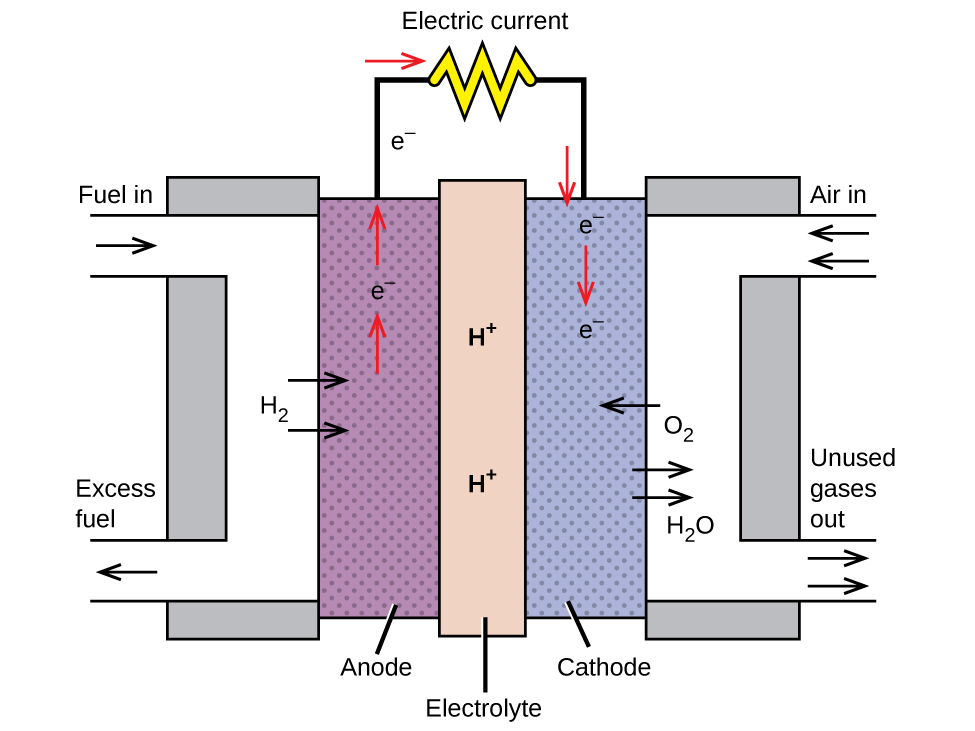

Figure 17.14図 17.14
In this hydrogen fuel cell, oxygen from the air reacts with hydrogen, producing water and electricity.
この水素燃料電池では、空気中の酸素が水素と反応し、水と電気を生じる。
These types of fuel cells generally produce voltages of approximately 1.2 V. Compared to an internal combustion engine, the energy efficiency of a fuel cell using the same redox reaction is typically more than double (~20%–25% for an engine versus ~50%–75% for a fuel cell). Hydrogen fuel cells are commonly used on extended space missions, and prototypes for personal vehicles have been developed, though the technology remains relatively immature.
英語のヒント
この種の燃料電池は、一般に約1.2 Vの電圧を生じる。同じ酸化還元反応を使う内燃機関と比べると、燃料電池のエネルギー効率は通常2倍を超える(エンジンでは約20%~25%、燃料電池では約50%~75%)。水素燃料電池は長期の宇宙ミッションでよく使われ、個人用車両の試作機も開発されているが、この技術はまだ比較的未成熟である。
Key Concepts and Summary重要概念とまとめ
Galvanic cells designed specifically to function as electrical power supplies are called batteries. A variety of both single-use batteries (primary cells) and rechargeable batteries (secondary cells) are commercially available to serve a variety of applications, with important specifications including voltage, size, and lifetime. Fuel cells, sometimes called flow batteries, are devices that harness the energy of spontaneous redox reactions normally associated with combustion processes. Like batteries, fuel cells enable the reaction’s electron transfer via an external circuit, but they require continuous input of the redox reactants (fuel and oxidant) from an external reservoir. Fuel cells are typically much more efficient in converting the energy released by the reaction to useful work in comparison to internal combustion engines.
英語のヒント
電力供給源として働くよう特別に設計されたガルバニ電池を、電池と呼ぶ。使い切りの電池(一次電池)と充電式の電池(二次電池)のどちらも、さまざまな用途に向けて多様なものが市販されており、重要な仕様には電圧、サイズ、寿命がある。燃料電池は、フロー電池とも呼ばれることがあり、通常は燃焼過程に伴う自発的な酸化還元反応のエネルギーを利用する装置である。電池と同様、燃料電池は外部回路を通じて反応の電子移動を行うが、外部の貯蔵部から酸化還元反応物(燃料と酸化剤)を連続供給する必要がある。燃料電池は通常、反応が放出するエネルギーを有用な仕事へ変換する効率が、内燃機関よりはるかに高い。
Chemistry End of Chapter Exercises章末問題
Exercises 32–36練習問題 32–36
Exercise 32問題 32
Consider a battery made from one half-cell that consists of a copper electrode in 1 M CuSO4 solution and another half-cell that consists of a lead electrode in 1 M Pb(NO3)2 solution.
1 MのCuSO4溶液中の銅電極から成る半電池と、1 MのPb(NO3)2溶液中の鉛電極から成るもう一つの半電池で作った電池を考えなさい。
(a) What is the standard cell potential for the battery?
(a) この電池の標準電池電位はいくらか。
(b) What are the reactions at the anode, cathode, and the overall reaction?
(b) アノードとカソードでの反応、および全体の反応は何か。
(c) Most devices designed to use dry-cell batteries can operate between 1.0 and 1.5 V. Could this cell be used to make a battery that could replace a dry-cell battery? Why or why not.
(c) 乾電池を使うよう設計された機器の大部分は、1.0~1.5 Vで動作できる。このセルを使って、乾電池の代わりになる電池を作ることはできるか。できる、またはできない理由を述べなさい。
(d) Suppose sulfuric acid is added to the half-cell with the lead electrode and some PbSO4(s) forms. Would the cell potential increase, decrease, or remain the same?
(d) 鉛電極のある半電池に硫酸を加え、PbSO4(s)がいくらか生成したとする。電池電位は増加するか、減少するか、それとも変わらないか。
Exercise 33問題 33
Consider a battery with the overall reaction:
全体の反応が次のとおりである電池を考えなさい。
(a) What is the reaction at the anode and cathode?
(a) アノードとカソードでの反応は何か。
(b) A battery is “dead” when its cell potential is zero. What is the value of Q when this battery is dead?
英語のヒント
(b) 電池電位がゼロになると電池は「切れた」状態になる。この電池が切れたとき、Qの値はいくらか。
(c) If a particular dead battery was found to have [Cu2+] = 0.11 M, what was the concentration of silver ion?
(c) ある切れた電池について、[Cu2+] = 0.11 Mであることが分かった。銀イオン濃度はいくらであったか。
Solution解き方
(a) (b) 3.5 1015; (c) 5.6 10−9 M
(a) 。(b) 3.5 1015。(c) 5.6 10−9 M。
Exercise 34問題 34
Why do batteries go dead, but fuel cells do not?
電池は切れるのに、燃料電池は切れないのはなぜか。
Solution解き方
Batteries are self-contained and have a limited supply of reagents to expend before going dead. Alternatively, battery reaction byproducts accumulate and interfere with the reaction. Because a fuel cell is constantly resupplied with reactants and products are expelled, it can continue to function as long as reagents are supplied.
英語のヒント
電池は必要なものを内部に備えており、電池が切れるまでに消費できる反応物の量に限りがある。あるいは、電池反応の副生成物が蓄積し、反応を妨げる。燃料電池では、反応物が絶えず補給され、生成物が排出されるので、反応物が供給される限り動作し続けることができる。
Exercise 35問題 35
Use the Nernst equation to explain the drop in voltage observed for some batteries as they discharge.
一部の電池で放電するにつれて観察される電圧低下を、ネルンストの式で説明しなさい。
Exercise 36問題 36
Automobile batteries are often rated with regard to “cold-cranking amps,” a measure of the ability of the battery to perform in low-temperature weather. Suggest a reason to explain why a battery’s ability to deliver current is diminished at low temperatures. (Hint: Consider the kinetics of chemical reactions.)
英語のヒント
自動車用電池は、「コールドクランキングアンペア」という、低温の天候で電池が動作する能力の尺度で評価されることが多い。低温で電池の電流供給能力が低下する理由を考えなさい。(ヒント:化学反応の速度論を考える。)
Solution解き方
According to kinetic theory, chemical reactions occur more slowly at lower temperatures due to the decreased rate of collisions between reactant molecules. The rates of the redox reactions taking place within batteries decrease with temperature, resulting in a decreased production of electrical current.
運動論によると、低温では反応物分子どうしの衝突の頻度が減少するため、化学反応はより遅く起こる。電池内で起こる酸化還元反応の速度は、温度が下がるにつれて減少し、その結果、発生する電流が減少する。
alkaline battery
アルカリ電池
primary battery similar to a dry cell that uses an alkaline (often potassium hydroxide) electrolyte; designed to be an improved replacement for the dry cell, but with more energy storage and less electrolyte leakage than typical dry cell
アルカリ性の電解質(多くは水酸化カリウム)を使う、乾電池に似た一次電池。乾電池を改良した代替品として設計され、典型的な乾電池より多くのエネルギーを蓄え、電解質の漏れが少ない。
battery
電池
single or series of galvanic cells designed for use as a source of electrical power
電力源として使うために設計された、単独または直列につないだガルバニ電池。
dry cell
乾電池
primary battery, also called a zinc-carbon battery, based on the spontaneous oxidation of zinc by manganese(IV)
英語のヒント
マンガン(IV)による亜鉛の自発的な酸化に基づく一次電池。亜鉛・炭素電池とも呼ばれる。
fuel cell
燃料電池
devices similar to galvanic cells that require a continuous feed of redox reactants; also called a flow battery
酸化還元反応物を連続供給する必要のある、ガルバニ電池に似た装置。フロー電池とも呼ばれる。
lead acid battery
鉛蓄電池
rechargeable battery commonly used in automobiles; it typically comprises six galvanic cells based on Pb half-reactions in acidic solution
自動車によく使われる充電池。典型的には、酸性溶液中のPbの半反応に基づく六つのガルバニ電池から成る。
lithium ion battery
リチウムイオン電池
widely used rechargeable battery commonly used in portable electronic devices, based on lithium ion transfer between the anode and cathode
アノードとカソード間のリチウムイオン移動に基づく、広く使用される充電池。携帯型電子機器でよく使われる。
nickel-cadmium battery
ニッケル・カドミウム電池
rechargeable battery based on Ni/Cd half-cells with applications similar to those of lithium ion batteries
Ni/Cd半電池に基づき、リチウムイオン電池と同様の用途に使われる充電池。
primary cell
一次電池
nonrechargeable battery, suitable for single use only
充電できず、一回の使用だけに適した電池。
secondary cell
二次電池
battery designed to allow recharging
充電できるように設計された電池。