第17章電気化学
17.4 Potential, Free Energy, and Equilibrium17.4 電位、自由エネルギー、平衡
Learning Objectives学習目標
By the end of this section, you will be able to:
この節を学び終えると、次のことができるようになる。
- Explain the relations between potential, free energy change, and equilibrium constants電位、自由エネルギー変化、平衡定数の関係を説明する。
- Perform calculations involving the relations between cell potentials, free energy changes, and equilibrium電池電位、自由エネルギー変化、平衡の関係を含む計算を行う。
- Use the Nernst equation to determine cell potentials under nonstandard conditionsネルンストの式を用いて、標準条件以外での電池電位を求める。
So far in this chapter, the relationship between the cell potential and reaction spontaneity has been described, suggesting a link to the free energy change for the reaction (see chapter on thermodynamics). The interpretation of potentials as measures of oxidant strength was presented, bringing to mind similar measures of acid-base strength as reflected in equilibrium constants (see the chapter on acid-base equilibria). This section provides a summary of the relationships between potential and the related thermodynamic properties ΔG and K.
英語のヒント
本章ではここまで、電池電位と反応の自発性の関係を説明し、反応の自由エネルギー変化とのつながりを示唆してきた(熱力学の章を参照)。電位を酸化剤の強さの尺度として解釈する方法も示した。これは、平衡定数に反映される酸塩基の強さの尺度を思い起こさせる(酸塩基平衡の章を参照)。この節では、電位と、それに関連する熱力学的性質ΔGおよびKとの関係をまとめる。
E° and ΔG°E°とΔG°
The standard free energy change of a process, ΔG°, was defined in a previous chapter as the maximum work that could be performed by a system, wmax. In the case of a redox reaction taking place within a galvanic cell under standard state conditions, essentially all the work is associated with transferring the electrons from reductant-to-oxidant, welec:
前の章で、過程の標準自由エネルギー変化ΔG°を、系が行うことのできる最大の仕事wmaxとして定義した。標準状態の条件でガルバニ電池内に起こる酸化還元反応の場合、実質的にすべての仕事は、還元剤から酸化剤への電子移動に伴う仕事welecである。
The work associated with transferring electrons is determined by the total amount of charge (coulombs) transferred and the cell potential:
英語のヒント
電子移動に伴う仕事は、移動する電荷の総量(クーロン)と電池電位によって決まる。
where n is the number of moles of electrons transferred, F is Faraday’s constant, and E°cell is the standard cell potential. The relation between free energy change and standard cell potential confirms the sign conventions and spontaneity criteria previously discussed for both of these properties: spontaneous redox reactions exhibit positive potentials and negative free energy changes.
英語のヒント
ここで、nは移動する電子の物質量、Fはファラデー定数、E°cellは標準電池電位である。自由エネルギー変化と標準電池電位の関係は、これらの性質について先に説明した符号の規約と自発性の基準を裏付ける。自発的な酸化還元反応は、正の電位と負の自由エネルギー変化を示す。
E° and KE°とK
Combining a previously derived relation between ΔG° and K (see the chapter on thermodynamics) and the equation above relating ΔG° and E°cell yields the following:
先に導いたΔG°とKの関係(熱力学の章を参照)と、上のΔG°とE°cellを関係付ける式を組み合わせると、次の式が得られる。
This equation indicates redox reactions with large (positive) standard cell potentials will proceed far towards completion, reaching equilibrium when the majority of reactant has been converted to product. A summary of the relations between E°, ΔG° and K is depicted in Figure 17.7, and a table correlating reaction spontaneity to values of these properties is provided in Table 17.2.
英語のヒント
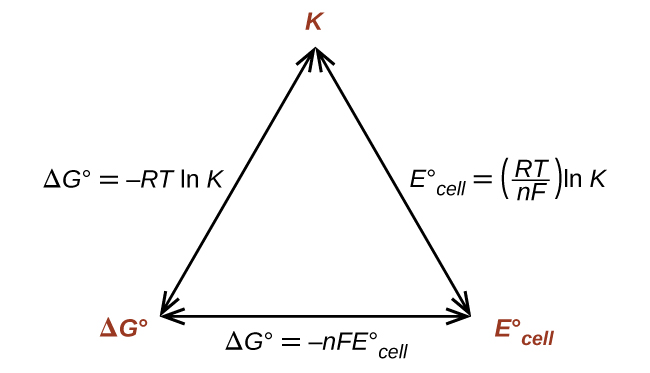

Figure 17.7図 17.7
Graphic depicting the relation between three important thermodynamic properties.
三つの重要な熱力学的性質の関係を示す図。
K |
ΔG° |
E°cell |
|
> 1 |
< 0 |
> 0 |
Reaction is spontaneous under standard conditions 反応は標準条件で自発的 Products more abundant at equilibrium 平衡では生成物のほうが多い |
< 1 |
> 0 |
< 0 |
Reaction is non-spontaneous under standard conditions 反応は標準条件で非自発的 Reactants more abundant at equilibrium 平衡では反応物のほうが多い |
= 1 |
= 0 |
= 0 |
Reaction is at equilibrium under standard conditions 反応は標準条件で平衡状態にある Reactants and products equally abundant 反応物と生成物の量が等しい |
Example 17.6例題 17.6
Equilibrium Constants, Standard Cell Potentials, and Standard Free Energy Changes平衡定数、標準電池電位、標準自由エネルギー変化
Use data from Appendix L to calculate the standard cell potential, standard free energy change, and equilibrium constant for the following reaction at 25 °C. Comment on the spontaneity of the forward reaction and the composition of an equilibrium mixture of reactants and products.
付録Lのデータを用い、次の反応について25 °Cでの標準電池電位、標準自由エネルギー変化、平衡定数を計算しなさい。正反応の自発性と、反応物および生成物の平衡混合物の組成について述べなさい。
Solution解き方
The reaction involves an oxidation-reduction reaction, so the standard cell potential can be calculated using the data in Appendix L.
この反応は酸化還元反応を伴うので、付録Lのデータを使って標準電池電位を計算できる。
With n = 2, the equilibrium constant is then
n = 2なので、平衡定数は次のようになる。
The standard free energy is then
したがって、標準自由エネルギーは次のようになる。
The reaction is spontaneous, as indicated by a negative free energy change and a positive cell potential. The K value is very large, indicating the reaction proceeds to near completion to yield an equilibrium mixture containing mostly products.
負の自由エネルギー変化と正の電池電位が示すように、この反応は自発的である。Kの値は非常に大きく、反応がほぼ完結するまで進み、生成物を主に含む平衡混合物を生じることを示している。
Check Your Learning理解度の確認
What is the standard free energy change and the equilibrium constant for the following reaction at room temperature? Is the reaction spontaneous?
次の反応の室温での標準自由エネルギー変化と平衡定数はいくらか。この反応は自発的か。
Potentials at Nonstandard Conditions: The Nernst Equation標準条件以外での電位:ネルンストの式
Most of the redox processes that interest science and society do not occur under standard state conditions, and so the potentials of these systems under nonstandard conditions are a property worthy of attention. Having established the relationship between potential and free energy change in this section, the previously discussed relation between free energy change and reaction mixture composition can be used for this purpose.
英語のヒント
科学と社会が関心を寄せる酸化還元過程の大部分は、標準状態の条件では起こらない。そのため、標準条件以外におけるこれらの系の電位は、注目に値する性質である。この節で電位と自由エネルギー変化の関係が確立できたので、この目的には、先に説明した自由エネルギー変化と反応混合物の組成の関係を利用できる。
Notice the reaction quotient, Q, appears in this equation, making the free energy change dependent upon the composition of the reaction mixture. Substituting the equation relating free energy change to cell potential yields the Nernst equation:
英語のヒント
この式には反応商Qが現れ、そのため自由エネルギー変化が反応混合物の組成に依存することに注意しよう。自由エネルギー変化と電池電位を関係付ける式を代入すると、ネルンストの式が得られる。
This equation describes how the potential of a redox system (such as a galvanic cell) varies from its standard state value, specifically, showing it to be a function of the number of electrons transferred, n, the temperature, T, and the reaction mixture composition as reflected in Q. A convenient form of the Nernst equation for most work is one in which values for the fundamental constants (R and F) and standard temperature (298) K), along with a factor converting from natural to base-10 logarithms, have been included:
英語のヒント
この式は、酸化還元系(ガルバニ電池など)の電位が標準状態での値からどのように変わるかを表す。具体的には、移動する電子の数n、温度T、およびQに反映される反応混合物の組成の関数であることを示している。多くの用途に便利なネルンストの式の形は、基本定数(RとF)および標準温度(298 K)の値と、自然対数から常用対数への変換係数をあらかじめ組み込んだものである。
Example 17.7例題 17.7
Predicting Redox Spontaneity Under Nonstandard Conditions標準条件以外での酸化還元反応の自発性を予測する
Use the Nernst equation to predict the spontaneity of the redox reaction shown below.
ネルンストの式を用いて、以下に示す酸化還元反応の自発性を予測しなさい。
Solution解き方
Collecting information from Appendix L and the problem,
付録Lと問題から情報を集めると、
Notice the negative value of the standard cell potential indicates the process is not spontaneous under standard conditions. Substitution of the Nernst equation terms for the nonstandard conditions yields:
標準電池電位の負の値は、この過程が標準条件では自発的でないことを示している点に注意しよう。標準条件以外の値をネルンストの式の各項に代入すると、次の結果が得られる。
The cell potential remains negative (slightly) under the specified conditions, and so the reaction remains nonspontaneous.
指定された条件でも電池電位は(わずかに)負のままなので、反応は非自発的なままである。
Check Your Learning理解度の確認
For the cell schematic below, identify values for n and Q, and calculate the cell potential, Ecell.
以下の電池の模式表記について、nとQの値を特定し、電池電位Ecellを計算しなさい。
A concentration cell is constructed by connecting two nearly identical half-cells, each based on the same half-reaction and using the same electrode, varying only in the concentration of one redox species. The potential of a concentration cell, therefore, is determined only by the difference in concentration of the chosen redox species. The example problem below illustrates the use of the Nernst equation in calculations involving concentration cells.
英語のヒント
濃淡電池は、ほとんど同一の二つの半電池をつないで作る。両半電池は同じ半反応に基づき、同じ電極を用い、一つの酸化還元化学種の濃度だけが異なる。したがって、濃淡電池の電位は、選んだ酸化還元化学種の濃度差だけで決まる。以下の例題は、濃淡電池に関する計算でのネルンストの式の使い方を示している。
Example 17.8例題 17.8
Concentration Cells濃淡電池
What is the cell potential of the concentration cell described by
次のように表される濃淡電池の電池電位はいくらか。
Solution解き方
From the information given:
与えられた情報より、
Substituting into the Nernst equation,
ネルンストの式に代入すると、
The positive value for cell potential indicates the overall cell reaction (see above) is spontaneous. This spontaneous reaction is one in which the zinc ion concentration in the cathode falls (it is reduced to elemental zinc) while that in the anode rises (it is produced by oxidation of the zinc anode). A greater driving force for zinc reduction is present in the cathode, where the zinc(II) ion concentration is greater (Ecathode > Eanode).
英語のヒント
電池電位の正の値は、電池全体の反応(上記参照)が自発的であることを示す。この自発的反応では、カソード側の亜鉛イオン濃度が減少する(単体の亜鉛に還元される)のに対し、アノード側の濃度は増加する(亜鉛アノードの酸化によって生成する)。亜鉛(II)イオン濃度が大きいカソード側に、亜鉛の還元に対するより大きな駆動力がある(Ecathode > Eanode)。
Check Your Learning理解度の確認
The concentration cell above was allowed to operate until the cell reaction reached equilibrium. What are the cell potential and the concentrations of zinc(II) in each half-cell for the cell now?
上の濃淡電池を、電池反応が平衡に達するまで作動させた。この時点での電池電位と、各半電池の亜鉛(II)濃度はいくらか。