第17章電気化学
17.3 Electrode and Cell Potentials17.3 電極電位と電池電位
Learning Objectives学習目標
By the end of this section, you will be able to:
この節を学び終えると、次のことができるようになる。
- Describe and relate the definitions of electrode and cell potentials電極電位と電池電位の定義を説明し、両者を関連付ける。
- Interpret electrode potentials in terms of relative oxidant and reductant strengths電極電位を、酸化剤と還元剤の相対的な強さの観点から解釈する。
- Calculate cell potentials and predict redox spontaneity using standard electrode potentials標準電極電位を用いて電池電位を計算し、酸化還元反応の自発性を予測する。
Unlike the spontaneous oxidation of copper by aqueous silver(I) ions described in section 17.2, immersing a copper wire in an aqueous solution of lead(II) ions yields no reaction. The two species, Ag+(aq) and Pb2+(aq), thus show a distinct difference in their redox activity towards copper: the silver ion spontaneously oxidized copper, but the lead ion did not. Electrochemical cells permit this relative redox activity to be quantified by an easily measured property, potential. This property is more commonly called voltage when referenced in regard to electrical applications, and it is a measure of energy accompanying the transfer of charge. Potentials are measured in the volt unit, defined as one joule of energy per one coulomb of charge, V = J/C.
英語のヒント
17.2節で説明した水溶液中の銀(I)イオンによる銅の自発的な酸化とは異なり、銅線を鉛(II)イオンの水溶液に浸しても反応は起こらない。したがって、Ag+(aq)とPb2+(aq)という二つの化学種は、銅に対する酸化還元の反応性に明確な違いを示す。銀イオンは銅を自発的に酸化したが、鉛イオンはそうしなかった。電気化学セルを使うと、容易に測定できる性質である電位によって、この相対的な酸化還元の反応性を定量化できる。この性質は、電気的な応用に関連して述べる場合には電圧と呼ばれることが多く、電荷の移動に伴うエネルギーの尺度である。電位はボルト単位で測定され、1クーロンの電荷あたり1ジュールのエネルギー、V = J/Cと定義される。
When measured for purposes of electrochemistry, a potential reflects the driving force for a specific type of charge transfer process, namely, the transfer of electrons between redox reactants. Considering the nature of potential in this context, it is clear that the potential of a single half-cell or a single electrode can’t be measured; “transfer” of electrons requires both a donor and recipient, in this case a reductant and an oxidant, respectively. Instead, a half-cell potential may only be assessed relative to that of another half-cell. It is only the difference in potential between two half-cells that may be measured, and these measured potentials are called cell potentials, Ecell, defined as
英語のヒント
電気化学を目的として測定するとき、電位は、ある特定の種類の電荷移動過程、すなわち酸化還元反応物間の電子移動の駆動力を反映する。この文脈での電位の性質を考えると、単独の半電池や単独の電極の電位は測定できないことが明らかである。電子の「移動」には供与体と受容体の両方、この場合はそれぞれ還元剤と酸化剤が必要だからである。したがって、半電池の電位は、別の半電池の電位との相対的な値としてのみ評価できる。測定できるのは二つの半電池間の電位差だけであり、この測定された電位を電池電位Ecellと呼び、次のように定義する。
where Ecathode and Eanode are the potentials of two different half-cells functioning as specified in the subscripts. As for other thermodynamic quantities, the standard cell potential, E°cell, is a cell potential measured when both half-cells are under standard-state conditions (1 M concentrations, 1 bar pressures, 298 K):
ここで、EcathodeとEanodeは、下付き文字で指定された役割を果たす二つの異なる半電池の電位である。他の熱力学量と同様に、標準電池電位E°cellは、両半電池が標準状態の条件(濃度1 M、圧力1 bar、298 K)にあるときに測定した電池電位である。
To simplify the collection and sharing of potential data for half-reactions, the scientific community has designated one particular half-cell to serve as a universal reference for cell potential measurements, assigning it a potential of exactly 0 V. This half-cell is the standard hydrogen electrode (SHE) and it is based on half-reaction below:
英語のヒント
半反応の電位データの収集と共有を簡単にするため、科学界は一つの特定の半電池を、電池電位測定の共通基準として指定し、その電位を厳密に0 Vとした。この半電池は標準水素電極(SHE)であり、以下の半反応に基づいている。
A typical SHE contains an inert platinum electrode immersed in precisely 1 M aqueous H+ and a stream of bubbling H2 gas at 1 bar pressure, all maintained at a temperature of 298 K (see Figure 17.5).
典型的なSHEには、厳密に1 MのH+水溶液に浸された不活性な白金電極と、圧力1 barで泡立ちながら流れるH2気体があり、全体が298 Kの温度に保たれている(図17.5を参照)。
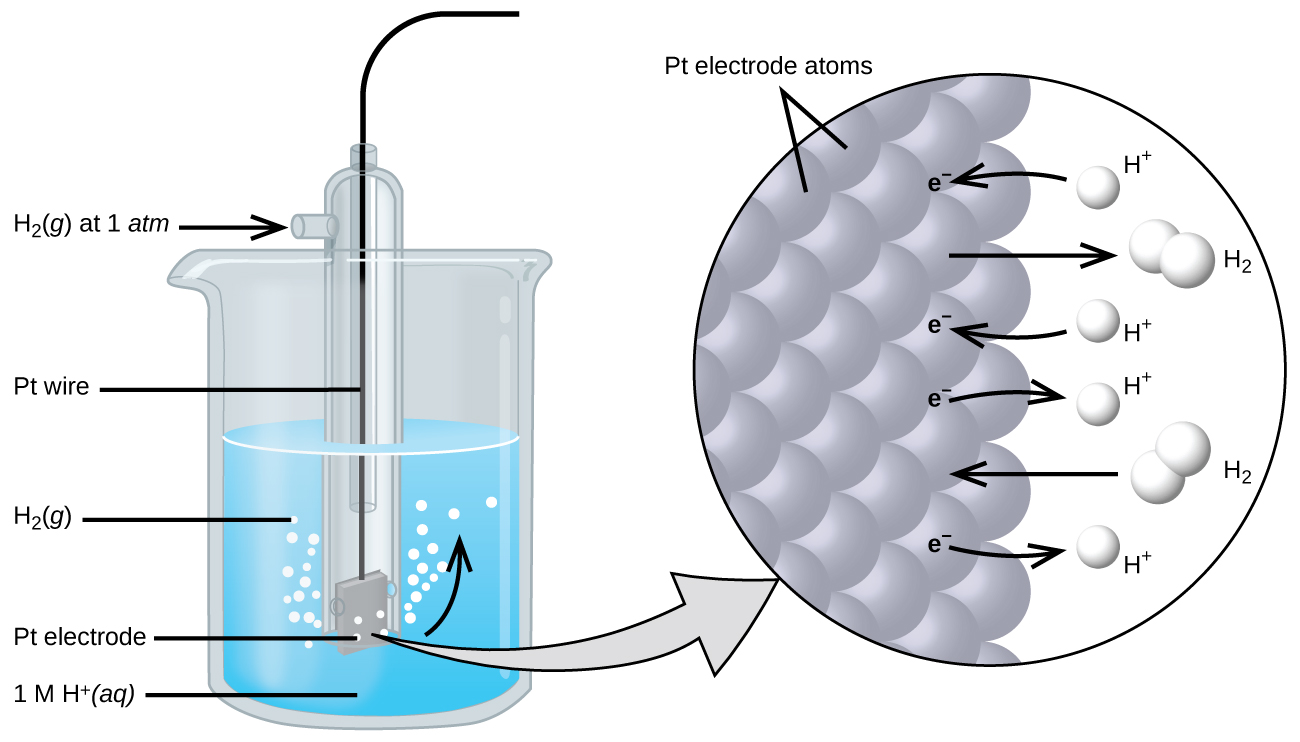
Figure 17.5図 17.5
A standard hydrogen electrode (SHE).
標準水素電極(SHE)。
The assigned potential of the SHE permits the definition of a conveniently measured potential for a single half-cell. The electrode potential (EX) for a half-cell X is defined as the potential measured for a cell comprised of X acting as cathode and the SHE acting as anode:
SHEに割り当てた電位を用いると、単独の半電池について、便利に測定できる電位を定義できる。半電池Xの電極電位(EX)は、Xがカソード、SHEがアノードとして働く電池について測定した電位として定義する。
When the half-cell X is under standard-state conditions, its potential is the standard electrode potential, E°X. Since the definition of cell potential requires the half-cells function as cathodes, these potentials are sometimes called standard reduction potentials.
半電池Xが標準状態の条件にあるとき、その電位は標準電極電位E°Xである。電池電位の定義では、半電池がカソードとして機能することが必要なので、これらの電位を標準還元電位と呼ぶこともある。
This approach to measuring electrode potentials is illustrated in Figure 17.6, which depicts a cell comprised of an SHE connected to a copper(II)/copper(0) half-cell under standard-state conditions. A voltmeter in the external circuit allows measurement of the potential difference between the two half-cells. Since the Cu half-cell is designated as the cathode in the definition of cell potential, it is connected to the red (positive) input of the voltmeter, while the designated SHE anode is connected to the black (negative) input. These connections insure that the sign of the measured potential will be consistent with the sign conventions of electrochemistry per the various definitions discussed above. A cell potential of +0.337 V is measured, and so
英語のヒント
電極電位を測定するこの方法を、図17.6に示す。この図は、SHEを標準状態の条件にある銅(II)/銅(0)半電池に接続した電池を示している。外部回路の電圧計により、二つの半電池の電位差を測定できる。電池電位の定義ではCu半電池をカソードと指定するので、電圧計の赤(正)の入力端子に接続し、アノードと指定されたSHEを黒(負)の入力端子に接続する。この接続により、測定した電位の符号が、上で述べた各定義に従う電気化学の符号の規約と一致することが保証される。+0.337 Vの電池電位が測定されるので、次のようになる。
Tabulations of E° values for other half-cells measured in a similar fashion are available as reference literature to permit calculations of cell potentials and the prediction of the spontaneity of redox processes.
英語のヒント
同じような方法で測定した他の半電池のE°の値の表が参考資料として利用でき、電池電位の計算や酸化還元過程の自発性の予測に使える。
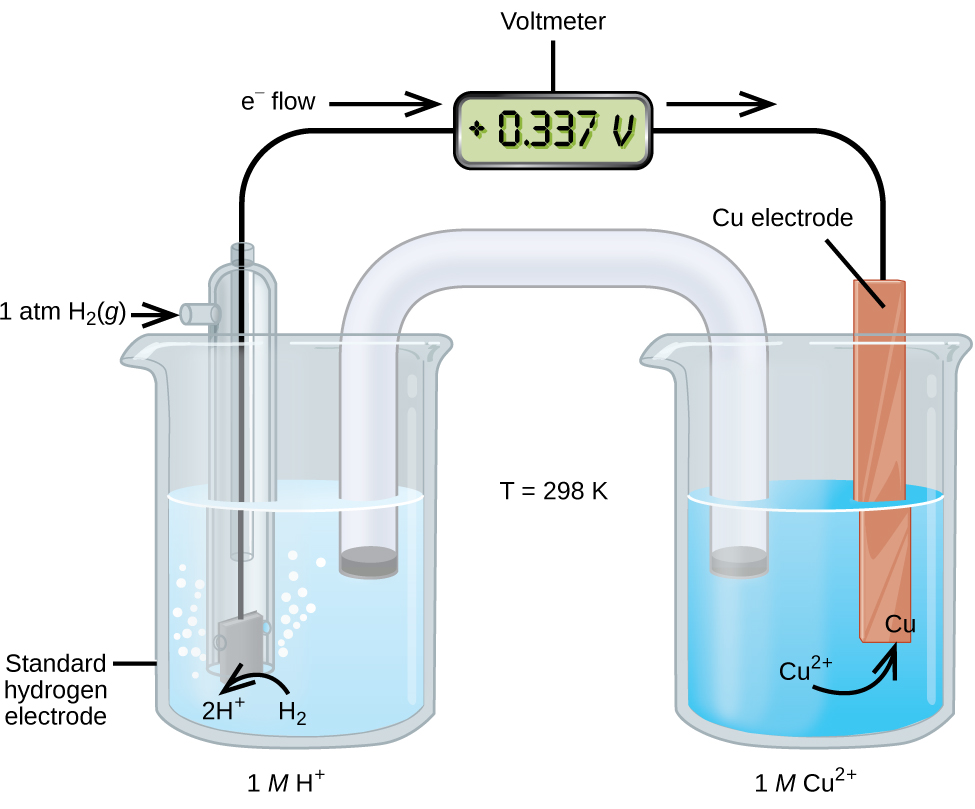


Figure 17.6図 17.6
A cell permitting experimental measurement of the standard electrode potential for the half-reaction
半反応の標準電極電位を実験的に測定できる電池。
Table 17.1 provides a listing of standard electrode potentials for a selection of half-reactions in numerical order, and a more extensive alphabetical listing is given in Appendix L.
Selected Standard Reduction Potentials at 25 °C 25 °Cにおける代表的な標準還元電位 |
|
|---|---|
Half-Reaction 半反応 |
E° (V) |
+2.866 |
|
+1.69 |
|
+1.507 |
|
+1.498 |
|
+1.35827 |
|
+1.229 |
|
+1.20 |
|
+1.0873 |
|
+0.7996 |
|
+0.7973 |
|
+0.771 |
|
+0.558 |
|
+0.5355 |
|
+0.49 |
|
+0.34 |
|
+0.26808 |
|
+0.22233 |
|
+0.151 |
|
0.00 |
|
−0.1262 |
|
−0.1375 |
|
−0.257 |
|
−0.28 |
|
−0.3505 |
|
−0.4030 |
|
−0.447 |
|
−0.744 |
|
−1.185 |
|
−1.245 |
|
−0.7618 |
|
−1.662 |
|
−2.372 |
|
−2.71 |
|
−2.868 |
|
−2.912 |
|
−2.931 |
|
−3.04 |
|
Example 17.4例題 17.4
Calculating Standard Cell Potentials標準電池電位を計算する
What is the standard potential of the galvanic cell shown in Figure 17.3?
図17.3に示すガルバニ電池の標準電位はいくらか。
Solution解き方
The cell in Figure 17.3 is galvanic, the spontaneous cell reaction involving oxidation of its copper anode and reduction of silver(I) ions at its silver cathode:
図17.3の電池はガルバニ電池であり、その自発的な電池反応は、銅アノードの酸化と銀カソードでの銀(I)イオンの還元を伴う。
The standard cell potential computed as
標準電池電位は、次のように計算される。
Check Your Learning理解度の確認
What is the standard cell potential expected if the silver cathode half-cell in Figure 17.3 is replaced with a lead half-cell: ?
図17.3の銀カソード側の半電池を、鉛の半電池に置き換えた場合、どのような標準電池電位が予想されるか。